Within Balloon Matches
When balloon drift looks like controlled flight
Wind layers can make balloons seem to hover, reverse, or steer, so drift checks are often the strongest first test for a UFO report.
On this page
- How wind layers change apparent movement
- Matching witness direction to upper air data
- When drift evidence stops fitting
Page outline Jump by section
Introduction
Many UFO reports begin to look less mysterious once investigators compare the object’s movement against recorded winds at different altitudes. This is one of the fastest and most effective screening steps in AI-assisted UFO investigation because balloons often produce motion that appears intelligent from the ground even when the object is simply drifting through changing air currents.
 A balloon can seem to hover, reverse direction, accelerate, or follow a curved path without any propulsion at all. The key question is not whether the movement looked unusual to witnesses, but whether it matched the layered wind structure above the sighting area at that time. Modern investigation workflows therefore treat wind drift analysis as an early triage filter. If the object’s track aligns with known atmospheric motion, the probability of a balloon explanation rises sharply. If the reported behaviour consistently conflicts with measured winds, the case becomes more difficult to dismiss as passive drift alone. AARO’s published balloon resolutions repeatedly cite “drifting at wind speed and direction” as a central reason for identifying objects as lighter-than-air balloons rather than unknown craft.[AARO]aaro.milUAP Imagery… lighter-than-air objects, e.g., drifting at wind speed and direction. PR-009, UAP Report Resolved as a Balloon, Europe…
How wind layers change apparent movement
One reason balloon reports repeatedly enter UFO databases is that the atmosphere does not move as a single uniform flow. Wind direction and speed can change dramatically between ground level and higher altitudes. A balloon rising through those layers may follow one direction near the surface, then gradually arc into a different track as it ascends.
To a ground observer with no altitude reference, this can resemble deliberate manoeuvring. A balloon moving into a crosswind may appear to “turn”. A balloon entering a slower wind layer can appear to pause or hover. In some geometries, perspective effects can even create the impression of reversal.
Weather services rely on this exact behaviour to measure upper-air winds. Radiosondes attached to weather balloons are tracked by GPS and radar specifically because their drift reveals wind speed and direction at different heights. NOAA and the US National Weather Service describe upper-air balloon observations as a primary source of atmospheric wind profiling. NOAA[National Weather Service]weather.govMaps of upper air data from radiosondes is…Read more…
This matters for UFO investigation because witnesses naturally interpret movement from a human-scale perspective. A high-altitude object drifting slowly across a distant sky may look stationary. A reflective party balloon moving in gusty lower winds may appear erratic and reactive. AI-assisted comparison systems therefore examine whether the reported motion changed in ways expected from vertical wind shear rather than from powered flight.
Wind shear is especially important in sightings involving claims such as:
- “The object stopped suddenly”
- “It changed direction without turning”
- “It hovered against the wind”
- “It drifted one way, then another”
- “It looked stationary for several minutes”
In many resolved balloon cases, those observations become less extraordinary after investigators reconstruct the atmosphere above the sighting location.
Matching witness direction to upper-air data
The practical test is straightforward in principle: compare the witness account with the wind profile that existed during the sighting.
Modern UFO investigation workflows increasingly automate this process. A structured case file can combine:
- Witness-estimated direction of travel
- Estimated elevation angle
- Duration and time stamps
- Known balloon launch locations * Radiosonde and upper-air sounding data[weather.gov]weather.govMaps of upper air data from radiosondes is…Read more… * Surface weather observations[weather.gov]weather.govMaps of upper air data from radiosondes is…Read more…
- Terrain and viewing geometry
The goal is not merely to ask whether the object moved with the wind at ground level. Many witnesses already know surface winds and report that the object appeared inconsistent with them. The more important comparison is with upper-air winds, because high-altitude balloons may be travelling through completely different flow patterns from those felt by observers on the ground.
This distinction repeatedly causes confusion in public UFO discussions. A witness may insist that “the wind was blowing east, but the object moved north”, yet upper-air soundings may show a strong northerly flow several kilometres above the surface. Weather balloon operations depend on these layered atmospheric conditions every day.[National Weather Service]weather.govMaps of upper air data from radiosondes is…Read more… Wikipedia AI systems are useful here because they can rapidly align multiple data sources against the sighting timeline. A workflow may automatically:[Wikipedia]WikipediaRadiosondeA radiosonde is a battery-powered telemetry instrument carried into the atmosphere usually by a weather balloon that measure…
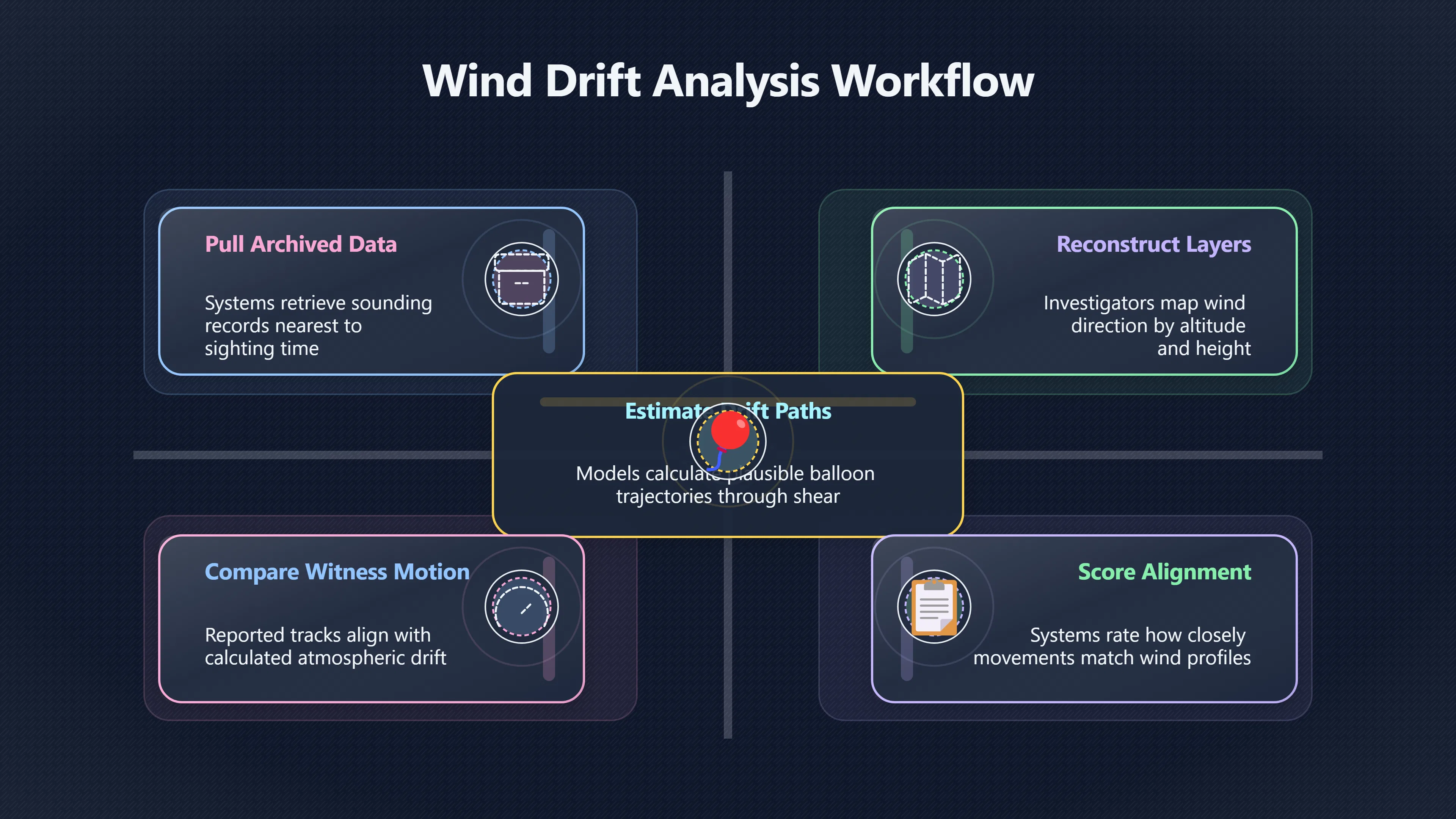
- Pull archived atmospheric sounding data nearest to the event time.
- Reconstruct wind direction by altitude.
- Estimate plausible balloon drift paths.
- Compare those paths against witness-reported motion.
- Score how closely the movements align.
This process is far more reliable than relying on visual intuition alone.
A concrete example appears in AARO’s published balloon assessments. Several military-recorded UAP videos from Europe in 2022 were resolved as balloons partly because their “performance characteristics” aligned with lighter-than-air drift behaviour. The identification was not based solely on shape or imagery quality. Motion relative to wind direction was treated as evidentially important.[AARO]aaro.milological balloon; a large Mylar balloon; or…Read more…
Why balloons can look like controlled flight
The strongest balloon misidentifications often happen when atmospheric conditions create visually deceptive motion.
Apparent hovering
A balloon travelling almost directly toward or away from an observer can appear stationary despite substantial movement. If the object also sits against a featureless sky, the effect becomes stronger because the witness lacks distance cues.
This is especially common in reports describing “hovering silver spheres” seen at high altitude.
False acceleration
If sunlight suddenly catches a reflective balloon, the object may become visible only intermittently. Witnesses then perceive abrupt appearance and disappearance rather than continuous drift. Combined with changing wind layers, this can create the illusion of bursts of speed.
Direction reversals
A balloon ascending through opposing wind layers can genuinely curve across the sky. From the ground, that curve may look like a deliberate turn.
Upper-level wind shear is a well-known meteorological phenomenon and is monitored closely in aviation and launch operations.[Air Force]af.milweather balloons and rocket scienceAir ForceWeather balloons and rocket science26 Feb 2016 — Simply put, wind-shear is radical changes in wind speeds or direction." Some of…
Apparent pacing behaviour
Observers in moving vehicles often report that a UFO “followed” them. In many balloon cases, this results from parallax. A distant drifting object can appear to maintain relative position while the observer moves underneath it.
This becomes particularly misleading at night when depth perception is weak.
When drift evidence strongly supports a balloon explanation
Wind drift becomes persuasive when several independent indicators align at once.
The strongest balloon matches usually include most of the following:
- Object movement consistent with measured upper-air winds
- Slow average speed without rapid acceleration
- Curving or meandering paths matching wind-layer transitions
- No evidence of propulsion or controlled turns
- Long visibility duration
- Reflective flashes or changing brightness
- Shape instability or apparent deformation
- Known balloon launches in the region and time window
Weather balloons routinely travel very large distances during ascent. The US National Weather Service notes that a typical radiosonde balloon can drift more than 300 kilometres from its launch point while rising above 35 kilometres altitude.[National Weather Service]weather.govMaps of upper air data from radiosondes is…Read more…
That scale matters in UFO investigation because witnesses often assume that an object seen overhead must have originated locally. In reality, a balloon may have travelled across regions or national borders before observation.
Resolved cases also improve machine comparison systems over time. Once an investigation confirms that a particular movement pattern corresponded to atmospheric drift, that pattern can become part of a searchable comparison library for future reports. This is one reason balloon resolutions are disproportionately valuable in AI-assisted UFO triage: they help define what “normal but visually deceptive” aerial behaviour actually looks like.
When drift evidence stops fitting
Wind alignment is powerful evidence, but it is not an automatic explanation for every sighting.
Cases become more difficult to reconcile with balloon drift when multiple independent data points consistently contradict passive atmospheric motion. Investigators pay closer attention when reports include features such as:
- Sustained motion directly across strong upper-air winds
- Rapid acceleration inconsistent with drift
- Sharp angular turns without transitional curves
- Abrupt altitude changes
- Coordinated movement between multiple objects
- Reliable radar or tracking data conflicting with atmospheric trajectories
Even here, caution is necessary. Witnesses often misjudge speed, distance, and altitude, especially at night. Sensor footage can also distort apparent motion through zoom effects, stabilisation artefacts, or moving-camera geometry.
The important distinction is not whether the motion looked strange, but whether it remained strange after reconstruction against known atmospheric conditions.
This is where AI-assisted workflows become especially valuable. They reduce the risk of prematurely classifying a case as anomalous simply because a witness lacked access to upper-air weather data. At the same time, they help identify the smaller set of reports where atmospheric drift genuinely fails to account for the observed behaviour.
Why wind drift checks matter in UFO triage
Among all first-pass explanation tests in UFO investigation, wind comparison is one of the most efficient because it converts a subjective visual report into something measurable.
A witness may disagree with another witness about shape, brightness, or apparent intent. But wind fields, launch records, and atmospheric soundings provide objective external data. That allows investigators to move from impression-based discussion toward evidence-based elimination.
For AI-assisted systems, resolved balloon cases therefore serve two important purposes simultaneously:
- They remove large numbers of explainable sightings from deeper anomaly review.
- They train comparison systems to recognise how ordinary atmospheric drift can mimic extraordinary motion.
That does not mean every unresolved case is extraordinary. It means the investigative process becomes more disciplined. Once a sighting survives detailed wind-drift comparison instead of merely surviving casual visual inspection, the remaining uncertainty becomes more meaningful.
Amazon book picks
Further Reading
Books and field guides related to When balloon drift looks like controlled flight. Use these as the next step if you want deeper reading beyond the article.
Weather For Dummies
Explains wind, atmosphere and weather patterns behind balloon drift.
eBay marketplace picks
Marketplace Samples
Example marketplace items related to this page. Use the search link to explore similar finds on eBay.



Endnotes
1.
Source: aaro.mil
Link:https://www.aaro.mil/UAP-Cases/Official-UAP-Imagery/
Source snippet
UAP Imagery... lighter-than-air objects, e.g., drifting at wind speed and direction. PR-009, UAP Report Resolved as a Balloon, Europe...
2.
Source: noaa.gov
Link:https://www.noaa.gov/jetstream/upperair/radiosondes
Source snippet
Radiosondes | National Oceanic and Atmospheric...16 Sept 2025 — The radiosonde is a small instrument package that is suspended below...
3.
Source: weather.gov
Link:https://www.weather.gov/rah/virtualtourballoon
Source snippet
Maps of upper air data from radiosondes is...Read more...
4.
Source: weather.gov
Link:https://www.weather.gov/ilx/ua-tour
Source snippet
What Goes Into the Weather Balloon Launches?A GPS sensor within the radiosonde sends back the exact position of the instrument; this data...
5.
Source: weather.gov
Link:https://www.weather.gov/upperair/reqdahdr
Source snippet
National Weather ServiceA Brief History of Upper-air ObservationsAlthough winds aloft data could be obtained in near real-time, the ballo...
6.
Source: Wikipedia
Link:https://en.wikipedia.org/wiki/Radiosonde
Source snippet
RadiosondeA radiosonde is a battery-powered telemetry instrument carried into the atmosphere usually by a weather balloon that measure...
7.
Source: weather.gov
Link:https://www.weather.gov/upperair/factsheet
Source snippet
National Weather ServiceRadiosonde ObservationIn that time, the radiosonde can ascend to an altitude exceeding 35 km (about 115,000 feet)...
8.
Source: Wikipedia
Title: Weather balloon
Link:https://en.wikipedia.org/wiki/Weather_balloon
Source snippet
Weather balloonA weather balloon, also known as a sounding balloon, is a high-altitude balloon (HAB) that carries instruments into the...
9.
Source: weather.gov
Link:https://www.weather.gov/gjt/education_corner_balloon
Source snippet
Education Corner weather balloonWeather balloons carry an instrument called a radiosonde which is tracked by specialized ground equipment...
10.
Source: wpo.noaa.gov
Title: windborne weather balloon reaches new heights
Link:https://wpo.noaa.gov/windborne-weather-balloon-reaches-new-heights/
Source snippet
Weather Balloon Reaches New Heights...With an average flight time of 7 days and a maximum flight time of 16, the balloons are capable of...
11.
Source: aoml.noaa.gov
Title: These sensors are
Link:https://www.aoml.noaa.gov/upper-air-observations/
Source snippet
Air Observations: How Weather Balloons Improve...1 Sept 2017 — As the balloon rises, sensors on the radiosonde measure values of atmosph...
12.
Source: aaro.mil
Link:https://www.aaro.mil/portals/136/PDFs/case_resolution_reports/Case_Resolution_of_Eglin_UAP_2508.pdf
Source snippet
ological balloon; a large Mylar balloon; or...Read more...
13.
Source: sciencedirect.com
Title: ScienceDirect Radiosondes
Link:https://www.sciencedirect.com/topics/earth-and-planetary-sciences/radiosondes
Source snippet
Radiosondes - an overviewVertical profiles of wind speed and direction are typically inferred from weather balloon drift, using radiosond...
14.
Source: af.mil
Title: weather balloons and rocket science
Link:https://www.af.mil/News/Article-Display/Article/731632/weather-balloons-and-rocket-science/
Source snippet
Air ForceWeather balloons and rocket science26 Feb 2016 — Simply put, wind-shear is radical changes in wind speeds or direction." Some of...
Additional References
15.
Source: faa.gov
Link:https://www.faa.gov/sites/faa.gov/files/regulations_policies/handbooks_manuals/aviation/balloon_safety_tips.pdf
Source snippet
Balloon Safety TipsThe real difference from a pilot's view- point is the location of the occurrence. False lift occurs from a known posit...
16.
Source: reddit.com
Link:https://www.reddit.com/r/UFOB/comments/1kfpkev/this_ones_for_you_corbell_aaro_did_that_dude_so/
17.
Source: theeyewall.com
Title: weather balloon launch cuts an honest look at how it should impact forecasts
Link:https://theeyewall.com/weather-balloon-launch-cuts-an-honest-look-at-how-it-should-impact-forecasts/
Source snippet
Weather balloon launch cuts: An honest look at how it...23 Mar 2025 — The data from balloon launches can be plotted on a chart called a...
18.
Source: youtube.com
Link:https://www.youtube.com/watch?v=pcLkkoR2LS4
Source snippet
Weather Balloons and RadiosondesLearn about how weather balloons are used to study upper-levels of the atmosphere and how the data are co...
19.
Source: facebook.com
Link:https://www.facebook.com/kytxcbs19/posts/a-behind-the-scenes-look-at-the-nws-releasing-a-weather-balloon-to-figure-out-te/1376434954530545/
Source snippet
It is used to assess atmospheric stability, wind shear, [freezing]({{ 'freezing-fog/' | relative_url }}) levels, and the overall...Read more...
20.
Source: intermetsystems.com
Title: Radiosondes measure atmospheric pressure, air temperature, water
Link:https://www.intermetsystems.com/products/introduction-to-radiosondes-and-atmospheric-soundings/
Source snippet
Radiosonde Overview - InterMet Systems - Grand Rapids, MIRadiosondes are carried into the air by latex weather balloons filled with heliu...
21.
Source: reddit.com
Link:https://www.reddit.com/r/UFOs/comments/111cs3l/curious_as_to_why_all_of_a_sudden_the_sub_is_hell/
Source snippet
wind. So maybe it's not a balloon, but it seems to be a lighter than air object that wind is pushing. And we shot it down. This isn't the...
22.
Source: twz.com
Title: china sees balloon launched drone swarms in its future
Link:https://www.twz.com/china-sees-balloon-launched-drone-swarms-in-its-future
Source snippet
China Sees Balloon-Launched Drone Swarms In Its Future2 Mar 2023 — Researchers in China and elsewhere have demonstrated that high-altitud...
23.
Source: facebook.com
Link:https://www.facebook.com/tamilnaduweatherman/posts/had-the-honor-of-launching-the-weather-balloon-for-upper-air-data-collection-in-/1534000831425956/
Source snippet
res temperature, moisture, pressure, wind speed, and wind direction...Read more...
24.
Source: x.com
Link:https://x.com/praddy06/status/2055445368448635301/photo/4
Source snippet
edicting severe damal dumeels. The radiosonde flight can last for...Read more...
Topic Tree