Within Satellites
When A Fireball Is Really Falling Space Debris
Slow clusters of glowing fragments usually point to human-made debris re-entering the atmosphere rather than meteors.
On this page
- Visual clues that favour re entry debris
- Why re entries last longer than meteors
- Using re entry databases in case checks
Page outline Jump by section
Introduction
A bright object breaking into glowing fragments across the night sky is one of the most common triggers for UFO reports. In many cases, though, the event is not an exotic craft or even a natural meteor. It is a controlled or uncontrolled re-entry: the visible destruction of human-made space hardware falling back through the atmosphere. Rocket bodies, old satellites, and discarded spacecraft components regularly produce dramatic “fireball” sightings that can look startlingly unusual to witnesses on the ground.[ESA Re-Entry Predictions]reentry.esoc.esa.intESA Re-Entry PredictionsESA's re-entry predictionsOn average an object with mass above one ton re-enters the Earth's atmosphere every two…
 For an AI-assisted UFO investigation, distinguishing a meteor fireball from re-entering space debris is one of the highest-value early checks. The visual clues are often strong if investigators know what to look for. Re-entries usually move more slowly, last longer, fragment repeatedly, and follow shallow, horizon-spanning tracks. Meteors are generally faster, shorter-lived, and more abrupt. The difference matters because a correctly identified re-entry can rapidly move a case from “unknown aerial phenomenon” into a documented orbital event linked to known objects, launch schedules, and tracking databases.[The Aerospace Corporation]aerospace.orgThe Aerospace CorporationWhat Does a Reentry Look LikeA guide to telling if you saw a meteor or the reentry of a human-made object… Sp…
Visual Clues That Favour Re-entry Debris
The most useful witness descriptions are not emotional reactions such as “it looked alien” or “it moved intelligently”, but concrete observations about timing, fragmentation, colour, duration, and movement pattern.
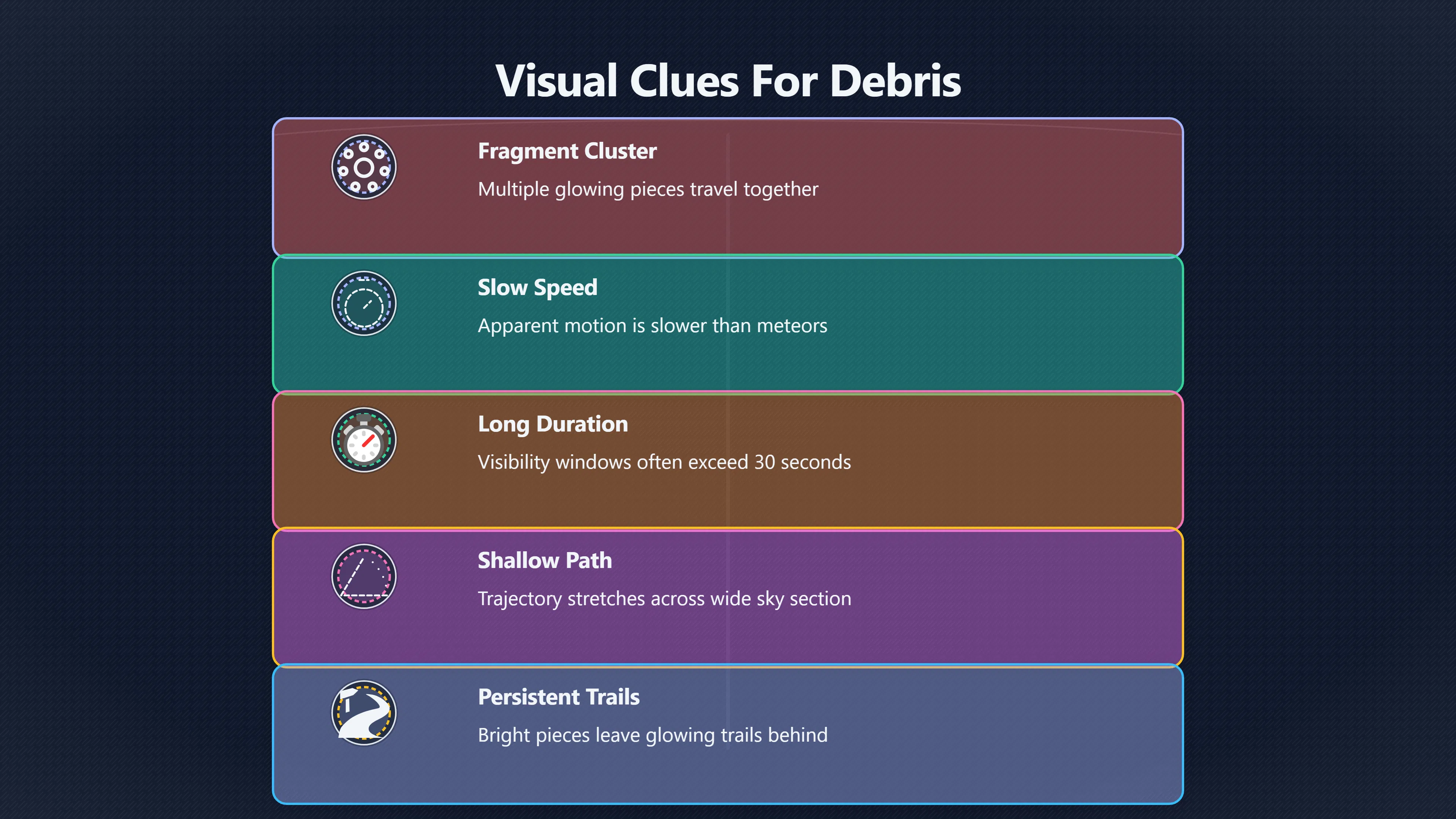
Human-made re-entries often produce:
- Multiple glowing fragments travelling together[watchers.news]watchers.newsThe WatchersWidely observed space junk reentry over Delhi and…Sep 20, 2025 — The bright fireball produced multiple glowing fragments b…
- A slow apparent speed relative to meteors
- Long visibility windows, sometimes over 30 seconds
- A shallow path stretching across a large section of sky
- Persistent glowing trails behind fragments
- Bright pieces separating gradually rather than exploding once
- Orange, white, or green fragments moving in parallel
The Aerospace Corporation’s re-entry guidance notes that re-entering debris frequently resembles “a bright central body followed by a long, dazzling tail” and often breaks into “numerous fragments”.[The Aerospace Corporation]aerospace.orgThe Aerospace CorporationWhat Does a Reentry Look LikeA guide to telling if you saw a meteor or the reentry of a human-made object… Sp…
That fragmentation pattern is one of the strongest indicators in UFO case triage. A classic meteor usually behaves more like a single high-speed streak. Some meteors do fragment, especially larger bolides, but the breakup tends to happen violently and quickly. Re-entry debris instead often resembles a slow-moving cluster of embers spreading across the sky.
Witnesses frequently describe these events as:
- “A fleet of lights”
- “Burning wreckage”
- “A formation”
- “Something falling apart”
- “A silent convoy of fire”
Those descriptions strongly overlap with known orbital debris behaviour.
One important investigative clue is geographic spread. If social media posts, CCTV clips, and local reports emerge simultaneously across hundreds of kilometres, that strongly supports a high-altitude re-entry. Meteor fireballs can also be visible over large areas, but re-entries often generate unusually prolonged and widely shared observations because of their slower apparent movement. The widely observed debris event over northern India in September 2025 produced exactly this pattern, with many witnesses initially assuming it was a meteor or UFO before video analysis suggested orbital debris breakup.[The Watchers]watchers.newsThe WatchersWidely observed space junk reentry over Delhi and…Sep 20, 2025 — The bright fireball produced multiple glowing fragments b…
Why Re-entries Last Longer Than Meteors
The physics behind these events explains why they look different.
Meteor fireballs are natural objects entering the atmosphere at extremely high speeds, commonly between about 11 and 72 km/s depending on orbital geometry. Re-entering spacecraft debris is already orbiting Earth and typically re-enters at roughly 7 km/s.[The Aerospace Corporation]aerospace.orgThe Aerospace CorporationWhat Does a Reentry Look LikeA guide to telling if you saw a meteor or the reentry of a human-made object… Sp…
That lower speed changes the entire visual experience for observers.
A meteor often flashes into view suddenly, burns intensely, and disappears within a few seconds. Re-entry debris descends on a much shallower atmospheric angle, frequently below one degree according to space debris safety studies.[UNOOSA]unoosa.orgSpace Debris Reentry HazardsSpace hardware reenters at very shallow angle (<1 degree). • ~40 objects weighing more than 1 ton reent…
This shallow trajectory produces several recognisable effects:
- Longer visibility times
- Slower apparent motion
- Extended fragmentation sequences
- Broad horizontal travel across the sky
- Repeated flare-ups as pieces break apart
Large spacecraft rarely fail all at once. Different materials heat and rupture at different altitudes. Tanks, panels, insulation, antennas, and structural sections separate progressively. This staged breakup creates the familiar “string of fire” appearance often mistaken for multiple coordinated objects.
The European Space Agency notes that the thermal and mechanical stresses of re-entry are sufficient to make breakup visible from the ground, even in daylight under some conditions.[ESA Re-Entry Predictions]reentry.esoc.esa.intESA Re-Entry PredictionsESA's re-entry predictionsOn average an object with mass above one ton re-enters the Earth's atmosphere every two…
For UFO investigators, duration is especially valuable because witness time estimates are often poor in ordinary sightings but unusually reliable in major fireball events. If several independent witnesses describe an object remaining visible for 45 seconds to two minutes, a conventional meteor explanation becomes less likely. That does not make the event anomalous; it often points more strongly toward re-entering debris instead.
Why Fragmenting Space Debris Is Often Mistaken For Controlled Flight
One reason these events generate UFO reports is that the breakup can appear structured.
Witnesses commonly interpret:
- Parallel fragments as “formation flying”
- Gradual separation as “objects manoeuvring”
- Variable brightness as “powered movement”
- Persistent tracks as “energy trails”
Human perception struggles with high-altitude motion at night. Without distance references, observers can mistake orbital-scale events for nearby aircraft-sized objects.
This is especially true when fragments remain grouped for long periods. A debris train moving across the sky can look coordinated even though every fragment is simply following similar ballistic trajectories.
AI-assisted analysis helps by converting subjective descriptions into measurable features:
Witness wordingInvestigative interpretation“Several lights keeping formation”Possible debris fragmentation“Slow fireballs moving together”Typical re-entry behaviour“One object became many”Progressive structural breakup“No sound despite huge brightness”High-altitude atmospheric event“Travelled horizon to horizon”Shallow orbital re-entry path
This translation layer matters because many UFO databases store reports in free text. Automated extraction can identify recurring re-entry signatures across large historical datasets.
Using Re-entry Databases In Case Checks
Modern UFO investigation increasingly depends on correlating sightings against known orbital events.
Several public databases now make this practical.
Aerospace re-entry tracking
The Aerospace Corporation’s Center for Orbital and Reentry Debris Studies maintains a searchable re-entry database covering objects that have fallen back through the atmosphere since 2000.[The Aerospace Corporation]aerospace.orgThe Aerospace CorporationWhat Does a Reentry Look LikeA guide to telling if you saw a meteor or the reentry of a human-made object… Sp…
Useful fields include:
- Object name
- Launch origin
- Predicted re-entry time
- Re-entry classification
- Associated mission
For investigators, this creates a direct comparison path:
- Build the sighting timeline
- Convert witness times into UTC
- Check orbital debris databases for matching windows
- Compare travel direction and visibility region
- Review video for fragmentation behaviour
A match does not require perfect timing. Re-entry predictions can initially carry uncertainties of many hours because atmospheric drag changes constantly. ESA’s live updates for the ERS-2 satellite re-entry in February 2024 showed prediction windows narrowing progressively as the event approached.[blogs.esa.int]blogs.esa.intER S-2 reentry – live updates – Rocket ScienceERS-2 reentry – live updates – Rocket Science - ESA's blogsFeb 5, 2024 — *This post provides live updates from ESA's Space Debris Office…
That uncertainty matters in UFO investigations because witnesses may assume a database “miss” rules out debris. In reality, investigators must compare the entire prediction window and projected ground track.
ESA re-entry monitoring
ESA’s re-entry monitoring resources provide another valuable source for checking large falling spacecraft.[ESA Re-Entry Predictions]reentry.esoc.esa.intESA Re-Entry PredictionsESA's re-entry predictionsOn average an object with mass above one ton re-enters the Earth's atmosphere every two…
Important investigation clues include:
- Whether the re-entry was controlled or uncontrolled
- Expected visibility regions
- Approximate breakup altitude
- Object mass
- Time uncertainty range
Controlled re-entries may produce sightings concentrated along planned oceanic corridors. Uncontrolled re-entries can appear unexpectedly over populated areas.
Fireball camera networks
Meteor observation systems also help identify re-entries.
ESA demonstrated that all-sky fireball cameras captured the visible burn associated with an Atlas V rocket re-entry sequence.[European Space Agency]esa.intThe latest updates are available on ESA's Rocket Science blog.Read more…
This overlap is important because many automated meteor networks unintentionally record artificial debris events. AI-assisted workflows can compare:
- Fragment spacing
- Deceleration patterns
- Spectral colours
- Duration
- Ground track geometry
against known spacecraft breakup behaviour.
Cases Where Meteors And Re-entries Are Easily Confused
Some events remain genuinely ambiguous at first glance.
Large meteors known as bolides can survive long enough to fragment dramatically. Conversely, compact spacecraft components can produce fast, meteor-like streaks.
Several factors complicate quick identification:
- Poor witness timing
- Missing direction data
- Cloud cover
- Smartphone exposure distortion
- Viral reposts using incorrect locations
- Delayed reporting
This is why investigation systems should avoid binary language such as “definitely a meteor” or “definitely space junk” until multiple evidence layers align.
A balanced classification framework works better:
ClassificationMeaningConfirmed re-entryDatabase and visual match are strongProbable re-entryBehaviour strongly fits debris but tracking incompletePlausible meteorFits known meteor behaviourAmbiguous fireballEvidence insufficientUnresolved aerial eventAvailable explanations weak or contradictory
That structure prevents overstatement while still allowing rapid mundane screening.
The Growing Importance Of Re-entry Checks
Re-entry analysis is becoming more important because low Earth orbit is becoming more crowded.
ESA states that objects above one tonne re-enter Earth’s atmosphere roughly every two weeks on average.[ESA Re-Entry Predictions]reentry.esoc.esa.intESA Re-Entry PredictionsESA's re-entry predictionsOn average an object with mass above one ton re-enters the Earth's atmosphere every two…
At the same time, large satellite constellations are increasing the number of future re-entry events. Researchers studying spacecraft breakup behaviour are now treating atmospheric re-entries as a growing observational category in their own right rather than isolated rarities.[ScienceDirect]sciencedirect.comLuminous efficiency determination of spacecraft materials…by D Leiser · 2025 · Cited by 1 — This paper reports the approa…
That means future UFO databases will likely contain more reports caused by:
- Satellite disposal operations
- Rocket stage re-entries
- Fragmenting orbital debris[aerospace.org]aerospace.orgThe Aerospace CorporationReentriesThe Center for Orbital and Reentry Debris Studies (CORDS) Reentry Database documents objects and payloa…
- Controlled spacecraft de-orbits
- Constellation-related hardware loss
For investigators, this changes the baseline assumption. A dramatic multi-fragment fireball is no longer an exceptionally rare event requiring exotic explanations first. In many cases, the statistically strongest starting hypothesis is now human-made orbital debris.
The key investigative task is not debunking witnesses, but matching the observed event against independently verifiable orbital activity while clearly separating confirmed data from inference and uncertainty.
Amazon book picks
Further Reading
Books and field guides related to When A Fireball Is Really Falling Space Debris. Use these as the next step if you want deeper reading beyond the article.
NightWatch: A Practical Guide to Viewing the Universe
Excellent foundation for identifying re-entries and other sky events.
eBay marketplace picks
Marketplace Samples
Example marketplace items related to this page. Use the search link to explore similar finds on eBay.




Endnotes
1.
Source: reentry.esoc.esa.int
Link:https://reentry.esoc.esa.int/
Source snippet
ESA Re-Entry PredictionsESA's re-entry predictionsOn average an object with mass above one ton re-enters the Earth's atmosphere every two...
2.
Source: aerospace.org
Link:https://aerospace.org/article/what-does-reentry-look-like
Source snippet
The Aerospace CorporationWhat Does a Reentry Look LikeA guide to telling if you saw a meteor or the reentry of a human-made object... Sp...
3.
Source: unoosa.org
Link:https://www.unoosa.org/pdf/pres/stsc2012/tech-39E.pdf
Source snippet
Space Debris Reentry HazardsSpace hardware reenters at very shallow angle (<1 degree). • ~40 objects weighing more than 1 ton reent...
4.
Source: watchers.news
Link:https://watchers.news/2025/09/20/widely-observed-space-junk-fireball-reentry-delhi-gurugram-india/
Source snippet
The WatchersWidely observed space junk reentry over Delhi and...Sep 20, 2025 — The bright fireball produced multiple glowing fragments b...
5.
Source: aerospace.org
Link:https://aerospace.org/reentries
Source snippet
The Aerospace CorporationReentriesThe Center for Orbital and Reentry Debris Studies (CORDS) Reentry Database documents objects and payloa...
6.
Source: blogs.esa.int
Title: ER S-2 reentry – live updates – Rocket Science
Link:https://blogs.esa.int/rocketscience/2024/02/05/ers-2-reentry-live-updates/
Source snippet
ERS-2 reentry – live updates – Rocket Science - ESA's blogsFeb 5, 2024 — *This post provides live updates from ESA's Space Debris Office...
7.
Source: esa.int
Link:https://www.esa.int/Space_Safety/Space_Debris/ERS-2_spotted_by_other_satellites_during_descent
Source snippet
The latest updates are available on ESA's Rocket Science blog.Read more...
8.
Source: esa.int
Title: European Space Agency ESA
Link:https://www.esa.int/ESA_Multimedia/Videos/2021/09/Fireball_camera_spots_rocket_reentry_burn
Source snippet
European Space AgencyESA - Fireball camera spots rocket reentry burnA camera in the Allsky7 fireball network spots the moment an Atlas-V...
9.
Source: sciencedirect.com
Link:https://www.sciencedirect.com/science/article/pii/S0273117724012110
Source snippet
Luminous efficiency determination of spacecraft materials...by D Leiser · 2025 · Cited by 1 — This paper reports the approa...
10.
Source: conference.sdo.esoc.esa.int
Title: SDC4 paper44
Link:https://conference.sdo.esoc.esa.int/proceedings/sdc4/paper/44/SDC4-paper44.pdf
Source snippet
of reentered debris and implications for...by W Ailor · 2005 · Cited by 55 — A breakup time of 9:36:7 GMT yielded the smallest errors in...
11.
Source: indico.esa.int
Link:https://indico.esa.int/event/493/timetable/?view=standard_numbered
Source snippet
The aim is to bring together atmospheric chemists and physicists.Read more...
12.
Source: conference.sdo.esoc.esa.int
Title: NEOSST2 paper19
Link:https://conference.sdo.esoc.esa.int/proceedings/neosst2/paper/19/NEOSST2-paper19.pdf
Source snippet
OF RE-ENTRY EVENT OF CZ-3B R/B...A re-entry event was captured on October 24th 22:01. HST (October 25th 08:01:37 UTC) by the automated m...
13.
Source: conference.sdo.esoc.esa.int
Link:https://conference.sdo.esoc.esa.int/proceedings/sdc7/paper/345/SDC7-paper345.pdf
Source snippet
COMPARISON OF DAMAGING METEOROID AND...by W Cooke · Cited by 11 — The vagueness of these boundaries has prompted this work, in which we...
14.
Source: esa.int
Link:https://www.esa.int/ESA_Multimedia/Videos/2023/07/Aeolus_reentry_the_breakdown
Source snippet
Aeolus reentry: the breakdownThe main objectives are to lower the satellite down to 250 km and to check how the satellite behaves when ex...
15.
Source: space.com
Link:https://www.space.com/space-exploration/satellites/scientists-chased-a-falling-spacecraft-with-a-plane-to-understand-satellite-air-pollution
Source snippet
Scientists chased a falling spacecraft with a plane to...5 May 2025 — "We think that it might mean that the breakup of the satellite pro...
Published: May 2025
16.
Source: aerospace.org
Link:https://aerospace.org/sites/default/files/2019-04/Crosslink%20Fall%202015%20V16N1%20.pdf
Source snippet
Understanding Space DebrisAerospace has honed expertise for more than 25 years in modeling space debris fragmentation events—from acciden...
17.
Source: nescacademy.nasa.gov
Link:https://nescacademy.nasa.gov/video/fe98e63f00f74c42bc85bd357ee47b491d
Source snippet
Debris | NESC Academy OnlineAnimations of space debris orbits over the last 65 years visually illustrate the rapidly increasing density o...
Additional References
18.
Source: spaceacademy.net.au
Link:https://www.spaceacademy.net.au/watch/debris/reentryhaz.htm
Source snippet
Hazards of Reentering Space DebrisBecause a debris reentry has a lower velocity than a meteor/fireball it will be visible for longer - no...
19.
Source: facebook.com
Link:https://www.facebook.com/Astronature1/posts/multiple-fire-trails-at-once-not-a-meteor-shower-%EF%B8%8Fif-you-saw-this-in-real-time-y/122142737204966798/
Source snippet
MULTIPLE FIRE TRAILS AT ONCE.. NOT A METEOR...This kind of “many bright streaks moving together” is most often space debris re-entering...
20.
Source: lens.monash.edu
Title: comet rocket space junk or meteor heres how to tell your fireballs apart
Link:https://lens.monash.edu/comet-rocket-space-junk-or-meteor-heres-how-to-tell-your-fireballs-apart/
Source snippet
monash.eduComet, rocket, space junk or meteor? Here's how to tell your...May 16, 2025 — Comet, rocket, space junk or meteor? Here's how...
Published: May 16, 2025
21.
Source: iaaspace.org
Link:https://iaaspace.org/wp-content/uploads/iaa/Scientific%20Activity/debris6.pdf
Source snippet
• Location of uncontrolled reentries is unpredictable. • Major breakup at ~78 km. • 10...Read mor...
22.
Source: eucass.eu
Link:https://www.eucass.eu/component/docindexer/?id=7435&task=download
Source snippet
r feedbacks, showing that no unified metric yet exists, and set out research...Read more...
23.
Source: researchgate.net
Title: Fireball produced by the re-entry of space debris
Link:https://www.researchgate.net/figure/Fireball-produced-by-the-re-entry-of-space-debris-The-image-was-taken-during-a-ATV-1_fig1_339499301
Source snippet
These fireballs are also relatively slow (with a velocity of about 8 km/s) and have various clear visible fragmentations in most cases. T...
24.
Source: medium.com
Link:https://medium.com/the-aerospace-corporation/a-quick-guide-to-understanding-orbital-debris-reentry-predictions-4b84a8e2bd04
Source snippet
ates a window of uncertainty around the prediction of ± 20% of...Read more...
25.
Source: youtube.com
Link:http://www.youtube.com/watch?v=rF2-OD44Jp0
Source snippet
what really happens during atmospheric reentry(Neil degrasse tyson)_why do spaceship burn on reentry...
26.
Source: ndtv.com
Title: Shooting stars burn with colours that reflect their composition.Read more
Link:https://www.ndtv.com/science/heres-how-to-tell-if-that-fireball-is-comet-rocket-space-junk-or-meteor-8392655
Source snippet
Here's How To Tell If That Fireball Is Comet, Rocket, Space...May 12, 2025 — Here's how to tell if that fireball is comet, rocket, space...
Published: May 12, 2025
27.
Source: forethought.org
Title: Can Space Debris Block Access to Outer Space?
Link:https://www.forethought.org/research/space-debris-and-launch-denial
Source snippet
17 Dec 2025 — Virtually all orbital space debris — solid matter in orbit around Earth — is put there by humans; overwhelmingly...
Topic Tree