Within Light pillars
Why Phone Footage Makes Light Pillars Look Alien
Phone cameras often intensify colours and contrast, making ordinary light pillars look solid and artificial in footage.
On this page
- Exposure stacking and brightening in dark scenes
- Colour saturation and artificial looking beams
- Comparing eyewitness views with recorded footage
Page outline Jump by section
Introduction
A real light pillar can already look strange to the naked eye: a vertical shaft of light apparently suspended in the sky, sometimes coloured red, blue, or white, and sometimes detached from any obvious source on the ground. Modern smartphones often make the effect look even more artificial. In many UFO videos, the recorded image appears sharper, brighter, taller, and more solid than the witness remembers seeing in person.
 That mismatch matters in AI-assisted UFO sighting investigation because investigators increasingly work from phone footage rather than direct observation. Computational photography systems inside modern phones aggressively brighten dark scenes, merge multiple exposures, amplify colour, and smooth noise. Those processes can unintentionally transform a faint atmospheric optics effect into something resembling a glowing “energy beam” or a structured object. Understanding how the camera altered the scene is often as important as understanding the atmospheric phenomenon itself.[Euro Tech]eurotraining.netEuro Tech How Computational Photography Lets Phones Shine After DarkEuro TechHow Computational Photography Lets Phones Shine After DarkSeptember 10, 2025 — 9 Sept 2025 — Discover how computational photogra…[Android Central]androidcentral.comAt the hardware level, a larger sensor and wider aperture allow more light to be captured in dark environments. However, the real innovat…
Exposure Stacking Can Turn a Faint Glow Into a Solid Beam
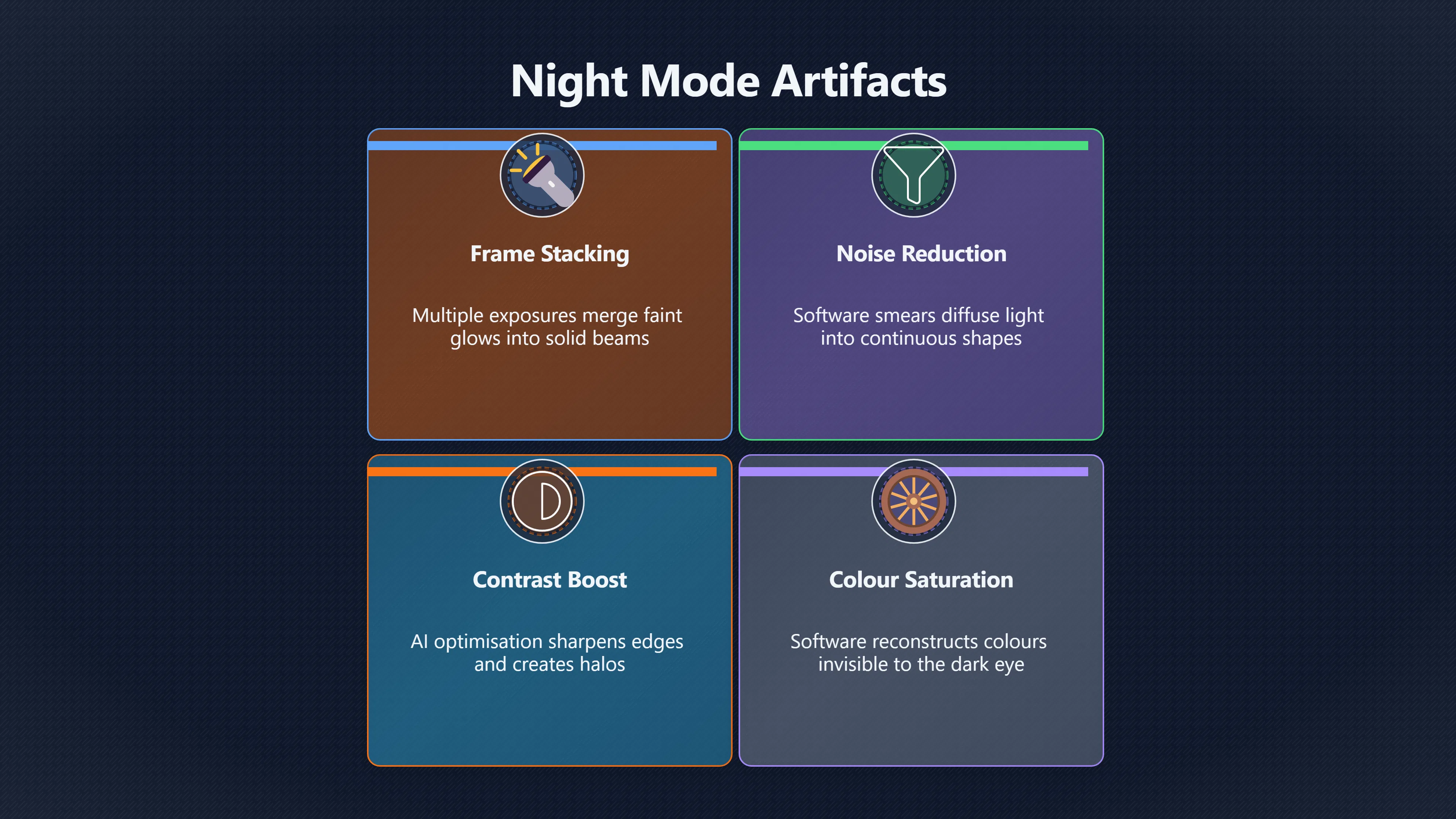
Most modern smartphones no longer capture a single night image. In low light, phones rapidly record multiple frames and combine them using computational photography techniques such as HDR (high dynamic range) processing and image stacking. The aim is to reduce noise and reveal detail that the tiny camera sensor would otherwise miss.[Euro Tech]eurotraining.netEuro Tech How Computational Photography Lets Phones Shine After DarkEuro TechHow Computational Photography Lets Phones Shine After DarkSeptember 10, 2025 — 9 Sept 2025 — Discover how computational photogra…[Android Central]androidcentral.comAt the hardware level, a larger sensor and wider aperture allow more light to be captured in dark environments. However, the real innovat…
This works well for ordinary photography, but it can distort atmospheric light phenomena. A faint or shimmering light pillar that looked semi-transparent to a witness may become a bright, continuous column in recorded footage because the phone repeatedly reinforces the same luminous area across multiple merged frames.
Several effects combine at once:
- The phone brightens dark regions to make the scene appear clearer.
- HDR processing prevents bright lights from clipping completely white.
- Multi-frame stacking reduces grain, making diffuse light appear smoother and more defined.
- AI scene optimisation may selectively increase contrast around bright structures.
The result is often a beam that appears unnaturally clean and geometrically stable. In reality, many light pillars flicker subtly and blend softly into surrounding haze when viewed directly by eye. Computational processing suppresses much of that ambiguity.[Android Central]androidcentral.comAt the hardware level, a larger sensor and wider aperture allow more light to be captured in dark environments. However, the real innovat… Visidon This difference becomes especially misleading in UFO investigations because viewers tend to trust video more than witness recollection. A per[visidon.fi]visidon.fiWhy Night HDR Is More Challenging Than Daytime HDRAt night, there is less visual information to mask mistakes, making artifacts mo… son may initially describe “a strange glow” yet later reinterpret the event after seeing their own footage, now dominated by a vivid vertical column.
Small Sensors Push Phones Toward Aggressive Processing
Dedicated cameras with large sensors can capture more light naturally. Smartphones cannot. Their sensors and lenses are physically tiny, so they rely heavily on software enhancement in darkness.[researchgate.net]researchgate.nety can gather, leading to noisy images in low light.Read more…[2picturecorrect.com]picturecorrect.comDecoding Darkness: How Smartphones Capture the NightGenerally, larger sensors can gather more light, leading to better image quality and…
That limitation creates several artefacts relevant to UFO-like light pillars:
- Bright points spread into neighbouring pixels more easily.
- High contrast edges can develop halos.
- Compression algorithms simplify subtle gradients into harder edges.
- Noise reduction smears diffuse light into continuous shapes.
A distant industrial light pillar that appeared faint and textured in person may therefore record as a saturated, laser-like beam. This is particularly common with LED lighting because LEDs often produce intense narrow-spectrum colours that smartphone software boosts aggressively.
Some phones also apply scene-recognition systems designed to make night photos look visually impressive rather than scientifically accurate. Reviews of smartphone HDR systems frequently note that images can appear “over-processed”, unnaturally vivid, or artificially balanced.[Lifewire]lifewire.comDespite advancements in phone camera technology, including Smart HDR, users like technology critic Michael Tsai and Tech YouTuber Marques…
For UFO analysis, this means a phone image is not a neutral recording instrument. It is an interpreted reconstruction generated by software decisions that vary between manufacturers and even between software updates on the same device.
Colour Saturation Makes Atmospheric Effects Look Artificial
One reason light pillars are mistaken for “alien beams” is that phone footage often exaggerates colour intensity beyond normal human night vision.
Human eyesight behaves differently in darkness. At low light levels, colour perception weakens and contrast drops. A witness may see only a pale reddish or whitish glow. A smartphone, however, can accumulate light over several seconds and reconstruct colours that the eye barely noticed.[Android Central]androidcentral.comAt the hardware level, a larger sensor and wider aperture allow more light to be captured in dark environments. However, the real innovat…
This is why aurora photographs, star fields, and atmospheric optics often look dramatically more colourful on phones than in direct observation. The same mechanism affects light pillars.
Common distortions include:
- Deep red pillars from brake lights or warning lamps appearing neon-bright.
- Blue-white LED pillars acquiring a sci-fi appearance.
- Purple colour fringing around bright beams.
- Artificially separated colour bands inside the column.
When uploaded to social media, further compression and contrast enhancement can intensify the effect again. Reposted clips often lose subtle gradients and dark detail, leaving only a hard luminous shaft against a black sky.
Investigators using AI-assisted workflows should therefore preserve original files whenever possible. Metadata, exposure information, frame timing, and uncompressed originals can help distinguish genuine scene characteristics from software enhancement.

Video Modes Introduce Their Own Distortions
Still-photo night modes and video modes behave differently. Many UFO clips involving apparent vertical beams are recorded as handheld video, where the phone continuously adjusts exposure in real time.
That creates several misleading behaviours:
- The pillar appears to pulse as automatic exposure changes.
- Slight hand movement causes rolling blur along the vertical axis.
- Autofocus “hunts” around the bright area, briefly sharpening or widening the beam.
- Compression introduces blocky glowing edges in dark skies.
These changes can make a stationary light pillar appear active or intelligent. A subtle atmospheric shimmer caused by moving ice crystals may become exaggerated into apparent motion.
Long-exposure blending can also create persistence effects. If a witness pans the camera slightly while filming, the beam may smear across frames and appear broader or taller than it really was.
Similar mechanisms explain many historical “rod” or elongated light artefacts in video imagery, where motion blur and frame integration transformed ordinary objects into apparently structured anomalies.[Wikipedia]WikipediaRod (optical phenomenonRod (optical phenomenon
Comparing What the Witness Saw With What the Phone Recorded
One of the most useful investigative steps is comparing eyewitness testimony against the raw footage before viewers reinterpret the event through the video itself.
In many light-pillar cases, witnesses later adopt the stronger visual language suggested by the recording:
- “It looked like a beam.”
- “It seemed solid.”
- “It looked metallic.”
- “It looked like a portal.”
But initial descriptions are often softer and less defined:
- “A strange glow.”
- “A vertical light.”
- “A coloured streak.”
- “Something shining upward.”
That difference can be analytically important. If the witness remembered a diffuse or semi-transparent effect while the phone shows a rigid column, computational enhancement becomes a strong candidate explanation.
AI-assisted case systems can formalise this comparison by separating:
- direct human observation,
- first-generation original media,
- edited or reposted media,
- and AI-enhanced or filtered versions.
This prevents later interpretations from contaminating the earliest evidence state.
Why This Matters in UFO Case Screening
Light pillars are already visually deceptive because they create the illusion of altitude, structure, and directionality. Smartphone imaging systems intensify all three qualities.
For rapid UFO triage, several warning signs suggest a camera-amplified atmospheric optics event rather than an unknown structured object:
- The beam remains vertically aligned despite camera movement.
- The colour matches nearby ground lighting.
- Weather records show freezing temperatures or ice crystals.
- Witnesses describe a weaker effect than the footage suggests.
- The beam becomes more dramatic when digital zoom is used.
- Different phones record the same event differently.
AI-assisted investigation systems can use these cues alongside weather data, local lighting maps, and image metadata to flag likely atmospheric optics cases early in the review process.
The key point is not that the witness fabricated the sighting. The light pillar was real. The exaggeration occurred in the translation between atmosphere, sensor, software, compression, and human interpretation.
Amazon book picks
Further Reading
Books and field guides related to Why Phone Footage Makes Light Pillars Look Alien. Use these as the next step if you want deeper reading beyond the article.
The UFO Experience
Cited by the New York Review of Books as "the best brief for visitation," this classic study presents an analysis of UFO reports and conc...
UFOs
NEW YORK TIMES BESTSELLER • Impeccably researched, this riveting journalistic investigation separates fact from fiction, and documents th...
eBay marketplace picks
Marketplace Samples
Example marketplace items related to this page. Use the search link to explore similar finds on eBay.


Endnotes
1.
Source: researchgate.net
Link:https://www.researchgate.net/publication/309955462_Burst_photography_for_high_dynamic_range_and_low-light_imaging_on_mobile_cameras
Source snippet
y can gather, leading to noisy images in low light.Read more...
2.
Source: visidon.fi
Link:https://www.visidon.fi/why-night-hdr-is-more-challenging-than-daytime-hdr/
Source snippet
Why Night HDR Is More Challenging Than Daytime HDRAt night, there is less visual information to mask mistakes, making artifacts mo...
3.
Source: lifewire.com
Link:https://www.lifewire.com/hdr-images-on-the-iphone-camera-are-not-very-good-heres-why-7094889
Source snippet
Despite advancements in phone camera technology, including Smart HDR, users like technology critic Michael Tsai and Tech YouTuber Marques...
4.
Source: picturecorrect.com
Link:https://www.picturecorrect.com/decoding-darkness-how-smartphones-capture-the-night/
Source snippet
Decoding Darkness: How Smartphones Capture the NightGenerally, larger sensors can gather more light, leading to better image quality and...
5.
Source: Wikipedia
Title: Rod (optical phenomenon)
Link:https://en.wikipedia.org/wiki/Rod_%28optical_phenomenon%29
6.
Source: eurotraining.net
Title: Euro Tech How Computational Photography Lets Phones Shine After Dark
Link:https://www.eurotraining.net/computational-photography-how-to-capture-stunning-night-shots-with-your-phone/
Source snippet
Euro TechHow Computational Photography Lets Phones Shine After DarkSeptember 10, 2025 — 9 Sept 2025 — Discover how computational photogra...
Published: September 10, 2025
7.
Source: androidcentral.com
Link:https://www.androidcentral.com/phones/tech-talk-how-does-your-phone-cameras-night-mode-work
Source snippet
At the hardware level, a larger sensor and wider aperture allow more light to be captured in dark environments. However, the real innovat...
Additional References
8.
Source: graphics.stanford.edu
Link:https://graphics.stanford.edu/papers/night-sight-sigasia19/night-sight-sigasia19.pdf
Source snippet
Stanford GraphicsHandheld Mobile Photography in Very Low LightThis paper presents a system for producing detailed, realistic- looking pho...
9.
Source: medium.com
Link:https://medium.com/%40Mike_James/take-stunning-night-photography-low-light-photos-iphone-and-android-tips-5224d5546db4
Source snippet
Take stunning night photography low light photosOur objective is to capture the subject within a sufficiently lit and detailed scene, wit...
10.
Source: reddit.com
Link:https://www.reddit.com/r/skeptic/comments/379nt7/ufos_and_cell_phones_with_cameras/
Source snippet
UFOs and cell phones with cameras: r/skepticIt's funny how now that we have cell phones with cameras and always on GPS, there has been n...
11.
Source: reddit.com
Link:https://www.reddit.com/r/S25Ultra/comments/1n5a8x8/artifacts_in_low_light_photos/
12.
Source: facebook.com
Link:https://www.facebook.com/groups/panoramicphotographers/posts/7021690594541658/
13.
Source: alynwallacephotography.com
Title: astrophotography with a smartphone huawei redmi google pixel iphone
Link:https://alynwallacephotography.com/blog/astrophotography-with-a-smartphone-huawei-redmi-google-pixel-iphone
Source snippet
Astrophotography with a Smartphone25 Jul 2021 — By using techniques such as stacking multiple images for noise reduction, or using artifi...
14.
Source: aldomedia.com
Title: Best Tips for UFO and UAP Photography with Your
Link:https://www.aldomedia.com/blog/ufo-uap-photography-tips
Source snippet
UFOs directly, external lighting can help illuminate surrounding details if needed. Reporting and Sharing Your Photos. Once you've captur...
15.
Source: instagram.com
Link:https://www.instagram.com/reel/DUOnZPKDH65/
Source snippet
ne craft #ufo #uap #unidentified #ufosighting #orb. more. View all...
16.
Source: techgenyz.com
Title: AI enables better HDR, realistic portrait
Link:https://techgenyz.com/next-gen-smartphone-camera-ai-brilliant-night-mode/
Source snippet
Next-Gen Smartphone Camera AI: Brilliant Night Mode...20 Jan 2026 — Night Mode and Astro Mode use computational photography to...
17.
Source: techtrendske.co.ke
Title: night mode smartphone photography guide
Link:https://techtrendske.co.ke/2025/08/10/night-mode-smartphone-photography-guide/
Source snippet
Night Mode Smartphone Photography Explained10 Aug 2025 — Night Mode smartphone photography blends big sensors, smart software, and AI to...
Topic Tree