Within Review Checks
When does a Starlink match really hold?
A Starlink explanation should survive realistic errors in witness timing, direction and viewing position before it is presented as likely.
On this page
- Testing witness time ranges against satellite passes
- Checking direction, elevation and observer position
- Explaining confidence without overstating the match
Page outline Jump by section
Introduction
A Starlink explanation should not be published simply because a satellite-tracking tool showed a visually similar pass near the reported time. In AI-assisted UFO investigation, Starlink is now one of the most common “solved” explanations for rows of lights, moving formations and silent luminous objects. That makes it useful, but also risky. A weak Starlink match can look convincing if the AI system assumes exact witness timing, precise viewing direction or an observer position that was never properly verified.
 The key pre-publication question is therefore not “could Starlink fit?” but “does the match still hold when realistic uncertainty is introduced?” A strong identification should survive timing drift, direction errors, observer-location uncertainty and changes in elevation estimates. If the explanation collapses after small adjustments, it should be described as tentative rather than likely. This matters because modern UAP analysis already suffers from incomplete metadata, uncertain timings and weak calibration, problems repeatedly highlighted in NASA and AARO assessments of unresolved cases.[ScienceAlert]sciencealert.comthe pentagons ufo office has given an official update on its findingsThe Pentagon's UFO Office Has Given an Official Update…24 Apr 2023 — "Without sufficient data, we are unable to reach defendable concl…[NASA Science]science.nasa.govScience Independent Study Team ReportNASA ScienceIndependent Study Team ReportSeptember 13, 2023 — At present, analysis of UAP data is hampered by poor sensor calibration, th…[NASA]science.nasa.govScience Independent Study Team ReportNASA ScienceIndependent Study Team ReportSeptember 13, 2023 — At present, analysis of UAP data is hampered by poor sensor calibration, th…
Testing witness time ranges against satellite passes
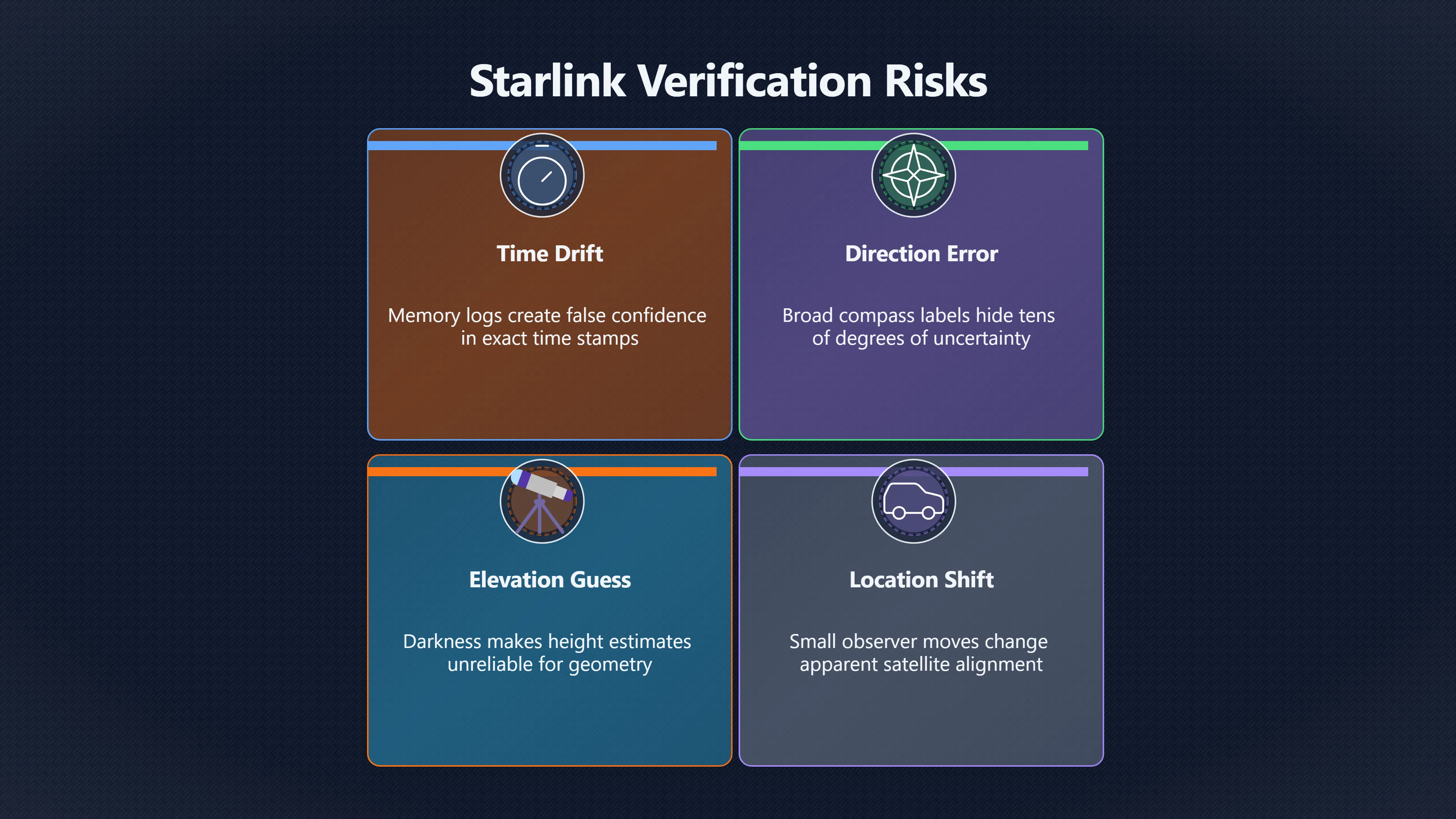
The most common failure in Starlink identification is treating a remembered time as an exact timestamp.
Witnesses often reconstruct sighting times afterwards using memory, message logs, television schedules, social media posts or approximate journey times. A witness saying “around 10 pm” may realistically mean anywhere from 21:50 to 22:15. An AI workflow that silently converts that estimate into “22:00:00” can create false confidence.
This matters because Starlink visibility changes rapidly. A train that looked dramatic at 22:01 may already be below the horizon or entering Earth’s shadow by 22:10. Likewise, another unrelated pass could appear in a neighbouring direction a few minutes later. Starlink satellites also move quickly across the sky, typically completing an orbital cycle in roughly 90 minutes.[Space]space.comStarlink satellite train: how to see and track it in the night skyThese satellites often create a "Starlink satellite train" — a captivating formation of closely grouped, bright lights moving in a line a…
A robust review process therefore stress-tests the timing rather than accepting the best-fitting minute.
A useful review method
Before publication, investigators should deliberately widen the possible observation window and rerun the match.
For example:
- Reported sighting time: 22:03
- Claimed certainty: “about ten o’clock”
- Tested review window: 21:50–22:15
The reviewer can then ask:
- Does the same Starlink train remain visible throughout the plausible range?
- Does the apparent direction still match?
- Would a different satellite group become a better fit?
- Would the reported behaviour still make sense?
If the explanation only works inside a narrow one-minute interval, that limitation should be stated openly.
A particularly important check is whether the witness timed the beginning, midpoint or end of the event. A witness may report the moment they first noticed the lights rather than when the formation entered the sky. That distinction can materially change the geometry.
Duration claims often distort the match
Witness duration estimates are notoriously unreliable in unusual events. A witness may report “ten minutes” for an event that lasted three minutes, or vice versa. Stress and surprise alter time perception, especially during unexpected aerial sightings.
This becomes important because Starlink trains generally show smooth, predictable motion. If a witness describes lights remaining nearly stationary for fifteen minutes, a reviewer should test whether the identified satellites would actually have crossed substantial portions of the sky during that interval.
If not, the match weakens sharply.
That does not automatically invalidate the explanation. Witnesses can misremember movement. But the report should then distinguish between:
- a geometrically plausible pass
- a pass that fully matches the witness description
Those are not the same thing.
Checking direction, elevation and observer position
A convincing Starlink match must also survive basic geometry checks.
Many weak identifications happen because the AI system found “a satellite overhead near the right time” without verifying whether the witness could actually have seen it from the stated location and viewing angle.
Direction errors are common
Witnesses frequently compress compass directions into broad labels such as “west” or “south-west”. In practice, this may represent an error margin of tens of degrees.
A review should therefore test multiple interpretations of the viewing direction rather than locking onto a single azimuth.
For example:
- “Moving east” may actually mean east-north-east
- “Over the sea” may refer to a broad horizon sector
- “Above the trees” depends on local terrain and observer height
A Starlink pass that only aligns under one highly specific directional assumption should not be presented as a clean match.
This matters especially because satellite trains have recognisable motion patterns. Newly launched trains often move in evenly spaced linear formations, while older operational satellites appear more dispersed and dimmer. Space[EarthSky If witnesses described abrupt turns]earthsky.orgThey would move across the sky in a line like a trainStarlink satellites can look like a plume or train of light12 Sept 2022 — This artist's concept shows a trail of Starlink satelli…, hovering or repeated directional reversals, reviewers should check whether those claims can reasonably be explained by perspective effects before asserting a Starlink explanation.
Elevation estimates are usually weak
Humans are poor at estimating elevation angles in darkness. A light 20 degrees above the horizon may later be remembered as “almost overhead”.
This becomes critical because apparent satellite brightness changes strongly with viewing geometry and solar reflection angle. Starlink visibility is often concentrated shortly after sunset or before sunrise, when satellites remain sunlit while observers on the ground are in darkness.[Space]space.comStarlink satellites are easier to see a day or twoStarlink satellites: Facts, tracking and impact on astronomyThe satellites can appear as a string of pearls or a "train" of bright l…
A reviewer should therefore test:
- whether the satellites would have been illuminated at the claimed elevation
- whether local buildings or terrain blocked the line of sight
- whether atmospheric haze near the horizon could alter apparent brightness
- whether the observer confused angular height with apparent closeness
If the identified satellites would have been barely above the horizon while the witness repeatedly described a high overhead object, the confidence rating should drop.
Observer position can change the result completely
Small location errors can materially affect satellite alignment.
A witness might say they were “in Manchester” while actually viewing from a motorway several kilometres away. A beach observer may have walked during the sighting. A driver may report the location where they stopped rather than where the event began.
Because low-Earth-orbit satellites move rapidly, even modest observer displacement can alter:
- apparent elevation
- apparent convergence
- timing of horizon entry
- visibility duration
This is especially important near coastlines, hills and urban skylines where obstructions differ sharply between locations.
A strong review process therefore reconstructs the actual viewing point as closely as possible instead of relying on a town-level coordinate.
Why “it looked like Starlink” is not enough
Starlink has become so visually recognisable that investigators can become overconfident.
Rows of evenly spaced lights are indeed a common Starlink signature. However, publication risk increases when pattern recognition replaces measurement.
Several problems recur repeatedly:
- the AI model chooses the nearest available Starlink pass even if the geometry is weak
- the reviewer assumes all linear lights are Starlink
- contradictory witness details are ignored because the visual resemblance seems persuasive
- satellite databases are treated as infallible despite timing and orbital update limitations
A good stress test therefore tries to break the explanation deliberately.
The reviewer should ask:
- What observation detail least fits the match?
- Which assumptions are carrying most of the conclusion?
- Would another investigator independently choose the same pass?
- Would the match still look persuasive if the witness time moved by ten minutes?
If the answer to the last question is “no”, the conclusion should be downgraded.

Explaining confidence without overstating the match
Public-facing UFO analysis often fails not because the proposed explanation is impossible, but because the certainty language becomes inflated.
A careful Starlink assessment should distinguish between levels of confidence rather than collapsing everything into “identified”.
Useful phrasing includes:
- “consistent with a Starlink pass”
- “plausibly matched”
- “strong geometric agreement”
- “timing broadly aligns”
- “tentative identification”
- “possible but not conclusive”
Investigators should avoid wording such as:
- “definitively identified”
- “certainly Starlink”
- “case solved”
unless the evidence genuinely supports that level of confidence.
This distinction matters because AI-generated summaries naturally tend towards narrative coherence. A model may smooth over contradictions that a human reviewer would consider significant. NASA’s UAP review stressed that poor metadata and incomplete calibration routinely weaken interpretation reliability, while AARO has repeatedly noted that many unresolved cases remain unresolved because available evidence is insufficient for a defensible conclusion.[ScienceAlert]sciencealert.comthe pentagons ufo office has given an official update on its findingsThe Pentagon's UFO Office Has Given an Official Update…24 Apr 2023 — "Without sufficient data, we are unable to reach defendable concl…[NASA Science]science.nasa.govScience Independent Study Team ReportNASA ScienceIndependent Study Team ReportSeptember 13, 2023 — At present, analysis of UAP data is hampered by poor sensor calibration, th…[NASA]nasa.govupdate nasa shares uap independent study report names directorUPDATE: NASA Shares UAP Independent Study Report14 Sept 2023 — We found that NASA can help the whole-of-government UAP effort through sys…
What a stronger Starlink identification looks like
A Starlink explanation becomes substantially stronger when several independent factors align simultaneously:
- witness timing matches across a realistic uncertainty range
- movement direction remains consistent after geometry checks
- observer position is verified
- elevation estimates broadly fit the predicted pass
- multiple witnesses independently describe a linear satellite formation
- local photographs or video show spacing consistent with known trains
- the visibility window matches expected illumination conditions
The more assumptions required to maintain the fit, the weaker the publication claim should become.
The main publication risk: turning plausibility into certainty
The danger in AI-assisted UFO investigation is not merely false positives. It is the gradual transformation of “possible explanation” into “settled fact” through repetition, automation and confident wording.
Starlink has become a genuine explanation for many modern UFO reports. But because it is now such a familiar explanation, it can also become an analytical shortcut.
A good pre-publication review therefore treats Starlink matching as a hypothesis to be stress-tested rather than a box to tick. If the explanation survives realistic uncertainty in time, direction, observer position and viewing geometry, it may deserve high confidence. If it only works under narrow assumptions, the uncertainty should remain visible in the final case assessment.
Amazon book picks
Further Reading
Books and field guides related to When does a Starlink match really hold?. Use these as the next step if you want deeper reading beyond the article.

The Signal and the Noise
Relevant to not overstating a near but fragile Starlink match.
eBay marketplace picks
Marketplace Samples
Example marketplace items related to this page. Use the search link to explore similar finds on eBay.


Endnotes
1.
Source: science.nasa.gov
Title: Science Independent Study Team Report
Link:https://science.nasa.gov/wp-content/uploads/2023/09/uap-independent-study-team-final-report.pdf
Source snippet
NASA ScienceIndependent Study Team ReportSeptember 13, 2023 — At present, analysis of UAP data is hampered by poor sensor calibration, th...
Published: September 13, 2023
2.
Source: nasa.gov
Title: update nasa shares uap independent study report names director
Link:https://www.nasa.gov/news-release/update-nasa-shares-uap-independent-study-report-names-director/
Source snippet
UPDATE: NASA Shares UAP Independent Study Report14 Sept 2023 — We found that NASA can help the whole-of-government UAP effort through sys...
3.
Source: aaro.mil
Link:https://www.aaro.mil/UAP-Cases/Official-UAP-Imagery/
Source snippet
UAP ImageryThe video footage associated with this report is insufficient for AARO to render a determination on its subject matter. This u...
4.
Source: sciencealert.com
Title: the pentagons ufo office has given an official update on its findings
Link:https://www.sciencealert.com/the-pentagons-ufo-office-has-given-an-official-update-on-its-findings
Source snippet
The Pentagon's UFO Office Has Given an Official Update...24 Apr 2023 — "Without sufficient data, we are unable to reach defendable concl...
5.
Source: space.com
Title: Starlink satellite train: how to see and track it in the night sky
Link:https://www.space.com/starlink-satellite-train-how-to-see-and-track-it
Source snippet
These satellites often create a "Starlink satellite train" — a captivating formation of closely grouped, bright lights moving in a line a...
6.
Source: space.com
Title: Starlink satellites are easier to see a day or two
Link:https://www.space.com/spacex-starlink-satellites.html
Source snippet
Starlink satellites: Facts, tracking and impact on astronomyThe satellites can appear as a string of pearls or a "train" of bright l...
7.
Source: earthsky.org
Title: They would move across the sky in a line like a train
Link:https://earthsky.org/space/spacex-starlink-satellites-explained/
Source snippet
Starlink satellites can look like a plume or train of light12 Sept 2022 — This artist's concept shows a trail of Starlink satelli...
8.
Source: space.com
Title: However, AARO’s ability to resolve
Link:https://www.space.com/space-exploration/search-for-life/pentagon-ufo-chief-tells-senate-very-anomalous-objects-need-careful-study-video
Source snippet
Pentagon UFO chief tells Senate 'very anomalous objects'...19 Nov 2024 — Still, AARO's 2024 report says that many cases remain unso...
9.
Source: aaro.mil
Link:https://www.aaro.mil/
Source snippet
AARO HomeOur team of experts leads the U.S. government's efforts to address Unidentified Anomalous Phenomena (UAP) using a rigorous scien...
10.
Source: science.nasa.gov
Link:https://science.nasa.gov/uap/
Source snippet
nasa.govUAP9 Jun 2022 — The UAP Independent Study shall report on the following questions: What types of scientific data currently collec...
11.
Source: space.com
Title: nasa ufo uap study team first results revealed
Link:https://www.space.com/nasa-ufo-uap-study-team-first-results-revealed
Source snippet
NASA UFO report finds no evidence of 'extraterrestrial...14 Sept 2023 — NASA's UFO study team released its long-awaited first report tod...
12.
Source: dvidshub.net
Link:https://www.dvidshub.net/video/977839/pr-008-unresolved-uap-report-europe-2022
Source snippet
PR-008, Unresolved UAP Report, Europe 2022The United States European Command submitted a report of an unidentified anomalous phenomenon t...
13.
Source: dvidshub.net
Link:https://www.dvidshub.net/video/988675/pr-017-unresolved-uap-report-europe-2024
Source snippet
PR-017, Unresolved UAP Report, Europe 2024The video footage associated with this report is insufficient for AARO to render a determinatio...
14.
Source: war.gov
Link:https://www.war.gov/UFO/
Source snippet
Presidential Unsealing and Reporting System for UAP...8 May 2026 — The materials archived here are unresolved cases, meaning the governm...
Published: May 2026
15.
Source: Wikipedia
Link:https://en.wikipedia.org/wiki/Starlink
Source snippet
StarlinkAs of March 2026, the constellation consists of over 10,020 satellites in low Earth orbit (LEO) that communicate with designa...
Published: March 2026
Additional References
16.
Source: [astronomy]({{ ‘astronomy/’ | relative_url }}). ie
Link:https://astronomy.ie/starlink-satellites/
Source snippet
Astronomy IrelandSTARLINK SATELLITESThese satellites for space-based internet are considered the vermin of the sky as they will potential...
17.
Source: reddit.com
Link:https://www.reddit.com/r/nasa/comments/16ij1ym/nasa_has_released_the_unidentified_anomalous/
Source snippet
NASA has released the Unidentified Anomalous...DOD and NASA now both say there are objects in the air that they can't identify. This UAP...
18.
Source: reddit.com
Link:https://www.reddit.com/r/UFOs/comments/1batrqa/robert_powells_takedown_analysis_of_the_aaro/
Source snippet
Robert Powell's takedown analysis of the AARO report. He...AARO found no verifiable evidence that any reported UAP sighting has... This...
19.
Source: reddit.com
Link:https://www.reddit.com/r/UFOs/comments/16ik6x5/summary_of_nasa_unidentified_anomalous_phenomena/
Source snippet
SUMMARY OF NASA UNIDENTIFIED ANOMALOUS...- **Challenges in UAP Data Deciphering**: The efficacy of UAP data analysis is impeded by issue...
20.
Source: war.gov
Title: dod working to better understand resolve anomalous phenomena
Link:https://www.war.gov/News/News-Stories/Article/article/3368109/dod-working-to-better-understand-resolve-anomalous-phenomena/
Source snippet
DOD Working to Better Understand, Resolve Anomalous...19 Apr 2023 — A large number of cases remain technically unresolved, but this is p...
21.
Source: thebaynet.com
Title: pentagons latest uap report sheds light on anomalies but questions remain
Link:https://thebaynet.com/pentagons-latest-uap-report-sheds-light-on-anomalies-but-questions-remain/
Source snippet
Pentagon's Latest UAP Report Sheds Light On Anomalies...20 Nov 2024 — AARO's ability to resolve cases is often constrained by the lack o...
22.
Source: youtube.com
Link:https://www.youtube.com/watch?v=C3uXUfgSadU
Source snippet
UAP Independent Study Event Post-Meeting Media...NASA holds a virtual post-meeting media teleconference following the May 31, 2023 publi...
Published: May 31, 2023
23.
Source: youtube.com
Link:https://www.youtube.com/watch?v=TQcqOW39ksk
Source snippet
Unidentified Anomalous Phenomena Independent Study ReportNASA commissioned an independent study team to examine unidentified anomalous ph...
24.
Source: war.gov
Title: You can find the unclassified version of the annual
Link:https://www.war.gov/News/Releases/Release/Article/3964824/department-of-defense-releases-the-annual-report-on-unidentified-anomalous-phen/
Source snippet
Department of Defense Releases the Annual Report on...14 Nov 2024 — This brought the total cases that AARO has been reviewing to over 1...
25.
Source: meritalk.com
Title: nasa urged to take more permanent role in uap research effort
Link:https://www.meritalk.com/articles/nasa-urged-to-take-more-permanent-role-in-uap-research-effort/
Source snippet
NASA Urged to Take More Permanent Role in UAP...15 Sept 2023 — The study team found that most UAP data is “hampered by poor sensor calib...
Topic Tree