Within Drone clues
When a drone explanation flies too high
UK height and visual-line-of-sight rules help test whether a reported object was plausibly a nearby multicopter or something else.
On this page
- The 120 metre rule in sighting checks
- Visual line of sight and likely launch points
- When altitude and duration weaken the drone theory
Page outline Jump by section
Introduction
One of the quickest ways to test a drone explanation in a UK UFO sighting is to ask a simple question: could an ordinary drone legally and practically have been where the witness says it was? UK drone rules do not prove that a sighting was mundane, but they provide useful boundaries. Most consumer drones in the UK are expected to remain below 120 metres (400 feet) above ground and within the pilot’s visual line of sight.[Civil Aviation Authority]caa.co.ukIf you fly where the ground falls or rises…Read more…[Civil Aviation Authority]caa.co.ukIf you fly where the ground falls or rises…Read more…
 That matters because witnesses often describe lights that appear “thousands of feet up”, “far out over the sea”, or “hovering silently for half an hour”. In many cases, those impressions conflict with the limits of normal multicopter operation. AI-assisted UFO investigation workflows can therefore use UK Civil Aviation Authority (CAA) rules as a reality check rather than as a definitive answer. If a reported object would have required illegal altitude, impossible visual tracking, or extreme endurance from a small multicopter, the drone theory weakens. If the sighting instead matches the height, range and behaviour expected from ordinary drone use, the explanation becomes more plausible.
The 120 metre rule in sighting checks
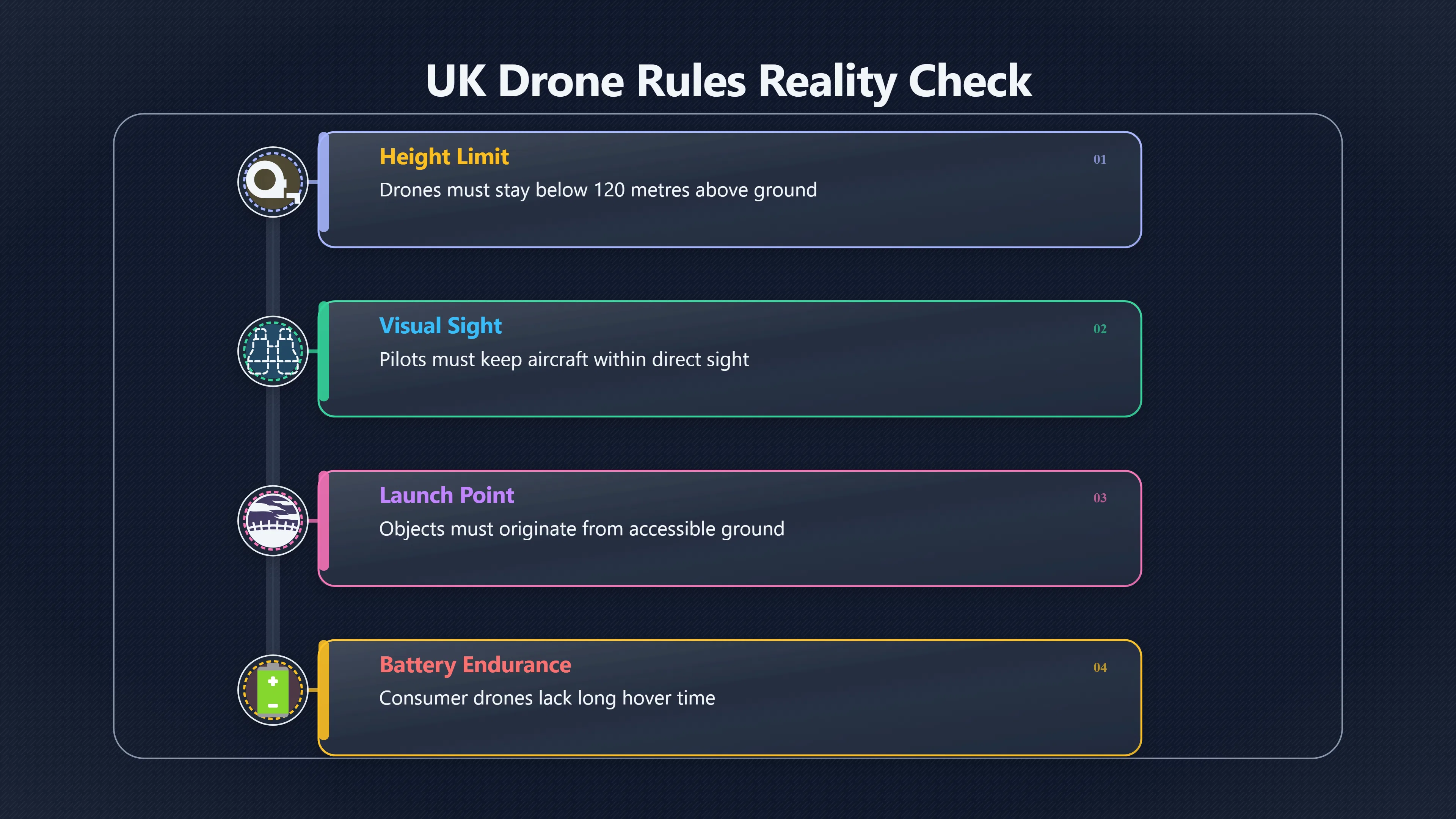
The core UK height rule is straightforward: drones and model aircraft must normally stay below 120 metres above the closest point of the earth’s surface.[Civil Aviation Authority]caa.co.ukIf you fly where the ground falls or rises…Read more…[Civil Aviation Authority]caa.co.ukIf you fly where the ground falls or rises…Read more… That is not merely guidance for hobbyists. It exists to separate most drone activity from manned aviation operating at higher altitudes.
For UFO investigation, the important point is not whether every pilot obeys the law. Some do not. The important point is probability. Most casual consumer drone flights occur within the legal envelope because pilots want to avoid crashes, enforcement problems and loss of signal. A report that places an object dramatically above normal drone altitude therefore deserves extra scrutiny.
This becomes especially useful when witnesses estimate altitude from appearance alone. Humans are notoriously poor at judging height at night. A bright LED-equipped drone only 80 or 100 metres high can appear vastly farther away against a dark sky with no reference points. Phone cameras often worsen the illusion by enlarging lights through autofocus bloom or digital zoom.
A common investigative pattern looks like this:
- A witness reports a “huge silent craft” hovering over a housing estate.
- The object is later estimated from nearby rooftops or trees to have been roughly 60 to 120 metres high.
- The movement pattern fits a multicopter: hovering, short lateral shifts, repeated pauses.
- The legal altitude ceiling and local geography both support a nearby drone explanation.
In those cases, the 120 metre rule does not solve the case by itself, but it provides a realistic operating ceiling that aligns with ordinary drone behaviour.
The rule also helps expose claims that are internally inconsistent. If a witness says a light remained fixed directly overhead yet simultaneously appeared “as high as a commercial jet”, the description conflicts with normal perception. Commercial aircraft cruise many thousands of feet above the ground, while ordinary drones remain comparatively low. AI-assisted workflows can flag such mismatches automatically by comparing estimated angular size, reported sound, apparent speed and known drone limits.
Another important detail is that UK rules measure height from the nearest point on the ground, not from the launch point.[Civil Aviation Authority]caa.co.ukIf you fly where the ground falls or rises…Read more… Over hills, cliffs or valleys, a drone pilot may legally follow terrain contours while remaining within 120 metres of the surface below. That means witnesses near coastal cliffs or upland terrain can misinterpret drone height if they assume the aircraft is being measured from sea level or from a distant take-off point.
Visual line of sight and likely launch points
UK drone operations normally require visual line of sight, commonly shortened to VLOS. The pilot must be able to see the drone directly and maintain awareness of its position and orientation without relying entirely on cameras or binoculars.[Civil Aviation Authority]caa.co.ukIf you fly where the ground falls or rises…Read more…[Civil Aviation Authority]caa.co.ukIf you fly where the ground falls or rises…Read more… Operational guidance commonly treats around 500 metres as the practical upper boundary for standard VLOS operations.[Civil Aviation Authority]caa.co.ukIf you fly where the ground falls or rises…Read more…[Filming in England]filminginengland.co.ukYes. Yes. Yes. Yes. Maximum distance from operator. 500m (VLOS). 500m (VLOS). 500m (VLOS).Read more…
For UFO investigation, this is often more revealing than the height limit.[hiredronepilot.uk]hiredronepilot.ukdrone height limit ukThe UK Drone Height Limit: What 120 Metres Really Means12 Sept 2025 — The UK drone height limit is 120 metres, roughly 400 feet, measured…
A witness may report a hovering object “miles away over open countryside”. If the object was actually a small multicopter, someone usually had to launch and monitor it from somewhere nearby. That introduces practical questions:
- Was there an accessible launch area?
- Could a pilot realistically maintain visual contact?
- Would buildings, trees or terrain block the view?
- Was the object visible for so long that battery endurance becomes unlikely?
These questions can dramatically narrow the drone hypothesis.
For example, a bright hovering light reported over an urban park for five minutes may fit an ordinary recreational flight. The likely launch area could be nearby footpaths, car parks or open fields. By contrast, a reported object stationary “far offshore” for forty minutes becomes harder to reconcile with a normal multicopter unless there is evidence for specialised operations or nearby vessels.
AI-assisted investigation systems can test these constraints geographically. A workflow may combine witness direction estimates with terrain maps, housing density, roads, parks and coastline access to identify probable launch corridors. If no realistic operator position exists within VLOS range, confidence in a consumer-drone explanation should decrease.
This is especially relevant for sightings over:
- Restricted industrial sites
- Mountain ridges
- Offshore locations
- Large estuaries
- Remote moorland
- Military training areas
Witnesses often assume a mysterious object came from “nowhere”, but multicopters usually originate from somewhere physically accessible to a pilot. A good investigative system treats launch practicality as part of the evidence chain rather than as an afterthought.

When altitude and duration weaken the drone theory
Drone explanations become less convincing when multiple constraints fail simultaneously.
One weak factor alone proves little. A pilot can break altitude rules. Some operators use enhanced video links. Specialist drones exist. But when a sighting exceeds several normal multicopter limits at once, the burden on the drone hypothesis increases.
Key warning signs include:
- Extreme apparent altitude: Witnesses independently describe the object above cloud layers or at heights associated with conventional aircraft.
- Long stationary duration: Many consumer multicopters have limited battery endurance, especially in wind.
- Very large travel distance: Continuous movement across a wide area may fit fixed-wing aircraft better than hovering multicopters.
- No plausible launch point: The surrounding terrain offers nowhere realistic for a pilot to operate unnoticed.
- Weather mismatch: Strong winds, rain or poor visibility would make stable drone flight difficult.
- Silent operation at close range: Multicopters usually produce a noticeable rotor sound when nearby, especially at night in otherwise quiet areas.
This does not mean the object becomes extraordinary. It simply means investigators should widen the explanation set instead of forcing the case into the drone category.
One recurring mistake in UFO discussions is treating “drone” as a universal debunking label detached from operational reality. A balanced investigation asks whether the specific sighting fits the known constraints of ordinary drone activity in that location and time window.
For instance, a witness who observes a light for two minutes above nearby rooftops has described something fully compatible with normal multicopter use. A witness who tracks an object silently crossing an entire county at high apparent altitude for forty-five minutes has described something that strains the consumer-drone explanation considerably more.
The distinction matters because many UFO cases become distorted by binary thinking. Either every light is declared anomalous, or every light is dismissed as “probably a drone”. In practice, UK drone rules help create a middle category: sightings that are drone-compatible, drone-possible-but-weak, or operationally inconsistent with ordinary multicopters.
Illegal flights, exemptions and edge cases
The 120 metre and VLOS rules are not absolute proof against drone involvement because exemptions and specialist operations exist. The UK CAA allows some authorised operators to conduct more advanced flights, including beyond visual line of sight operations in specific circumstances.[Civil Aviation Authority]caa.co.ukIf you fly where the ground falls or rises…Read more… Reuters Certain model flying organisations have also received permissions allowing some aircraft types to exceed standard height limits under control[reuters.com]reuters.comThese rules would allow drones to be flown beyond the visual line of sight, relying only on the drone's camera. The proposed regulations… led conditions.[FPV UK]fpvuk.orgFPV UKCAA Permission for flight above 400ftFPV UK, the UK drone flying association, has been issued with a special CAA permission for dro…
That means investigators should avoid overconfident statements such as “it could not have been a drone because it was above 400 feet”.
Instead, the more accurate assessment is:
- ordinary recreational multicopter activity becomes less likely above standard limits;
- specialised or unlawful operations remain possible;
- additional evidence is needed before excluding drones completely.
This distinction is important around airports, infrastructure inspections, emergency services operations and industrial surveys, where authorised drone activity may occur outside ordinary hobbyist patterns.
Modern regulations are also changing. The UK introduced updated drone classification and Remote ID rules in 2026, affecting registration thresholds and operational categories.[TechRadar]techradar.comTech Radar UK drone laws have just changedTwo major changes are introduced: the new UK Class Marks system and phased Remote ID requirements. UK Class Marks, ranging from UK0 to UK… These changes may gradually improve post-event investigation because more drone operations could become traceable through broadcast identification systems.
For UFO analysis, however, the central lesson remains the same: legal frameworks are most useful as behavioural baselines. They describe how ordinary drone activity usually occurs in the real world.
Why these rules matter in AI-assisted UFO investigation
In a structured UFO case workflow, drone regulations become machine-testable constraints rather than background trivia.
An AI-assisted system can compare a witness report against:
- reported altitude;
- estimated viewing distance;
- local terrain elevation;
- drone endurance estimates;
- known VLOS constraints;
- likely launch sites;
- nearby population density;
- weather conditions;
- and nearby aviation activity.
That allows automated triage of common misidentifications.
For example, a system may flag a sighting as strongly drone-compatible if it involves:
- low altitude;
- hovering;
- repeated local manoeuvres;
- operation near accessible open ground;
- and short duration.
The same system may downgrade the drone explanation where the object was reportedly visible at great altitude, over inaccessible terrain, for unusually long periods with no obvious pilot location.
Used carefully, UK drone rules help investigators avoid two opposite errors: dismissing unusual reports too quickly, or accepting ordinary low-altitude drone activity as something extraordinary.
Amazon book picks
Further Reading
Books and field guides related to When a drone explanation flies too high. Use these as the next step if you want deeper reading beyond the article.
The Drone Pilot's Handbook
Directly relevant to drone operating limits and practical use.
eBay marketplace picks
Marketplace Samples
Example marketplace items related to this page. Use the search link to explore similar finds on eBay.


Endnotes
1.
Source: reuters.com
Link:https://www.reuters.com/world/uk/uks-new-drone-proposals-allow-flying-medical-deliveries-rail-checks-2024-02-20/
Source snippet
These rules would allow drones to be flown beyond the visual line of sight, relying only on the drone's camera. The proposed regulations...
2.
Source: techradar.com
Title: Tech Radar UK drone laws have just changed
Link:https://www.techradar.com/cameras/drones/uk-drone-laws-have-just-changed-if-your-drone-has-a-camera-read-this-now
Source snippet
Two major changes are introduced: the new UK Class Marks system and phased Remote ID requirements. UK Class Marks, ranging from UK0 to UK...
3.
Source: caa.co.uk
Link:https://www.caa.co.uk/drones/getting-started-with-drones-and-model-aircraft/drone-code/where-you-can-fly-points-3-to-9/
Source snippet
If you fly where the ground falls or rises...Read more...
4.
Source: caa.co.uk
Link:https://www.caa.co.uk/drones/getting-started-with-drones-and-model-aircraft/where-you-can-fly/
Source snippet
Civil Aviation AuthorityWhere you can flyYou must not fly closer to individual buildings than 50m horizontally. Individual means at least...
5.
Source: caa.co.uk
Link:https://www.caa.co.uk/drones/moving-on-to-more-advanced-flying/beyond-visual-line-of-sight-bvlos/
Source snippet
Normally, you must always keep your drone within direct sight. This is often called Visual Line of Sight, or VLOS for short.Read more...
6.
Source: caa.co.uk
Link:https://www.caa.co.uk/media/csmfqbs1/the-drone-code-march-2026.pdf
Source snippet
The Drone and Model Aircraft Codeanyone wanting to fly a drone or model aircraft in the UK.... Your drone or model aircraft must be with...
7.
Source: hiredronepilot.uk
Title: drone height limit uk
Link:https://hiredronepilot.uk/blog/drone-height-limit-uk/
Source snippet
The UK Drone Height Limit: What 120 Metres Really Means12 Sept 2025 — The UK drone height limit is 120 metres, roughly 400 feet, measured...
8.
Source: dronescene.co.uk
Link:https://dronescene.co.uk/400ft
Source snippet
If you fly where the ground falls or rises...
9.
Source: caa.co.uk
Link:https://www.caa.co.uk/drones/specific-category/pdra01-operational-authorisation/pdra01-overview/
Source snippet
Civil Aviation AuthorityPDRA01 overview | UK Civil Aviation AuthorityFlights must be conducted within VLOS as per the definition given in...
10.
Source: filminginengland.co.uk
Link:https://www.filminginengland.co.uk/wp-content/uploads/2024/03/UK-Drone-Regulations-Matrix-for-the-Open-Category.pdf
Source snippet
Yes. Yes. Yes. Yes. Maximum distance from operator. 500m (VLOS). 500m (VLOS). 500m (VLOS).Read more...
11.
Source: fpvuk.org
Link:https://fpvuk.org/caa-permission-for-flight-above-400ft/
Source snippet
FPV UKCAA Permission for flight above 400ftFPV UK, the UK drone flying association, has been issued with a special CAA permission for dro...
12.
Source: greyarro.ws
Title: Visual Line Of Sight?
Link:https://greyarro.ws/t/visual-line-of-sight/85848
Source snippet
Questions & Answers28 Oct 2024 — My question really relates to VLS, visual line of sight! I think my eye sight is reasonably good. I wear...
13.
Source: filminginengland.co.uk
Link:https://www.filminginengland.co.uk/wp-content/uploads/2021/06/UK-Drone-Regulations-Matrix-for-the-Open-Category-v1.pdf
Source snippet
UK Drone Regulations Matrix for the Open CategoryThis matrix provides an overview of the key regulations and restrictions for each drone...
Additional References
14.
Source: t3.com
Link:https://www.t3.com/active/outdoors/caa-drone-regulation-changes-2026
Source snippet
Key updates include lowering the registration threshold, requiring anyone flying drones over 100g (previously 250g) to obtain a free Flye...
15.
Source: carrot.co.uk
Link:https://www.carrot.co.uk/understanding-drone-flight-altitude-open-category
Source snippet
Drone Flight Altitude in Open Category: Rules ExplainedThis regulation permits drones to ascend up to 15 metres above the peak of an 'art...
16.
Source: nationwidedrones.co.uk
Link:https://www.nationwidedrones.co.uk/enhanced-caa-permissions/
Source snippet
Enhanced CAA PermissionsGenerally, commercial drone operators are required to maintain a minimum distance of 50 meters from uninvolved pe...
17.
Source: theguardian.com
Link:https://www.theguardian.com/technology/2024/feb/20/drones-could-deliver-medical-supplies-under-uk-travel-watchdog-plans
Source snippet
These proposals aim to maintain safe drone operations at low heights and near infrastructure, predicting fewer aircraft in these areas. K...
18.
Source: caa.co.uk
Link:https://www.caa.co.uk/
Source snippet
UK Civil Aviation AuthorityThe UK Civil Aviation Authority (CAA), the UK's independent aerospace regulator, protects people and enables a...
19.
Source: facebook.com
Link:https://www.facebook.com/NorthWestLeicsPolice/posts/-key-uk-drone-laws-rules-%EF%B8%8Fflyer-id-from-the-1st-of-january-2026-anyone-flying-a-/1305645221603916/
Source snippet
Key UK Drone Laws & Rules 🛸 ▪️Flyer ID: From the 1st of🛸 Key UK Drone Laws & Rules 🛸 ▪️Flyer ID: From the 1st of January 2026, anyone f...
Published: january 2026
20.
Source: facebook.com
Link:https://www.facebook.com/groups/903879063054302/posts/8929414957167299/
Source snippet
For all those questions about how far can the drone be away from you to comply with our UK CAA. To me the regulations...
21.
Source: flybydronetraining.co.uk
Title: Drone Legislation at a glance | Press Kit The drone must always be in sight
Link:https://www.flybydronetraining.co.uk/press-kit/drone-legislation-at-a-glance
Source snippet
It must never be flown more than 400ft (120m) high to avoid risk of collision with planes and helicopters. Never fly closer...Read more...
22.
Source: greyarro.ws
Title: where does it say that vlos has max limit of 500m on the caa website
Link:https://greyarro.ws/t/where-does-it-say-that-vlos-has-max-limit-of-500m-on-the-caa-website/5617
Source snippet
Where does it say that VLOS has max limit of 500m on...11 Jan 2019 — The maximum distance a UAV should be flown from its operator is 500...
23.
Source: dronestudionortheast.co.uk
Title: can you fly a drone over a motorway uk drone flight guidelines 2024
Link:https://dronestudionortheast.co.uk/can-you-fly-a-drone-over-a-motorway-uk-drone-flight-guidelines-2024/
Source snippet
Can You Fly a Drone Over a Motorway?29 Aug 2025 — In the UK, drones must adhere to a maximum legal flight ceiling of 120 metres (400 feet...
Topic Tree