Within Timeline
When satellites look stranger than expected
Satellites can brighten, vanish, or appear in lines when sunlight, observer darkness, and orbital timing align.
On this page
- Why satellites appear and disappear suddenly
- Starlink trains, flares, and re entry confusion
- Testing a satellite match against the witness account
Page outline Jump by section
Introduction
A surprisingly large number of UFO reports turn out to involve ordinary satellites behaving in ways that do not look ordinary at all. A satellite can appear from nowhere, brighten suddenly, split into a line of lights, pulse repeatedly, or vanish in seconds without changing direction. In a raw witness account, those behaviours often sound unusual or even impossible. In a reconstructed timeline, they frequently match known orbital geometry.
 For AI-assisted UFO sighting investigation, satellite checks matter because they are highly testable. A dated and located sighting can be compared against orbital predictions, twilight conditions, the observer’s viewing angle, and known launches or re-entries. That does not mean every sighting has a satellite explanation. It means satellites are one of the fastest ways to separate a likely mundane event from a genuinely unresolved case. The important point is not merely whether a satellite was overhead, but whether its timing, brightness, direction, duration, and disappearance behaviour fit the witness account closely enough to explain what was seen.[Wikipedia]WikipediaSatellite flareSatellite flare[Heavens-Above]heavens-above.comSatellite predictions and other astronomical data customised for your locationHeavens-AboveSatellite predictions and other astronomical data customised for your location…
Why satellites appear and disappear suddenly
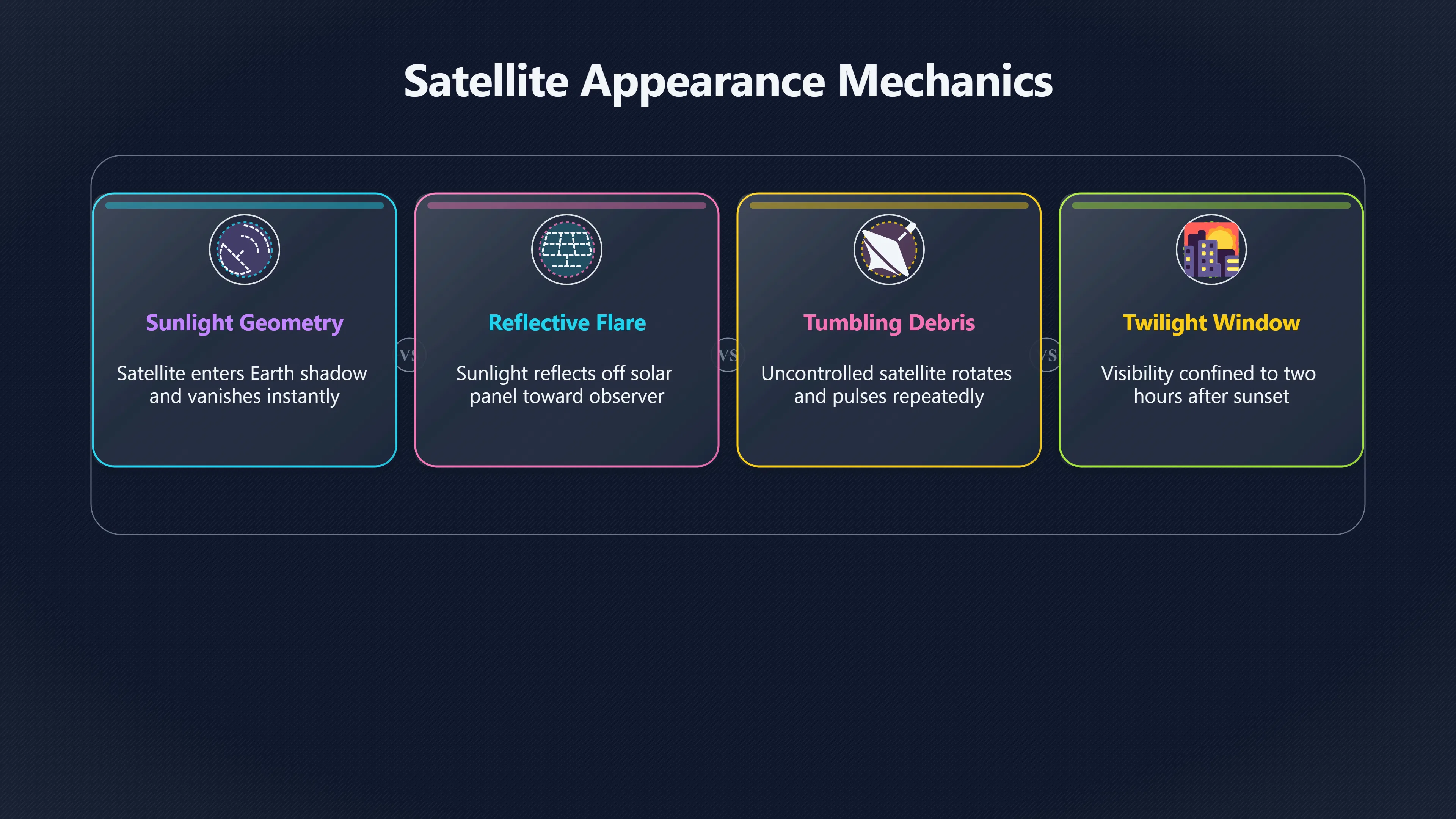
Many witnesses describe a light that “came out of nowhere” or “blinked out instantly”. Those phrases sound dramatic, but they are also classic descriptions of low Earth orbit satellites crossing the boundary between sunlight and Earth’s shadow.
A satellite seen shortly after sunset or before sunrise may still be illuminated even though the observer on the ground is in darkness. As the spacecraft continues along its orbit, it can suddenly enter Earth’s shadow and disappear. To a witness with no visible structure, no blinking navigation lights, and no audible engine noise, the effect can look abrupt and unnatural. Amateur astronomy observers regularly describe this exact behaviour during ordinary satellite passes.[Reddit]reddit.comPair of bright objects fade to nothingr/AstronomyJuly 12, 2018 — this sounds like satellites because of them fading out as they entered Earth's shadow. (Heavens-Above is a gre…[Reddit]reddit.comtil passing the terminator line into Earth's shadow…
The reverse also happens. A dim satellite can emerge into sunlight mid-pass and rapidly brighten. In witness language this may become “the object materialised” or “a stationary light suddenly switched on”. The key mechanism is geometry rather than propulsion. The satellite is already there; sunlight simply reaches it at a new angle.
Brightness changes can become much more dramatic when reflective surfaces align with the observer. This is the basis of a satellite flare or glint: sunlight reflects directly from a solar panel, antenna, or metallic surface toward a small area on Earth. The old Iridium communications satellites became famous for this effect because their antenna geometry created predictable bright flashes visible across narrow ground tracks. Some reached magnitudes brighter than Venus and could briefly be visible even in daylight.[Wikipedia]WikipediaSatellite flareSatellite flare[Satellites Observer]satobs.orgSatellites ObserverIridium FlaresA relatively small communications satellite has been providing spectacular visible reflective flares/gli…
For timeline reconstruction, the important investigative clue is not just brightness, but the pattern of change:
- Gradual brightening then fading often fits a normal satellite pass.
- A sharp flash lasting seconds can fit a specular reflection or flare.
- Repeated pulses at fixed intervals may indicate a tumbling rocket body or uncontrolled satellite rotating in sunlight.
- Sudden disappearance without directional change strongly fits entry into Earth’s shadow.
- Visibility confined to twilight periods is a major satellite indicator.
AI systems can use these patterns as probabilistic clues rather than final conclusions. A witness saying “the light vanished instantly” should trigger shadow-entry checks before more exotic explanations are considered.
Starlink trains, flares, and re-entry confusion
The rise of Starlink and other satellite constellations has changed the shape of modern UFO reporting. Before mega-constellations, most casual observers rarely saw multiple satellites together. Now newly launched groups can appear as long moving chains of lights, often prompting alarm calls and viral social media posts.[Space]space.comStarlink satellite train: how to see and track it in the night skyThese satellites often create a "Starlink satellite train" — a captivating formation of closely grouped, bright lights moving in a line a…
A newly deployed Starlink train typically appears as evenly spaced lights moving silently in formation across the sky. To observers unfamiliar with launch deployments, the effect can resemble coordinated craft or structured formations. The timing matters here: the trains are brightest soon after launch and during orbital raising, especially shortly after sunset or before sunrise when the satellites remain sunlit against a dark sky.[Space]space.comStarlink satellites: Facts, tracking and impact on astronomy5 May 2026 — You don't need any special equipment to see Starlink satellites…
The confusion increases because Starlink satellites can also produce unexpected flare behaviour. Research published in 2024 examined “extreme flaring” events where reflected sunlight created unusually bright transient lights. One investigated case involved airline pilots reporting what became classified as unidentified aerial phenomena before the geometry was matched to satellite reflections.[arXiv]arxiv.orgSource details in endnotes.[Sky & Telescope]skyandtelescope.orgstarlink flares can fool anyone even airline pilotsFlares may…Read more…
This matters for UFO investigations because witnesses often focus on the emotional impression of the event rather than the underlying geometry. A flare low on the horizon may seem stationary because the angular motion is small. Multiple satellites flaring along related orbital tracks can resemble intelligent coordination. Reflections can brighten and dim in ways that resemble manoeuvres rather than lighting effects.
Re-entry events create another layer of confusion. Failing satellites or de-orbiting hardware can fragment into glowing trails crossing large areas of sky. Witnesses may report fiery objects “breaking apart”, “dropping fragments”, or “moving in formation”. Genuine re-entries are visually dramatic, but they are still usually explainable through launch and orbital records.
A useful AI-assisted workflow therefore separates several commonly conflated categories:
Reported behaviourCommon satellite-related mechanismSilent line of moving lightsNewly launched Starlink trainSingle bright flashSatellite flare or glintLight appears then vanishesEntry into or exit from Earth’s shadowRepeating pulsesTumbling rocket body or uncontrolled satelliteFragmenting fiery streaksRe-entry debrisApparent hovering near horizonSlow angular motion combined with atmospheric perspective
The timeline context is crucial because these effects are strongly tied to solar position. Many satellite-related sightings cluster within roughly two hours after sunset or before sunrise. That timing alone does not prove a satellite explanation, but it is one of the strongest screening indicators available.

Testing a satellite match against the witness account
Finding a satellite overhead is not enough. Low Earth orbit contains thousands of active objects, and weak matches can easily become false positives. A credible investigation tests whether the predicted pass genuinely fits the witness description.
The first requirement is accurate timing. Even a one-minute error can change the visible sky position significantly. AI-assisted systems therefore need confidence scoring around timestamps: exact device metadata is stronger than later recollection. If the witness only says “around 10 pm”, the software should widen the comparison window rather than forcing a precise match.
The next step is observer location. Satellite visibility is highly position-dependent. A flare visible from one town may not be visible a few kilometres away because the reflection geometry is narrow. Prediction systems such as Heavens-Above and other orbital tracking tools rely on observer coordinates for this reason.[Heavens-Above]heavens-above.comThe most likely explanation, however, is…Read more…
A robust satellite comparison usually checks:
- Predicted azimuth and elevation against witness direction.
- Pass timing against reported appearance and disappearance.
- Maximum brightness against witness descriptions.
- Motion speed and path consistency.
- Whether the object crossed into Earth’s shadow at the reported vanish point.
- Whether twilight conditions supported visibility.
- Whether multiple witnesses from different locations described the same geometry consistently.
The strongest satellite matches tend to reproduce several independent details simultaneously. For example:
- Witness reports a bright silent object moving west to east.
- Sighting occurred 45 minutes after sunset.
- Object faded suddenly halfway across the sky.
- Orbital data shows a Starlink satellite on the same path entering Earth’s shadow at the same moment.
That combination is much stronger than merely proving a satellite existed somewhere overhead.
Weak matches often fail on key behavioural points. If witnesses describe rapid direction changes, hovering for long periods, or movement inconsistent with orbital paths, a satellite explanation becomes less convincing unless the account itself is unreliable or perception effects are likely. AI systems should therefore classify satellite correlations by strength rather than treating them as binary solved-or-unsolved outcomes.
Why witness perception and cameras complicate satellite sightings
Satellite sightings are often more convincing to witnesses than investigators expect because the human visual system is poor at judging distance and speed in a dark sky. A small bright object against a featureless background can appear much closer and more manoeuvrable than it really is.
Several recurring perception effects appear in UFO reports involving satellites:
- Autokinesis: a stationary or slowly moving light appears to drift because the observer’s eyes make involuntary movements.
- Relative motion illusion: clouds or foreground objects move, making the satellite appear to change direction.
- Brightness-driven speed perception: a flare brightening rapidly can seem to accelerate.
- Loss of reference points: once a satellite enters shadow, witnesses may perceive an intentional disappearance rather than a lighting change.
Phone cameras add further distortion. Automatic exposure systems can exaggerate flares, while digital zoom can make ordinary satellites appear to pulse or wobble. Compression artefacts may create apparent structure around point sources. A timeline reconstruction should therefore compare the witness account against both the raw sky conditions and the recording device behaviour.
One important investigative distinction is between what the witness genuinely experienced and what the physical event most likely was. A person can honestly report an extraordinary-looking object while the underlying mechanism remains entirely conventional. The job of the timeline is not to dismiss the witness, but to determine whether orbital and lighting geometry reproduce the reported behaviour convincingly enough to explain it.
When a satellite explanation remains uncertain
Satellite matching is powerful, but it is not infallible. Orbital prediction data can contain timing errors, especially for recently launched objects or tumbling debris. Witness times may also be inaccurate. Some flares are poorly documented because uncontrolled rotation changes reflectivity unpredictably.[Wikipedia]WikipediaSatellite flareSatellite flare
There are also cases where a satellite explanation partially fits but leaves important gaps. A pass may match the timing and direction while failing to explain claimed motion changes or duration. In those cases, a balanced investigation should separate confirmed correlations from unresolved elements rather than forcing a complete explanation.
A sensible evidence-led classification might look like this:
- Ruled out: no relevant pass, wrong direction, impossible timing.
- Plausible: broad timing and geometry fit, but incomplete detail match.
- Strong match: timing, brightness, path, and disappearance behaviour align closely.
- Weak correlation: satellite overhead but inconsistent with core witness claims.
- Unresolved: no convincing satellite or alternative explanation fits available evidence.
That approach keeps the investigation grounded. Satellite analysis is most useful not because it explains every UFO report, but because it explains many reports that initially seem far stranger than they are.
Amazon book picks
Further Reading
Books and field guides related to When satellites look stranger than expected. Use these as the next step if you want deeper reading beyond the article.
NightWatch: A Practical Guide to Viewing the Universe
Excellent for identifying satellites and other bright sky objects.
The Backyard Astronomer's Guide
Provides observing techniques relevant to satellite sightings.
The Demon-Haunted World
Supports evidence-based interpretation of unusual observations.
eBay marketplace picks
Marketplace Samples
Example marketplace items related to this page. Use the search link to explore similar finds on eBay.



Endnotes
1.
Source: Wikipedia
Title: Satellite flare
Link:https://en.wikipedia.org/wiki/Satellite_flare
2.
Source: heavens-above.com
Title: Satellite predictions and other astronomical data customised for your location
Link:https://www.heavens-above.com/
Source snippet
Heavens-AboveSatellite predictions and other astronomical data customised for your location...
3.
Source: arxiv.org
Link:https://arxiv.org/abs/2208.03226
4.
Source: reddit.com
Title: Pair of bright objects fade to nothing
Link:https://www.reddit.com/r/Astronomy/comments/8y8775/pair_of_bright_objects_fade_to_nothing/
Source snippet
r/AstronomyJuly 12, 2018 — this sounds like satellites because of them fading out as they entered Earth's shadow. (Heavens-Above is a gre...
Published: July 12, 2018
5.
Source: reddit.com
Link:https://www.reddit.com/r/Astronomy/comments/1bsqncp/what_is_this_bright_light_that_slowly_faded_as_it/
Source snippet
til passing the terminator line into Earth's shadow...
6.
Source: space.com
Title: Starlink satellite train: how to see and track it in the night sky
Link:https://www.space.com/starlink-satellite-train-how-to-see-and-track-it
Source snippet
These satellites often create a "Starlink satellite train" — a captivating formation of closely grouped, bright lights moving in a line a...
7.
Source: arxiv.org
Title: arXiv Starlink Mini Satellite Brightness Distributions Across the Sky
Link:https://arxiv.org/abs/2401.01546
8.
Source: arxiv.org
Title: arXiv Extreme Flaring of Starlink Satellites
Link:https://arxiv.org/abs/2405.13091
Source snippet
Extreme Flaring of Starlink SatellitesMay 21, 2024...
Published: May 21, 2024
9.
Source: arxiv.org
Link:https://arxiv.org/pdf/2405.13091
Source snippet
Extreme Flaring of Starlink Satellitesby A Mallama · 2024 · Cited by 2 — Abstract. Starlink satellites can become extremely bright when s...
10.
Source: arxiv.org
Link:https://arxiv.org/pdf/2506.11382
Source snippet
In order to explore why the Starlink satellites are ∼ 11 times brighter during the.Read more...
11.
Source: reddit.com
Link:https://www.reddit.com/r/SpaceXLounge/comments/1izudtk/spacex_update_on_targeted_reentry_for_starlink/
Source snippet
SpaceX Update on Targeted Re-entry for Starlink satellites...Successful targeted reentry requires maintaining attitude control down to v...
12.
Source: reddit.com
Link:https://www.reddit.com/r/Astronomy/comments/1649yjj/satellite_flares/
Source snippet
Satellite flares?: r/AstronomyMy current theory (which I'm looking for your guidance on) is LEO satellites hurtling over the western hor...
13.
Source: reddit.com
Link:https://www.reddit.com/r/askastronomy/comments/flwizx/are_iridium_flares_still_possible_to_see/
Source snippet
Are Iridium Flares still possible to see?: r/askastronomyEven if there are still satellites up there they are no longer being controlled...
14.
Source: space.com
Link:https://www.space.com/spacex-starlink-satellites.html
Source snippet
Starlink satellites: Facts, tracking and impact on astronomy5 May 2026 — You don't need any special equipment to see Starlink satellites...
Published: May 2026
15.
Source: heavens-above.com
Link:https://www.heavens-above.com/faq.aspx?alt=100&cul=en&lat=44.813792&lng=-76.515932&loc=Cygnus+Hill+Observatory&tz=EST
Source snippet
The most likely explanation, however, is...Read more...
16.
Source: heavens-above.com
Link:https://www.heavens-above.com/explain.aspx
Source snippet
Explanatory NotesSatellites are visible only when the sun is already well below the observer's horizon but the satellite is still in sunl...
17.
Source: satobs.org
Link:https://www.satobs.org/iridium.html
Source snippet
Satellites ObserverIridium FlaresA relatively small communications satellite has been providing spectacular visible reflective flares/gli...
18.
Source: skyandtelescope.org
Title: [starlink flares]({{ ‘starlink-flares/’ | relative_url }}) can fool anyone even airline pilots
Link:https://skyandtelescope.org/astronomy-news/starlink-flares-can-fool-anyone-even-airline-pilots/
Source snippet
Flares may...Read more...
19.
Source: accuweather.com
Link:https://www.accuweather.com/en/space-news/spacex-fires-back-at-faa-report-suggesting-its-starlink-internet-constellation-could-be-deadly/1586449
Source snippet
SpaceX fires back at FAA report suggesting its Starlink...The FAA analysis does acknowledge that SpaceX says its Starlink satellites ful...
20.
Source: facebook.com
Link:https://www.facebook.com/groups/2365809903441367/posts/9486232744732345/
Source snippet
red the earth's shadow, the umbra to be exact.Read more...
21.
Source: space.stackexchange.com
Title: are starlink satellites flaring
Link:https://space.stackexchange.com/questions/52149/are-starlink-satellites-flaring
Source snippet
Starlink satellites flaring?May 14, 2021 — The "Old and Busted" Iridium satellites flared like crazy because they had big flat metal surf...
Published: May 14, 2021
22.
Source: youtube.com
Link:https://www.youtube.com/watch?v=aWpeN3cU17Q
Source snippet
SpaceX's Starlink, satellite flares, and spectacular twilight...The geometry behind satellite flare and how you can see sunlight and ref...
23.
Source: amazon.co.uk
Link:https://www.amazon.co.uk/Heavens-Above-GmbH/dp/B0782SLZL2
24.
Source: cloudynights.com
Title: satellite visibility?
Link:https://www.cloudynights.com/topic/430687-satellite-visibility/page-1
Source snippet
General Observing and AstronomyAug 24, 2013 — You're seeing them because they're high above you, still in the sunlight long after the Sun...
25.
Source: satflare.com
Title: STARLIN K Train
Link:https://www.satflare.com/track.asp?q=starlink5
Source snippet
STARLINK Train - 3D REAL TIME TRACKINGIn this page you can track in real time all the satellites orbiting the Earth, with both 2D and 3D...
26.
Source: wesh.com
Title: spacex starlink satellites
Link:https://www.wesh.com/article/spacex-starlink-satellites/45588620
Source snippet
FAA flags SpaceX Starlink satellite reentry concerns19 Oct 2023 — The Federal Aviation Administration raised alarm about the potential da...
Additional References
27.
Source: catchingtime.com
Link:https://catchingtime.com/starlink-satellite-swarm-from-37n-latitude/
Source snippet
4/10/24: Starlink Satellite Swarm from 37°N latitudeFlares of this type are essentially direct specular reflections of the sun (which lie...
28.
Source: facebook.com
Link:https://www.facebook.com/groups/2365809903441367/posts/7695491230473181/
Source snippet
Predicting Starlink Satellite Flares VisibilityPossible Starlink flares. I noticed this last night. I think each frame is a separate flar...
29.
Source: facebook.com
Link:https://www.facebook.com/groups/blueridgemountainlife/posts/3807018919435087/
Source snippet
Satellite panel flares in night skyIt is a satellite pass visible to the naked eye as a brief, bright "flare". It is caused by the reflec...
30.
Source: cloudynights.com
Link:https://www.cloudynights.com/forums/topic/966424-what-is-the-best-time-to-see-satellites-on-the-night-sky-and-satellite-flares/
Source snippet
What is the best time to see satellites on the night sky...31 May 2025 — Most of the sats you will see are in low-Earth orbit and will d...
Published: May 2025
31.
Source: astronomy.stackexchange.com
Title: what could be an explanation for a satellite like moving light in the night sky
Link:https://astronomy.stackexchange.com/questions/50156/what-could-be-an-explanation-for-a-satellite-like-moving-light-in-the-night-sky
Source snippet
could be an explanation for a satellite-like moving...10 Aug 2022 — It very likely IS a satellite which is moving from the sunlit part i...
32.
Source: phys.org
Title: In one instance they were reported as Unidentified Aerial Phenomenon
Link:https://phys.org/news/2024-05-starlinks-bright-flares.html
Source snippet
Starlinks can produce surprisingly bright flares for pilotsMay 27, 2024 — This study demonstrated that Starlinks can be exceedingly brigh...
Published: May 27, 2024
33.
Source: xt8dob.wordpress.com
Title: crash course heavens above part two satellite predictions
Link:https://xt8dob.wordpress.com/2015/05/25/crash-course-heavens-above-part-two-satellite-predictions/
Source snippet
Orion XT8 Blog: Every Night is a New SkyCrash Course in Heavens-Above: Part Two – Satellite...25 May 2015 — To give you some idea of how...
Published: May 2015
34.
Source: nationalgeographic.com
Title: Will Elon Musk’s Starlink satellites harm astronomy?
Link:https://www.nationalgeographic.com/science/article/elon-musk-starlink-internet-satellites-trouble-for-astronomy-light-pollution
Source snippet
Here's...May 29, 2019 — However, like the Iridium satellites that preceded them, Starlink satellites can sometimes “flare” if their sola...
Published: May 29, 2019
35.
Source: aaro.mil
Title: AARO Satellite Flaring Paper 508 FINAL 04222025
Link:https://www.aaro.mil/Portals/136/PDFs/Information%20Papers/AARO_Satellite_Flaring_Paper_508_FINAL_04222025.pdf
Source snippet
Correlations of Starlink Satellite Flaring with UAP...by A An · 2024 — This is determined from the inset in Figure 10, which shows that...
36.
Source: cloudynights.com
Title: 356942 brightness of iss on heavens above
Link:https://www.cloudynights.com/topic/356942-brightness-of-iss-on-heavens-above/
Source snippet
Brightness of ISS on heavens above2 Jan 2012 — It does change appearance as it crosses the sky and of course fades to invisible when it m...
Topic Tree