Within Video Limits
When the Camera Creates the UFO Effect
Infrared glare, digital zoom and night-vision effects can create movements and shapes that are not physically real.
On this page
- Infrared bloom and glare effects
- Digital zoom and stabilisation distortions
- Why calibration changes conclusions
Page outline Jump by section
Introduction
A UFO video can look extraordinary because the camera system itself is behaving in unusual ways. Infrared glare can turn a distant aircraft into a glowing disc. Digital zoom can exaggerate shake and apparent speed. Image stabilisation can make lights appear to dart across the sky. Night-vision systems can create halos, trails and rotating shapes that are not physically present in the scene.
 This matters because many modern UFO and UAP cases depend heavily on video evidence from phones, drones, military infrared systems and low-light cameras. In AI-assisted UFO sighting investigation, one of the first technical questions is not “what is the object?” but “what did the sensor do to the image?” NASA’s UAP study stressed that poor sensor calibration, limited metadata and weak baseline data make interpretation difficult. NASA Science Space A balanced investigation therefore treats sensor artefacts as a normal part of evidence handling rather than as a dismissive explanation. Som[space.com]space.comsensor metadata, and the lack of baseline data," the report states.Read moreNASA UFO report finds no evidence of 'extraterrestrial…14 Sept 2023 — "At present, analysis of UAP data is hampered by poor senso… e videos genuinely capture unknown objects. Others record ordinary objects that become visually strange because of the way imaging systems process heat, light, motion and contrast.
Infrared bloom and glare effects
Infrared and thermal cameras are especially important in modern UFO discussions because many military UAP videos come from forward-looking infrared systems, usually called FLIR. These systems do not “see” objects the same way the human eye does. They detect heat contrast and then convert it into an image.
That difference creates several common failure modes.
Heat sources can become artificial shapes
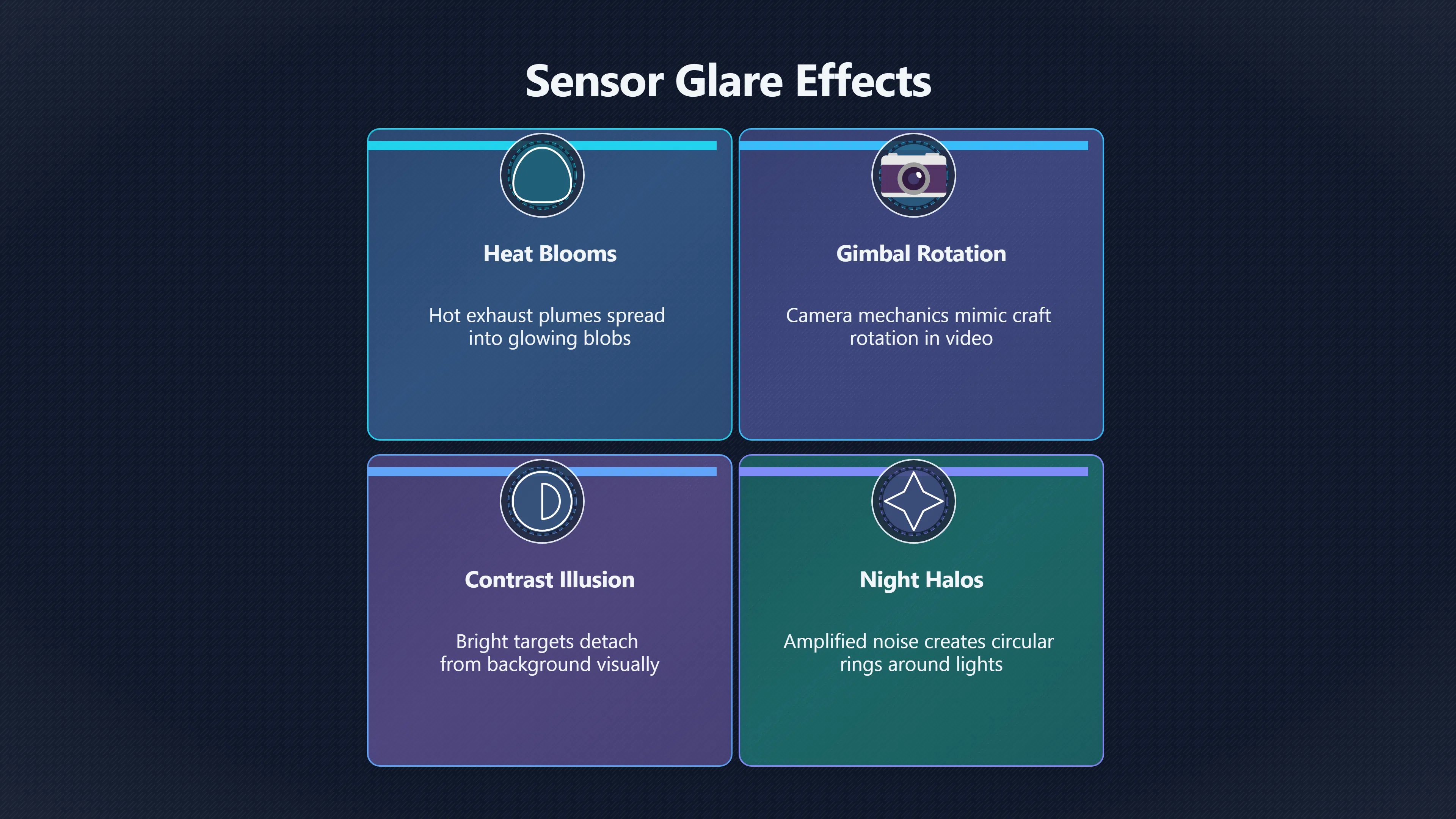
A distant jet engine, hot exhaust plume or bright reflection may spread beyond its true boundaries inside the sensor. This is often called blooming or glare. Instead of showing a sharp aircraft silhouette, the camera may produce a glowing blob, diamond or rotating shape.
The famous “Gimbal” Navy video became a major example of this debate. Viewers interpreted the rotating bright form as a rotating craft. Later technical analyses argued that the apparent rotation was more consistent with infrared glare rotating with the camera’s gimbal mechanism rather than with the object itself rotating in flight.[Metabunk]metabunk.orga gimbal glare explainer.12230A Gimbal Glare Explainer17 Jan 2022 — In a large part, the current UFO-hype is based on the official Pentagon-UFOs. For sure, the…
That does not automatically identify the underlying object. A glare artefact can still originate from a real aircraft or unknown target. The key point is narrower: the visible shape on screen may describe the optics of the camera more than the structure of the object.
For investigators, this changes the workflow dramatically. AI-assisted analysis systems should avoid treating the outline of an infrared object as reliable evidence of craft geometry unless the sensor characteristics are known.
Infrared contrast exaggerates apparent motion
Thermal systems also compress depth cues. A hot target against a cold background can appear detached from the environment, creating the impression that it is hovering or moving independently of normal atmospheric conditions.
Several public military videos show isolated bright points against empty sky or ocean backgrounds. Without visible terrain, horizon references or depth markers, viewers naturally infer extreme manoeuvres. Yet even modest camera movement can produce dramatic apparent motion when the image contains only one bright target.
The “GoFast” video is important here because the object looked as though it was racing just above the ocean surface. AARO later concluded that the apparent speed resulted largely from parallax and viewing geometry rather than extraordinary propulsion.[AARO]aaro.milGo Fast Case Resolution Card Methodology FinalAARO GoFast Case Resolution6 Feb 2025 — AARO assesses the object did not demonstrate anomalous performance characteristics. The objec…
Although parallax is primarily a geometry issue, infrared presentation amplified the effect. The bright tracked target stood out strongly while the background offered few intuitive distance clues. The result was a visually convincing illusion of extreme low-altitude speed.
Night-vision amplification introduces noise and halos
Consumer night-vision cameras and military low-light systems introduce another class of artefacts. These systems amplify tiny amounts of light electronically. In poor conditions they also amplify noise, reflections and sensor imperfections.
Common effects include:
- Circular halos around lights
- Smearing during rapid movement
- Flickering from automatic gain adjustment
- Bright stars appearing to pulse or drift
- Lens reflections that duplicate or mirror lights
- Grain patterns mistaken for structured objects
In UFO footage, these artefacts are often interpreted as energy fields, rotating surfaces or changing craft shapes. In reality, many arise because the sensor is operating close to its technical limits.
AI systems trained on calibrated night-sky footage can sometimes identify these patterns automatically by comparing the behaviour of suspected anomalies against known optical signatures from stars, aircraft lights and infrared reflections.
Digital zoom and stabilisation distortions
Modern phones and many military imaging systems heavily process video before the user ever sees it. This processing can create movement that appears physically impossible.
Digital zoom creates false acceleration
Digital zoom does not work like optical zoom. Instead of magnifying genuine detail through lenses, it enlarges pixels and uses software enhancement to fill gaps.
When a small bright object is digitally enlarged:
- Tiny hand movements become exaggerated
- Compression artefacts become visible
- Atmospheric shimmer appears as object motion
- Autofocus hunting creates pulsing size changes
- Tracking software may “snap” the image position
This is why distant lights filmed on mobile phones often appear to zig-zag or jump erratically. The object itself may be nearly stationary while the camera struggles to maintain focus and stabilisation at extreme magnification.
A useful investigative rule is that unexplained movement becomes less persuasive when it only appears after high digital zoom is applied.
Image stabilisation can detach the object from the scene
Electronic stabilisation systems attempt to keep a target centred by shifting or cropping the frame in real time. If the software locks onto a bright point while the background moves differently, the target may appear to accelerate unnaturally.
This creates several classic UFO impressions:
- Sudden directional jumps
- Instant stopping and starting
- Floating against moving clouds
- Abrupt changes in angular speed
The problem becomes worse when the original unprocessed footage is unavailable. Many social media uploads already contain stabilisation, sharpening and frame interpolation before investigators see them.
NASA’s UAP study repeatedly stressed the importance of metadata and sensor information for exactly this reason. Without knowing what processing occurred inside the device, analysts cannot reliably separate object behaviour from software behaviour.[NASA Science]science.nasa.govNASA ScienceIndependent Study Team ReportAt present, analysis of UAP data is hampered by poor sensor calibration, the lack of multiple me…[Wikisource]en.wikisource.orgNASA Unidentified Anomalous Phenomena: Independent…14 Oct 2023 — The panel notes that, at present, gathering data on UAP is…

Compression artefacts create shape changes
Online UFO clips are often downloaded, re-uploaded and recompressed multiple times. Video codecs simplify detail to save bandwidth. Bright isolated objects suffer especially badly.
Compression can produce:
- Rotating block patterns
- Flickering edges
- Artificial trails
- Sudden shape transformations
- Fragmentation into multiple lights
A distant aircraft beacon can therefore mutate into something that appears structured or morphing. Viewers may believe the object is physically changing shape when the changes are actually produced by aggressive compression and sharpening algorithms.
This is one reason investigators place such high value on original files rather than edited clips from social platforms.
Why calibration changes conclusions
Sensor calibration sounds technical, but in UFO analysis it often determines whether a case remains mysterious.
A calibrated system reveals what the camera normally does
Calibration establishes how a sensor behaves under known conditions. Investigators can then compare a supposed anomaly against normal artefacts produced by the same equipment.
Without calibration data, analysts may not know:
- Whether the sensor overexposes bright heat sources
- How the stabilisation behaves during tracking
- How much distortion appears near frame edges
- Whether dead pixels or flare patterns are common
- How atmospheric conditions affect the image
This is why military and scientific investigations place so much emphasis on instrument metadata. NASA’s independent UAP report argued that missing calibration and missing contextual data are major barriers to reliable interpretation. NASA Science[The Debrief]thedebrief.orgnasas unidentified anomalous phenomena report key takeawaysNASA's Unidentified Anomalous Phenomena Report14 Sept 2023 — “At present, analysis of UAP data is hampered by poor sensor calibration, th…

Multi-sensor comparison is often decisive
One of the strongest ways to identify sensor artefacts is to compare different instruments observing the same event.
For example:
- A thermal camera may show a rotating glow while visible-light footage shows a normal aircraft light pattern.
- Radar may indicate slow movement while video appears to show rapid acceleration.
- Two cameras with different lenses may produce different object shapes.
If the anomaly changes with the sensor rather than with the object, that strongly suggests an imaging artefact.
This is increasingly important in AI-assisted workflows. Machine-learning systems can compare simultaneous data streams from optical, infrared, radar and environmental sensors to identify inconsistencies that human viewers may miss.
Reconstructing the sensor state matters as much as the object
In many unresolved UFO cases, analysts focus intensely on the target while knowing very little about the observing system. A more rigorous approach reconstructs both.
A useful case file therefore includes:
- Camera model and firmware version
- Lens type and zoom level
- Exposure settings
- Stabilisation status
- Compression format
- Infrared polarity mode
- Tracking mode
- Observer movement
- Weather and atmospheric conditions
This may sound mundane compared with the dramatic object on screen, but it often determines whether extraordinary interpretations survive scrutiny.
Why these artefacts remain persuasive
Sensor artefacts are convincing because they interact with normal human perception. People instinctively trust video, especially footage from military systems or expensive cameras. A glowing rotating shape recorded by a targeting pod feels more authoritative than a verbal witness statement.
Yet the apparent precision of advanced sensors can be misleading. Complex imaging systems frequently produce outputs that are difficult even for trained operators to interpret correctly outside their intended context.
This creates an important tension in UFO investigation:
- The sensor captured something real.
- The displayed image may still misrepresent what that thing physically looked like or how it moved.
That distinction explains why some UFO videos remain publicly debated even after technical explanations emerge. The footage still feels visually anomalous, even when investigators identify optical or processing effects that could plausibly account for the apparent behaviour.
For AI-assisted UFO sighting investigation, the practical lesson is straightforward: before classifying an object as unresolved or anomalous, investigators should first model the behaviour of the camera itself. In many cases, the “UFO manoeuvre” occurs inside the imaging chain rather than in the sky.
Amazon book picks
Further Reading
Books and field guides related to When the Camera Creates the UFO Effect. Use these as the next step if you want deeper reading beyond the article.
How to Read a Photograph
Helps readers understand how images can misrepresent reality.
The Demon-Haunted World
Ideal for evaluating extraordinary-looking imagery cautiously.
Understanding Exposure
Rating: 4.5/5 from 19 Google Books ratings
Explains camera behaviour, light and image distortions.
The Visual Display of Quantitative Information
Supports disciplined interpretation of visual evidence.
eBay marketplace picks
Marketplace Samples
Example marketplace items related to this page. Use the search link to explore similar finds on eBay.



Endnotes
1.
Source: science.nasa.gov
Link:https://science.nasa.gov/wp-content/uploads/2023/09/uap-independent-study-team-final-report.pdf
Source snippet
NASA ScienceIndependent Study Team ReportAt present, analysis of UAP data is hampered by poor sensor calibration, the lack of multiple me...
2.
Source: space.com
Title: sensor metadata, and the lack of baseline data,” the report states.Read more
Link:https://www.space.com/nasa-ufo-uap-study-team-first-results-revealed
Source snippet
NASA UFO report finds no evidence of 'extraterrestrial...14 Sept 2023 — "At present, analysis of UAP data is hampered by poor senso...
3.
Source: metabunk.org
Title: a [gimbal glare]({{ ‘gimbal-glare/’ | relative_url }}) explainer.12230
Link:https://www.metabunk.org/threads/a-gimbal-glare-explainer.12230/
Source snippet
A Gimbal Glare Explainer17 Jan 2022 — In a large part, the current UFO-hype is based on the official Pentagon-UFOs. For sure, the...
4.
Source: aaro.mil
Title: Go Fast Case Resolution Card Methodology Final
Link:https://www.aaro.mil/Portals/136/PDFs/case_resolution_reports/AARO_GoFast_Case_Resolution_Card_Methodology_Final.pdf
Source snippet
AARO GoFast Case Resolution6 Feb 2025 — AARO assesses the object did not demonstrate anomalous performance characteristics. The objec...
5.
Source: en.wikisource.org
Link:https://en.wikisource.org/wiki/NASA_Unidentified_Anomalous_Phenomena%3A_Independent_Study_Team_Report/Responses_to_Statement_of_Task
Source snippet
NASA Unidentified Anomalous Phenomena: Independent...14 Oct 2023 — The panel notes that, at present, gathering data on UAP is...
6.
Source: en.wikisource.org
Title: Page:UAP Independent Study Team Final Report
Link:https://en.wikisource.org/wiki/Page%3AUAP_Independent_Study_Team_-_Final_Report.pdf/5
Source snippet
wikisource.orgPage:UAP Independent Study Team - Final Report.pdf/512 Nov 2023 — At present, analysis of UAP data is hampered by poor sens...
7.
Source: metabunk.org
Link:https://www.metabunk.org/threads/go-fast-footage-from-tom-delonges-to-the-stars-academy-bird-balloon.9569/
Source snippet
"GO FAST" Footage from Tom DeLonge's To The Stars...Mar 9, 2018 — This accents the visual illusion that the object is moving because the...
8.
Source: metabunk.org
Title: nasa panel analyzes go fast.13174
Link:https://www.metabunk.org/threads/nasa-panel-analyzes-go-fast.13174/
Source snippet
NASA panel analyzes GO FAST19 Sept 2023 — The main point of the NASA analysis is that the GO FAST object looks fast because of parallax—b...
9.
Source: navair.navy.mil
Title: mil Documents | NAVAIR
Link:https://www.navair.navy.mil/foia/documents
Source snippet
NAVAIR - FOIADocument Library · GOFAST. GOFAST - Please download · HEEMFG Spin test experiment test plan w. test results · GIMBAL. Vide...
10.
Source: thedebrief.org
Title: nasas unidentified anomalous phenomena report key takeaways
Link:https://thedebrief.org/nasas-unidentified-anomalous-phenomena-report-key-takeaways/
Source snippet
NASA's Unidentified Anomalous Phenomena Report14 Sept 2023 — “At present, analysis of UAP data is hampered by poor sensor calibration, th...
Additional References
11.
Source: reddit.com
Link:https://www.reddit.com/r/UFOs/comments/1gv8xak/aaro_has_resolved_the_go_fast_uap/
Source snippet
AARO has resolved the "Go Fast" UAP: r/UFOsGo Fast explanation: paralax Object altitude 13.000 ft, speed 45mph / 39 knots. Wind speed at...
12.
Source: reddit.com
Link:https://www.reddit.com/r/UFOs/comments/166dk0u/according_to_aaros_new_website_the_flir_gimbal/
Source snippet
According to AARO's new website, the FLIR, Gimbal and...According to AARO, the FLIR (Tic Tac UAP), Gimbal, and GoFast videos are “unreso...
13.
Source: instagram.com
Link:https://www.instagram.com/p/DYPAgUqEj5B/
14.
Source: thenationalnews.com
Title: nasas ufo report advises us government on how to detect mysterious objects
Link:https://www.thenationalnews.com/world/us-news/2023/09/14/nasas-ufo-report-advises-us-government-on-how-to-detect-mysterious-objects/
Source snippet
Nasa's UFO report reveals how public can help hunt for...14 Sept 2023 — Released online on Thursday, the 36-page document says that exis...
15.
Source: meritalk.com
Title: nasa urged to take more permanent role in uap research effort
Link:https://www.meritalk.com/articles/nasa-urged-to-take-more-permanent-role-in-uap-research-effort/
Source snippet
NASA Urged to Take More Permanent Role in UAP...15 Sept 2023 — The study team found that most UAP data is “hampered by poor sens...
16.
Source: nevadacurrent.com
Title: nasa report finds no evidence that ufos are extraterrestrial
Link:https://nevadacurrent.com/2023/09/18/nasa-report-finds-no-evidence-that-ufos-are-extraterrestrial/
Source snippet
18 Sept 2023 — Analysis of this data is “hampered by poor sensor calibration, the lack of multiple measurements, the lack of sensor metad...
17.
Source: behavior-podcast.com
Title: gimbal ufo video and others explained in new documentary
Link:https://behavior-podcast.com/gimbal-ufo-video-and-others-explained-in-new-documentary/
Source snippet
“Gimbal” UFO video and other famous videos explained in...9 Jan 2025 — The documentary also delves into some of the more famous UFO myth...
18.
Source: nextgov.com
Link:https://www.nextgov.com/ideas/2023/09/nasa-report-finds-no-evidence-ufos-are-extraterrestrial/390350/
Source snippet
NASA report finds no evidence that UFOs are extraterrestrial15 Sept 2023 — Analysis of this data is “hampered by poor sensor calibration...
19.
Source: nypost.com
Title: pentagon claims to debunk famous gofast ufo radar video
Link:https://nypost.com/2024/11/20/us-news/pentagon-claims-to-debunk-famous-gofast-ufo-radar-video/
Source snippet
Pentagon claims to debunk famous 'GOFAST' UFO radar...20 Nov 2024 — The “GOFAST” video shows a radar recording of an object that appeare...
20.
Source: boingboing.net
Link:https://boingboing.net/2022/03/14/navy-ufo-moves-with-camera-mechanisms-in-glaring-problem-for-alien-fans.html
Source snippet
Here's an interesting analysis of the fairly-recent "Navy UFO" video...Read more...
Topic Tree