Within Timeline
Can phone metadata prove the sighting time?
Original photo and video files can anchor a sighting timeline, but device clocks, exports and app uploads can quietly shift the apparent time.
On this page
- What EXIF timestamps can and cannot show
- How clock settings, daylight saving and exports create errors
- How AI should flag weak or altered file timing
Page outline Jump by section
Introduction
Phone photos and videos are now among the most common forms of evidence attached to UFO and UAP reports. A single image may appear to answer a crucial question immediately: exactly when did the sighting happen? In practice, the answer is often less certain than investigators expect.
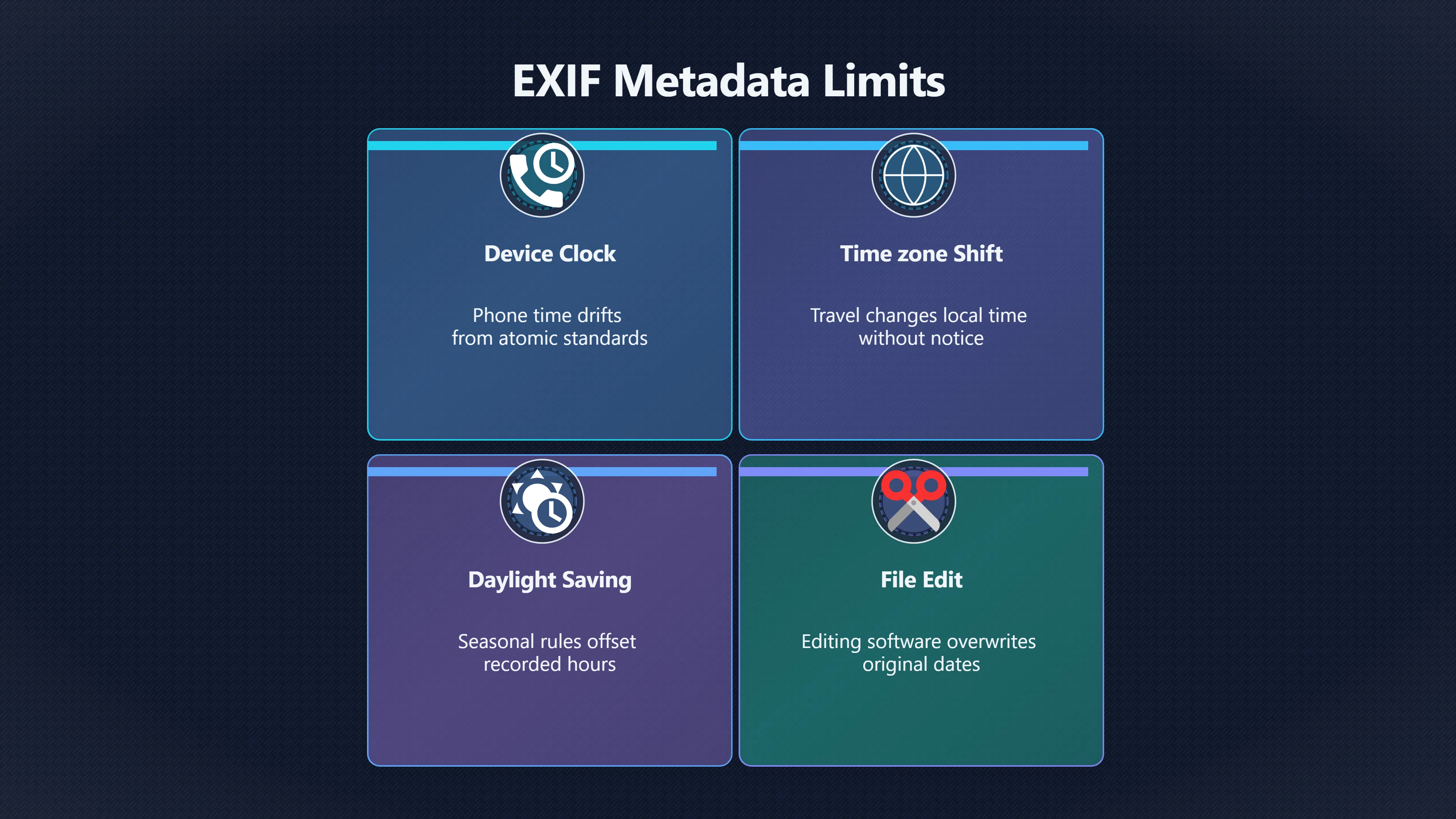
 EXIF metadata can provide a valuable timestamp anchor, especially when the original file is available directly from the recording device. But phone clocks drift, users change time zones, daylight saving settings fail, exported files lose metadata, and social media platforms routinely rewrite or strip timing information. A sighting that appears to have occurred at 21:14 may actually have been recorded several minutes, or even several hours, earlier or later. That difference can completely change whether the object aligns with a satellite pass, aircraft approach, bright planet, rocket stage re-entry or no obvious explanation at all.
For AI-assisted UFO sighting investigation, metadata should therefore be treated as evidence to be tested, not as automatic proof. The aim is to determine how trustworthy the timing really is, how much uncertainty remains, and whether the file timing survives comparison with external records.
What EXIF timestamps can and cannot show
Exchangeable Image File Format, usually shortened to EXIF, is metadata embedded inside many image and video files. Phones often record information such as:
- capture date and time[discussions.apple.com]discussions.apple.comDOC 250002750Apple Support CommunityMovie dates and Photos.app20 Sept 2025 — 3. If 'Keys:CreationDate' in a movie or 'ExifIFD:OffsetTimeOriginal' meta…
- device model
- lens and camera settings
- GPS location
- orientation
- software used to edit or export the file
- timezone offset in newer formats
The most important field for UFO timeline reconstruction is usually DateTimeOriginal, which attempts to record when the image was captured. On newer devices there may also be timezone-related tags such as OffsetTimeOriginal. These became more widely supported only in recent years, meaning many older files contain local time but no explicit timezone reference.[Photography Stack Exchange]photo.stackexchange.comgraphy Stack ExchangeCan I assume the DateTimeOriginal of an image without…5 Nov 2022 — Other than the GPS timestamps, EXIF times…
That limitation matters more than many witnesses realise. If a witness travelled recently, crossed time zones, manually changed clock settings, or restored a phone backup incorrectly, the recorded capture time may be detached from real local time. In practical UFO investigation work, that can create false matches or false eliminations.
A good example is a witness who reports a glowing object over Cornwall at “about 10pm BST”, while the image metadata actually reflects UTC, a previous travel timezone, or a manually offset phone clock. An astronomical check could wrongly rule out Venus or incorrectly match a Starlink pass because the underlying timestamp is shifted.
Investigators should also distinguish carefully between several different dates often attached to the same file:
- Date captured — when the camera claims the image was recorded
- Date modified — when the file was edited
- Date exported — when the file left an app or cloud service
- Filesystem creation date — when the current copy appeared on a device
These are not interchangeable. A screenshot, edited clip or re-saved video can inherit newer timestamps that have little relationship to the original sighting event.
Why “automatic time” is not a guarantee
Most modern phones synchronise their clocks automatically using network time services connected ultimately to highly accurate atomic clock systems. NIST explains that phone time is normally linked through telecommunications and GPS timing infrastructure to international atomic time standards.[NIST]nist.govkeeping us timeKeeping Us On Time | NISTJun 30, 2025 — All told, GPS delivers time that is accurate to within 100 billionths of a second. So the tim…
That sounds reassuring, and in many ordinary cases it is. However, UFO investigations frequently involve edge cases where automatic synchronisation failed or became unreliable:
- the phone had no signal for long periods
- automatic time was disabled manually
- the user changed regions while travelling
- daylight saving rules updated incorrectly
- the battery failed or the device reset
- the recording happened during network outages
- the file came from an older secondary device with poor synchronisation
Even small clock errors matter in event reconstruction. A three-minute offset may wrongly exclude a meteor report or aircraft track. A one-hour daylight saving error can make a night-time astronomical explanation appear impossible when it was actually plausible.
Investigators should therefore avoid phrases such as “the metadata proves the sighting happened at 21:14”. A more defensible formulation is usually:
“The available metadata suggests capture near 21:14 local device time, pending validation against external timing references.”
That wording preserves uncertainty honestly while still treating the metadata as useful evidence.
How daylight saving and timezone errors distort UFO timelines
One of the most common timing failures in public UFO submissions is confusion between UTC, local time and daylight saving time.
The UK provides a particularly easy trap because sightings may occur under either GMT or BST depending on the season. Witnesses often report times from memory rather than directly from the device record, while databases, astronomy software and aviation logs may each use different standards.
Common failure patterns include:
- witness reports BST while software assumes UTC
- exported files lose timezone metadata
- investigators compare local witness time against UTC satellite data without conversion
- image viewers silently reinterpret timestamps based on the computer’s current timezone
- cloud photo systems reorder files after travel
Timezone handling is inconsistent across software ecosystems. Discussions among metadata specialists and Apple Photos users repeatedly show that exported media can shift display times depending on whether timezone tags are preserved. NeededApps Forum[Adobe Community]community.adobe.comThis means exports from Lightroom would be out of orderAdobe CommunityP: Add proper UTC offset support when changing image time2 May 2024 — Some apps, such as Apple Photos, uses the utc offset…
This becomes especially important when comparing a sighting against:
- ISS or satellite pass predictions
- ADS-B flight tracking
- meteor observations
- military exercise schedules
- launch and re-entry records
Many of those systems publish times in UTC. A witness may unknowingly provide local time. AI systems that fail to standardise time references can generate convincing but false correlations.
A robust workflow therefore stores:
Time representationPurposeOriginal device timestampPreserves raw evidenceNormalised UTC timeEnables external correlationLocal reported timePreserves witness accountConfidence estimateShows uncertainty level
This allows later investigators to audit the conversion process instead of inheriting hidden assumptions.

Why exports, messaging apps and social media weaken timing evidence
The strongest timing evidence usually comes from the untouched original file copied directly from the recording device. Every later export stage can degrade confidence.
Messaging apps and social media platforms commonly compress images, strip metadata or rewrite timestamps during upload and download. IPTC metadata studies and digital preservation guidance have repeatedly shown that many platforms remove embedded metadata fields entirely. IPTC 3IPTC[The Library of Congress]blogs.loc.govsocial media networks stripping data from your digital photosThe Library of CongressSocial Media Networks Stripping Data from Your Digital…Apr 11, 2013 — This survey shows that a number of the mo…
For UFO investigations, that means:
- a TikTok upload is weaker than the original phone video
- a WhatsApp forward may contain almost no usable timing metadata
- screenshots usually destroy original capture timestamps
- edited clips may overwrite the original creation date
- cloud downloads can inherit new filesystem dates
Modern forensic studies on image metadata handling also note that social and chat platforms often apply aggressive compression and metadata stripping that substantially reduces evidential value.[SCIEPublish]sciepublish.comimages are transferred as “images” (i.e., in chat mode) or uploaded through social media, aggressive compression algorithms strip Exif me…
This does not make the sighting false. It simply means the timing evidence becomes weaker.
A practical investigation hierarchy often looks like this:
- Original unedited file direct from device
- Original cloud backup export
- Edited file retaining metadata
- Messaging-app copy
- Social media repost[iptc.org]iptc.orgsocial media sites photo metadata test results 2019Social Media Sites Photo Metadata Test Results 2019 - IPTCSystems have been tested by members of the IPTC Photo Metadata Working Grou…
- Screenshot or screen recording
AI-assisted workflows should automatically classify files into these confidence bands rather than treating all uploads equally.

How AI should flag weak or altered file timing
AI systems are useful not because they can magically determine the “true” time, but because they can identify inconsistencies quickly across large case collections.
A well-designed investigation workflow should automatically flag:
- missing EXIF fields
- timezone mismatches
- daylight saving inconsistencies
- impossible chronology sequences
- edits after the claimed sighting time
- metadata inconsistent with the stated device model
- exported or recompressed files
- GPS-time versus device-time disagreement
For example, an AI pipeline might detect that:
- the witness claims the sighting occurred at 22:30 BST
- the EXIF file lacks timezone metadata
- GPS coordinates place the device in Spain earlier that day
- the file export software rewrote timestamps
- the local sunset conditions fit 21:30 instead
That does not disprove the report. It simply means the timing confidence should be downgraded and broader comparison windows used.
This is especially important because metadata can be altered intentionally or accidentally. Simple EXIF editing tools exist and are widely available online. Edited timestamps alone are therefore weak proof of authenticity unless supported by independent evidence.
The strongest cases combine metadata with external anchors such as:
- text messages
- smart doorbell recordings
- CCTV
- app notifications
- flight tracks
- witness cross-confirmation
- astronomical conditions
- weather radar
- live social media posts[iptc.org]iptc.orgsocial media sites photo metadata test results 2019Social Media Sites Photo Metadata Test Results 2019 - IPTCSystems have been tested by members of the IPTC Photo Metadata Working Grou…
AI is most effective when it treats metadata as one layer inside a broader evidence matrix rather than as a standalone truth source.
Practical signs that a timestamp is probably reliable
A timestamp becomes more credible when several independent details line up simultaneously.
Higher-confidence indicators include:
- original file supplied directly from the phone
- consistent EXIF and filesystem timing
- intact timezone metadata
- matching GPS location
- no evidence of editing software
- alignment with known sunset, weather or aircraft conditions
- multiple witnesses whose devices agree closely
- cloud backup records consistent with the capture time
Lower-confidence indicators include:
- screenshots instead of originals
- inconsistent timezones
- edited or transcoded files
- metadata stripped by social media[iptc.org]iptc.orgsocial media sites photo metadata test results 2019Social Media Sites Photo Metadata Test Results 2019 - IPTCSystems have been tested by members of the IPTC Photo Metadata Working Grou…
- impossible chronology sequences
- device clocks obviously wrong elsewhere
- witness uncertainty about phone settings
- timestamps that match only after large manual corrections
An honest UFO case assessment should preserve these distinctions openly. Weak timing evidence does not automatically invalidate a sighting, but it reduces the strength of later claims built on precise chronology.
Why timestamp uncertainty matters more than many witnesses expect
Many ordinary explanations for UFO reports depend on timing precision down to the minute or second.
A Starlink train visible at 21:11 may be gone by 21:18. Venus may sit low on the horizon at one claimed time but already be obscured at another. An aircraft landing pattern may align perfectly with blinking lights only during a narrow interval.
Because of this, a hidden clock error can completely reshape the interpretation of a case.
The key investigative lesson is simple: phone metadata is valuable, but it is not self-authenticating. EXIF timestamps should be treated as evidence requiring validation, contextualisation and uncertainty scoring. The strongest UFO timeline reconstructions emerge not from a single timestamp, but from multiple independent timing anchors that converge on the same narrow event window.
eBay marketplace picks
Marketplace Samples
Example marketplace items related to this page. Use the search link to explore similar finds on eBay.



Endnotes
1.
Source: nist.gov
Title: keeping us time
Link:https://www.nist.gov/atomic-clocks/keeping-us-time
Source snippet
Keeping Us On Time | NISTJun 30, 2025 — All told, GPS delivers time that is accurate to within 100 billionths of a second. So the tim...
2.
Source: nist.gov
Title: how does atomic time get your phone
Link:https://www.nist.gov/atomic-clocks/how-does-atomic-time-get-your-phone
Source snippet
How Does Atomic Time Get to Your Phone?Sep 30, 2024 — Follow the journey of time from atomic clocks in government labs to the phone i...
3.
Source: forum.neededapps.com
Title: You can manually add them via the tag manager.Read more
Link:https://forum.neededapps.com/t/exif-time-stamps-general-discussion/347
Source snippet
NeededApps ForumEXIF time stamps-General Discussion - MetaImageJuly 30, 2023 — 30 Jul 2023 — Please note that MetaImage supports time zon...
Published: July 30, 2023
4.
Source: community.adobe.com
Title: This means exports from Lightroom would be out of order
Link:https://community.adobe.com/feature-requests-676/p-add-proper-utc-offset-support-when-changing-image-time-665891
Source snippet
Adobe CommunityP: Add proper UTC offset support when changing image time2 May 2024 — Some apps, such as Apple Photos, uses the utc offset...
Published: May 2024
5.
Source: discussions.apple.com
Title: DOC 250002750
Link:https://discussions.apple.com/docs/DOC-250002750
Source snippet
Apple Support CommunityMovie dates and Photos.app20 Sept 2025 — 3. If 'Keys:CreationDate' in a movie or 'ExifIFD:OffsetTimeOriginal' meta...
6.
Source: iptc.org
Title: social media sites photo metadata test results 2019
Link:https://www.iptc.org/standards/photo-metadata/social-media-sites-photo-metadata-test-results-2019/
Source snippet
Social Media Sites Photo Metadata Test Results 2019 - IPTCSystems have been tested by members of the IPTC Photo Metadata Working Grou...
7.
Source: iptc.org
Title: Photo Metadata
Link:https://iptc.org/standards/photo-metadata/
Source snippet
Photo Metadata - IPTCWe examine metadata in commonly used software, social media platforms, and more. The removal of rights informati...
8.
Source: iptc.org
Title: Many Social Media Sites Still Remove Image Rights
Link:https://www.iptc.org/news/many-social-media-sites-still-remove-image-rights-information-from-photos/
Source snippet
Jan 19, 2016 — Important image metadata is not retained in images after upload to some of the most popular social media sites, accord...
9.
Source: sciepublish.com
Link:https://www.sciepublish.com/article/pii/567
Source snippet
images are transferred as “images” (i.e., in chat mode) or uploaded through social media, aggressive compression algorithms strip Exif me...
10.
Source: photo.stackexchange.com
Link:https://photo.stackexchange.com/questions/130570/can-i-assume-the-datetimeoriginal-of-an-image-without-an-offsettimeoriginal-is-a
Source snippet
graphy Stack ExchangeCan I assume the DateTimeOriginal of an image without...5 Nov 2022 — Other than the GPS timestamps, EXIF times...
11.
Source: blogs.loc.gov
Title: social media networks stripping data from your digital photos
Link:https://blogs.loc.gov/thesignal/2013/04/social-media-networks-stripping-data-from-your-digital-photos/
Source snippet
The Library of CongressSocial Media Networks Stripping Data from Your Digital...Apr 11, 2013 — This survey shows that a number of the mo...
Additional References
12.
Source: reddit.com
Link:https://www.reddit.com/r/osxphotos/comments/1mssx37/datetimeoriginal_timezone_handling_issue/
Source snippet
DateTimeOriginal timezone handling issue: r/osxphotosIn your exiftool output there is no timezone data (OffsetTimeOriginal) whic...
13.
Source: youtube.com
Title: Understanding EXIF Metadata and Photo Timestamps
Link:https://www.youtube.com/watch?v=Ff57L0-f4qY
Source snippet
Why Your Phone Photos Have the Wrong Date...
14.
Source: youtube.com
Title: The Hidden Data Inside Your Digital Photos
Link:https://www.youtube.com/watch?v=c7rNf46s434
Source snippet
How Time Zone Settings Affect Photo Metadata...
15.
Source: youtube.com
Title: Digital Forensics: Analyzing Image Metadata
Link:https://www.youtube.com/watch?v=kYJjZ3L1oXk
Source snippet
The Hidden Data Inside Your Digital Photos...
16.
Source: youtube.com
Title: Why Your Phone Photos Have the Wrong Date
Link:https://www.youtube.com/watch?v=qT2bXN2S6Hk
Source snippet
Digital Forensics: Analyzing Image Metadata...
17.
Source: youtube.com
Title: How Time Zone Settings Affect Photo Metadata
Link:https://www.youtube.com/watch?v=N4U3pQoI5Dk
Topic Tree