Within Astronomy
Why bright stars seem to flash and move
Low bright stars can flash colours and seem to move when atmosphere, handheld filming or drifting cloud changes the view.
On this page
- Atmospheric scintillation and colour changes
- Using fixed foreground references to test motion
- Common bright stars in night UFO reports
Page outline Jump by section
Introduction
Bright stars are among the most common ordinary explanations for “flashing UFO” reports, especially when the object appears low above the horizon and remains visible for several minutes without clear travel across the sky. Witnesses often describe a light that pulses red, blue, green or white, seems to hover, and occasionally appears to drift or dart slightly. In many cases the object is not moving through the sky at all. The apparent motion and colour changes are created by Earth’s atmosphere, unstable viewing conditions, handheld filming, autofocus behaviour, or moving cloud layers.
 For an AI-assisted UFO sighting investigation, this is a high-value astronomy check because it can often be tested quickly against fixed sky positions and known bright stars visible at the reported time. The explanation becomes especially strong when the object stayed in roughly the same place relative to rooftops, trees or hills for an extended period. Bright stars such as Sirius, Capella, Vega and Arcturus repeatedly appear in night-time UFO reports because they are prominent, visually striking, and capable of dramatic atmospheric twinkling.[Wikipedia]WikipediaOpen source on wikipedia.org.[EarthSky]earthsky.orgwhat star in the northeast flashes red and greenWhat star in the northeast flashes colorfully? It's Capella!10 Oct 2025 — The bright star Capella in the constellation Auriga the…
Atmospheric scintillation and colour changes
Astronomers call star twinkling “atmospheric scintillation”. The effect happens because starlight passes through turbulent layers of air with different temperatures and densities before reaching the observer. Those moving air pockets bend the light slightly in changing directions, producing rapid variations in brightness, apparent position and colour. Scientific American 3Wikipedia[Sky & Telescope]skyandtelescope.orgSky & Telescope Why Stars TwinkleSky & TelescopeWhy Stars Twinkle - Stellar ScintillationAs light travels through the blanket of air around our planet, it is diffracted (…
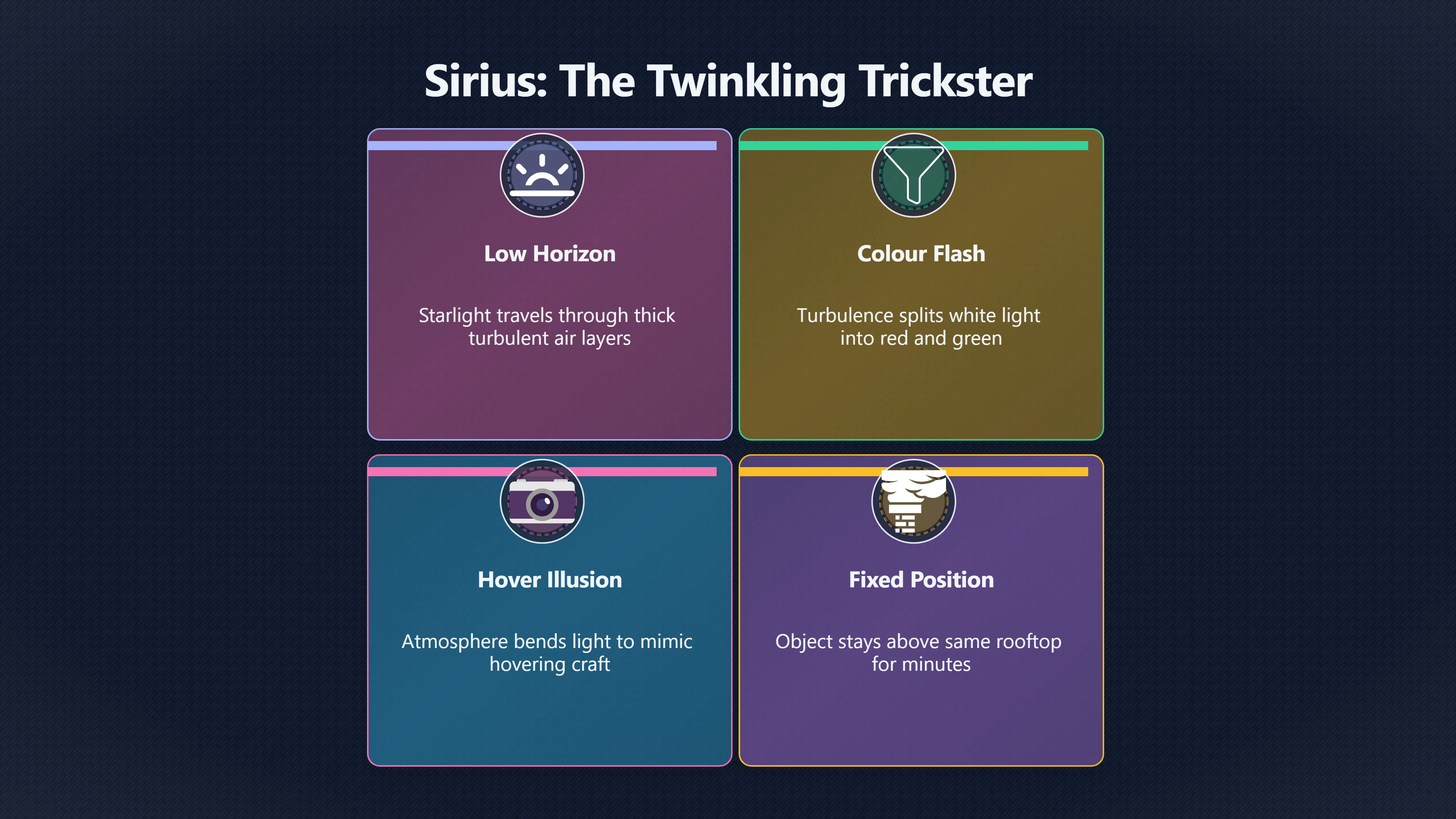
The effect becomes much stronger when a star is low in the sky because its light must travel through far more atmosphere. Near the horizon, turbulence, haze, pollution, humidity and heat gradients can make a bright star appear unusually unstable. Under poor seeing conditions, a white star may flash red, green and blue in rapid succession.[Atmospheric Phenomena]atoptics.wordpress.comsirius scintillationscintillation | Atmospheric Phenomena31 Oct 2011 — The lower a star is in the sky, the more pronounced is this effect, especially at very…
This matters in UFO investigations because witnesses often interpret these colour changes as evidence of powered flight, structured lighting, or “signalling” behaviour. Reports sometimes describe:
- “A craft flashing different colours”[stargazerslounge.com]stargazerslounge.comWhy does Sirius sparkle with different colours?Observing23 Jan 2010 — Sirius twinkles because it is so low down to the horizon as seen from the UK. The light from it has to travel thro…
- “A hovering orb changing from red to blue”
- “A stationary object sending Morse-code-like pulses”
- “A light that sparkled like a diamond”
Those descriptions can match strong scintillation remarkably well.[Space]space.comThe brightest star in the night sky shows off this springApr 25, 2025 — In the case of bright stars, particularly close to the horiz…[Universe Today]universetoday.comsirius ufo trickster extraordinaireUniverse TodaySirius, UFO trickster extraordinaire23 Mar 2014 — When Sirius is low above the horizon, refraction (bending of light) is st…
The brightest stars produce the strongest visual impression because they remain visible even while atmospheric distortion breaks their light into separate colours. Sirius is particularly notorious in UFO reports because it is the brightest true star in the night sky and often sits low from UK latitudes during winter evenings. Observers regularly report it “hovering”, “spinning”, or “flashing red and green”.[Universe Today]universetoday.comsirius ufo trickster extraordinaireUniverse TodaySirius, UFO trickster extraordinaire23 Mar 2014 — When Sirius is low above the horizon, refraction (bending of light) is st…[Universe]universetoday.comsirius ufo trickster extraordinaireUniverse TodaySirius, UFO trickster extraordinaire23 Mar 2014 — When Sirius is low above the horizon, refraction (bending of light) is st…
Some stars become repeat offenders in local sighting databases simply because they occupy noticeable seasonal positions. During autumn and winter evenings in Britain, Capella can appear low enough in the north-east to flash vivid colours.[EarthSky]earthsky.orgwhat star in the northeast flashes red and greenWhat star in the northeast flashes colorfully? It's Capella!10 Oct 2025 — The bright star Capella in the constellation Auriga the…
Why a fixed star can seem to move
A major source of confusion in UFO reports is that a fixed astronomical object can appear mobile even when it is not changing position in the sky.
Human vision is poor at judging motion in darkness without stable reference points. If the witness is standing in an open field, driving, looking through trees, or observing through broken cloud, the brain can misinterpret tiny eye movements or changing cloud gaps as object movement. This is especially true for isolated lights with no visible structure around them.
Several common mechanisms create the illusion of motion:
- Handheld camera shake: Zoomed smartphone footage magnifies tiny hand movements. A stationary star can appear to zig-zag, hover, rotate or accelerate in video.
- Autofocus hunting: Phone cameras repeatedly adjust focus and exposure on bright point sources, producing expanding shapes, flickering halos and apparent pulsing.
- Cloud drift: Thin cloud moving across a bright star can create the impression that the object itself is manoeuvring or changing shape.
- Autokinesis: In darkness, humans often perceive stationary lights as drifting slightly when staring at them for extended periods.
- Atmospheric shimmer: Turbulent air can make a star appear to jump or jitter microscopically.[Wikipedia]WikipediaCapella - WikipediaThis evening, check out one of the flashiest stars in the sky. It's…
These effects become more convincing when the observer expects movement or interprets the object as nearby rather than astronomical. Once the brain assigns a distance estimate to the light, tiny angular changes can feel like rapid motion.
In UFO case analysis, this is why investigators ask whether the object moved relative to fixed foreground features rather than relative to clouds alone. A star explanation becomes much weaker if the light clearly crosses the sky against buildings, hills or treelines over a short period.
Using fixed foreground references to test motion
One of the most useful practical checks in an AI-assisted UFO investigation is comparing the reported object against fixed landmarks.
A bright star will appear to remain in the same general position relative to rooftops, poles, chimneys or trees over short periods, aside from Earth’s slow rotation. Aircraft, drones and satellites move noticeably faster against those same references.
Useful witness questions include:
- Did the object stay above the same rooftop or hill?
- Was it still there 10 or 20 minutes later?
- Did it track steadily across the sky or remain roughly fixed?
- Did binoculars reveal a point-like source rather than a structured craft?
- Did the movement disappear when the observer stabilised the camera?
AI-assisted workflows can strengthen this check by combining witness direction estimates with astronomy software or planetarium databases. If a report says “flashing red and blue object low in the south-east at 9:30 pm for 40 minutes”, the system can test whether a bright star occupied that exact bearing and elevation at that time.
A strong astronomical match usually contains several reinforcing elements together:
- The object remained visible for a long duration.
- It stayed nearly stationary.
- It showed intense colour flashing.
- It was low above the horizon.
- Multiple witnesses from different locations saw it in the same direction.
- Phone footage shows a defocused point source rather than structured detail.
By contrast, a star explanation weakens when there is verified rapid travel across the sky, abrupt directional changes against fixed references, radar correlation, or synchronized movement observed from widely separated locations.

Common bright stars in night UFO reports
Certain stars repeatedly appear in UFO databases because of their brightness, seasonal visibility and position in the sky.
Sirius
Sirius is probably the single most common star involved in “flashing UFO” reports. From the UK it often sits low in the southern sky during winter, where atmospheric distortion is strongest. Witnesses frequently describe it as:
- Flashing multiple colours
- Hovering over houses or fields
- Pulsing rhythmically
- Appearing unusually large
- Moving slightly side to side
Astronomy writers and amateur observers have repeatedly noted how easily Sirius can resemble an artificial object under turbulent conditions. Universe Today[Space]space.comThe brightest star in the night sky shows off this springApr 25, 2025 — In the case of bright stars, particularly close to the horiz…
Capella
Capella is another common source of reports, especially during autumn and winter evenings. Because it can sit relatively low in the north-east during certain hours, it may flash red and green dramatically.[EarthSky]earthsky.orgwhat star in the northeast flashes red and greenWhat star in the northeast flashes colorfully? It's Capella!10 Oct 2025 — The bright star Capella in the constellation Auriga the…
Vega and Arcturus
Vega and Arcturus are also prominent enough to attract attention when atmospheric conditions are unstable. Their brightness makes them stand out strongly against urban skies where few other stars remain visible.
Why planets are slightly different
Planets can also be mistaken for UFOs, especially Venus, but they usually twinkle less dramatically than stars because they appear as tiny discs rather than perfect point sources. Their broader apparent size averages out some atmospheric distortion.[Wikipedia]WikipediaOpen source on wikipedia.org.[EarthSky]earthsky.orgwhy dont planets twinkle as stars doWhy do stars twinkle, but planets do not?4 Jun 2025 — Stars twinkle because they're so far away from Earth that, even through large teles…
That distinction can help investigators. A violently flashing multicoloured object low on the horizon is often more consistent with a bright star than with a planet.
How AI systems can flag likely star misidentifications
Modern UFO investigation workflows increasingly automate astronomy screening before treating a case as anomalous.
A useful AI-assisted process typically combines:
- Witness time and date
- GPS location
- Reported compass direction
- Estimated elevation angle
- Duration
- Weather and cloud data
- Known bright-object sky maps
The system can then compare the report against historical star positions and brightness. If the sighting aligns closely with a bright star known for heavy scintillation, the case can be tagged as a plausible astronomical explanation rather than immediately escalated as unexplained.
Confidence scoring becomes important here. A system should not simply declare “it was a star”. Instead it should separate:
- Confirmed match
- Strong candidate explanation
- Plausible but incomplete match
- Weak match
- Unresolved case
That distinction matters because witness estimates can be inaccurate, and some sightings contain mixed features. A star may explain the flashing colours but not an independently verified moving object recorded elsewhere in the same timeframe.
When a twinkling-star explanation does not fit well
Bright stars explain many reports, but not all reports involving lights at night.
The explanation becomes less convincing when evidence shows:
- Sustained travel across large sections of sky
- Clear manoeuvres against fixed foreground references
- Simultaneous radar tracking
- Multiple independently moving objects
- Short-duration high-speed motion
- Nearby sound, structure or low-altitude detail
- Correlated aircraft or satellite exclusions
A balanced investigation keeps the star explanation available without forcing every night-time light into that category. The purpose of astronomy screening is not to dismiss witnesses but to rapidly test whether ordinary celestial objects match the observation better than more exotic interpretations.
In many real-world cases, the answer is not that the witness “imagined” something. It is that the atmosphere transformed an ordinary bright star into something visually dramatic enough to resemble a hovering, colour-changing craft.
Amazon book picks
Further Reading
Books and field guides related to Why bright stars seem to flash and move. Use these as the next step if you want deeper reading beyond the article.
NightWatch: A Practical Guide to Viewing the Universe
Explains how to identify bright stars and understand observing conditions.
Turn Left at Orion
Helps readers recognise stars and fixed sky objects rather than mistaking them for UFOs.
The Backyard Astronomer's Guide
Covers real-world observing effects and sky identification.
The Cloudspotter's Guide
Adds context for atmospheric effects that alter star appearance.
eBay marketplace picks
Marketplace Samples
Example marketplace items related to this page. Use the search link to explore similar finds on eBay.


![Listing image for Magnetic Reward Chart [300 Stars 80 Tasks 1-3 Kids] Star Chart for Children For](https://i.ebayimg.com/images/g/ScsAAeSwHQBp-Q2T/s-l225.jpg)
Endnotes
1.
Source: Wikipedia
Link:https://en.wikipedia.org/wiki/Twinkling
2.
Source: earthsky.org
Title: what star in the northeast flashes red and green
Link:https://earthsky.org/tonight/what-star-in-the-northeast-flashes-red-and-green/
Source snippet
What star in the northeast flashes colorfully? It's Capella!10 Oct 2025 — The bright star Capella in the constellation Auriga the...
3.
Source: space.com
Link:https://www.space.com/stargazing/the-brightest-star-in-the-night-sky-shows-off-this-spring-how-to-see-a-scintillating-sirius
Source snippet
The brightest star in the night sky shows off this springApr 25, 2025 — In the case of bright stars, particularly close to the horiz...
4.
Source: Wikipedia
Link:https://en.wikipedia.org/wiki/Capella
Source snippet
Capella - WikipediaThis evening, check out one of the flashiest stars in the sky. It's...
5.
Source: astronomy.com
Title: simply scintillating
Link:https://www.astronomy.com/science/simply-scintillating/
Source snippet
Astronomy MagazineSimply Scintillating | Astronomy.com24 Oct 2011 — Twinkling, the common term for stellar “scintillation,” refers to tin...
6.
Source: earthsky.org
Title: why dont planets twinkle as stars do
Link:https://earthsky.org/space/why-dont-planets-twinkle-as-stars-do/
Source snippet
Why do stars twinkle, but planets do not?4 Jun 2025 — Stars twinkle because they're so far away from Earth that, even through large teles...
7.
Source: universetoday.com
Title: sirius ufo trickster extraordinaire
Link:https://www.universetoday.com/articles/sirius-ufo-trickster-extraordinaire
Source snippet
Universe TodaySirius, UFO trickster extraordinaire23 Mar 2014 — When Sirius is low above the horizon, refraction (bending of light) is st...
8.
Source: skyandtelescope.org
Title: Sky & Telescope Why Stars Twinkle
Link:https://skyandtelescope.org/astronomy-resources/why-do-stars-twinkle/
Source snippet
Sky & TelescopeWhy Stars Twinkle - Stellar ScintillationAs light travels through the blanket of air around our planet, it is diffracted (...
9.
Source: atoptics.wordpress.com
Title: sirius scintillation
Link:https://atoptics.wordpress.com/2011/10/31/sirius-scintillation/
Source snippet
scintillation | Atmospheric Phenomena31 Oct 2011 — The lower a star is in the sky, the more pronounced is this effect, especially at very...
10.
Source: universetoday.com
Title: why does sirius twinkle
Link:https://www.universetoday.com/articles/why-does-sirius-twinkle
Source snippet
Universe TodayWhy Does Sirius Twinkle?16 Jan 2012 — Sirius appears to twinkle or shimmer more than other stars for some very simple reaso...
Additional References
11.
Source: reddit.com
Link:https://www.reddit.com/r/explainlikeimfive/comments/ax3gkx/eli5_why_the_star_sirius_appears_to_change_colors/
Source snippet
ELI5 why the star Sirius appears to change colors so...If Sirius is close to the horizon, the Raleigh effect of the atmosphere will scat...
12.
Source: pubs.aip.org
Title: Publishing Demonstrations of atmospheric scintillation: Stars vs
Link:https://pubs.aip.org/aapt/pte/article/63/2/134/3332305/Demonstrations-of-atmospheric-scintillation-Stars
Source snippet
planets1 Feb 2025 — When starlight enters our atmosphere, it encounters turbulent air of varying refractive index. The refractive index o...
13.
Source: astronomy.stackexchange.com
Title: what is this rapidly twinkling red blue and white star i saw
Link:https://astronomy.stackexchange.com/questions/23320/what-is-this-rapidly-twinkling-red-blue-and-white-star-i-saw
Source snippet
The phenomenon is called "seeing" by astronomers, and it's basically air turbulence. · Possible but Capella is higher in the sky, and the...
14.
Source: news.wisc.edu
Title: curiosities why do stars appear to twinkle in the night sky
Link:https://news.wisc.edu/curiosities-why-do-stars-appear-to-twinkle-in-the-night-sky/
Source snippet
wisc.eduCuriosities: Why do stars appear to twinkle in the night sky?1 Nov 2010 — Stars twinkle because we view them through our atmosphe...
15.
Source: reddit.com
Link:https://www.reddit.com/r/askastronomy/comments/kivv8n/why_do_some_stars_look_like_theyre_flickering_red/
Source snippet
This is why the Sun looks like it's a different color at sunset than it does...Read more...
16.
Source: stargazerslounge.com
Title: Why does Sirius sparkle with different colours?
Link:https://stargazerslounge.com/topic/57590-why-does-sirius-sparkle-with-different-colours/
Source snippet
Observing23 Jan 2010 — Sirius twinkles because it is so low down to the horizon as seen from the UK. The light from it has to travel thro...
17.
Source: facebook.com
Link:https://www.facebook.com/ScienceEvidenceIntelligence/posts/sirius-the-rainbow-star-although-white-to-blue-white-in-color-sirius-might-be-ca/1459686762825595/
Source snippet
e horizon where starlight must pass through many turbulent...Read more...
18.
Source: physicsforums.com
Title: why does sirius a blink in many colors.902706
Link:https://www.physicsforums.com/threads/why-does-sirius-a-blink-in-many-colors.902706/
Source snippet
Why does Sirius A blink in many colors?5 Feb 2017 — Basically this happens due to atmospheric refraction and to every stars but Sirius is...
19.
Source: primitiveproton.com
Link:https://primitiveproton.com/atmospheric-scintillation-why-stars-twinkle-and-planets-dont/
Source snippet
ion. An electromagnetic wave gets deviated from its normal path...
20.
Source: facebook.com
Link:https://www.facebook.com/groups/outinoregon/posts/26338788459037924/
Source snippet
by the Earth's atmosphere. Why It Changes Colors...Read more...
Topic Tree