Within Calibration
When AI Confidence Scores Stop Matching Reality
AI systems can sound highly certain about UFO explanations even when their probability estimates have never been tested properly.
On this page
- What calibration means in probabilistic systems
- Why UFO datasets lack stable ground truth
- How overconfidence appears in ambiguous sightings
Page outline Jump by section
Introduction
An AI system that labels a UFO sighting as “94% likely to be a drone” can appear authoritative even when the underlying estimate has never been properly tested against reality. In AI-assisted UFO investigation, calibration failures matter because readers often interpret percentages as hard scientific probabilities rather than provisional judgements built on incomplete evidence. A system may sound precise while consistently overstating its own reliability.
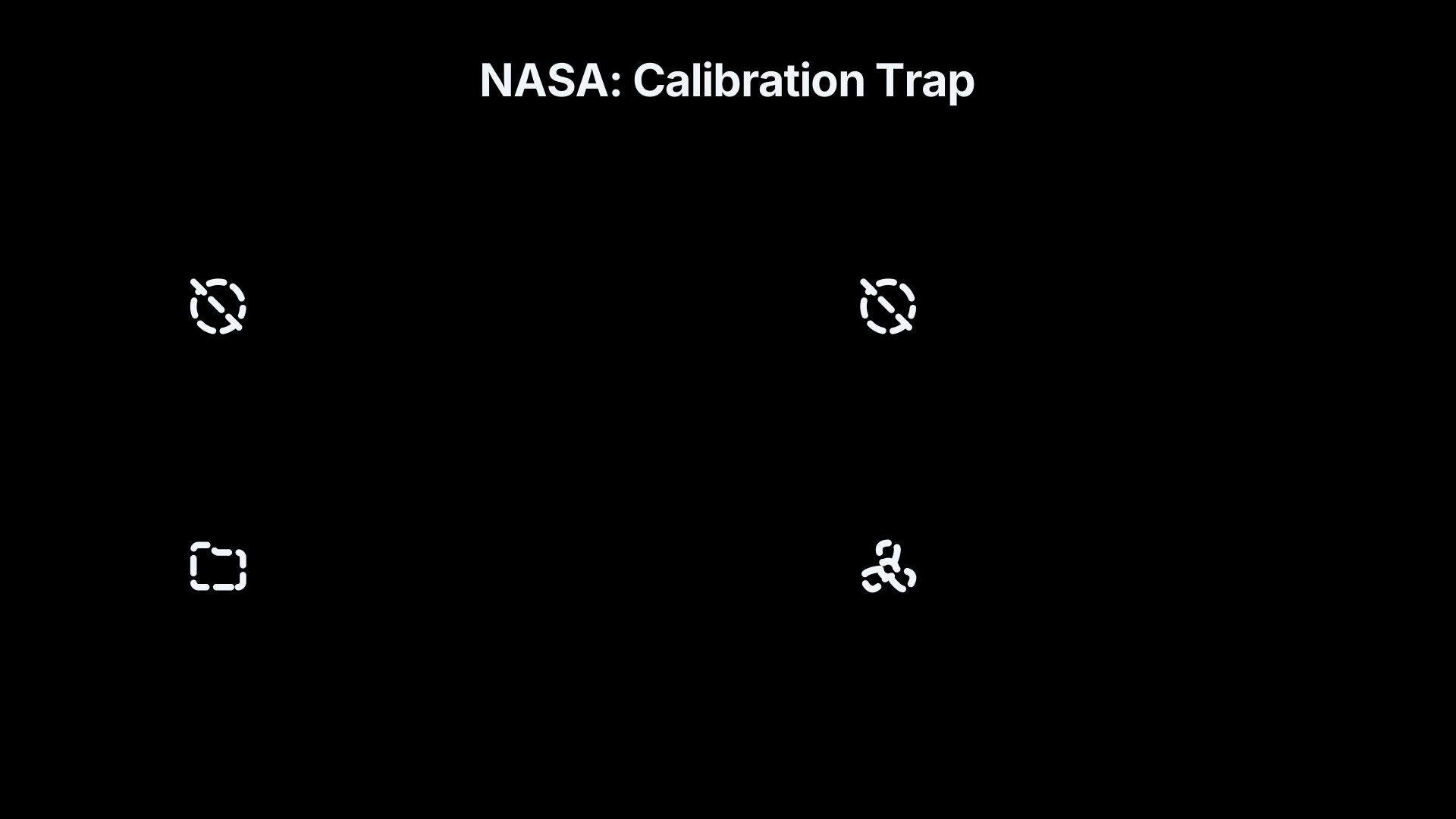 This problem becomes especially serious in UFO and UAP case work because the field lacks stable ground truth. Many sightings are never conclusively solved. Witness reports are uneven, sensor data is often incomplete, and older archives contain disputed classifications. Under those conditions, a machine-learning system can become confidently wrong without investigators noticing. NASA’s UAP study repeatedly stressed that AI analysis is constrained less by algorithms than by poor-quality data, fragmented reporting systems, weak metadata, and inconsistent sensor calibration.[NASA Science]science.nasa.govScience Independent Study Team ReportNASA ScienceIndependent Study Team ReportSeptember 13, 2023 — However, the effectiveness of. AI and ML in studying UAP depends critically…[NASA]science.nasa.govScience Independent Study Team ReportNASA ScienceIndependent Study Team ReportSeptember 13, 2023 — However, the effectiveness of. AI and ML in studying UAP depends critically…
The result is a dangerous mismatch between how confident an AI system sounds and how trustworthy its confidence scores actually are.
What calibration means in probabilistic systems
In probabilistic AI systems, calibration refers to whether confidence scores match real-world outcomes over time. A calibrated model does not merely produce high-confidence answers. It produces confidence levels that consistently correspond to observed accuracy.
For example:
- If a system gives 70% confidence to 100 similar sightings
- Roughly 70 of those assessments should later prove correct
That is what calibration means in practice. Researchers commonly test this using reliability diagrams and calibration metrics that compare predicted probabilities against observed outcomes.[arXiv]arxiv.orgarXiv Evaluating model calibration in classificationEvaluating model calibration in classificationFebruary 19, 2019…
A poorly calibrated UFO-analysis model behaves differently. It may assign extremely high confidence scores even when its real success rate is much lower. An AI classifier might repeatedly label ambiguous night lights as “95% aircraft” while only being correct 60% of the time when those cases are independently checked later.
This distinction is easy to miss because humans instinctively trust numerical precision. A sentence like “likely balloon” sounds cautious and subjective. “91% balloon probability” sounds scientific, measurable, and objective, even when the percentage itself has weak statistical foundations.
Modern neural networks are known to suffer from overconfidence problems even in controlled benchmark environments with clean labelled data. Research on neural-network calibration has shown that highly accurate models can still produce unreliable probability estimates.[arXiv]arxiv.orgarXiv Evaluating model calibration in classificationEvaluating model calibration in classificationFebruary 19, 2019… UFO investigation adds far messier conditions than those benchmark environments.
Why UFO datasets lack stable ground truth
Calibration only works when predictions can eventually be compared against reliable outcomes. Weather forecasting can compare predictions against measured rainfall. Medical diagnosis systems can compare predictions against confirmed diagnoses. UFO investigation rarely has that luxury.
Most civilian UFO reports contain major uncertainty gaps:
- Missing timestamps
- Unverified witness accounts
- No range measurements
- No radar confirmation
- Incomplete video metadata
- Unknown camera settings
- No atmospheric instrumentation
- Edited or compressed footage
NASA’s UAP study highlighted that current reporting systems are “inhomogeneously collected, processed, and curated”, making systematic analysis difficult.[NASA Science]science.nasa.govScience Independent Study Team ReportNASA ScienceIndependent Study Team ReportSeptember 13, 2023 — However, the effectiveness of. AI and ML in studying UAP depends critically…
This creates a calibration trap. AI systems require labelled examples to learn meaningful confidence estimates, but many UFO cases have uncertain labels themselves. A historical database may classify a sighting as “probable aircraft” simply because investigators lacked enough evidence to rule anything else out. Another archive may mark a similar case as “unknown”. A machine-learning model trained on those inconsistent categories can absorb hidden human uncertainty while still outputting sharp numerical probabilities.
The problem becomes worse when unresolved cases are quietly forced into ordinary categories to simplify databases. A model trained on heavily normalised archives may learn that ambiguity itself should be treated as evidence for mundane explanations. That can create an illusion of strong performance while masking systematic overconfidence.
NASA’s report specifically warned that meaningful anomaly detection requires a well-calibrated understanding of “normal” observations first.[NASA Science]science.nasa.govScience Independent Study Team ReportNASA ScienceIndependent Study Team ReportSeptember 13, 2023 — However, the effectiveness of. AI and ML in studying UAP depends critically… Without reliable baseline data about aircraft behaviour, balloons, sensor artefacts, atmospheric optics, satellites, and common observational errors, probability estimates become unstable.
How overconfidence appears in ambiguous sightings
Calibration failures become most visible in borderline sightings where evidence is incomplete but emotionally compelling.
Single-witness night sightings
Imagine a report involving:
- One witness
- A shaky mobile-phone video
- Bright lights near the horizon
- No confirmed direction of travel
- Uncertain timestamp
- No corroborating radar or ADS-B aviation data
A poorly calibrated AI system may still generate outputs like:
- “96% aircraft”
- “89% satellite flare”
- “93% lens artefact”
Those percentages may reflect internal mathematical confidence inside the model rather than real-world reliability. The AI may simply recognise visual similarities with previous labelled cases, even though the available evidence is too weak for genuine certainty.
The danger is psychological as much as technical. Readers often stop questioning high-confidence outputs. Once a report displays a precise percentage, uncertainty becomes socially invisible.
Out-of-distribution events
Calibration also breaks down when AI systems encounter unusual situations absent from training data. In machine learning, this is known as an out-of-distribution problem.
Examples in UFO investigation include:
- Rare atmospheric optical effects
- Military sensor artefacts
- Experimental drones
- Rocket re-entry fragments
- Infrared glare events
- Camera sensor blooming
- Multiple overlapping explanations occurring simultaneously
A model trained mostly on ordinary aircraft sightings may still output high confidence scores during unfamiliar events because neural networks frequently remain overconfident outside their training distribution.[arXiv]arxiv.orgarXiv Evaluating model calibration in classificationEvaluating model calibration in classificationFebruary 19, 2019…
This is one reason NASA emphasised that collecting better-quality baseline data matters more than inventing new AI techniques.[NASA Science]science.nasa.govScience Independent Study Team ReportNASA ScienceIndependent Study Team ReportSeptember 13, 2023 — However, the effectiveness of. AI and ML in studying UAP depends critically…
Confidence inflation from class imbalance
Most UFO reports eventually receive mundane explanations. That creates heavily imbalanced datasets dominated by aircraft, balloons, stars, satellites, and hoaxes.
An AI system trained on such data may learn that assigning ordinary explanations with extreme confidence usually improves apparent accuracy statistics. Over time, the model becomes biased towards aggressive certainty because statistically cautious answers may appear “less efficient” during optimisation.
In practical UFO case analysis, this can distort triage workflows:
- Weak evidence gets labelled too confidently
- Human investigators trust the AI prematurely
- Alternative explanations receive less scrutiny
- Ambiguous cases become artificially “resolved”
The result is not necessarily fraud or deliberate bias. It is often a statistical side effect of how optimisation systems behave under uncertainty.
Why calibration failures are hard to detect in UFO work
A badly calibrated system can still appear impressive.
Suppose an AI model correctly identifies many obvious aircraft sightings. Investigators may conclude that its confidence estimates are trustworthy overall. But calibration quality is usually hardest to evaluate precisely where it matters most: unusual, sparse, ambiguous edge cases.
This creates a misleading feedback loop:
- The AI succeeds on routine sightings
- Investigators gain confidence in the model
- High confidence scores appear credible
- Ambiguous cases inherit that credibility
- Overconfidence goes unchallenged
Reliability testing becomes difficult because many UFO cases never receive definitive resolution. An unresolved case cannot easily be used to verify whether “93% aircraft probability” was reasonable or wildly inflated.
Research into probabilistic forecasting has long shown that systems can appear statistically sophisticated while still exhibiting systematic overconfidence.[arXiv]arxiv.orgarXiv Evaluating model calibration in classificationEvaluating model calibration in classificationFebruary 19, 2019… UFO analysis inherits those problems while also suffering from fragmented reporting standards and uncertain labels.
This is one reason careful investigative language often communicates uncertainty more honestly than exact percentages. A phrase such as “consistent with known drone behaviour but lacking decisive confirmation” may be scientifically stronger than a fabricated-looking “92% drone confidence” unsupported by long-term calibration evidence.
The difference between calibrated language and false precision
In practical UFO case reporting, calibration-aware language usually avoids pretending that uncertainty has disappeared.
Well-calibrated investigative phrasing tends to:
- Separate observed facts from interpretations
- Describe confidence qualitatively when data is sparse
- Explain which evidence is missing
- Acknowledge unresolved contradictions
- Distinguish plausible from confirmed explanations
- Reserve numerical probabilities for genuinely validated models
Poorly calibrated reporting does the opposite. It compresses uncertainty into clean-looking percentages that imply a stronger empirical basis than actually exists.
For example:
Weakly calibrated phrasingBetter calibrated phrasing“97% likely to be a satellite”“The timing and trajectory are broadly consistent with satellite activity, but the available data is incomplete.”“91% drone probability”“A drone remains plausible, although no corroborating drone records were located.”“99% atmospheric phenomenon”“Some visual features resemble atmospheric optics, but the evidence is insufficient for confirmation.”
The second style may sound less dramatic, but it more accurately reflects the real evidential limits common in UFO investigations.
Why better calibration starts with better evidence
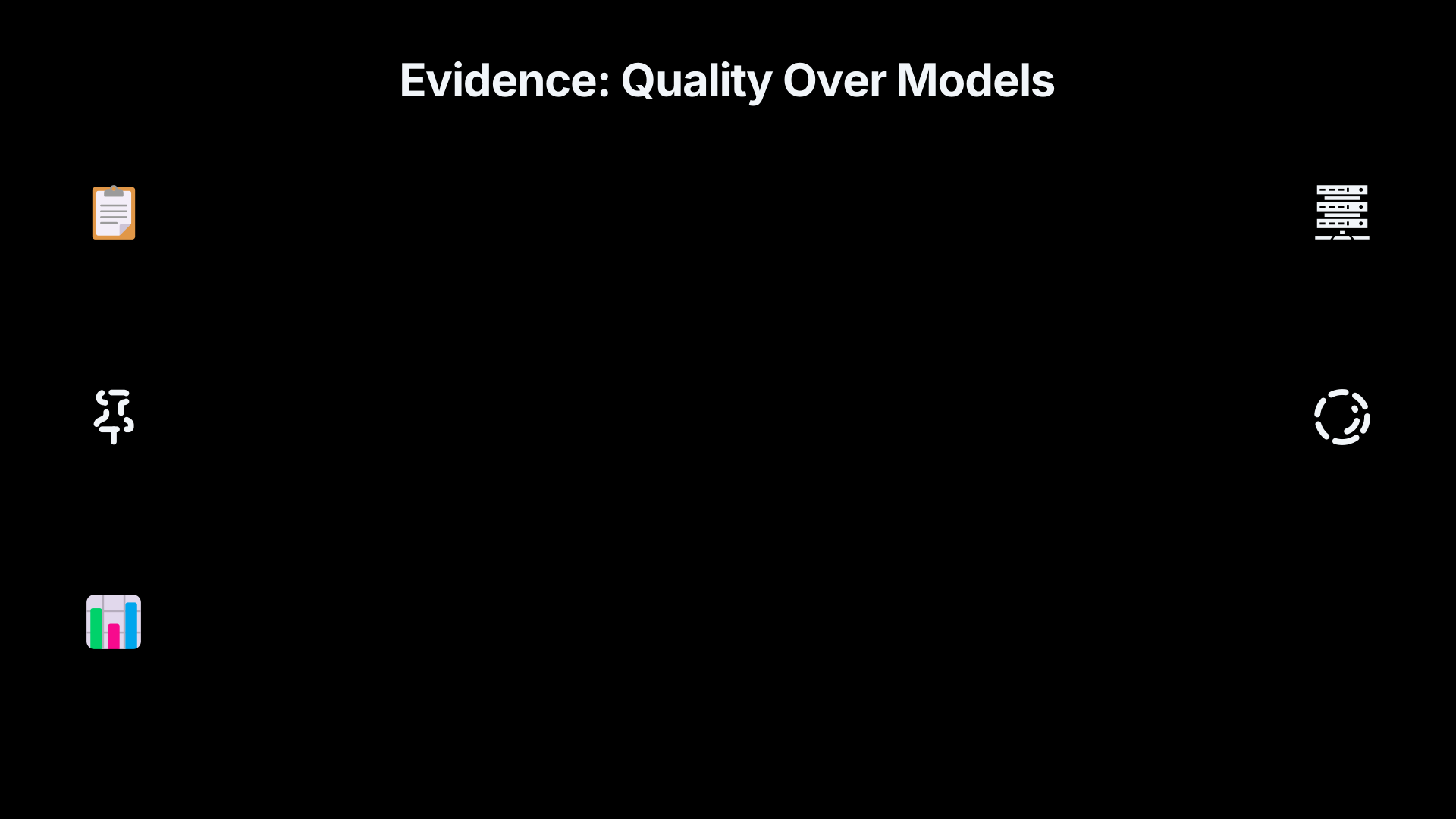
The central lesson from current AI-assisted UFO research is that confidence quality depends on evidence quality. NASA’s UAP study repeatedly argued that systematic sensor calibration, richer metadata, multiple independent measurements, and standardised reporting matter more than increasingly sophisticated AI models alone.[NASA Science]science.nasa.govScience Independent Study Team ReportNASA ScienceIndependent Study Team ReportSeptember 13, 2023 — However, the effectiveness of. AI and ML in studying UAP depends critically…[NASA]nasa.govupdate nasa shares uap independent study report names directorUPDATE: NASA Shares UAP Independent Study Report14 Sept 2023 — We found that NASA can help the whole-of-government UAP effort through sys…
A genuinely calibrated UFO-analysis pipeline would require:
- Consistent intake schemas
- Standardised timestamps
- Reliable geolocation
- Sensor metadata preservation
- Verified outcome labels
- Long-term validation studies
- Cross-checking against aviation, satellite, and weather databases
- Explicit uncertainty handling
Without those foundations, percentage-based AI confidence claims risk becoming a form of numerical theatre: technically formatted, emotionally persuasive, but weakly connected to measurable reality.
That does not make AI useless in UFO investigation. AI can still help cluster similar sightings, identify mundane explanations quickly, detect anomalies within large datasets, and surface patterns human investigators may miss. But calibration failures are a reminder that an AI system sounding certain is not the same thing as an AI system being trustworthy.
Amazon book picks
Further Reading
Books and field guides related to When AI Confidence Scores Stop Matching Reality. Use these as the next step if you want deeper reading beyond the article.
The Signal and the Noise
Directly addresses when confidence scores fail to match reality.
Thinking, Fast and Slow
Explains overconfidence and misleading certainty in ambiguous cases.
eBay marketplace picks
Marketplace Samples
Example marketplace items related to this page. Use the search link to explore similar finds on eBay.



Endnotes
1.
Source: science.nasa.gov
Title: Science Independent Study Team Report
Link:https://science.nasa.gov/wp-content/uploads/2023/09/uap-independent-study-team-final-report.pdf
Source snippet
NASA ScienceIndependent Study Team ReportSeptember 13, 2023 — However, the effectiveness of. AI and ML in studying UAP depends critically...
Published: September 13, 2023
2.
Source: nasa.gov
Title: update nasa shares uap independent study report names director
Link:https://www.nasa.gov/news-release/update-nasa-shares-uap-independent-study-report-names-director/
Source snippet
UPDATE: NASA Shares UAP Independent Study Report14 Sept 2023 — We found that NASA can help the whole-of-government UAP effort through sys...
3.
Source: arxiv.org
Title: arXiv Evaluating model calibration in classification
Link:https://arxiv.org/abs/1902.06977
Source snippet
Evaluating model calibration in classificationFebruary 19, 2019...
Published: February 19, 2019
4.
Source: arxiv.org
Title: arXiv Metrics of calibration for probabilistic predictions
Link:https://arxiv.org/abs/2205.09680
5.
Source: arxiv.org
Title: arXiv On Calibration of Modern Neural Networks
Link:https://arxiv.org/abs/1706.04599
6.
Source: arxiv.org
Title: arXiv Statistical Perspectives on Reliability of Artificial Intelligence Systems
Link:https://arxiv.org/abs/2111.05391
Source snippet
Statistical Perspectives on Reliability of Artificial Intelligence SystemsNovember 9, 2021...
Published: November 9, 2021
7.
Source: science.nasa.gov
Link:https://science.nasa.gov/uap/
Source snippet
nasa.govUAP9 Jun 2022 — A study team to examine unidentified anomalous phenomena (UAPs) – that is, observations of events in the sky that...
8.
Source: youtube.com
Title: When calibration beats metrics
Link:https://www.youtube.com/watch?v=oOZr4kRJgFE
Source snippet
Model Calibration | Machine Learning...
9.
Source: youtube.com
Title: Model Calibration | Machine Learning
Link:https://www.youtube.com/watch?v=hWb-MIXKe-s
Source snippet
Model Calibration - Estimated Calibration Error (ECE) Explained...
10.
Source: youtube.com
Title: Model Calibration
Link:https://www.youtube.com/watch?v=NDY2fH1FitQ
Source snippet
in 60s: When “0.80” Actually Means 80% (Reliability Diagram)...
Additional References
11.
Source: avi-loeb.medium.com
Link:https://avi-loeb.medium.com/high-quality-data-is-worth-a-thousand-llms-in-resolving-ambiguities-about-ufos-dab9bc74c7c0
Source snippet
medium.comHigh-Quality Data is Worth a Thousand LLMs in Resolving...I Used an LLM to Analyze 140,000 UFO Reports. The Aliens Are Real… L...
12.
Source: aerospaceamerica.aiaa.org
Link:https://aerospaceamerica.aiaa.org/nasa-study-team-suggests-applying-artificial-intelligence-to-trove-of-mystery-sightings/
Source snippet
study team suggests applying artificial intelligence to...2 Jun 2023 — UAP is short for unidentified anomalous phenomena, a less-freight...
13.
Source: youtube.com
Title: Model Calibration in 60s: When “0.80” Actually Means 80% (Reliability Diagram)
Link:https://www.youtube.com/watch?v=hRWtovlUwfw
Source snippet
AI model calibration explained reliability diagrams Probability Calibration: Data Science Concepts ritvikmath...
14.
Source: popsci.com
Title: physicist ufo study
Link:https://www.popsci.com/technology/physicist-ufo-study/
Source snippet
Physicists use AI to hunt for UAPs and UFOs6 Jun 2025 — Physicists use AI to hunt for UAPs and UFOs. Their new... “Given the longstandin...
15.
Source: aimagazine.com
Title: nasa aims to use ai and ml for new uap ufo research
Link:https://aimagazine.com/data-and-analytics/nasa-aims-to-use-ai-and-ml-for-new-uap-ufo-research
Source snippet
NASA has said that it will begin using AI and citizen reporting to study UFOs with the...
16.
Source: nextgov.com
Title: nasa report finds no evidence ufos are extraterrestrial
Link:https://www.nextgov.com/ideas/2023/09/nasa-report-finds-no-evidence-ufos-are-extraterrestrial/390350/
Source snippet
From sensationalism to science. During a press briefing...
17.
Source: journalofscientificexploration.org
Link:https://journalofscientificexploration.org/index.php/jse/issue/view/115/53
Source snippet
Journal of Scientific Exploration26 Mar 2026 — study of UFO/UAP experiencers and near-death experi- encers (NDEers)... reliable calibrat...
18.
Source: popsci.com
Link:https://www.popsci.com/technology/nasa-uap-report-findings/
Source snippet
Popular ScienceNASA wants to use AI to study unidentified aerial...14 Sept 2023 — Decoding the Pentagon's latest UFO report.] “We don't...
19.
Source: youtube.com
Title: Probability Calibration: Data Science Concepts
Link:https://www.youtube.com/watch?v=AunotauS5yI
Source snippet
When calibration beats metrics...
Topic Tree