Within Twinkling stars
When twinkling becomes a flashing craft
Turbulent air can split starlight into rapid colour and brightness changes that witnesses may read as signalling lights.
On this page
- What scintillation does to starlight
- Why low stars flash stronger colours
- When colour changes fit a star explanation
Page outline Jump by section
Introduction
Many “flashing UFO” reports begin with a bright light that appears to hover in one place while rapidly changing colour. Witnesses often describe red, blue, green and white pulses, sparkling edges, or a light that seems to signal intentionally. In a large number of cases, the object is not an aircraft or unknown craft at all but a bright star distorted by Earth’s atmosphere through a process called atmospheric scintillation.[Sky & Telescope]skyandtelescope.orgWhy Don't Planets Twinkle Too?Read moreSky & TelescopeWhy Stars Twinkle - Stellar ScintillationBecause the light waves come from a single point, this effect can make the star's…[EarthSky]earthsky.orgwhy dont planets twinkle as stars doWhy do stars twinkle, but planets do not?4 Jun 2025 — Stars twinkle because they're so far away from Earth that, even through lar…
 For AI-assisted UFO sighting investigation, scintillation is one of the most important ordinary explanations to test early because it matches several common report patterns at once: stationary position, flashing colours, apparent hovering, and inconsistent apparent movement. The effect becomes especially dramatic when a star sits low above the horizon, where its light must travel through thicker, more turbulent layers of air before reaching the observer.[Sky at Night Magazine]skyatnightmagazine.comwhy do stars twinkle?2 May 2025 — Stars appear to twinkle because their light passes through our atmosphere and is bent and distorted by varying temperatures…
What scintillation does to starlight
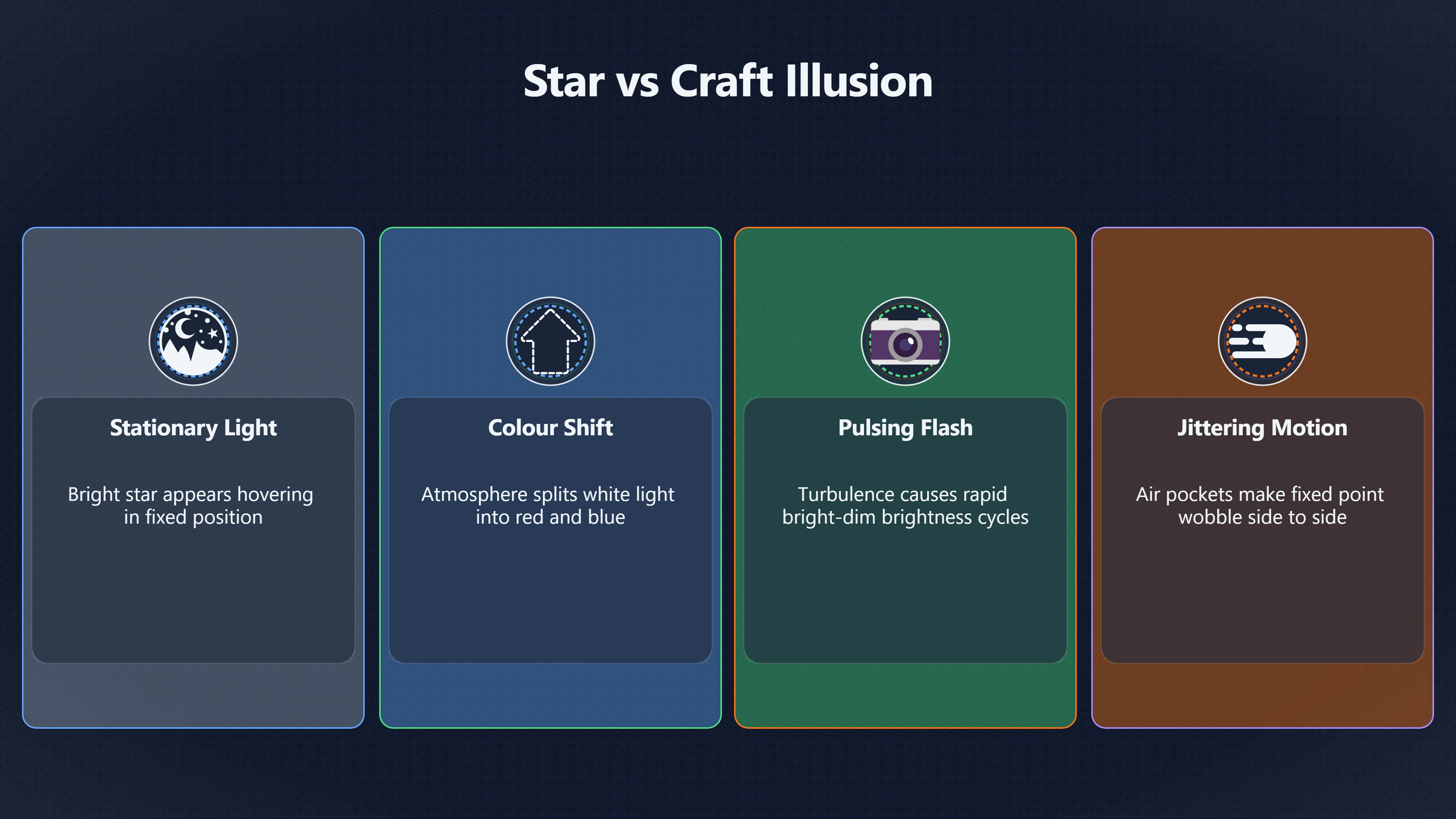
Astronomers use the term “scintillation” for the rapid variations in a star’s apparent brightness, colour and position caused by turbulence in the atmosphere. Although stars themselves shine steadily, their light arrives at Earth after passing through constantly shifting layers of air with different temperatures and densities. Those moving air pockets bend the incoming light slightly differently from moment to moment. Sky & Telescope[Encyclopedia Britannica]britannica.comEncyclopedia BritannicaWhy Do Stars Twinkle? | Stars, Astronomy, & Facts7 days ago — Stars twinkle due to turbulence in Earth's atmospher…
Because stars are so distant, they appear to the human eye as extremely small point sources. That makes them unusually vulnerable to atmospheric distortion. Even tiny changes in refraction can make a star appear to flicker, pulse, wobble or fragment into different colours.[EarthSky]earthsky.orgwhy dont planets twinkle as stars doWhy do stars twinkle, but planets do not?4 Jun 2025 — Stars twinkle because they're so far away from Earth that, even through lar…[Wikipedia]WikipediaOpen source on wikipedia.org.
In UFO reports, witnesses commonly interpret these effects as signs of active technology or controlled motion. Scintillation can produce:
- Sudden colour shifts from white to red, green or blue
- Rapid bright-dim-bright pulsing
- A sparkling or “diamond-like” appearance
- Apparent side-to-side jittering
- The illusion that the light is hovering and manoeuvring
Under dark-sky viewing conditions, especially when there are few surrounding reference points, the brain can misread those atmospheric distortions as purposeful behaviour. A witness may sincerely report a “craft flashing coloured lights” even though the object has remained astronomically fixed throughout the observation.[EarthSky]earthsky.orgwhy dont planets twinkle as stars doWhy do stars twinkle, but planets do not?4 Jun 2025 — Stars twinkle because they're so far away from Earth that, even through lar…[Astronomy Magazine]astronomy.comsimply scintillatingAstronomy MagazineSimply Scintillating | Astronomy.com18 May 2023 — Twinkling, the common term for stellar “scintillation,” refers to tin…
This becomes particularly important in event reconstruction. A structured UFO case review should compare the reported object position against the known locations of bright stars at the exact time and azimuth of the sighting. AI-assisted correlation systems can automate this step quickly using astronomy software and sky catalogues.
Why low stars flash stronger colours
The strongest scintillation usually occurs when a star sits low above the horizon. At low angles, the starlight travels through far more atmosphere than it does when overhead. The extra distance increases the amount of turbulence, moisture, pollution and thermal mixing affecting the light path.[Sky at Night Magazine]skyatnightmagazine.comwhy do stars twinkle?2 May 2025 — Stars appear to twinkle because their light passes through our atmosphere and is bent and distorted by varying temperatures…
This low-angle geometry explains why many UFO reports occur shortly after sunset or before dawn, when bright stars and planets sit near the horizon line and become visually unstable.
Colour changes become especially noticeable because Earth’s atmosphere acts partly like a weak prism. Different wavelengths of light are bent by slightly different amounts. Rapid fluctuations in air density then scatter those colours unevenly, creating split-second flashes of red, green and blue.[Universe Today]universetoday.comsirius ufo trickster extraordinaireUniverse TodaySirius, UFO trickster extraordinaireMar 23, 2014 — When Sirius is low above the horizon, refraction (bending of light) is s…[EarthSky]earthsky.orgEarth Sky Is that a UFO?!There's probably an explanation15 Dec 2020 — Of course UFOs exist. A UFO is just an unidentified object. Like many of the things listed t…
Sirius is the classic example. As the brightest true star in the night sky, it repeatedly appears in UFO databases and witness reports. Observers frequently describe it as:
- A hovering orb
- A craft with changing navigation lights
- A flashing diamond
- A stationary object emitting coloured pulses
Astronomy sources specifically note that Sirius’s brightness and strong colour flickering near the horizon regularly lead people to report it as a UFO.[EarthSky]earthsky.orgwhy dont planets twinkle as stars doWhy do stars twinkle, but planets do not?4 Jun 2025 — Stars twinkle because they're so far away from Earth that, even through lar…[Universe]universetoday.comsirius ufo trickster extraordinaireUniverse TodaySirius, UFO trickster extraordinaireMar 23, 2014 — When Sirius is low above the horizon, refraction (bending of light) is s…
From UK latitudes, Sirius often remains relatively low in winter evenings, which strengthens the effect. Other bright stars such as Capella and Arcturus can also produce vivid scintillation under unstable atmospheric conditions.
Why witnesses perceive a “craft” instead of a star
The human visual system is poorly adapted to judging isolated lights in darkness. Without nearby reference points, even a stationary object can appear active or mobile. Scintillation exploits several weaknesses in night-time perception at once.
A bright star undergoing heavy atmospheric distortion may appear to:
- Drift slightly
- Pulse rhythmically
- Rotate or spin
- Change shape
- Flash in organised sequences
Once a witness interprets the object as a structured craft, later perception often follows that assumption. Random atmospheric flickers may then be remembered as deliberate signalling patterns.
The problem becomes stronger during prolonged staring. Tiny involuntary eye movements, known as microsaccades, can make a fixed point seem mobile. Thin cloud movement can add another layer of apparent motion. Vehicle movement, wind-blown branches or handheld cameras can reinforce the illusion further.
Smartphone recording introduces additional distortions. Autofocus systems continually hunt for focus on bright point sources, while digital zoom exaggerates hand shake and exposure fluctuations. A scintillating star can therefore appear in video footage as a pulsing, rotating or morphing luminous object even though the original source remains stationary. This is one reason low-quality UFO videos often look far more dramatic than the naked-eye experience itself.
When colour changes fit a star explanation
Scintillation does not explain every aerial light report, but some patterns strongly support a bright-star interpretation.
A star explanation becomes much more plausible when the reported object:
- Remained fixed relative to rooftops, trees or hills
- Showed no consistent directional travel
- Was visible for many minutes or longer
- Flashed multiple colours rapidly
- Appeared low above the horizon
- Was observed during clear but turbulent atmospheric conditions
- Matched the position of a known bright star at that date and time
Investigators should also compare the witness description against known scintillation behaviour rather than treating “flashing lights” as evidence of aircraft by default. Aircraft lighting usually follows structured navigation patterns with directional movement. Scintillation instead tends to produce irregular, chaotic colour changes and unstable brightness.
Contradictions matter too. A star explanation weakens if the object was conclusively observed crossing large sections of sky, disappearing behind terrain independently of cloud movement, interacting with radar-confirmed traffic, or showing structured physical detail through multiple independent observations.
This distinction is important for balanced UFO analysis. A good investigation neither dismisses witnesses nor assumes extraordinary explanations too quickly. Instead, it asks whether the observed behaviour matches known atmospheric optics before moving to less common possibilities.
How AI-assisted investigations test scintillation quickly
Modern UFO case workflows can automate many of the checks that historically required experienced amateur astronomers.
An AI-assisted investigation system can:
- Reconstruct the sky for the reported time and coordinates
- Identify bright stars near the witness line of sight
- Calculate star elevation above the horizon[universetoday.com]universetoday.comsirius ufo trickster extraordinaireUniverse TodaySirius, UFO trickster extraordinaireMar 23, 2014 — When Sirius is low above the horizon, refraction (bending of light) is s…
- Flag periods of strong atmospheric instability
- Compare witness descriptions against previous scintillation-driven reports
- Score the likelihood of astronomical misidentification
This matters because scintillation reports often cluster around recurring seasonal targets. Sirius, Venus and Capella repeatedly appear in public UFO submissions because they are visually striking and easy to misinterpret under poor viewing conditions. Automated comparison against historical databases can reveal these recurring patterns rapidly.
A useful workflow is not simply “debunking”. Instead, it separates explanations into categories such as strongly matched, plausible, weakly supported, unresolved or inconsistent with available data. Scintillation becomes one evidence layer within a broader investigation framework that also checks aviation activity, satellites, weather conditions, drones and observational reliability.
Why scintillation remains a persistent UFO trigger
Scintillation continues to generate UFO reports because the effect is genuinely dramatic. To an observer unfamiliar with astronomy, a bright low star can look astonishingly unnatural. It can shimmer violently, flash saturated colours, appear to hover silently for long periods and seem to dart unpredictably.
The effect also exploits expectation. Once someone frames the light as a possible craft, later perception and memory can exaggerate apparent motion and structure. Social media clips then amplify the impression, especially when digital zoom and camera autofocus distort the image further.
That combination of atmospheric physics, human perception and modern imaging technology makes scintillation one of the most persistent ordinary explanations in UFO investigation. Understanding it does not trivialise witness experiences. Instead, it explains why sincere observers can report extraordinary-looking aerial behaviour even when the original source is a stationary star distorted by turbulent air.
eBay marketplace picks
Marketplace Samples
Topic-anchored marketplace searches for visual, collectible, or second-hand items related to this page.


Endnotes
1.
Source: earthsky.org
Title: why dont planets twinkle as stars do
Link:https://earthsky.org/space/why-dont-planets-twinkle-as-stars-do/
Source snippet
Why do stars twinkle, but planets do not?4 Jun 2025 — Stars twinkle because they're so far away from Earth that, even through lar...
2.
Source: astronomy.com
Title: simply scintillating
Link:https://www.astronomy.com/science/simply-scintillating/
Source snippet
Astronomy MagazineSimply Scintillating | Astronomy.com18 May 2023 — Twinkling, the common term for stellar “scintillation,” refers to tin...
Published: May 2023
3.
Source: Wikipedia
Link:https://en.wikipedia.org/wiki/Twinkling
4.
Source: britannica.com
Link:https://www.britannica.com/science/Why-Do-Stars-Twinkle
Source snippet
Encyclopedia BritannicaWhy Do Stars Twinkle? | Stars, Astronomy, & Facts7 days ago — Stars twinkle due to turbulence in Earth's atmospher...
5.
Source: earthsky.org
Title: Earth Sky Is that a UFO?!
Link:https://earthsky.org/space/if-its-not-a-ufo-what-is-it/
Source snippet
There's probably an explanation15 Dec 2020 — Of course UFOs exist. A UFO is just an unidentified object. Like many of the things listed t...
6.
Source: astronomy.com
Link:https://www.astronomy.com/observing/why-do-some-stars-appear-to-twinkle-while-others-dont/
Source snippet
Astronomy MagazineWhy do some stars appear to twinkle while others don't?4 days ago — Stars twinkle and sometimes appear to move around d...
7.
Source: earthsky.org
Link:https://earthsky.org/brightest-stars/sirius-the-brightest-star/
Source snippet
See Sirius, the brightest star in the night skyFeb 10, 2026 — The brightness, twinkling and color changes sometimes prompt people...
8.
Source: Wikipedia
Link:https://en.wikipedia.org/wiki/Sirius
Source snippet
SiriusSirius often flashes rainbow colours in the sky due to its twinkling. Sirius can be observed in daylight with the naked eye unde...
9.
Source: skyandtelescope.org
Title: Why Don’t Planets Twinkle Too?Read more
Link:https://skyandtelescope.org/astronomy-resources/why-do-stars-twinkle/
Source snippet
Sky & TelescopeWhy Stars Twinkle - Stellar ScintillationBecause the light waves come from a single point, this effect can make the star's...
10.
Source: skyatnightmagazine.com
Title: why do stars twinkle
Link:https://www.skyatnightmagazine.com/space-science/why-do-stars-twinkle
Source snippet
?2 May 2025 — Stars appear to twinkle because their light passes through our atmosphere and is bent and distorted by varying temperatures...
Published: May 2025
11.
Source: universetoday.com
Title: sirius ufo trickster extraordinaire
Link:https://www.universetoday.com/articles/sirius-ufo-trickster-extraordinaire
Source snippet
Universe TodaySirius, UFO trickster extraordinaireMar 23, 2014 — When Sirius is low above the horizon, refraction (bending of light) is s...
12.
Source: universetoday.com
Title: why do stars twinkle
Link:https://www.universetoday.com/articles/why-do-stars-twinkle
Source snippet
?8 Aug 2013 — Stars twinkle, I mean scintillate, because as light passes down through a volume of air, turbulence in the Earth's atmosphe...
13.
Source: meteorwatch.org
Title: It is very bright, which can amplify atmospheric effects.Read more
Link:https://meteorwatch.org/sirius-twinkle/
Source snippet
Sirius - The Multicoloured Star and Why it TwinklesJan 10, 2019 — Sirius appears to twinkle or shimmer more than other stars due to some...
Additional References
14.
Source: skyandtelescope.org
Link:https://skyandtelescope.org/astronomy-equipment/beating-the-seeing/
Source snippet
How to Successfully Beat Atmospheric SeeingTelescope users recognize two types of atmospheric seeing: "slow" and "fast." Slow seeing make...
15.
Source: facebook.com
Link:https://www.facebook.com/groups/madisonastronomicalsociety/posts/24331316033141186/
Source snippet
Observing scintillation of star Sirius near horizonThe flickering colours are especially easy to notice when you spot Sirius low in the s...
16.
Source: skepticalinquirer.org
Link:https://skepticalinquirer.org/2018/11/ufo-identification-process/
Source snippet
UFO Identification ProcessRadar-visuals represent the supposed matching of a radar return and a sighting of a UFO, but once again investi...
17.
Source: space.com
Link:https://www.space.com/stargazing/the-brightest-star-in-the-night-sky-shows-off-this-spring-how-to-see-a-scintillating-sirius
Source snippet
The brightest star in the night sky shows off this springApr 25, 2025 — The lustrous star Sirius will be putting on its best show for eve...
18.
Source: facebook.com
Link:https://www.facebook.com/groups/326916019733179/posts/625950963163015/
Source snippet
1. Atmospheric Refraction: • The Earth's atmosphere is made up of layers of air with varying densities and temperatures.Read more...
19.
Source: reddit.com
Link:https://www.reddit.com/r/askastronomy/comments/kivv8n/why_do_some_stars_look_like_theyre_flickering_red/
Source snippet
This is why the Sun looks like it's a different color at sunset than it does when...Read more...
20.
Source: facebook.com
Link:https://www.facebook.com/ScienceEvidenceIntelligence/posts/sirius-the-rainbow-star-although-white-to-blue-white-in-color-sirius-might-be-ca/1459686762825595/
Source snippet
as a UFO! In fact, these changes are simply what happens...Read more...
21.
Source: cloudynights.com
Link:https://www.cloudynights.com/forums/topic/990613-sirius-scintillation/
Source snippet
Cloudy NightsSirius Scintillation - General Observing and AstronomyJan 18, 2026 — All stars scintillate-- Sirius is just more noticeable...
22.
Source: medium.com
Link:https://medium.com/starts-with-a-bang/ask-ethan-can-science-explain-ufo-sightings-99cae1fba3a
Source snippet
1 object of known origin that's mistaken for a UFO, as...Read more...
23.
Source: naturalnavigator.com
Link:https://www.naturalnavigator.com/news/2023/04/the-scintillating-secrets-of-twinkling-stars/
Source snippet
The Scintillating Secrets of Twinkling Stars5 Apr 2023 — When you look at stars at night, they appear to fluctuate in brightness...
Topic Tree