Within Media files
What Gets Lost When UFO Clips Go Viral
Reposts, screenshots and compressed clips often remove the metadata investigators need to test extraordinary claims.
On this page
- How Tik Tok and X strip metadata
- Why screenshots weaken identification work
- Tracing edits and compression history
Page outline Jump by section
Introduction
Most viral UFO footage online is not the original evidence. It is usually a compressed repost, cropped clip, screenshot, screen recording or edited remix several generations removed from the source file. That matters because the technical information stripped away during upload is often more valuable to investigators than the glowing object itself.
 In AI-assisted UFO sighting investigation, metadata helps establish whether a sighting can be reconstructed against known aircraft routes, satellite passes, weather conditions, astronomical objects or camera artefacts. Once a clip passes through TikTok, X, Instagram, Reddit or messaging apps, large parts of that evidential layer can disappear. Upload systems routinely re-encode videos, resize images, remove EXIF metadata, alter timestamps and generate entirely new files optimised for streaming rather than forensic analysis.[SCIEPublish]sciepublish.comForensic Value of Exif Data: An Analytical Evaluation…by N Soni · 2025 · Cited by 6 — This research adopts an empirical app…[Magnet Forensics]magnetforensics.comgetting to the source understanding metadata removal on social mediaMagnet ForensicsGetting to the…
The result is a recurring problem in modern UFO research: public debate centres on low-quality reposts while the original recording, device information and contextual data remain inaccessible or lost.
How Viral UFO Clips Lose Investigative Value
A UFO clip does not become stronger evidence because millions of people have seen it. In practice, virality often weakens the evidential chain.
Investigators trying to assess a sighting usually want to answer a series of basic questions:
- When exactly was the footage recorded?
- Where was the camera located?
- Which device captured it?
- What lens and zoom settings were used?
- Was image stabilisation active?
- Has the clip been edited or exported?
- Is the upload identical to the source file?
Original files sometimes preserve these answers through embedded metadata and codec information. Reposts usually do not.[Ipaco]ipaco.frAnalysis methodologyAnalysis methodology - IPACO.frThe IPACO software enables the analyst to determine, using metadata, whether a digital picture in JPE…[2arXiv]arxiv.orgarXiv Forensic Analysis of Video Files Using MetadataarXiv Forensic Analysis of Video Files Using Metadata
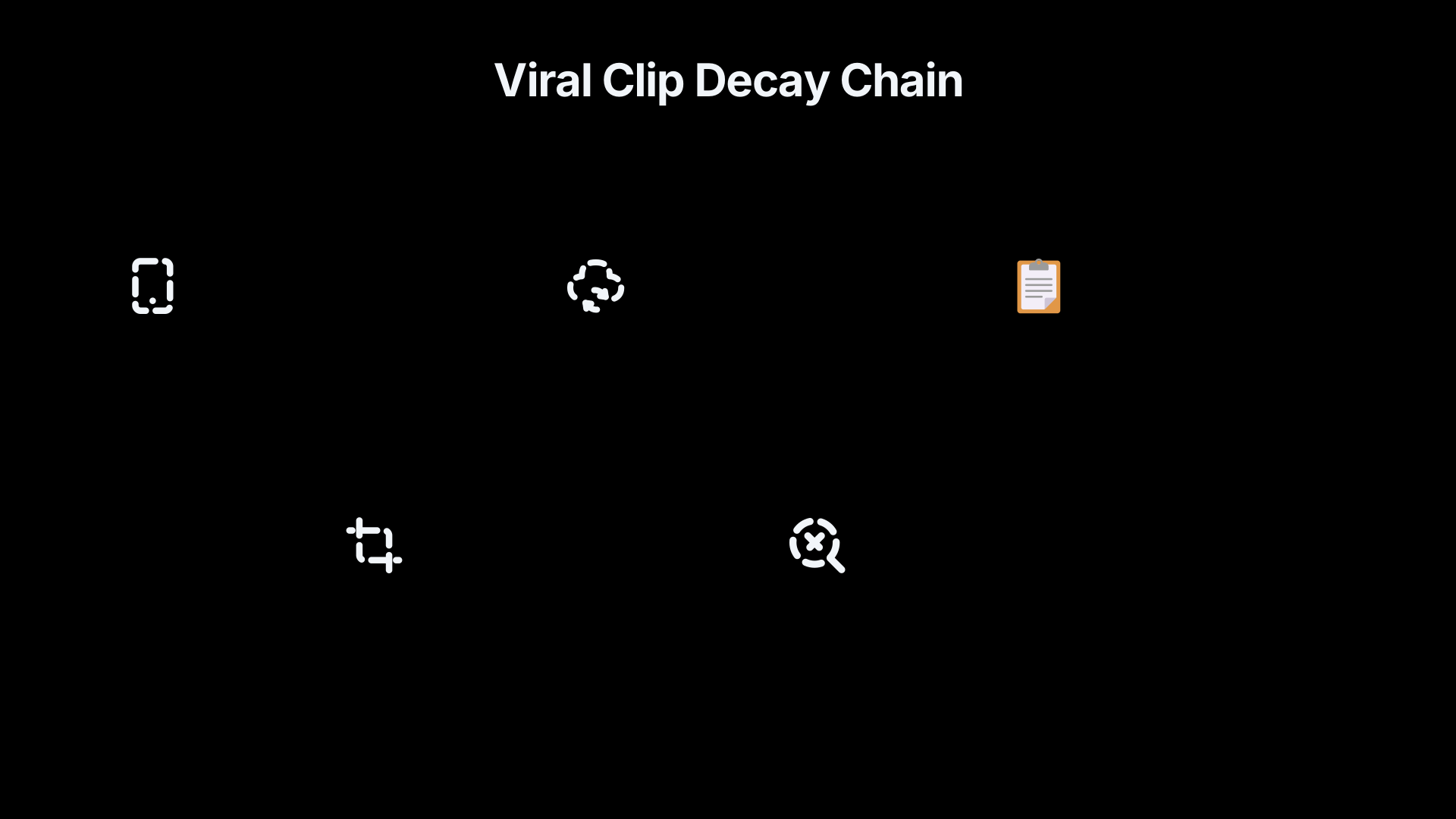
A common social-media evidence chain now looks like this:[A common social-media evidence chain now looks like this:]A common social-media evidence chain now looks like this:PrivacyStripDo X, Instagram & WhatsApp Strip EXIF Metadata? (2026)15 Dec 2024 — See whether X/Twitter, Instagram, WhatsApp, Signal, Faceb…
- A witness records a strange light.
- The original stays on their phone.
- A compressed upload goes to TikTok or Instagram.
- Another user screen-records the clip.
- Commentary channels crop and enhance it.
- News accounts repost excerpts.
- Reddit and X circulate fragments with no provenance.
By the final stage, the online version may contain almost none of the original forensic information. The public still sees “the UFO video”, but investigators are often examining a completely new media file created by platform processing systems.[Magnet Forensics]magnetforensics.comgetting to the source understanding metadata removal on social mediaMagnet ForensicsGetting to the…
This is one reason serious investigations prioritise obtaining source media directly from witnesses rather than downloading public reposts.
How TikTok, X and Instagram Strip Metadata
Many social platforms remove metadata deliberately for privacy, bandwidth and storage reasons. The downloaded public version is often not the original upload but a recompressed derivative file.[Magnet Forensics]magnetforensics.comgetting to the source understanding metadata removal on social mediaMagnet ForensicsGetting to the…[Fastio]fast.ioioWhich Social Media Platforms Strip Photo Metadata?See which social media platforms strip EXIF data from photos. Tested results for…
What Usually Gets Removed
Depending on the platform and upload method, investigators may lose:
- GPS coordinates
- Original recording timestamps
- Camera make and model
- Lens information
- Exposure settings
- Frame-rate details
- Edit history
- File hashes
- Device serial identifiers
- Orientation and motion data
Testing across major platforms consistently shows that Instagram, Facebook, TikTok and X commonly strip or rewrite EXIF data from public copies.[PrivacyStrip]privacystrip.comPrivacy Strip Do Social Media Platforms Strip EXIF Metadata?2026)15 Dec 2024 — Do Twitter/X, Instagram, Facebook, and TikTok remove EXIF metadata? See what is stripped, what can remain, and how to…[Fastio]fast.ioioWhich Social Media Platforms Strip Photo Metadata?See which social media platforms strip EXIF data from photos. Tested results for… EXIFData That does not necessarily mean the platforms[exifdata.org]exifdata.orgDo Social Media Sites Strip EXIF Data?2025 TestAug 26, 2025 — Yes. Based on our 2025 tests, both Facebook and Instagram actively strip most of this metadata from photos upon u…“delete” metadata from the witness’s original upload in a simple sense. In many cases, the service generates a new optimised media file for distribution and streaming. The metadata investigators expect was never recreated in the exported version.[Magnet Forensics]magnetforensics.comgetting to the source understanding metadata removal on social mediaMagnet ForensicsGetting to the…
This distinction matters because many internet users assume a downloaded TikTok clip is still close to the original recording. Technically, it may be a heavily transformed derivative with altered bitrate, changed dimensions, recompressed frames and rewritten container data.
Compression Changes What Analysts Can See
Compression does more than lower image quality. It can interfere with the subtle artefacts investigators use to judge authenticity and distance.
Heavy recompression can:
- Blur stars and background reference points
- Smear motion trails
- Hide editing seams
- Introduce block artefacts
- Alter noise patterns
- Reduce low-light detail
- Create false glowing edges around bright objects
A distant aircraft light viewed through atmospheric haze may become a featureless orb after multiple upload cycles. A stabilised and cropped repost can also exaggerate apparent manoeuvres by removing contextual camera shake.
This becomes especially important in UFO clips claiming impossible acceleration or sudden direction changes. Without the original stabilisation data and full frame sequence, AI-assisted motion analysis can produce misleading estimates of speed or trajectory.
Research into forensic video analysis repeatedly notes that metadata and compression history are central to determining whether footage has been manipulated or transformed.[arXiv]arxiv.orgarXiv Forensic Analysis of Video Files Using MetadataarXiv Forensic Analysis of Video Files Using Metadata
Why Screenshots Are Particularly Weak Evidence
Screenshots are among the least useful forms of UFO evidence because they destroy both motion context and embedded file information.
A screenshot captures only displayed pixels. It does not preserve the original camera metadata from the source image or video.[Hacker Factor]hackerfactor.comHacker FactorSay No to Screenshots - The Hacker Factor Blog10 Jan 2022 — Since screenshots just capture pixels on the screen, the source'…
That creates several problems for investigators.
Motion Context Vanishes
Many UFO identifications depend on movement relative to the environment.
A short surrounding sequence may reveal:
- Aircraft navigation-light blinking
- Satellite drift
- Camera autofocus behaviour
- Lens flare movement
- Handshake-induced motion
- Exposure pumping
- Drone hovering patterns
A screenshot removes all of this context.
A still frame of Venus near the horizon may look extraordinary if isolated from the preceding footage showing slow stationary behaviour. Likewise, a bright aircraft landing light can appear disc-shaped and enormous in a single compressed frame.

Scale and Distance Become Harder to Judge
AI-assisted analysis often depends on reference objects such as stars, clouds, buildings or tree lines.
Screenshots frequently crop out these anchors. Once that happens, even basic estimates of direction, elevation or angular movement become unreliable.
This is why many experienced investigators treat screenshots primarily as prompts for locating the original media rather than as evidence in themselves.
Screenshots Can Conceal Editing
Because screenshots generate a brand-new image file, they can accidentally or deliberately hide evidence of prior manipulation.
A manipulated video exported from editing software may contain traces in its metadata or codec structure. A screenshot of that manipulated clip removes much of this forensic history.
That does not prove deception. Many witnesses simply share screenshots for convenience. But from an evidential perspective, screenshots dramatically reduce the ability to verify authenticity.
Tracing Edits and Compression History
Even when metadata has been stripped, investigators can sometimes reconstruct parts of a file’s history.
This is where AI-assisted workflows increasingly intersect with digital forensics.
Signs a UFO Clip Has Been Reprocessed
Analysts may look for:
- Multiple compression layers
- Resolution mismatches
- Frame interpolation artefacts
- Repeated encoding signatures
- Cropping inconsistencies
- Audio-video sync changes
- Evidence of export from editing software
- Noise-pattern discontinuities
Some forensic tools also analyse MP4 container metadata and codec structures to identify likely editing workflows or device origins.[arXiv]arxiv.orgarXiv Forensic Analysis of Video Files Using MetadataarXiv Forensic Analysis of Video Files Using Metadata
In UFO cases, this can reveal that a supposedly “raw” clip was exported through software such as Adobe Premiere, CapCut or Photoshop before publication.
That alone does not invalidate a sighting. Witnesses routinely trim clips or add captions. But it changes how strongly investigators can treat the file as untouched source evidence.

AI Can Help Detect Re-encoding Chains
Machine-learning systems are increasingly used to classify compression artefacts and detect synthetic or altered media patterns.
For UFO investigations, these systems can help identify:
- Whether footage likely originated from a phone camera
- Whether the clip has undergone multiple exports
- Whether enhancement filters were applied
- Whether noise patterns match claimed recording conditions
- Whether frames appear AI-generated or interpolated
However, AI analysis has limits. Once a clip has passed through enough social-media processing stages, important information may be permanently unrecoverable.
A viral repost can therefore create a false impression that “the evidence is online somewhere” when the critical evidential layer disappeared during the first upload.
Why Original Files Matter More Than Viral Reach
Official and institutional investigations consistently emphasise full-length source recordings rather than short social-media excerpts.
The US All-domain Anomaly Resolution Office (AARO), for example, has shown that longer sensor sequences and additional contextual information often lead to conventional explanations such as balloons or ordinary airborne objects.[AARO]aaro.milUAP ImageryThe United States European Command submitted a report of an unidentified anomalous phenomenon to the All-domain Anomaly Re…
A six-second viral fragment may omit:
- The object entering normally
- A visible tether
- Surrounding aircraft traffic
- Stabilisation drift
- The witness lowering the camera
- A change in focus or zoom
- Behaviour before or after the “anomalous” moment
This is why AI-assisted UFO investigation workflows increasingly prioritise evidence preservation at intake.
The strongest practice is usually:
- Preserve the original file immediately
- Export without recompression
- Record witness notes separately
- Retain the entire sequence
- Document upload history
- Avoid screenshots where possible
- Archive hashes and timestamps early
Without those steps, investigators may spend weeks analysing a socially amplified copy while the original evidence quietly disappears from a damaged phone, expired cloud account or deleted app cache.
The Bigger Problem: Social Media Rewards Impressions, Not Provenance
Modern UFO culture is shaped by platforms designed to maximise engagement rather than preserve evidential integrity.
Short clips spread faster than long contextual recordings. Dramatic crops outperform full sequences. Reactions outperform documentation. Algorithms reward spectacle over provenance.
As a result, the most widely viewed UFO videos are often the least technically useful.
This creates a tension at the centre of AI-assisted UFO investigation. Automated tools can compare sightings against astronomy databases, flight tracks, weather archives and historical cases, but only if reliable timing, location and recording data survive.
Once uploads, reposts and screenshots destroy that evidential layer, the investigation shifts from analysing a documented event to analysing internet folklore around a degraded clip.
That does not mean every viral UFO video is false. It means the path from “interesting footage” to “investigable evidence” is much narrower than online discussion usually assumes.
eBay marketplace picks
Marketplace Samples
Example marketplace items related to this page. Use the search link to explore similar finds on eBay.



Endnotes
1.
Source: sciepublish.com
Link:https://www.sciepublish.com/article/pii/567
Source snippet
Forensic Value of Exif Data: An Analytical Evaluation...by N Soni · 2025 · Cited by 6 — This research adopts an empirical app...
2.
Source: ipaco.fr
Title: Analysis methodology
Link:https://www.ipaco.fr/page27.html
Source snippet
Analysis methodology - IPACO.frThe IPACO software enables the analyst to determine, using metadata, whether a digital picture in JPE...
3.
Source: arxiv.org
Title: arXiv Forensic Analysis of Video Files Using Metadata
Link:https://arxiv.org/abs/2105.06361
4.
Source: privacystrip.com
Title: Privacy Strip Do Social Media Platforms Strip EXIF Metadata?
Link:https://privacystrip.com/blog/social-media-metadata-policies
Source snippet
(2026)15 Dec 2024 — Do Twitter/X, Instagram, Facebook, and TikTok remove EXIF metadata? See what is stripped, what can remain, and how to...
5.
Source: exifdata.org
Title: Do Social Media Sites Strip EXIF Data?
Link:https://exifdata.org/blog/do-social-media-sites-strip-exif-data-2025-test
Source snippet
2025 TestAug 26, 2025 — Yes. Based on our 2025 tests, both Facebook and Instagram actively strip most of this metadata from photos upon u...
7.
Source: aaro.mil
Link:https://www.aaro.mil/UAP-Cases/Official-UAP-Imagery/
Source snippet
UAP ImageryThe United States European Command submitted a report of an unidentified anomalous phenomenon to the All-domain Anomaly Re...
8.
Source: magnetforensics.com
Title: getting to the source understanding metadata removal on social media
Link:https://www.magnetforensics.com/blog/getting-to-the-source-understanding-metadata-removal-on-social-media/
Source snippet
Magnet ForensicsGetting to the...
9.
Source: fast.io
Link:https://fast.io/resources/social-media-photo-metadata-platforms-strip/
Source snippet
ioWhich Social Media Platforms Strip Photo Metadata?See which social media platforms strip EXIF data from photos. Tested results for...
10.
Source: hackerfactor.com
Link:https://www.hackerfactor.com/blog/index.php?%2Farchives%2F946-Say-No-to-Screenshots.html=
Source snippet
Hacker FactorSay No to Screenshots - The Hacker Factor Blog10 Jan 2022 — Since screenshots just capture pixels on the screen, the source'...
Additional References
11.
Source: blogs.loc.gov
Title: social media networks stripping data from your digital photos
Link:https://blogs.loc.gov/thesignal/2013/04/social-media-networks-stripping-data-from-your-digital-photos/
Source snippet
The Library of CongressSocial Media Networks Stripping Data from Your Digital...11 Apr 2013 — This survey shows that a number of the mor...
12.
Source: metaclean.app
Title: Meta Clean Which Social Media Apps Remove EXIF Data?
Link:https://metaclean.app/blog/social-media-metadata-comparison-2026
Source snippet
12 Platforms...Short answer: Instagram, TikTok, WhatsApp (Photo mode), Twitter/X, Facebook, and Snapchat all strip EXIF from public post...
13.
Source: forensicosint.com
Link:https://www.forensicosint.com/free-tools/image-metadata-analyzer
Source snippet
PS coordinates, camera serial numbers, XMP edit history, and IPTC copyright...
14.
Source: youtube.com
Title: How Forensic Tools Retrieve Data off your phone
Link:http://www.youtube.com/watch?v=1SABOmGJoUY
Source snippet
Do social media platforms strip metadata from images and videos Do All Photos Have EXIF Data? The Truth Exif Injector...
15.
Source: youtube.com
Title: Digital Forensics Hands-On Lab | USB Evidence Analysis with Autopsy
Link:http://www.youtube.com/watch?v=DpZQYHQbgXs
Source snippet
How Forensic Tools Retrieve Data off your phone...
16.
Source: youtube.com
Title: Mobile Device Forensics: Collection and Preservation
Link:http://www.youtube.com/watch?v=uZxb_pTAELg
Source snippet
Digital Forensics Hands-On Lab | USB Evidence Analysis with Autopsy...
17.
Source: ijsrcseit.com
Link:https://ijsrcseit.com/CSEIT2390373
Source snippet
The Significance of Metadata and Video Compression for...30 Jun 2023 — We first propose the acquisition extraction analysis in...
18.
Source: craigball.net
Title: the metadata vanishes
Link:https://craigball.net/2020/11/20/the-metadata-vanishes/
Source snippet
When the defense sought the missing metadata, the legal assistant...Read more...
19.
Source: youtube.com
Title: How image compression algorithms work
Link:http://www.youtube.com/watch?v=sROvs6dQ528
Source snippet
Mobile Device Forensics: Collection and Preservation...
20.
Source: youtube.com
Title: OSINT At Home #2
Link:http://www.youtube.com/watch?v=d3NsT8lJRlE
Source snippet
How image compression algorithms work...
Topic Tree