Within UFO Case AI
Who Checks the AI UFO Verdict?
Transparent review keeps AI outputs from becoming unsupported claims and protects the difference between data, inference, and belief.
On this page
- Human review of candidate explanations
- Audit trails and source notes
- Updating cases when new evidence appears
Page outline Jump by section
Introduction
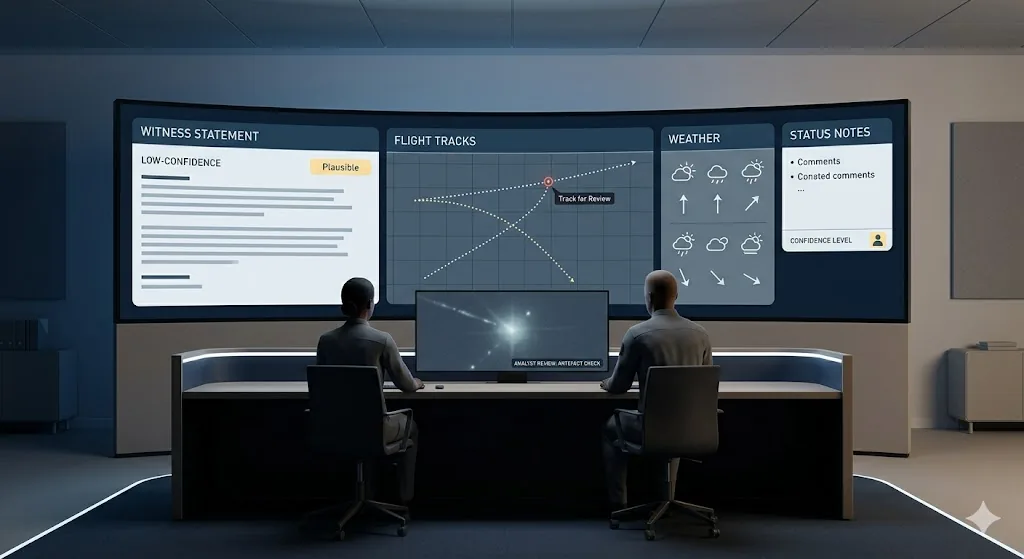
AI can help a UFO sighting investigation move faster, but it should not be allowed to issue a final verdict on its own. Human review is the safeguard that keeps “the model found a match” from becoming “the case is solved”, and keeps “unresolved” from being inflated into “extraordinary”. The central rule is simple: every AI-assisted conclusion should show what is confirmed, what is inferred, what remains uncertain, and who checked the reasoning.
This matters because UAP and UFO reports often arrive with weak, partial or uneven data. NASA’s independent UAP study found that present analysis is hampered by poor sensor calibration, lack of multiple measurements, lack of sensor metadata and lack of baseline data; it also warned that AI and machine learning are useful only when applied to well-characterised data gathered to strong standards.[NASA Science]science.nasa.govNASA Science… In practice, a responsible AI-assisted case file needs a human reviewer who can challenge neat explanations, preserve uncertainty and reopen a case when better evidence appears.
Human review of candidate explanations
The first human safeguard is not a dramatic “believer versus sceptic” judgement. It is a disciplined review of candidate explanations: aircraft, drones, balloons, birds, satellites, planets, meteors, atmospheric optics, sensor artefacts, hoaxes, and genuinely unresolved observations. The reviewer’s job is to ask whether the AI has found a good explanation, merely a possible one, or only a superficial resemblance.
A useful review begins by separating five labels that are often blurred in UFO discussion:
- Ruled out: the explanation conflicts with time, location, direction, motion, sensor data or witness detail.
- Plausible: the explanation fits the known facts but is not proven.
- Weak: the explanation fits only in a loose or partial way.
- Unresolved: available evidence is insufficient for a conclusion.
- Anomalous: the case remains unusual after good-quality evidence has been checked against ordinary explanations.
This protects both sides of the investigation. It prevents sceptical overreach, where any bright light becomes “probably a plane”, and it prevents extraordinary overreach, where a missing explanation becomes evidence of a non-human craft. AARO’s published case material shows why this discipline matters. Some cases are resolved with high confidence as balloons, birds or other ordinary objects, while others remain unresolved because the available video or sensor data is insufficient to determine whether a signature is a physical object, a reflection, a heat differential or a sensor display artefact.[aaro.mil]aaro.milUAP ImageryAARO UAP Imagery…
The human reviewer should also look for “automation-shaped” errors. AI systems are good at pattern matching, but a UFO case can be misled by the wrong comparison set. A round infrared signature may resemble a balloon, a bird, a drone, glare or a compression artefact depending on the sensor, distance, lens, background and motion. A line of lights may resemble Starlink, aircraft in approach, flares or reflections. A model can rank the closest match in its database even when the correct explanation is absent from that database.
The safest review question is therefore not “what did the AI choose?” but “what would have to be true for this explanation to hold?” For a balloon, the reviewer needs wind direction, altitude assumptions, apparent drift and morphology. For a satellite, they need observer position, time, azimuth, elevation and orbital prediction. For an aircraft, they need track data, lighting pattern, altitude, bearing and the possibility of non-broadcast or military traffic. For a sensor artefact, they need camera settings, compression, stabilisation, glare, focus and whether the object appears across independent sensors.
This is where human judgement adds value that automation cannot fully supply. A reviewer can notice when an explanation is psychologically persuasive but evidentially thin. They can ask whether the witness’s description has been over-normalised by the intake form. They can see when the AI has treated estimated distance, size or speed as if they were measured facts. Most UFO reports do not contain reliable range data, so apparent speed and size are especially dangerous: a nearby insect, distant aircraft and orbital object can all look strange if the distance is guessed.

Audit trails and source notes
A good AI-assisted UFO conclusion should be auditable. That means a later reviewer should be able to see the original witness account, the cleaned case-file fields, the datasets queried, the candidate explanations considered, the reasons each one was accepted or rejected, and the human decision that changed the case status.
This is not just good paperwork. In AI governance, documentation is a practical safety control. The NIST AI Risk Management Framework says documentation can improve transparency, human review and accountability across AI system teams.[NIST Publications]nvlpubs.nist.govPublications Artificial Intelligence Risk Management Framework (AI RMF 1.0NIST PublicationsArtificial Intelligence Risk Management Framework (AI RMF 1.0)… For UFO casework, that principle becomes very concrete: a conclusion without source notes is not a conclusion the public can fairly assess.
A useful audit trail should preserve at least four layers:
- Original evidence: witness statement, photos, videos, metadata, sensor output, time stamps and location data in their original form.
- Normalised case file: structured fields such as date, time zone, coordinates, direction of view, duration, elevation, motion and camera type.
- AI processing record: prompts, model versions, retrieval results, data sources checked, confidence scores and rejected hypotheses.
- Human review note: the reviewer’s reasoning, caveats, confidence level, unresolved gaps and decision date.
The audit trail should also mark evidence quality, not just evidence quantity. Ten reposted copies of the same compressed video do not equal ten independent observations. A timestamp from a social media upload is not the same as the original camera timestamp. A witness estimate of “very fast” is not the same as a measured angular velocity. These distinctions are easy to lose when an automated system gathers sources at speed.
Official UAP reporting shows the value of this separation. The 2024 AARO annual report said that 444 cases lacked sufficient data for analysis and were placed in an active archive for trend analysis or possible reopening if more information appears. It also said resolved cases during the reporting period were attributed to prosaic objects such as balloons, birds and unmanned aerial systems, while other cases merited further analysis.[Director of National Intelligence]dni.govDOD AARO Consolidated Annual Report on UAP Nov2024Director of National IntelligenceAll-domain Anomaly Resolution Office FY 2024 Consolidated Annual Report on UAP… That is the right posture for public-facing AI work: not every case needs a dramatic verdict, and “insufficient data” is often the most honest outcome.
Audit notes should be written in plain language. A public case file does not need to expose sensitive systems or private personal details, but it should explain the reasoning well enough for a reader to understand the status. For example:
“The AI matched the object’s apparent drift and shape to several resolved balloon cases. Human review found this plausible because recorded wind direction matches the object’s movement and no aircraft or satellite track fits the timing. Confidence is moderate because the video lacks range information and no second sensor confirms altitude.”
That kind of note is more valuable than a bare label such as “balloon: 82%”. Percentages can look scientific while hiding the real uncertainty. A reviewer should explain what the number means, how it was produced, and whether it reflects evidence strength or only similarity to previous cases.
What reviewers should challenge before a verdict goes public
The strongest safeguard is a structured challenge process before publication. The reviewer should not merely approve the AI’s top answer; they should actively test whether the answer survives obvious objections.
A practical pre-publication review asks:
- Does the proposed explanation fit the exact time and place? A satellite pass, flight track or weather condition must match the observer’s location and time zone, not just the general region.
- Does it fit the direction and elevation? Many false matches come from checking what was in the sky, but not whether it was where the witness was looking.
- Does the explanation match duration and movement? A meteor, aircraft, balloon and planet can all be bright, but their apparent motion and duration differ.
- Are estimates being treated as measurements? Size, speed, altitude and distance are often inferred, not observed.
- Could the sensor be producing the oddity? Infrared glare, compression, autofocus, digital stabilisation and rolling shutter effects can make ordinary objects appear strange.
- Has the system checked ordinary but less glamorous explanations? Birds, balloons, drones, advertising lights, sky lanterns and aircraft on approach are easy to underweight if the model is trained on dramatic cases.
- Would a different reviewer reach the same conclusion from the notes? If not, the case needs clearer reasoning or a lower-confidence status.
This approach mirrors the more careful classification culture used by GEIPAN, the French UAP investigation group within CNES. GEIPAN classifies cases using both the consistency of the observation and the residual strangeness after investigation; its methodology weighs the quantity and reliability of collected data and asks how far the case remains from known phenomena after hypotheses are tested.[cnes-geipan.fr]cnes-geipan.frMission & Geipan | GEIPANMission & Geipan | GEIPAN The lesson for AI-assisted work is that a strange-looking report with weak data should not be treated the same as a strange-looking report with strong, independent evidence.
Human review should also guard against “explanation laundering”. This happens when an AI-generated possibility is repeated by analysts, websites or social media until it appears to be an established finding. A case note should therefore state whether a match is based on direct evidence, analogy to prior cases, environmental correlation, or simple absence of a better explanation. Those are very different levels of support.

Review boards, not lone verdicts
For low-stakes cases, one trained reviewer may be enough. For public, high-interest or apparently anomalous cases, a small review panel is safer. The point is not bureaucracy; it is to reduce blind spots. A useful panel might include someone with aviation knowledge, someone with astronomy or satellite-tracking experience, someone who understands camera and sensor artefacts, and someone responsible for evidence handling and public wording.
The panel should not be asked, “Is this a UFO?” That question is too vague. It should be asked:
- What explanations have been tested?
- Which explanations are inconsistent with the evidence?
- Which explanations remain plausible?
- What evidence would change the assessment?
- What confidence level is justified?
- What wording can be published without overstating the case?
This matters because even official investigations have repeatedly faced the same problem: public trust suffers when conclusions look either dismissive or credulous. Historical UFO files show that many reports remain unidentified, but “unidentified” has never automatically meant extraordinary. The US National Archives summary of Project Blue Book records 12,618 sightings between 1947 and 1969, with 701 remaining unidentified.[National Archives]archives.govNational Archives Project BLUE BOOKNational Archives Project BLUE BOOK That historical residue is a warning: unresolved cases are expected in large reporting systems, especially when reports are late, incomplete or based on brief observations.
A review board also helps with language. Public UFO writing often fails at the final sentence. “The object was a balloon” is too strong if the case only shows balloon-like motion and appearance. “The object defies explanation” is too strong if basic checks were incomplete. Better wording might be: “The strongest current explanation is a windborne balloon, but the case remains classed as plausible rather than resolved because no range or recovery evidence is available.”
Updating cases when new evidence appears
A UFO case should not be frozen at first publication. New evidence can arrive later: original camera files, additional witnesses, air traffic data, launch records, satellite predictions, local CCTV, weather balloon releases, drone-event reports, or expert review of sensor artefacts. A responsible AI-assisted workflow treats case status as versioned, not final.
AARO’s 2024 report describes an active archive where cases lacking sufficient data can be held for pattern-of-life and trend analysis, and reopened if additional information emerges.[Director of National Intelligence]dni.govDOD AARO Consolidated Annual Report on UAP Nov2024Director of National IntelligenceAll-domain Anomaly Resolution Office FY 2024 Consolidated Annual Report on UAP… That is a strong model for public-facing work. An unresolved case should not be abandoned; it should be parked with a clear explanation of what is missing.
Updates should be visible and dated. A case file might move from “unresolved” to “plausible satellite flare” after orbital modelling, or from “plausible balloon” to “resolved balloon” after a launch/recovery record is found. It may also move in the other direction: a previously neat aircraft explanation may weaken if the flight track was in the wrong part of the sky or if the timestamp was corrected.
The most important safeguard is to preserve earlier reasoning rather than silently overwrite it. A public update should say what changed:
“Updated 12 March 2026: the original phone file was received, correcting the sighting time from 21:43 to 21:49. The earlier aircraft match no longer fits. The case has been returned from ‘plausible aircraft’ to ‘unresolved pending further checks’.”
That kind of correction builds trust. It shows that the investigation is evidence-led rather than verdict-led. It also reduces the temptation to defend an early AI output simply because it has already been published.
How to word an AI-assisted UFO conclusion safely
The final safeguard is careful public language. A good conclusion should be clear enough for a mainstream reader but cautious enough to preserve the evidence boundary.
A safe conclusion usually contains five parts:
- Status: resolved, plausible, weak, unresolved or anomalous.
- Best current explanation: the strongest candidate, if there is one.
- Evidence basis: the sources that support that assessment.
- Limitations: missing data, sensor uncertainty, witness-estimate limits or untested alternatives.
- Update condition: what new evidence would change the case.
For example:
“Current status: plausible drone. The object’s low altitude, hovering behaviour and local direction of travel are consistent with a small unmanned aircraft. The assessment is limited by the lack of original video metadata, no confirmed operator record and no independent range measurement. The case should be reopened if additional footage, police logs or local drone-event records become available.”
This kind of wording does not pretend the AI is neutral magic. It makes the reasoning inspectable. It also respects the witness by taking the report seriously without making claims the evidence cannot carry.
The opposite style should be avoided:
- “AI proves it was a balloon.”
- “No known explanation exists, so it is anomalous technology.”
- “The model is 91% confident this is a satellite.”
- “Experts cannot explain it.”
- “The footage confirms a craft.”
Those statements either hide uncertainty or imply more evidence than the case contains. NASA’s UAP study is especially relevant here: it says AI and machine learning can help identify rare occurrences in large datasets, but the limiting factor is often data quality, and reliable analysis depends on calibrated instruments, metadata and proper curation.[NASA Science]science.nasa.govNASA Science… The public conclusion should reflect that reality.
Why the human safeguard is the verdict
In AI-assisted UFO sighting investigation, the human safeguard is not a decorative final approval. It is the part of the process that turns automated matching into accountable analysis. The reviewer checks whether the data are strong enough, whether ordinary explanations have been tested fairly, whether uncertainty has been preserved, and whether the public wording says no more than the evidence supports.
That is the difference between an AI-generated answer and an evidence-led case conclusion. The machine can gather tracks, compare images, cluster reports and surface likely explanations. The human reviewer must decide whether those outputs are sufficient, whether the case should remain unresolved, and how to state the result without confusing data, inference and belief.
Amazon book picks
Further Reading
Books and field guides related to Who Checks the AI UFO Verdict?. Use these as the next step if you want deeper reading beyond the article.
The Demon-Haunted World
Perfect fit for human review, scepticism, and evidential caution.
Weapons of Math Destruction
Relevant to checking AI outputs rather than accepting automated verdicts.
eBay marketplace picks
Marketplace Samples
Example marketplace items related to this page. Use the search link to explore similar finds on eBay.




Endnotes
1.
Source: science.nasa.gov
Link:https://science.nasa.gov/wp-content/uploads/2023/09/uap-independent-study-team-final-report.pdf
Source snippet
NASA Science...
2.
Source: aaro.mil
Title: UAP Imagery
Link:https://www.aaro.mil/UAP-Cases/Official-UAP-Imagery/
Source snippet
AARO UAP Imagery...
3.
Source: nvlpubs.nist.gov
Title: Publications Artificial Intelligence Risk Management Framework (AI RMF 1.0)
Link:https://nvlpubs.nist.gov/nistpubs/ai/nist.ai.100-1.pdf
Source snippet
NIST PublicationsArtificial Intelligence Risk Management Framework (AI RMF 1.0)...
4.
Source: cnes-geipan.fr
Title: Mission & Geipan | GEIPAN
Link:https://www.cnes-geipan.fr/en/missions-methodes-et-resultats
5.
Source: cnes-geipan.fr
Title: Classification | GEIPAN
Link:https://www.cnes-geipan.fr/en/node/58787
6.
Source: archives.gov
Title: National Archives Project BLUE BOOK
Link:https://www.archives.gov/research/military/air-force/ufos
7.
Source: science.nasa.gov
Link:https://science.nasa.gov/uap/
8.
Source: nasa.gov
Title: update nasa shares uap independent study report names director
Link:https://www.nasa.gov/news-release/update-nasa-shares-uap-independent-study-report-names-director/
9.
Source: nist.gov
Link:https://www.nist.gov/itl/ai-risk-management-framework
10.
Source: aaro.mil
Link:https://www.aaro.mil/
11.
Source: aaro.mil
Title: UAP Records
Link:https://www.aaro.mil/UAP-Records/
12.
Source: aaro.mil
Title: Congressional Press Products
Link:https://www.aaro.mil/Congressional-Press-Products/
13.
Source: cnes.fr
Link:https://cnes.fr/en/projects/geipan
14.
Source: archive.org
Link:https://archive.org/stream/pdfy-4vyHjooOJagoGAwN/Scientific%2BStudy%2BOf%2BUnidentified%2BFlying%2BObjects_djvu.txt
15.
Source: dni.gov
Title: DOD AARO Consolidated Annual Report on UAP Nov2024
Link:https://www.dni.gov/files/ODNI/documents/assessments/DOD-AARO-Consolidated-Annual-Report-on-UAP-Nov2024.pdf
Source snippet
Director of National IntelligenceAll-domain Anomaly Resolution Office FY 2024 Consolidated Annual Report on UAP...
16.
Source: Wikipedia
Title: Project Blue Book
Link:https://en.wikipedia.org/wiki/Project_Blue_Book
17.
Source: britannica.com
Title: Project Blue Book
Link:https://www.britannica.com/topic/Project-Blue-Book
18.
Source: history.com
Title: Project Blue Book
Link:https://www.history.com/articles/project-blue-book
Additional References
19.
Source: youtube.com
Link:http://www.youtube.com/watch?v=GivGke4kyC4
Source snippet
NASA UAP Independent Study Report — Press Conference (September 14, 2023)...
Published: September 14, 2023
20.
Source: youtube.com
Title: NASA UAP Independent Study Report
Link:http://www.youtube.com/watch?v=TCWB1YZrEuU
Source snippet
NASA UAP report independent study findings and methodology NASA UAP Independent Study Report — Press Conference (September 14, 2023) Lies...
Published: September 14, 2023
21.
Source: arxiv.org
Link:https://arxiv.org/html/2502.06794v1
22.
Source: cia.gov
Link:https://www.cia.gov/readingroom/docs/CIA-RDP81R00560R000100060001-5.pdf
23.
Source: youtube.com
Title: NASA: UAP Study Report Highlights
Link:http://www.youtube.com/watch?v=qSAQyOgiELA
Source snippet
NASA's in-depth UFO investigation report: Key findings and surprises | The truth about UFOs...
24.
Source: war.gov
Title: department of defense releases the annual report on unidentified anomalous phen
Link:https://www.war.gov/News/Releases/Release/Article/3964824/department-of-defense-releases-the-annual-report-on-unidentified-anomalous-phen/
25.
Source: aui.edu
Link:https://aui.edu/aaro-releases-report-on-unidentified-anomalous-phenomena-uap/
26.
Source: skepticalinquirer.org
Link:https://skepticalinquirer.org/wp-content/uploads/sites/29/2009/01/p47.pdf?ref=thegalacticmind.com
27.
Source: artificial-intelligence-act.com
Link:https://www.artificial-intelligence-act.com/Artificial_Intelligence_Act_Article_12.html
28.
Source: artificialintelligenceact.eu
Link:https://artificialintelligenceact.eu/article/14/
Topic Tree
Follow this branch
Parent topic
UFO Case AIRelated pages 9
- Aircraft Was It an Aircraft or Drone?
- Astronomy Was the UFO Really in the Sky Map?
- Case File What Makes a UFO Report Investigable?
- Case Match Has This UFO Sighting Happened Before?
- Confidence How Certain Can a UFO Explanation Be?
- Satellites Could It Be Starlink or a Satellite?
- Timeline What Else Was Happening During the Sighting?
- Video Limits Why Clear UFO Videos Can Still Mislead
- +1 more in sidebar