Within Timeline
What the video really shows
A sighting video needs its own timeline because file edits, platform metadata, camera motion, and exposure changes can alter the case.
On this page
- Separating file timestamps from shared copies
- Camera movement, focus, zoom, and exposure changes
- Building a media timeline beside the witness story
Page outline Jump by section
Introduction
A UFO sighting video is not a neutral recording of reality. It is a digital file with its own history: capture time, edits, exports, compression passes, uploads, stabilisation, cropping, exposure shifts, and platform processing. In a serious AI-assisted UFO sighting investigation, the video timeline therefore has to be separated from the witness timeline. What the witness remembers and what the file can demonstrate are related, but they are not the same thing.
 This distinction matters because many apparent anomalies are created or amplified by the recording process itself. A light may seem to accelerate because digital zoom changed. An object may appear to vanish because exposure compensation darkened the frame. A witness may remember a continuous event while the file shows missing segments or later edits. At the same time, a heavily shared or recompressed clip may lose metadata that would otherwise help confirm where and when it was recorded. The goal is not to dismiss witness testimony, but to prevent memory, platform behaviour, and file history from being blended into a single unsupported narrative.
Separating file timestamps from shared copies
The most important rule in video timeline reconstruction is simple: treat the original recording and every later copy as different evidence objects.
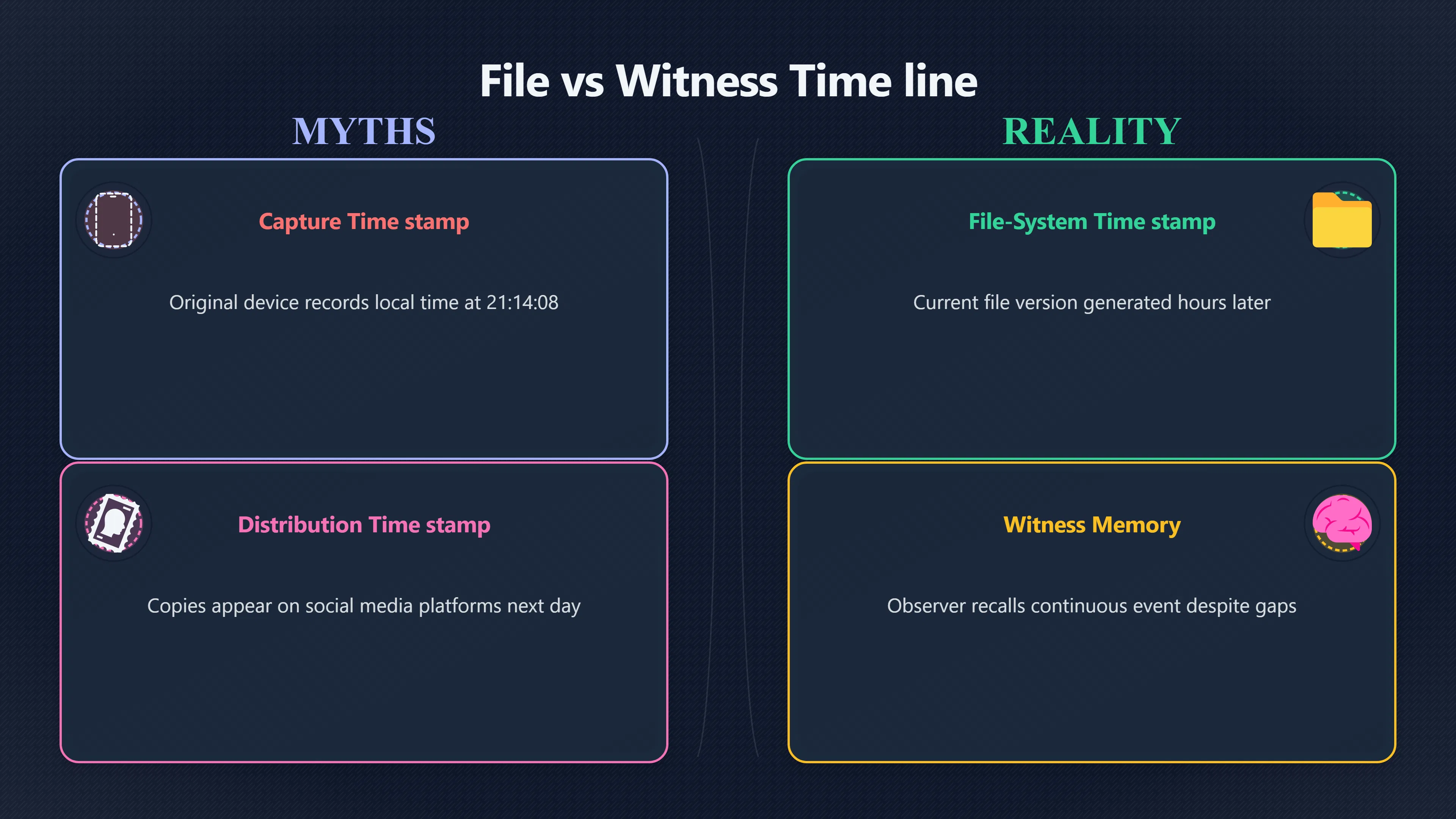
A phone may record a clip at 21:14:08 local time, but the version circulating online might have been exported hours later, uploaded the next day, trimmed for social media, or screen-recorded from another device. Once a clip moves through messaging apps or social platforms, metadata can change or disappear entirely. Research into social-media video forensics shows that platforms frequently alter compression structure, encoding, and metadata during upload and redistribution. PMC[Academia In practical UFO case work]academia.eduInternational Journal of Scientific Research in…Read more…, AI systems should therefore maintain at least three parallel timestamps:
- Capture timestamp: when the recording device claims the footage was created.
- File-system timestamp: when the current file version was generated or modified.
- Distribution timestamp: when copies appeared on messaging apps, forums, or social media.
Those timestamps often diverge. A witness may sincerely state that a video was uploaded “immediately”, while the file history shows export activity hours later. That does not prove deception. Many ordinary actions alter metadata:
- Sending through WhatsApp or Telegram.
- Editing brightness or cropping.
- Exporting from a photo app.
- Recording a screen replay.
- Downloading from cloud storage.
- Posting to TikTok, Instagram, or YouTube.
Digital-forensics guidance repeatedly warns that creation dates and frame timing information can change during processing or conversion.[NIST]nist.govOSAC 2022-S-0031 Standard Guide for Forensic Digital…For example, creation times or frame timing information may be changed…
For that reason, a structured UFO case file should preserve:
- The untouched original file whenever possible.
- Hash values for each version.
- Device information.[arxiv.org]arxiv.orgForensic Analysis of Video Files Using Metadataby Z Xiang · 2021 · Cited by 36 — This metadata information can be used to determine video…
- Upload chronology.
- Platform-specific copies.
- Any witness statements about editing or sharing.
This is especially important when a sighting becomes public quickly. Viral clips often acquire a false “single source” identity even though multiple edited generations exist simultaneously.
Why metadata alone is not enough
Metadata can be extremely useful, but it is not automatically trustworthy. EXIF and container metadata may reveal device model, codec, GPS information, frame rate, timezone, and edit history, yet metadata can also be stripped, altered, or regenerated.[SCIEPublish]sciepublish.comForensic Value of Exif Data: An Analytical Evaluation…by N Soni · 2025 · Cited by 6 — Buchholz and Spafford [8] explained h…
An AI workflow should therefore compare metadata against independent anchors such as:
- Emergency call logs.
- Weather conditions visible in-frame.
- Aircraft positions.
- Astronomical visibility.
- Nearby CCTV timing.
- Social-media posting times.[pmc.ncbi.nlm.nih.gov]pmc.ncbi.nlm.nih.govIdentification of Social-Media Platform of Videos through the…by L Maiano · 2021 · Cited by 23 — This is the first work that addres…
- Audio events such as church bells, sirens, or train announcements.
A claimed recording time that conflicts with visible cloud cover or aircraft lighting patterns may indicate either faulty timestamps or mistaken recollection rather than deliberate fabrication.
Camera movement can create false motion
Many UFO videos appear dramatic because the camera itself is moving unpredictably. A useful media timeline therefore tracks camera behaviour frame by frame, separately from claimed object behaviour.
Phone footage is especially vulnerable to this problem because smartphones continuously apply computational photography techniques while recording. Stabilisation, autofocus, exposure balancing, HDR processing, and rolling shutter effects can all change apparent motion or shape.
A common failure mode appears when the witness digitally zooms into a distant light source. Small hand movements become exaggerated, causing stars, planets, aircraft lights, or drones to seem to dart or zigzag across the sky. The object is not necessarily moving erratically; the camera is magnifying tiny shifts in framing.
The distinction becomes clearer when the AI system maps object motion against background references:
- Rooflines.
- Tree silhouettes.
- Power lines.
- Clouds.
- Stars.
- Horizon features.
If the entire frame shifts together, the apparent motion may come from camera movement rather than the object itself.
Focus hunting and apparent shape changes
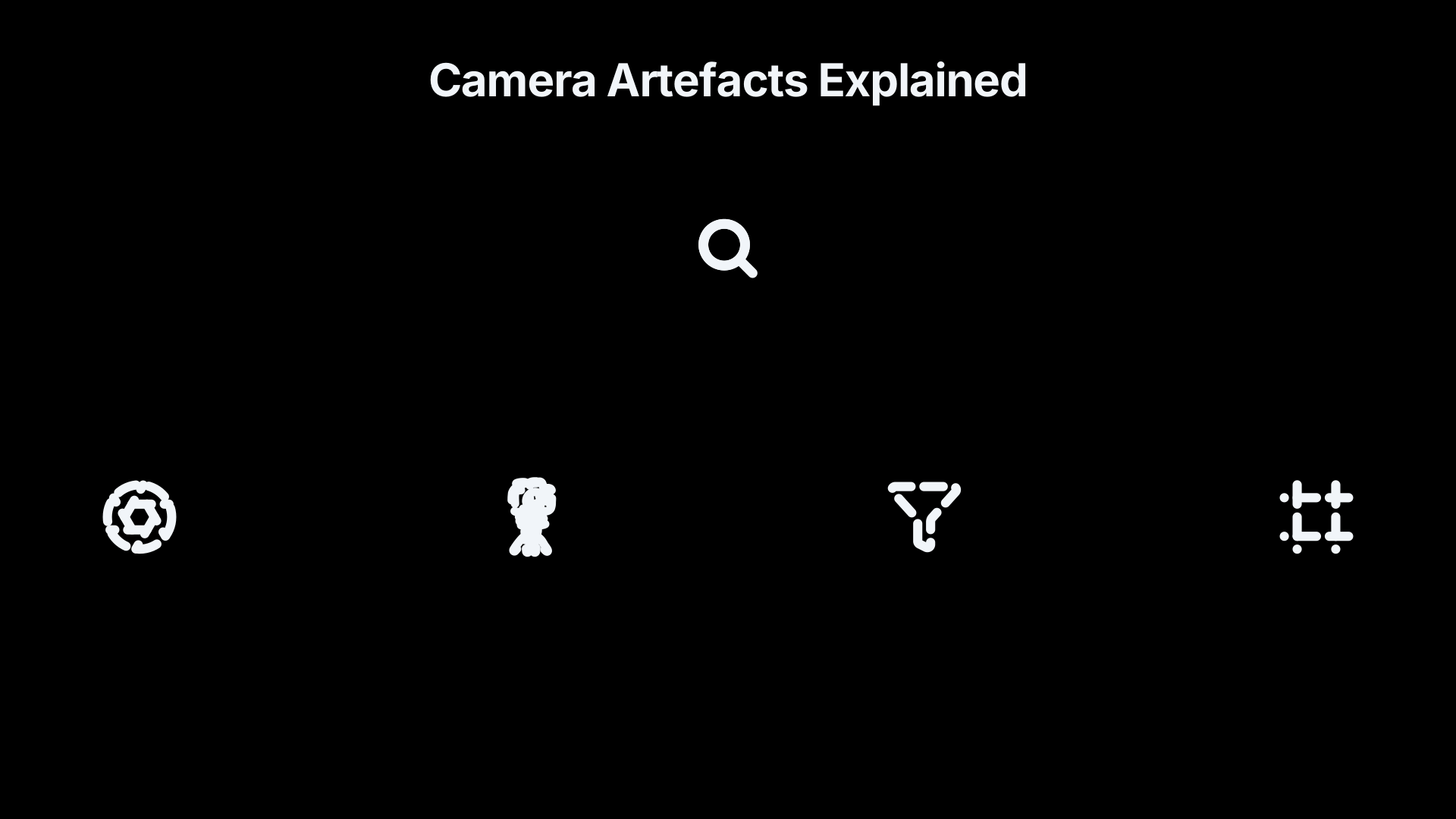
Autofocus systems are another major source of confusion in UFO footage. Bright point sources recorded at high zoom frequently transform into changing geometric blobs, rings, or pulsating forms when the camera loses focus.
This can create strong witness impressions of structured craft, rotating surfaces, or morphing shapes. In reality, the video may be showing lens artefacts and defocus patterns. The key investigative question is not whether the witness “really saw” those shapes, but whether the shapes existed externally or emerged from the imaging process.
A proper media timeline therefore marks moments where:
- Focus changes abruptly.
- Exposure compensation shifts.
- Stabilisation activates.
- Zoom level changes.
- Frame interpolation occurs.
- Noise reduction smears detail.
These transitions often correspond directly with perceived behavioural changes in the reported object.
Exposure changes can invent disappearances
One of the most misunderstood aspects of UFO footage is the apparent “disappearance” event.
Witnesses frequently describe lights that vanished instantly, blinked out unnaturally, or became invisible without moving away. Sometimes that is genuinely unexplained. But in many recordings, the timeline shows that the camera itself changed exposure settings.
Phone cameras constantly rebalance brightness while filming. If the scene darkens, the camera may brighten the sky and wash out faint lights. If a bright streetlamp enters frame, the camera may reduce exposure and dim everything else. Clouds, reflections, and auto-night modes complicate this further.
The result is that an object can appear to:
- Materialise suddenly.
- Pulse dramatically.
- Dim without moving.
- Vanish at frame edge.
- Reappear after reframing.
A video timeline should therefore include exposure-state markers alongside witness recollection. Without them, later viewers may interpret a camera behaviour change as object behaviour.
Frame-timing analysis standards used in digital forensics emphasise that timing and frame intervals require careful examination because stored video may not reflect perfectly continuous capture.[SWGDE - SWGDE]swgde.orgSWGDESWGDE Best Practice for Frame Timing Analysis of Video…9 Jun 2022 — The purpose of this document is to provide forensic e…
Building a media timeline beside the witness story
A strong UFO reconstruction does not replace the witness narrative with machine analysis. Instead, it keeps separate evidence layers visible at the same time.
The witness timeline records subjective experience:
- “It hovered silently.”
- “It accelerated suddenly.”
- “It disappeared behind cloud.”
- “It looked triangular.”
The media timeline records observable file events:
- Zoom increased from 3x to 10x.
- Exposure dropped two stops.
- Frame cadence changed.[nist.gov]nist.govOSAC 2022-S-0031 Standard Guide for Forensic Digital…For example, creation times or frame timing information may be changed…
- Clip gap of 14 seconds.
- Audio track cut.
- File exported after trimming.
Those two timelines may align, partially align, or conflict. The point is to avoid silently merging them.
A practical reconstruction structure
For a single-event UFO case, a useful AI-assisted media reconstruction often looks like this:
Timeline layerMain questionWitness accountWhat did the observer believe happened?Original file timelineWhat does the untouched recording contain?Edited/shared file timelineWhat changed during distribution?Camera-state timelineWhat did the device itself change while recording?Environmental timelineWhat was happening in the sky and surroundings?Analysis timelineWhich explanations strengthened or weakened over time?
This layered approach prevents a common investigative failure: treating later online versions of footage as if they were the original evidence.
Shared clips often become worse evidence over time
Ironically, the more famous a UFO video becomes, the less reliable the circulating versions often are.
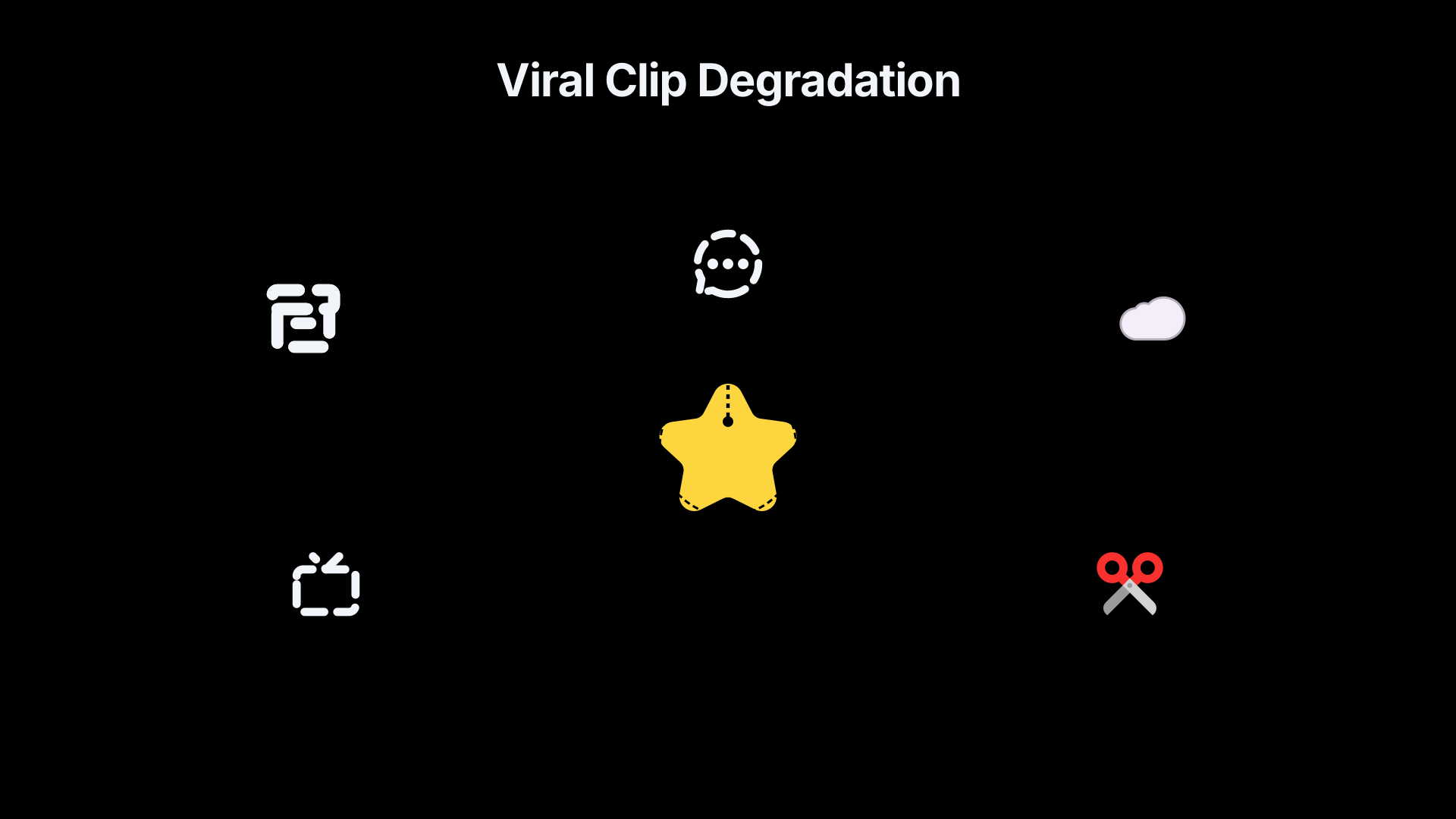
Social platforms routinely recompress footage. Some alter frame rates, strip metadata, crop aspect ratios, or apply additional stabilisation. Research into forensic video analysis repeatedly identifies compression and transcoding as major barriers to reliable reconstruction.[Academia]academia.eduInternational Journal of Scientific Research in…Read more… IJSRCSEIT By the time a clip reaches large audiences[ijsrcseit.com]ijsrcseit.comThe Significance of Metadata and Video Compression for…30 Jun 2023 — We first propose the acquisition extraction analysis in a forensi…, investigators may only have:
- A reposted vertical crop.
- A low-bitrate download.
- A screen recording of another upload.
- A compilation-video extract.[scribd.com]scribd.comForensic Analysis of Video FormatsThe document discusses the analysis of video file formats to extract metadata and characteristics for f…
- A slowed-down edit with music overlays.
At that stage, claims about speed, acceleration, colour, or timing become much weaker because the media object itself has drifted far from the original capture.
This is one reason why modern provenance systems are attracting attention. The Coalition for Content Provenance and Authenticity (C2PA) and related “Content Credentials” standards aim to preserve records of origin and edits in digital media.[C2PA]c2pa.orgC2PA | Verifying Media Content SourcesC2PA provides an open technical standard for publishers, creators and consumers to establish th…[Content Credentials]contentcredentials.orgContent Credentials | Verify Media AuthenticityContent Credentials provides media transparency with advanced authenticity detection tools…
However, current systems remain incomplete and fragile in practice. Metadata may still be stripped during uploads or exports, and researchers have warned that provenance standards should not yet be treated as foolproof authentication systems.[arXiv]arxiv.orgVerifying Provenance of Digital Media: Why the C2PA Specifications Fall ShortApril 27, 2026…[The Verge]theverge.comInstagram head Adam Mosseri recently raised concerns about AI eroding authenticity and suggested labeling real media. While C2PA — backed…
For UFO investigations, these systems are potentially useful but should be treated as supporting evidence rather than definitive proof.
Why memory changes after video review
Witness recollection often shifts after repeated viewing of footage. This is normal human behaviour, not necessarily dishonesty.
Once people replay a clip many times, their memory of the live event can become contaminated by:
- Freeze frames.
- Zoomed screenshots.
- Online commentary.
- AI-enhanced versions.
- Colour grading.
- Stabilised edits.
- Crowd interpretation.
A witness may later describe details that only became visible after enhancement or frame analysis. Over time, the memory of “what I saw” can merge with “what the processed video seems to show”.
That is why a serious case workflow records early testimony before prolonged collaborative review whenever possible.
The timeline should therefore preserve:
- Initial statements.
- Later revisions.
- Exposure to online discussion.
- Access to edited versions.
- New interpretations added after frame analysis.
This helps investigators distinguish between immediate perception and later reconstruction.
What a balanced assessment looks like
Separating file evidence from memory does not automatically debunk a UFO sighting. Sometimes the opposite happens. Careful reconstruction may strengthen parts of the account by confirming consistency between witness timing, environmental conditions, and media behaviour.
But many cases become less mysterious once the recording process itself is mapped properly. Apparent acceleration may track with zoom changes. Sudden disappearances may align with exposure shifts. Claimed continuous footage may contain undocumented gaps. Viral clips may turn out to be several generations removed from the source file.
The value of AI-assisted reconstruction is not that it declares footage “real” or “fake”. Its value is narrower and more reliable:
- preserving the original evidence chain,
- separating observation from interpretation,
- identifying camera-induced artefacts,
- tracking how media changed over time,
- and clarifying which parts of a sighting remain genuinely unresolved after technical review.
Amazon book picks
Further Reading
Books and field guides related to What the video really shows. Use these as the next step if you want deeper reading beyond the article.
The Visual Display of Quantitative Information
Relevant to separating data from presentation effects.
eBay marketplace picks
Marketplace Samples
Example marketplace items related to this page. Use the search link to explore similar finds on eBay.


Endnotes
1.
Source: pmc.ncbi.nlm.nih.gov
Link:https://pmc.ncbi.nlm.nih.gov/articles/PMC8404930/
Source snippet
Identification of Social-Media Platform of Videos through the...by L Maiano · 2021 · Cited by 23 — This is the first work that addres...
2.
Source: academia.edu
Link:https://www.academia.edu/103752968/The_Significance_of_Metadata_and_Video_Compression_for_Investigating_Video_Files_on_Social_Media_Forensic
Source snippet
International Journal of Scientific Research in...Read more...
3.
Source: ijsrcseit.com
Link:https://ijsrcseit.com/CSEIT2390373
Source snippet
The Significance of Metadata and Video Compression for...30 Jun 2023 — We first propose the acquisition extraction analysis in a forensi...
4.
Source: nist.gov
Link:https://www.nist.gov/document/osac-2022-s-0031-standard-guide-forensic-digital-video-examination-workflow-version-20
Source snippet
OSAC 2022-S-0031 Standard Guide for Forensic Digital...For example, creation times or frame timing information may be changed...
5.
Source: nist.gov
Link:https://www.nist.gov/document/osac-2022-s-0031standard-guide-forensic-digital-video-examination-workflowopen-comment
Source snippet
Digital Video Examination Workflow. 6 example, creation times or frame timing information may be changed as a.Read more...
6.
Source: sciepublish.com
Link:https://www.sciepublish.com/article/pii/567
Source snippet
Forensic Value of Exif Data: An Analytical Evaluation...by N Soni · 2025 · Cited by 6 — Buchholz and Spafford [8] explained h...
7.
Source: swgde.org
Link:https://www.swgde.org/wp-content/uploads/2023/11/2022-06-09-SWGDE-Best-Practices-for-Frame-Timing-Analysis-of-Video-Stored-in-ISO-Base-Media-File-Formats_v1.1.pdf
Source snippet
SWGDESWGDE Best Practice for Frame Timing Analysis of Video...9 Jun 2022 — The purpose of this document is to provide forensic e...
8.
Source: swgde.org
Link:https://www.swgde.org/documents/published-complete-listing/19-v-005-swgde-best-practice-for-frame-timing-analysis-of-video-stored-in-iso-base-media-file-formats/
Source snippet
SWGDESWGDE Best Practice for Frame Timing Analysis of Video...The delta of packet presentation times identifies the elapsed time...
9.
Source: c2pa.org
Link:https://c2pa.org/
Source snippet
C2PA | Verifying Media Content SourcesC2PA provides an open technical standard for publishers, creators and consumers to establish th...
10.
Source: spec.c2pa.org
Link:https://spec.c2pa.org/specifications/specifications/2.4/explainer/Explainer.html
Source snippet
c2pa.orgC2PA and Content Credentials ExplainerProvenance, as C2PA defines it, refers to the facts about the history of a piece of digital...
11.
Source: arxiv.org
Link:https://arxiv.org/abs/2604.24890
Source snippet
Verifying Provenance of Digital Media: Why the C2PA Specifications Fall ShortApril 27, 2026...
Published: April 27, 2026
12.
Source: youtube.com
Title: OSIN T At Home #2
Link:https://www.youtube.com/watch?v=d3NsT8lJRlE
Source snippet
OSINT At Home #2 - Five ways to find EXIF/metadata in a...In this video we're going to look at five different ways to view the exit data...
13.
Source: youtube.com
Link:https://www.youtube.com/watch?v=wMnVHeXPb6c
Source snippet
What is C2PA? C2PA and Digital AuthenticityC2PA attaches digital credentials to content like an invisible watermark of sorts detailing th...
14.
Source: youtube.com
Link:https://www.youtube.com/watch?v=fXDbZkEnojA
Source snippet
" evidence; they are often the primary data goldmines in modern...
15.
Source: nist.gov
Title: Forensics@NIST Day 2.1 | NISTDIGITAL EVIDENCE. 9:00
Link:https://www.nist.gov/video/forensicsnist-day-21
Source snippet
9:05am EST. Overview of the NIST Digital Evidence Program. Speaker(s). Barbara Guttman, NIST. 9:05 - 9:35am EST. NSRL...
16.
Source: nist.gov
Title: digital video exchange standards
Link:https://www.nist.gov/programs-projects/digital-video-exchange-standards
Source snippet
Nov 7, 2016 — NIST is working with Law Enforcement, Industry, and the Standards Community to establish a standardized digital video d...
17.
Source: nvlpubs.nist.gov
Link:https://nvlpubs.nist.gov/nistpubs/ir/2017/NIST.IR.8172.pdf
Source snippet
of Closed Circuit Digital Video Recording and...by M Garris · Cited by 1 — Following the metadata analysis, the files were demultiplexed...
18.
Source: nist.gov
Link:https://www.nist.gov/document/standard-practice-data-retrieval-digital-cctv-systems
Source snippet
d interested parties can consider the recommendations of the OSAC pertaining to.Read more...
19.
Source: c2pa.org
Title: releases specification of worlds first industry standard for content provenance
Link:https://c2pa.org/c2pa-releases-specification-of-worlds-first-industry-standard-for-content-provenance/
Source snippet
Coalition for Content Provenance and Authenticity (...6 Jan 2022 — The Coalition for Content Provenance and Authenticity (C2PA) is an op...
20.
Source: spec.c2pa.org
Link:https://spec.c2pa.org/specifications/specifications/2.4/index.html
Source snippet
c2pa.orgC2PA Specifications:: C2PA SpecificationsThe Coalition for Content Provenance and Authenticity (C2PA)... standards for certifyi...
21.
Source: c2pa.org
Link:https://c2pa.org/faqs/
Source snippet
FAQsIn the context of C2PA, content provenance is captured and preserved using Content Credentials, the technical standard the C2PA produ...
22.
Source: spec.c2pa.org
Link:https://spec.c2pa.org/specifications/specifications/2.4/specs/C2PA_Specification.html
Source snippet
Credentials: C2PA Technical SpecificationProvenance empowers content creators and editors, regardless of their geographic location or de...
23.
Source: arxiv.org
Link:https://arxiv.org/abs/2105.06361
Source snippet
Forensic Analysis of Video Files Using Metadataby Z Xiang · 2021 · Cited by 36 — This metadata information can be used to determine video...
24.
Source: c2pa.wiki
Link:https://c2pa.wiki/
Source snippet
Content Provenance & Authenticity Standard2 Dec 2025 — C2PA is an open technical standard providing publishers, creators, and consu...
25.
Source: youtube.com
Title: NEW UPDATE: THE DIGITAL EVIDENCE RCMP MAY BE USING TO RECONSTRUCT THE NIGHT
Link:http://www.youtube.com/watch?v=wVmxo6EdkBg
Source snippet
Idaho 4 Timeline — Evidence vs State Claims...
26.
Source: youtube.com
Title: Idaho 4 Timeline — Evidence vs State Claims
Link:http://www.youtube.com/watch?v=4gHni83F_x8
Source snippet
Crime Scene Reconstruction...
27.
Source: youtube.com
Title: Crime Scene Reconstruction
Link:http://www.youtube.com/watch?v=zVDIU-8xRtM
Source snippet
Project 002: Forensic Reconstruction of the Bernal Garcia Lineage...
28.
Source: youtube.com
Title: Project 002: Forensic Reconstruction of the Bernal Garcia Lineage
Link:http://www.youtube.com/watch?v=U1dVdEzDAeA
Source snippet
The Evolution of Forensic Science: From Fingerprints to DNA Profiling...
29.
Source: youtube.com
Title: The Evolution of Forensic Science: From Fingerprints to DNA Profiling
Link:http://www.youtube.com/watch?v=TK1Yj4Of5A4
Source snippet
Digital video forensics timeline reconstruction evidence Project 002: Forensic Reconstruction of the Bernal Garcia Lineage...
30.
Source: contentcredentials.org
Link:https://contentcredentials.org/
Source snippet
Content Credentials | Verify Media AuthenticityContent Credentials provides media transparency with advanced authenticity detection tools...
31.
Source: theverge.com
Link:https://www.theverge.com/ai-artificial-intelligence/882956/ai-deepfake-detection-labels-c2pa-instagram-youtube
Source snippet
Instagram head Adam Mosseri recently raised concerns about AI eroding authenticity and suggested labeling real media. While C2PA — backed...
Additional References
32.
Source: researchgate.net
Link:https://www.researchgate.net/publication/399539984_FORENSIC_ANALYSIS_OF_TEMPORAL_INCONSISTENCIES_AND_METADATA_DISCREPANCIES_IN_CCTV_FOOTAGE_A_CASE_STUDY
Source snippet
forensic analysis of temporal inconsistencies and metadata...9 Jan 2026 — The findings reveal measurable discrepancies between on-screen...
33.
Source: businessinsider.com
Link:https://www.businessinsider.com/openai-adding-digital-watermarks-ai-images-deepfakes
Source snippet
These watermarks, powered by the Coalition for Content Provenance and Authenticity (C2PA), are intended to enhance public trust by verify...
34.
Source: scribd.com
Link:https://www.scribd.com/document/269070074/Forensic-Analysis-of-Video-Formats
Source snippet
Forensic Analysis of Video FormatsThe document discusses the analysis of video file formats to extract metadata and characteristics for f...
35.
Source: aaro.mil
Link:https://www.aaro.mil/UAP-Cases/Official-UAP-Imagery/
Source snippet
UAP ImageryThe United States European Command submitted a report of an unidentified anomalous phenomenon to the All-domain Anomaly Resolu...
36.
Source: medium.com
Link:https://medium.com/%40daveowczarek/understanding-c2pa-and-audio-files-a347b6f748c9
Source snippet
Understanding C2PA and Audio Files | by Dave OwczarekC2PA provides tamper-evident assertion about the creators and provenance of a digita...
37.
Source: certifywebcontent.com
Link:https://www.certifywebcontent.com/the-new-standard-for-digital-evidence-hashes-timestamps-and-forensic-declarations/
Source snippet
The new standard for digital evidence: hashes, timestamps...Mar 7, 2026 — By combining cryptographic hashes, trusted timestamps, and for...
38.
Source: lcgdiscovery.com
Link:https://lcgdiscovery.com/beyond-the-screen-part-6-video-evidence-under-the-microscope-metadata-and-manipulation/
Source snippet
Compare the file's creation times and frame timestamps with independent references, such as 911 CAD logs or...Read more...
39.
Source: chesa.com
Title: understanding c2pa enhancing digital content provenance and authenticity
Link:https://chesa.com/understanding-c2pa-enhancing-digital-content-provenance-and-authenticity/
Source snippet
Understanding C2PA: Enhancing Digital Content Provenance...23 Aug 2024 — C2PA is a groundbreaking initiative aimed at combating digital...
40.
Source: onlinebrandambassadors.com
Title: C2PA: Certifying Digital Media Authenticity And Provenance What is C2PA?
Link:https://www.onlinebrandambassadors.com/c2pa-certifying-digital-medias-authenticity/?srsltid=AfmBOoqWseWDICBfnAhMz1H5Ls_pQsxWKpkO5NwwxIiRgRdA1wM6iMO9
Source snippet
Learn how this new standard, backed by Adobe and Microsoft, tracks the provenance and certifies the authenticity of digital media to fight...
41.
Source: openaccess.thecvf.com
Title: Xiang Forensic Analysis of Video Files Using Metadata CVPRW 2021 paper
Link:https://openaccess.thecvf.com/content/CVPR2021W/WMF/papers/Xiang_Forensic_Analysis_of_Video_Files_Using_Metadata_CVPRW_2021_paper.pdf
Source snippet
CVF Open AccessForensic Analysis of Video Files Using Metadataby Z Xiang · 2021 · Cited by 36 — In this paper we propose a framework that...
Topic Tree