Within Twinkling stars
Did the light move, or did the scene move?
Rooftops, trees and hills can reveal whether a flashing light stayed fixed like a star or travelled like a nearby object.
On this page
- Why dark skies make motion hard to judge
- Using foreground landmarks as a motion test
- How AI records uncertainty in a star match
Page outline Jump by section
Introduction
When witnesses report a flashing light that “hovered”, “shifted sideways” or “darted slightly”, one of the fastest reality checks is surprisingly simple: did the light stay fixed relative to nearby landmarks? A bright star low on the horizon can appear restless because of atmospheric scintillation, eye movement, drifting cloud gaps and handheld camera shake, even while remaining in the same true sky position. In many UFO investigations, rooftops, chimneys, trees, pylons or hill lines become more useful than the light itself.
 For AI-assisted UFO sighting investigation, this matters because apparent movement is often the dividing line between a probable astronomical explanation and a genuinely moving object. A structured workflow that compares the light against fixed foreground references can rapidly separate “the light moved” from “the observer or scene moved”. That distinction is especially important in reports involving flashing stars such as Sirius, Capella or Vega, which are repeatedly mistaken for hovering craft when viewed through unstable atmosphere near the horizon.[Wikipedia]WikipediaAutokinetic effectAutokinetic effect[Skybrary]skybrary.aeroAutokinetic Effect | SKYbrary Aviation SafetyIn darkness or in a featureless environment there is no reference point, so the move…
Why dark skies make motion hard to judge
Human motion perception works best when the brain has stable reference points. In darkness, especially over open countryside or water, isolated lights lose that context. A stationary point of light can then appear to wander, pulse or drift. Psychologists and aviation researchers call this the autokinetic effect.[Wikipedia]WikipediaAutokinetic effectAutokinetic effect Skybrary The effect becomes stronger under several common sighting conditions:[skybrary.aero]skybrary.aeroAutokinetic Effect | SKYbrary Aviation SafetyIn darkness or in a featureless environment there is no reference point, so the move…
- The witness stares at a single bright light for a long time.
- The sky is otherwise dark or cloud-broken.
- The observer is tired, anxious or emotionally primed.
- The witness is moving slightly while standing, walking or driving.
- The object sits low above the horizon, where stars twinkle most strongly.
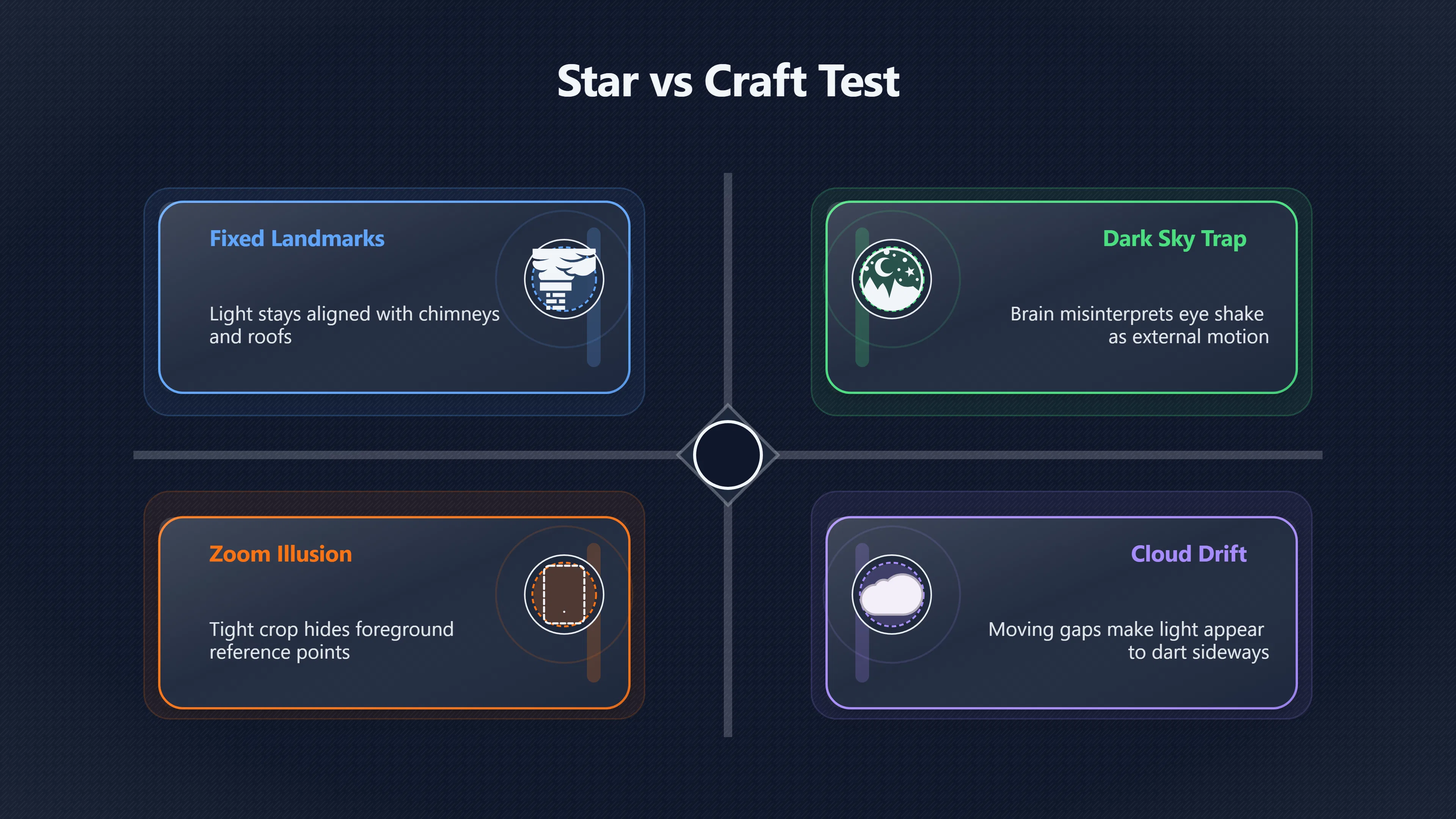
Investigators often underestimate how much visual instability can come from the observer rather than the object. Tiny involuntary eye movements, known as saccades, constantly shift the image on the retina. Without a stable frame around the light, the brain can misinterpret those corrections as external motion.[researchgate.net]researchgate.netFixational eye movements and the autokinetic illusionMarch 23, 2010 — 23 Feb 2026 — A stationary point light source in an otherwise completely dark room is often perceived as moving, a pheno…
This is why witnesses may sincerely describe a star as “zig-zagging”, “circling”, or “responding” to observation even when astronomical software later places a bright star at exactly that location. The experience can feel convincing because the apparent motion is genuinely perceived, not deliberately invented.
In UFO case work, this creates an important distinction:
- Perceived motion means the witness experienced movement.
- Measured motion means the object actually changed position relative to the environment.
Landmark testing is designed to separate those two things.
Using foreground landmarks as a motion test
A fixed star can twinkle violently and still remain stationary relative to the landscape. A nearby drone, aircraft or helicopter usually cannot. This makes foreground references one of the simplest high-value screening tools in a UFO workflow.
The core test
Investigators compare the light against stable objects in the foreground:
- Roof ridges
- Chimneys
- Tree lines
- Hills
- Radio masts
- Power pylons
- Building corners
- Window frames
If the light remains in the same position relative to those features over several minutes, the case for a star or planet becomes much stronger.
For example, a witness may report that a flashing object “hovered over the church tower”. If smartphone footage taken ten minutes apart still shows the light aligned with the same point above the tower, the object is probably not nearby. Earth’s rotation moves stars slowly enough that short observations often appear stationary to casual observers.[Bresser]bresser.comZodiac Signs & Constellations in the Night SkyThe stars seem to move in the sky, because the earth rotates around its own axis. Th…
A nearby aircraft or drone would normally drift against the foreground much more obviously unless it was intentionally hovering.
Why cameras exaggerate movement
Many UFO clips unintentionally destroy their own reference frame. The witness zooms tightly onto the light until the foreground disappears. Once that happens, the viewer loses all positional context.
A highly magnified smartphone recording can make a stationary star appear to:
- Bounce
- Rotate
- Accelerate
- Pulse rhythmically
- Change shape
- “React” to movement
In reality, the apparent motion often comes from hand tremor, autofocus hunting and atmospheric turbulence.[researchgate.net]researchgate.netEstimation of based on scintillation of fixed targets imagedNovember 26, 2015 — We define a pixel-based scintillation index for dynamic incoherent imaging of fixed high-contrast targets through atm…
This is why investigators prefer wide shots that preserve foreground structures. Even crude references can be useful. A branch silhouette crossing the frame may provide more investigative value than a perfectly zoomed light blob.
The “cloud drift” trap
Broken cloud can create especially misleading impressions. When thin clouds move across a bright star, the light may seem to dart between gaps or suddenly relocate. Witnesses often interpret this as controlled manoeuvring.
Landmark comparison helps expose this illusion. If the light repeatedly reappears in the same place relative to a rooftop or tree despite changing cloud cover, the apparent motion is probably environmental rather than physical.
This becomes particularly important in winter UFO reports in the UK, where bright low-altitude stars interact with haze, moisture and moving cloud layers near the horizon.
When landmark tests become more complicated
The method is powerful, but not foolproof. Several real-world complications can produce confusing results.
Moving observers create false parallax
If the witness is driving, walking or filming from a moving vehicle, even distant stars can appear to “follow” them. Nearby foreground objects shift rapidly while the star barely moves, creating a strong illusion that the light is pacing the observer.
This effect, known as parallax, is a major source of mistaken motion reports.[New Space Economy]newspaceeconomy.caNew Space Economy Decoding the Unidentified: A Comprehensive Analysis of UAPSatellites in low Earth orbit reflect sunlight and appear as moving stars. Large formations, such…Read more…
Investigators therefore ask:
- Was the witness stationary?
- Was the camera handheld?
- Was the observation made from a vehicle?
- Did the object only appear mobile during observer movement?
A star that seems to “track” a moving car but stays fixed once the witness stops is usually behaving like a distant celestial object rather than a nearby craft.
Trees and clouds can create accidental reference errors
Foreground landmarks are only useful if they are truly stable. Moving branches, swaying trees and drifting cloud edges can themselves create false motion cues.
This matters in windy conditions. A witness may unconsciously use a moving branch as the reference point instead of the building behind it. The star then appears to shift position even though the background structure remains fixed.
AI-assisted workflows therefore benefit from confidence scoring rather than binary conclusions.
How AI records uncertainty in a star match
Modern UFO investigation systems increasingly treat astronomical identification as a probabilistic process rather than a simple yes-or-no answer. Landmark testing becomes one input among several.
A structured case file may combine:
- Witness direction estimates
- Time and duration
- Sky visibility
- Foreground geometry
- Camera stability
- Weather conditions
- Astronomical object positions[reddit.com]reddit.comA “flickering” object in the northern hemisphere: r/askastronomyCould be Polaris, but most bright stars can flicker. Just use the…
- Cloud cover
- Observer movement
The software can then assess how strongly the evidence supports a stationary star explanation.
Example workflow
An AI-assisted investigation pipeline might process a flashing-light report like this:
- The witness uploads video and location data.
- The system extracts frame-by-frame motion relative to rooftops or trees.
- The software stabilises camera shake.
- Foreground landmarks are tracked automatically.
- The light’s angular position is measured against the fixed scene.
- Astronomical databases check whether a bright star occupied that position.
- Weather data assesses turbulence and visibility.
- The system assigns confidence levels rather than absolute conclusions.
A result might read:
- Strong match with Sirius at reported azimuth and elevation.
- Minimal measurable displacement relative to rooftop.
- High atmospheric scintillation likelihood due to low altitude and humidity.
- Witness-reported motion exceeds measured motion confidence.
That approach keeps the investigation evidence-led. The witness experience is acknowledged without overstating what the footage objectively shows.

Why uncertainty matters
Not every flashing-light case cleanly resolves into “just a star”. Poor footage, incomplete timing data or obstructed foregrounds can leave ambiguity.
For example:
- A star may explain the stationary flashing component.
- A separate moving aircraft may have entered the scene later.
- Witness memory may compress multiple events into one narrative.
- Video stabilisation may be insufficient for precise tracking.
Good investigative systems therefore distinguish between:
- Confirmed astronomical match
- Probable star explanation
- Consistent with star behaviour[facebook.com]facebook.comStar clusters visible with binocularsThis low to the horizon, the light scatter was terrible, so the cluster, though distinct through the…
- Insufficient evidence
- Motion unresolved
That distinction prevents overconfidence in both sceptical and extraordinary interpretations.
What investigators look for in a convincing stationary-light case
Landmark testing becomes especially persuasive when several indicators align together.
Strong indicators of a star misidentification
- The light stayed aligned with a fixed landmark.
- The observation lasted many minutes without measurable travel.
- The object flashed multiple colours.
- The light sat low near the horizon.
- Witnesses reported “hovering”.
- Smartphone footage shows exaggerated shake at high zoom.
- Astronomical software identifies a bright star in the same position.
- Weather conditions favoured strong scintillation.
Community astronomy discussions repeatedly show these patterns, particularly involving Sirius and other bright stars.[Reddit]reddit.comWhat is this??: r/UFOsAs soon as I hear music start on any UFO video I just shut it off…. The flashing colors are called scintillati…
Indicators that deserve further investigation
Landmark testing alone does not explain every report. Investigators continue examining cases when:
- The object measurably changes position against fixed structures.
- Multiple independent witnesses report coordinated movement.
- The light crosses large sky distances.
- Flight data and astronomy checks fail to fit the observation.
- Instrument data supports real motion.
- The object displays structured behaviour inconsistent with atmospheric effects.
The key point is not that all flashing UFO reports reduce to stars. It is that fixed-reference testing is one of the fastest and most reliable ways to identify when a dramatic-looking light was probably stationary all along.
Why this simple method remains so valuable
Sophisticated AI tools, image analysis systems and astronomical databases are increasingly useful in UFO investigations, but some of the strongest evidence still comes from ordinary visual anchors. A chimney edge or hill silhouette can reveal more about a flashing light than extreme digital zoom ever will.
That is partly because landmark testing addresses a central weakness in human night-time observation: people are far better at noticing brightness and colour changes than judging precise motion in darkness.[Wikipedia]WikipediaAutokinetic effectAutokinetic effect[Skybrary In practical investigations]skybrary.aeroAutokinetic Effect | SKYbrary Aviation SafetyIn darkness or in a featureless environment there is no reference point, so the move…, the question often becomes less “What was the light?” and more “Did the light itself move at all?” Once that question is answered carefully, many apparently mysterious flashing-object reports become much easier to classify.
eBay marketplace picks
Marketplace Samples
Topic-anchored marketplace searches for visual, collectible, or second-hand items related to this page.


Endnotes
1.
Source: Wikipedia
Title: Autokinetic effect
Link:https://en.wikipedia.org/wiki/Autokinetic_effect
2.
Source: skybrary.aero
Link:https://skybrary.aero/articles/autokinetic-effect
Source snippet
Autokinetic Effect | SKYbrary Aviation SafetyIn darkness or in a featureless environment there is no reference point, so the move...
3.
Source: reddit.com
Link:https://www.reddit.com/r/UFOs/comments/1k3wguz/what_is_this/
Source snippet
What is this??: r/UFOsAs soon as I hear music start on any UFO video I just shut it off.... The flashing colors are called scintillati...
4.
Source: researchgate.net
Title: Fixational eye movements and the autokinetic illusion
Link:https://www.researchgate.net/publication/245614384_Fixational_eye_movements_and_the_autokinetic_illusion
Source snippet
March 23, 2010 — 23 Feb 2026 — A stationary point light source in an otherwise completely dark room is often perceived as moving, a pheno...
Published: March 23, 2010
5.
Source: bresser.com
Link:https://www.bresser.com/guidebook/astronomy/the-view-of-the-starry-sky/
Source snippet
Zodiac Signs & Constellations in the Night SkyThe stars seem to move in the sky, because the earth rotates around its own axis. Th...
6.
Source: researchgate.net
Title: Estimation of based on scintillation of fixed targets imaged
Link:https://www.researchgate.net/publication/284551311_Estimation_of_based_on_scintillation_of_fixed_targets_imaged_through_atmospheric_turbulence
Source snippet
November 26, 2015 — We define a pixel-based scintillation index for dynamic incoherent imaging of fixed high-contrast targets through atm...
Published: November 26, 2015
7.
Source: reddit.com
Link:https://www.reddit.com/r/askastronomy/comments/1fhig5z/a_flickering_object_in_the_northern_hemisphere/
Source snippet
A “flickering” object in the northern hemisphere: r/askastronomyCould be Polaris, but most bright stars can flicker. Just use the...
8.
Source: reddit.com
Link:https://www.reddit.com/r/space/comments/d6ne8j/i_saw_a_phenomenon_in_the_sky_last_night_that_i/
Source snippet
I saw a phenomenon in the sky last night that I have never...Article: The Autokinetic effect is an optical illusion that makes stars loo...
9.
Source: youtube.com
Title: Visual Illusions Every Pilot Should Know
Link:http://www.youtube.com/watch?v=4gG9RlbPb5Q
Source snippet
The Autokinetic Effect - Social Influence & Group Processes | Class 12 Psychology Chapter 7...
10.
Source: youtube.com
Title: The Autokinetic Effect
Link:http://www.youtube.com/watch?v=cZUHoyEderQ
Source snippet
#mpc004 Social Psychology Experiment By Sherif | #autokineticeffect...
11.
Source: youtube.com
Link:http://www.youtube.com/watch?v=hxRw4pNGIyA
Source snippet
What James Fox Said is unbelievable 🤯 #jreclips #joerogan #jamesfox #alien #viral...
12.
Source: youtube.com
Title: Magnet Brains
Link:https://www.youtube.com/watch?v=b12rHkg1gsw
Source snippet
The Autokinetic Effect | #mpc004 Social Psychology Experiment By Sherif | #autokineticeffect Achiever's Hive...
13.
Source: newspaceeconomy.ca
Title: New Space Economy Decoding the Unidentified: A Comprehensive Analysis of UAP
Link:https://newspaceeconomy.ca/2025/12/02/decoding-the-unidentified-a-comprehensive-analysis-of-uap-explanations/
Source snippet
Satellites in low Earth orbit reflect sunlight and appear as moving stars. Large formations, such...Read more...
Additional References
14.
Source: conference.sdo.esoc.esa.int
Link:https://conference.sdo.esoc.esa.int/proceedings/sdc9/paper/344/SDC9-paper344.pdf
Source snippet
ESA Proceedings DatabaseATMOSPHERIC SCINTILLATION IN RESIDENT...by M Kuhn — A particular focus was placed on how the scintillation noise...
15.
Source: facebook.com
Link:https://www.facebook.com/groups/seestar/posts/816042597874691/
Source snippet
Star clusters visible with binocularsThis low to the horizon, the light scatter was terrible, so the cluster, though distinct through the...
16.
Source: facebook.com
Link:https://www.facebook.com/groups/5889909863/posts/10160545347924864/
Source snippet
Understanding the Autokinetic Effect in AstronomyBasically your brain will impart movement to a stationary object, especially if it's a p...
17.
Source: sky-lens.com
Link:https://sky-lens.com/guide
18.
Source: facebook.com
Title: whats in the night sky february saturn and jupiter winter hexagon asterism artem
Link:https://www.facebook.com/NationalSpaceCentre/posts/whats-in-the-night-sky-february-saturn-and-jupiter-winter-hexagon-asterism-artem/1342907911203037/
Source snippet
What's in the night sky? February 🔭 🪐 Saturn and Jupiter...TWINKLE TWINKLE LITTLE STAR You can tell whether you are looking at a planet...
19.
Source: youtube.com
Link:https://www.youtube.com/watch?v=DKQ8XuCINUU
Source snippet
Introductory Astronomy: Motions of the StarsVideo lecture that explains the apparent motion of stars in the sky using the celestial spher...
20.
Source: study.com
Link:https://study.com/academy/lesson/the-apparent-motion-of-stars-planets.html
Source snippet
Apparent Motion of Stars & Planets | Overview & TypesApparent motion is what happens when something that is not moving appears to move. T...
21.
Source: youtube.com
Link:http://www.youtube.com/watch?v=xuWscrshR4o
Source snippet
How to investigate ufo sightings using fixed landmarks What James Fox Said is unbelievable 🤯 #jreclips #joerogan #jamesfox #alien #viral...
22.
Source: scholarship.richmond.edu
Title: UR Scholarship Repository”Autokinetic Effect” by Donelson R
Link:https://scholarship.richmond.edu/jepson-faculty-publications/162/
Source snippet
Forsythby DR Forsyth · 2008 — The autokinetic effect is an optical illusion. It occurs when a perceiver staring at a stationary pinpoint...
23.
Source: academia.edu
Title: (PDF) UFOs and the extraterrestrial contact movement
Link:https://www.academia.edu/71337593/UFOs_and_the_extraterrestrial_contact_movement_a_bibliography
Source snippet
UFO investigations in the early days. His stance as a genuinely open-minded fact finder deflated for a time the charges of an Air Force c...
Topic Tree