Within False Matches
When a drone answer stops fitting
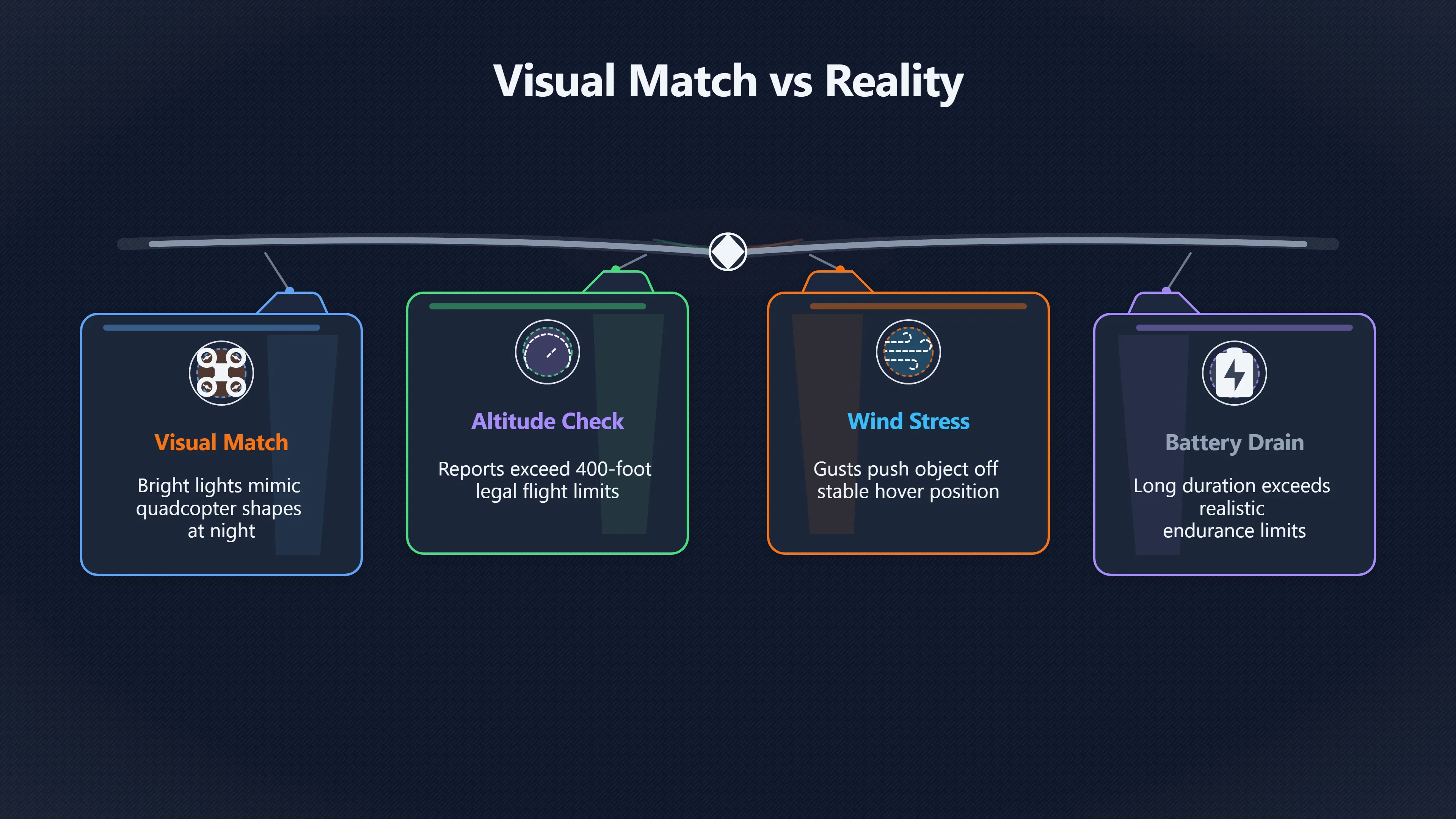
A drone match becomes weak when the claimed altitude, wind conditions, endurance or airspace context do not fit realistic operation.
On this page
- Drone movement that looks genuinely strange
- Wind, battery and range reality checks
- Airspace and witness clues that matter
Page outline Jump by section
Introduction
A drone is one of the most common explanations proposed during modern UFO or UAP case review. In many reports, that is sensible. Consumer quadcopters are widespread, often brightly lit, difficult to judge at night, and capable of movements that look unusual to an untrained observer. But in AI-assisted investigation, a drone match only remains credible if it survives basic physical and operational checks.
 The most important failures usually involve altitude, wind and flight endurance. A sighting may describe an object apparently stationary in gale-force winds, operating at heights far beyond normal drone limits, or remaining airborne for durations that do not fit realistic battery performance. AI systems trained to match visual similarity can still wrongly classify these events as drones if they rely too heavily on shape, lighting or motion patterns while ignoring environmental context. NASA’s UAP study warned that poor metadata and weak sensor calibration can encourage overconfident conclusions from incomplete evidence.[NASA Science]science.nasa.govNASA ScienceIndependent Study Team ReportAt present, analysis of UAP data is hampered by poor sensor calibration, the lack of multiple me…
In practical UFO investigation, the key question is not whether a drone explanation is possible in theory. The question is whether the specific drone explanation fits the actual conditions of the event.
When a drone answer stops fitting
Many weak drone explanations begin with a real visual resemblance. A hovering light, rapid directional change or flickering orb may initially resemble a quadcopter operating at night. Automated review systems often flag these similarities quickly because drones produce recognisable movement signatures in infrared and low-light footage.
The problem appears when investigators move beyond the image itself and reconstruct the physical situation around the sighting.
In a reliable case review, AI systems should compare the report against several operational constraints at once:
- Estimated altitude
- Surface and upper-level wind conditions
- Flight duration
- Local airspace restrictions
- Terrain and launch practicality
- Visibility and line-of-sight limitations
- Known consumer or commercial drone capabilities
A match weakens sharply if several of these factors conflict with normal drone operation.
For example, a report describing a silent object apparently remaining fixed for twenty minutes above a coastal cliff during strong crosswinds may superficially resemble a drone. Yet if weather data shows sustained winds beyond the stability limits of common quadcopters, the explanation becomes less convincing. Most consumer drones have practical wind tolerances well below severe gust conditions, and gust variability matters as much as average wind speed.[caa.co.uk]caa.co.ukely; wind on the ground is often very different to the wind at…Read more…[hiredronepilot.uk]hiredronepilot.ukflying drones windy weatherFlying Drones in Windy Weather: Safety Tips & Wind Limits…11 Sept 2025 — 1Most consumer drones can safely fly in winds up to 10-20 mph…
Likewise, sightings claiming extreme altitude can expose weak AI classification. UK Civil Aviation Authority guidance limits routine drone operations to 120 metres or 400 feet above the nearest point on the surface. FAA rules in the United States impose similar 400-foot restrictions for ordinary small unmanned aircraft operations.[Federal Aviation Administration]faa.govsmall unmanned aircraft systems uas regulations part 107The maximum allowable altitude is 400 feet above the ground, higher if your…Read more…
Witnesses are often poor at estimating height at night, so altitude claims alone do not automatically eliminate drones. But some reports include contextual clues that make ordinary drone operation difficult to reconcile with the scene.
Examples include:
- An object appearing above commercial cloud layers
- A light visible simultaneously across large geographic distances
- Sightings near high-altitude aircraft traffic
- Objects tracked on multiple cameras against stars or terrain
- Reports involving sustained operation far offshore or over mountains
An AI system focused mainly on image similarity can miss these contradictions unless the workflow explicitly integrates weather, geography and airspace data.
Drone movement that looks genuinely strange
Witnesses often describe drone-like behaviour in emotionally loaded terms: instant acceleration, impossible hovering, abrupt stops or silent manoeuvres. Some of these impressions are genuine perception errors caused by darkness, lack of reference points or camera stabilisation artefacts. Others are created by automated video processing itself.
But there are also cases where a drone explanation becomes operationally awkward rather than visually awkward.
A useful distinction in case review is the difference between apparently strange movement and physically unsupported movement.
Hovering in conditions that should push a drone away
Quadcopters compensate continuously against wind drift. In calm weather, this creates the illusion of perfectly stationary hovering. In stronger winds, however, drones tilt aggressively into the airflow to maintain position. At distance and at night, that tilt may not be visible, but the aircraft usually still exhibits some instability, lateral correction or altitude fluctuation.
If meteorological data shows strong upper-level winds while the object appears entirely motionless relative to fixed landmarks, investigators should test whether the drift profile matches realistic drone stabilisation.
The Civil Aviation Authority explicitly warns that wind conditions higher above the ground may differ substantially from those felt by the operator on the surface.[caa.co.uk]caa.co.uksurface. If you fly where the ground falls or rises…Read more…
This matters because many UFO videos are recorded from sheltered ground positions while the object itself may be hundreds of metres higher in stronger airflow.
A robust AI-assisted workflow therefore compares:
- Witness location
- Terrain shielding
- Wind gradient by altitude
- Gust intervals
- Claimed hover stability
- Estimated object distance
Without that layered comparison, the software may wrongly reward superficial “hovering drone” similarity.
Sudden acceleration that may actually be perspective
Some drone explanations fail because the object appears to accelerate far beyond consumer drone performance. Yet many of these cases collapse under geometric analysis rather than extraordinary physics.
Common causes include:
- Camera zoom changes
- Autofocus jumps
- Foreground reference loss
- Observer movement
- Rapid pan tracking
- Parallax against clouds or stars
However, not every acceleration claim can be dismissed automatically. A drone explanation becomes weaker if the sighting includes reliable reference points and measured angular motion inconsistent with plausible drone speed or control range.
This is where event reconstruction matters more than raw footage classification. AI systems that only process pixels often perform poorly compared with workflows that incorporate timing, orientation and environmental geometry.
Wind, battery and range reality checks
The easiest way to overfit a drone explanation is to ignore endurance limits.
Many UFO reports involve objects remaining visible for unusually long periods. Witnesses sometimes describe lights hovering or manoeuvring for thirty minutes, an hour or longer. A casual reviewer may still classify the object as a drone because the visual behaviour seems compatible.
But realistic endurance matters.
Consumer quadcopters often advertise long flight times under ideal conditions, yet real-world operation in darkness, wind, cold weather or heavy manoeuvring reduces battery performance substantially. Weather studies on drone flyability note that many common drone classes have limited tolerance for wind, rain and temperature extremes.[Nature]nature.comWeather constraints on global drone flyabilityby M Gao · 2021 · Cited by 237 — The CD class has an operational temperature range of…
Strong winds are especially important because maintaining a fixed hover in gusting conditions dramatically increases power consumption. A sighting involving:
- Long duration
- High winds
- Large apparent distance
- Repeated repositioning
may exceed realistic consumer drone endurance even if the visual profile initially resembles one.

Why upper-level wind matters more than surface conditions
A common investigative mistake is relying only on local ground weather.
Drone capability depends heavily on wind conditions at operational altitude. Wind speed often increases sharply with height, especially near coastlines, hills or frontal weather systems.
An object observed several hundred feet above ground may therefore encounter conditions very different from those experienced by the witness.
Good AI-assisted review systems should ingest:
- METAR aviation weather reports[faa.gov]faa.govsmall unmanned aircraft systems uas regulations part 107The maximum allowable altitude is 400 feet above the ground, higher if your…Read more…
- Wind sounding data
- Local terrain modelling
- Coastal orographic effects
- Gust timing
- Temperature and precipitation
This prevents simplistic classifications based only on visual similarity.
A drone explanation weakens considerably if the reconstructed environment suggests the aircraft would struggle to maintain stable flight or safely return to the operator.
Range and control assumptions
Another overlooked issue is practical operating range.
Many public discussions exaggerate how far drones can realistically operate. Marketing specifications often assume ideal signal conditions and unobstructed environments. Real-world operations are constrained by radio interference, terrain masking and legal visual line-of-sight rules. UK guidance requires pilots to maintain visual contact with the aircraft, while US rules similarly restrict ordinary operations. Aircam Drone Services DroneBundle That becomes relevant in UFO cases involving:[dronebundle.com]dronebundle.comDrone Bundle How Far Can a Drone Fly?Range Limits by Type, Model…4 Feb 2026 — Most consumer drones can transmit control signals up to 10-20 km (6-12 miles) under ideal co…
- Remote moorland
- Offshore sightings
- Mountain valleys
- Restricted military zones
- Sparse launch opportunities
If no plausible launch area exists within realistic operational range, the drone explanation becomes weaker even if the movement pattern initially resembles one.
Airspace and witness clues that matter
AI review systems sometimes treat all drone explanations as equally plausible regardless of location. In practice, airspace context matters enormously.
Restricted or impractical flight environments
Some sightings occur in places where drone operation would be risky, illegal or operationally awkward.
Examples include:
- Near active airports[faa.gov]faa.govwhat know about dronesWhat To Know About Drones14 Jan 2025 — You can fly drones in most locations below 400 feet. Flying near airports usually requires authori…
- Above military installations
- Inside temporary flight restriction areas[faa.gov]faa.govtemporary flight restrictionsTFRs)10 Mar 2025 — They restrict aircraft (including drones) from operating without permission in a certain area for a limited time. You…
- During severe weather
- Above dense urban crowds
- Offshore at night
This does not automatically rule drones out. Illegal flights happen regularly. But it changes the probability assessment.
FAA and CAA guidance both impose significant operational restrictions around controlled airspace and populated areas.[Federal Aviation Administration]faa.govsmall unmanned aircraft systems uas regulations part 107The maximum allowable altitude is 400 feet above the ground, higher if your…Read more…
A strong investigative workflow therefore checks:
- Local NOTAMs and temporary restrictions[faa.gov]faa.govtemporary flight restrictionsTFRs)10 Mar 2025 — They restrict aircraft (including drones) from operating without permission in a certain area for a limited time. You…
- Airport proximity
- Known drone events or commercial filming
- Police reports
- Public drone groups or race events
- Nearby roads or launch sites
Without these checks, an AI system may generate a technically possible but contextually weak explanation.
Witness behaviour can support or weaken the drone theory
Witness testimony also contains indirect operational clues.
For example:
- Did observers hear rotor noise?
- Was the object visible for longer than expected battery duration?
- Did multiple witnesses estimate radically different distances?
- Did the object appear to fight strong wind?
- Did it vanish suddenly behind terrain?
- Was there evidence of operator proximity?
Drone sounds are particularly complicated. Night-time atmospheric conditions can carry rotor noise surprisingly far, while wind direction can suppress it almost completely. Silence alone does not eliminate drones. But total absence of sound during a close, low-altitude sighting deserves scrutiny.
Likewise, witness estimates of size and distance are notoriously unreliable at night. AI-assisted systems should avoid treating these values as fixed facts. Instead, good workflows generate multiple plausible geometries and test whether a realistic drone profile still fits under each scenario.
Why AI systems overcommit to drone explanations
Machine-learning systems are vulnerable to pattern completion. If trained heavily on low-light drone footage, they may over-associate certain behaviours with drones even when environmental conditions contradict the classification.
This becomes more likely when:
- Video quality is poor
- Metadata is incomplete
- Wind information is absent
- Altitude is guessed rather than measured
- The footage lacks multiple viewing angles
NASA’s UAP study repeatedly emphasised that missing contextual metadata weakens reliable interpretation.[NASA Science]science.nasa.govNASA ScienceIndependent Study Team ReportAt present, analysis of UAP data is hampered by poor sensor calibration, the lack of multiple me…
In UFO case review, the danger is not merely a wrong answer. The danger is a convincing but weakly supported answer that closes inquiry too early.
A useful AI-assisted investigation system should therefore treat drone explanations probabilistically rather than conclusively. The software should not merely ask, “Does this resemble a drone?” It should ask:
- Could a drone realistically operate here?
- Could it maintain stable flight in these winds?
- Could it sustain this duration?
- Could it legally and practically launch nearby?
- Does the claimed altitude fit known operation limits?
- Do witness observations match known drone behaviour under these conditions?
Only after those checks should the explanation move from “possible” to “credible”.
Amazon book picks
Further Reading
Books and field guides related to When a drone answer stops fitting. Use these as the next step if you want deeper reading beyond the article.
The Complete Guide to Drones
Useful for understanding when drone explanations stop fitting.
The Signal and the Noise
Relevant to avoiding overconfident visual matches from weak data.
UFO Investigations Manual
Fits the human review process for drone explanations in UFO cases.
eBay marketplace picks
Marketplace Samples
Example marketplace items related to this page. Use the search link to explore similar finds on eBay.


Endnotes
1.
Source: science.nasa.gov
Link:https://science.nasa.gov/wp-content/uploads/2023/09/uap-independent-study-team-final-report.pdf
Source snippet
NASA ScienceIndependent Study Team ReportAt present, analysis of UAP data is hampered by poor sensor calibration, the lack of multiple me...
2.
Source: caa.co.uk
Link:https://www.caa.co.uk/drones/getting-started-with-drones-and-model-aircraft/drone-code/making-every-flight-safe-points-10-to-20/
Source snippet
ely; wind on the ground is often very different to the wind at...Read more...
3.
Source: hiredronepilot.uk
Title: flying drones windy weather
Link:https://hiredronepilot.uk/blog/flying-drones-windy-weather
Source snippet
Flying Drones in Windy Weather: Safety Tips & Wind Limits...11 Sept 2025 — 1Most consumer drones can safely fly in winds up to 10-20 mph...
4.
Source: caa.co.uk
Link:https://www.caa.co.uk/drones/getting-started-with-drones-and-model-aircraft/drone-code/where-you-can-fly-points-3-to-9/
Source snippet
surface. If you fly where the ground falls or rises...Read more...
5.
Source: faa.gov
Title: small unmanned aircraft systems uas regulations part 107
Link:https://www.faa.gov/newsroom/small-unmanned-aircraft-systems-uas-regulations-part-107
Source snippet
The maximum allowable altitude is 400 feet above the ground, higher if your...Read more...
6.
Source: faa.gov
Title: what know about drones
Link:https://www.faa.gov/newsroom/what-know-about-drones
Source snippet
What To Know About Drones14 Jan 2025 — You can fly drones in most locations below 400 feet. Flying near airports usually requires authori...
7.
Source: nature.com
Link:https://www.nature.com/articles/s41598-021-91325-w
Source snippet
Weather constraints on global drone flyabilityby M Gao · 2021 · Cited by 237 — The CD class has an operational temperature range of...
8.
Source: dronebundle.com
Title: Drone Bundle How Far Can a Drone Fly?
Link:https://dronebundle.com/blog/how-far-can-a-drone-fly
Source snippet
Range Limits by Type, Model...4 Feb 2026 — Most consumer drones can transmit control signals up to 10-20 km (6-12 miles) under ideal co...
9.
Source: faa.gov
Title: recreational flyers
Link:https://www.faa.gov/uas/recreational_flyers
Source snippet
Federal Aviation AdministrationRecreational Flyers & Community-Based OrganizationsMar 18, 2026 — Fly at or below FAA-authorized altitudes...
10.
Source: faa.gov
Title: Federal Aviation Administration Section 6
Link:https://www.faa.gov/air_traffic/publications/atpubs/foa_html/chap19_section_6.html
Source snippet
14 CFR Part 107, sUAS OperationsNo person may operate a small unmanned aircraft in Class B, Class C, or Class D airspace, or within the l...
11.
Source: faa.gov
Title: Section 8
Link:https://www.faa.gov/air_traffic/publications/atpubs/aim_html/chap11_section_8.html
Source snippet
Other Information and Best Practices... UAS limitations, local weather, and applicable flight rules; that the UAS itself is mechanically...
12.
Source: faa.gov
Title: temporary flight restrictions
Link:https://www.faa.gov/uas/getting_started/temporary_flight_restrictions
Source snippet
(TFRs)10 Mar 2025 — They restrict aircraft (including drones) from operating without permission in a certain area for a limited time. You...
13.
Source: faa.gov
Link:https://www.faa.gov/air_traffic/publications/atpubs/foa_html/chap5_section_5.html
14.
Source: nasa.gov
Title: update nasa shares uap independent study report names director
Link:https://www.nasa.gov/news-release/update-nasa-shares-uap-independent-study-report-names-director/
Source snippet
UPDATE: NASA Shares UAP Independent Study ReportSep 14, 2023 — NASA commissioned the independent study to better understand how the agenc...
15.
Source: nasa.gov
Title: to release discuss unidentified anomalous phenomena report
Link:https://www.nasa.gov/news-release/nasa-to-release-discuss-unidentified-anomalous-phenomena-report/
Source snippet
NASA to Release, Discuss Unidentified Anomalous...Sep 12, 2023 — NASA commissioned the study to examine UAP from a scientific perspectiv...
16.
Source: science.nasa.gov
Link:https://science.nasa.gov/uap/
Source snippet
9, 2022 — The UAP Independent Study shall report on the following questions: What types of scientific data currently collected and archiv...
18.
Source: hiredronepilot.uk
Link:https://hiredronepilot.uk/blog/1-to-1-rule-drones/
Source snippet
The Drone 1-to-1 Rule: What UK Law Actually Requires12 Sept 2025 — The Drone Code requires your horizontal distance from people to match...
19.
Source: caa.co.uk
Link:https://www.caa.co.uk/drones/getting-started-with-drones-and-model-aircraft/drone-code/drone-code-overview/
20.
Source: caa.co.uk
Link:https://www.caa.co.uk/drones/getting-started-with-drones-and-model-aircraft/where-you-can-fly/
Source snippet
Where you can flyKeep your drone or model aircraft at a safe distance from people. You must not fly closer to people than 50m horizontall...
21.
Source: caa.co.uk
Link:https://www.caa.co.uk/publication/download/21727
Source snippet
CAP2606 (1.5MB DOCX)Drone and remote piloted aircraft publications | Civil Aviation Authority (caa.co.uk)... Wind speed limits including...
Additional References
22.
Source: ecfr.gov
Link:https://www.ecfr.gov/current/title-14/chapter-I/subchapter-F/part-107
Source snippet
14 CFR Part 107 -- Small Unmanned Aircraft SystemsThis part applies to the registration, airman certification, and operation of civil sma...
23.
Source: nifc.gov
Link:https://www.nifc.gov/drones/blm/FAA%20Part%20107%20Fact%20Sheet.pdf
Source snippet
FAA Part 107 Fact SheetMinimum weather visibility is three miles from your control station. The maximum allowable altitude is 400 feet ab...
24.
Source: dartdrones.com
Link:https://www.dartdrones.com/faa-drone-regulations-commercial-drone-use/
Source snippet
FAA Drone Regulations for Commercial Drone UseThese flights include daylight and the recently amended night flight operations, flying und...
25.
Source: reddit.com
Link:https://www.reddit.com/r/space/comments/16ij6ui/nasa_shares_unidentified_anomalous_phenomena/
Source snippet
NASA Shares Unidentified Anomalous Phenomena...I read the report. To summarize: we should reduce stigma for reporting this stuff. we nee...
26.
Source: facebook.com
Link:https://www.facebook.com/AstroAlexandraOfficial/posts/nasa-uap-ufo-report-released-today-offers-a-few-answers-but-doesnt-find-or-rule-/319484690604324/
Source snippet
NASA UAP (UFO) report released today offers a few...The report acknowledges that analyzing UAP data faces challenges due to sensor calib...
27.
Source: reddit.com
Link:https://www.reddit.com/r/nasa/comments/16ij1ym/nasa_has_released_the_unidentified_anomalous/
Source snippet
NASA has released the Unidentified Anomalous...NASA has released the Unidentified Anomalous Phenomena independent study team's report wi...
28.
Source: skytechcambridge.co.uk
Link:https://www.skytechcambridge.co.uk/droneknowledgebase
Source snippet
UK Drone Knowledge BaseAccording to the UK's Civil Aviation Authority (CAA), the maximum altitude at which a drone can be flown is 400 fe...
29.
Source: aaro.mil
Link:https://www.aaro.mil/UAP-Cases/Official-UAP-Imagery/
Source snippet
UAP ImageryThe United States European Command submitted a report of an unidentified anomalous phenomenon to the All-domain Anomaly Resolu...
30.
Source: linkedin.com
Link:https://www.linkedin.com/posts/1971a_i-was-working-on-the-contradiction-at-the-activity-7459767973927342081-2Iaw
Source snippet
UFO Sightings: Separating Fact from Fiction | Erik Larson...A thing can be unidentified for boring reasons: bad [sensor data]({{ 'sensor-data/' | relative_url }}), optical ill...
31.
Source: flybyguys.com
Link:https://www.flybyguys.com/blog/weather-considerations-professional-drone-operations
Source snippet
Weather Considerations for Professional Drone OperationsMaximum wind speed limitations vary significantly between drone platforms, with s...
Topic Tree