Within UFO Case AI
Was the UFO Really in the Sky Map?
The Moon, Venus, Jupiter, meteors, and debris can appear surprising unless their position is checked from the witness location and time.
On this page
- Planets, Moon, stars, and meteors
- Observer specific sky positions
- When astronomy fits only part of the report
Page outline Jump by section
Introduction
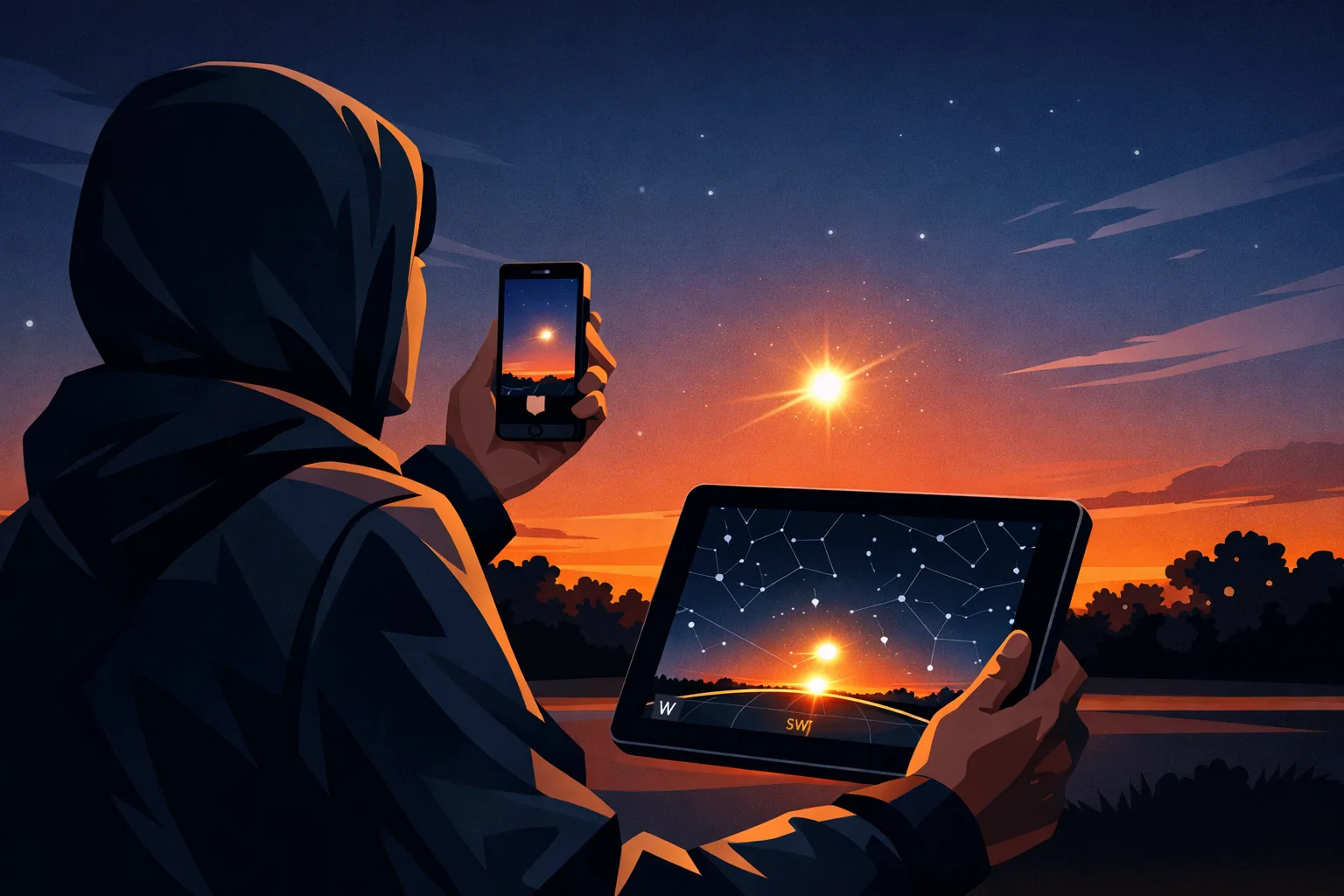
A bright “UFO” is not fully investigated until the sky itself has been checked from the witness’s exact place and time. Venus, Jupiter, the Moon, bright stars, meteors, fireballs and re-entering debris can all look startling when they appear low on the horizon, through haze, near cloud, in twilight, or on a zoomed phone video. The astronomy check does not dismiss the witness; it tests whether a known celestial object was in the right part of the sky, at the right brightness, moving or not moving in the right way, and visible under the reported conditions.
For an AI-assisted UFO sighting investigation, this is one of the quickest high-value screens. The case file should convert “bright light in the western sky” into testable quantities: observer location, clock time, bearing, elevation, duration, angular movement, colour, weather, and any camera metadata. NASA’s UAP work has stressed that better data collection and well-characterised observations are essential before advanced analysis can be useful; astronomy checks are a practical example of that principle.[NASA Science]science.nasa.govNASA ScienceUAPJune 16, 2022 — 9 Jun 2022 — A study team to examine unidentified anomalous phenomena (UAPs) – that is, observations of ev…
Planets, Moon, stars, and meteors
Astronomical explanations matter because they have a long record of producing convincing but ordinary UFO reports. A U.S. Air Force Project Blue Book fact sheet, preserved by the National Archives, says 12,618 sightings were reported between 1947 and 1969, with 701 remaining “unidentified”; another Project Blue Book document notes that astronomical sightings were among the most common types, including bright stars, planets, comets, fireballs, meteors, auroral streamers and other celestial bodies.[National Archives]nationalarchives.gov.ukSource details in endnotes.
That historical lesson transfers directly into modern casework. A witness can be sincere, observant and still misjudge distance or motion because the night sky lacks familiar scale cues. A planet low over rooftops may look like a hovering object. The Moon behind broken cloud may seem to pulse or follow a car. A meteor may be reported as a “craft” because it appears bright, coloured, silent and fast. A re-entry can fragment slowly enough to look engineered.
The first astronomy triage should separate the likely object classes:
Venus and Jupiter. Venus is the classic bright-object trap because it can dominate the evening or morning sky and, when low, can shimmer through atmosphere and cloud. Royal Museums Greenwich describes Venus as the brightest planet and notes its strong association with UFO confusion, while recent stargazing coverage continues to highlight Venus’s tendency to trigger UFO reports when it becomes the “Evening Star”.[Royal Museums Greenwich]rmg.co.ukSource details in endnotes. Jupiter is usually less brilliant than Venus but can still look unusually prominent, especially in clear air or when the observer has not noticed its nightly position before.
The Moon. The Moon is not usually mistaken for a small object when seen plainly, but partial cloud, haze, reflections, unusual colour near the horizon, or a narrow view through trees and buildings can make it appear detached from the familiar lunar disc. A serious case file should record lunar phase, altitude, azimuth, illumination and cloud cover before treating a large luminous patch as unexplained.
Bright stars. Sirius, Vega, Arcturus, Capella and other bright stars can appear to flash colour when low in the sky because their light passes through more turbulent atmosphere. Unlike aircraft, they remain fixed relative to the star background, but a handheld camera, moving witness or drifting cloud can create apparent motion. A star explanation is stronger when the object was stationary for many minutes and weakens when there is clear sustained travel across the sky against fixed foreground references.
Meteors and fireballs. The American Meteor Society defines a fireball as a very bright meteor, generally brighter than magnitude -4, roughly comparable to Venus at its brightest. The International Meteor Organization similarly describes fireballs as meteors brighter than normal. These objects can be spectacular enough to draw many independent reports over a wide area, but they are usually brief and directional rather than hovering or manoeuvring.[American Meteor Society]amsmeteors.orgSource details in endnotes.
Space debris and re-entry. This sits on the boundary between astronomy and satellite investigation. Re-entering debris can produce a train of lights, fragmentation and a slow shallow path. Public orbital datasets such as CelesTrak’s general perturbations element sets help investigators screen candidate artificial objects, while the sighting description itself also matters: a long, fragmenting, shallow track is often more consistent with re-entry than with a short meteor flash.[CelesTrak]celestrak.orgSource details in endnotes.
Observer-specific sky positions
A useful astronomy check is not “was Venus up somewhere that night?” It is “from this exact witness location, at this exact time, was Venus at the reported bearing and elevation, and would it have looked bright enough under the conditions?” The answer can change over a few miles for foreground alignment, and over minutes for objects near rise or set.
The key measurements are simple but must be handled carefully. Altitude is the angle above the horizon: 0 degrees is on the horizon and 90 degrees is overhead. Azimuth is the compass direction around the horizon, usually measured from true north; Skyfield’s documentation gives the same practical definitions, with north at 0 degrees, east at 90 degrees, south at 180 degrees and west at 270 degrees.[Rhodes Mill]rhodesmill.orgRhodes Mill Positions — Skyfield documentationRhodes Mill Positions — Skyfield documentation
The strongest workflow uses at least two independent checks:
- Ephemeris calculation. NASA JPL’s Horizons system provides custom ephemerides for solar-system objects as seen from specified observer locations, which makes it suitable for checking planets, the Moon, comets and asteroids against a dated sighting.[JPL Solar System Dynamics]ssd.jpl.nasa.govJPL Solar System Dynamics NASA Horizons ManualJPL Solar System Dynamics NASA Horizons Manual
- Visual sky reconstruction. Stellarium describes itself as a free, open-source planetarium that shows a realistic sky for a selected location and time. That kind of visual reconstruction helps investigators and witnesses compare the reported view with the actual sky map. Stellarium
- Sun and Moon reference data. The U.S. Naval Observatory provides services for altitude and azimuth of the Sun and Moon, including values referenced to true north and adjusted for standard atmospheric refraction where applicable. This is useful when a report involves twilight, moonrise, moonset, glare, or a bright object close to the horizon. US Naval Observatory
AI can automate much of this without turning the result into a black box. A case workflow can parse the witness account, extract a probable time window, geocode the observer position, convert local time to UTC, calculate sky positions for major planets and the Moon, then generate a ranked list of matches. The output should not say “solved by Venus” unless the geometry and behaviour fit. It should say, for example: “Venus was at azimuth 247 degrees, altitude 12 degrees, within the reported western field of view; brightness and stationary behaviour fit; claimed rapid movement does not fit unless caused by camera motion or moving cloud.”
This distinction is important because astronomy matches can be deceptively persuasive. A bright planet in the same broad direction is not enough. The investigator needs to compare:
- reported direction with true azimuth, not magnetic compass bearing unless corrected;
- reported elevation with calculated altitude;
- duration with the expected motion of the object;
- colour and flicker with atmospheric conditions;
- apparent movement with foreground references;
- camera field of view, zoom, stabilisation and exposure artefacts;
- whether the witness was stationary, driving, walking, or filming through glass.
A robust case file should preserve the sky-map output as evidence, not just as an analyst note. That means saving the source, tool version where possible, parameters used, coordinates, time zone conversion, and screenshots or tabulated altitude/azimuth results. Later reviewers should be able to reproduce the check.
Meteors and debris need different handling
Fast luminous events require a different astronomy workflow from bright stationary objects. A planet or star can be checked by position at one time. A meteor or re-entry needs a path, duration and multi-witness comparison.
Meteor organisations already use public reporting to build event pictures. The American Meteor Society’s fireball reporting system asks witnesses for precise details and notes that reports contribute to a broader database of meteor knowledge. A 2014 abstract on the AMS reporting system says the upgraded online tool uses maps and programmatic methods to capture observer location, azimuth and elevation with improved precision. American Meteor Society
For UFO investigation, the lesson is that one person’s “object descending near the village” may be a high-altitude event visible across counties or countries. A fireball can look local because it is bright and low in the witness’s field of view, but its actual path may be tens of kilometres high and far away. Cross-checking other reports is therefore central: if many observers across a wide region report the same brief streak at the same time, a meteor or re-entry explanation becomes much stronger.
Fireball clues include:
- a duration of seconds rather than minutes;
- a single sweeping direction across the sky;
- green, blue, orange or white colour;
- fragmentation or a terminal flash;
- no engine sound, though delayed booms may occur for larger events;
- reports from a wide geographic area at the same clock time.
The American Meteor Society notes that fireballs can leave trains or smoke trails, with most glowing trains lasting only seconds and rare ones lasting several minutes while being shaped by upper atmospheric winds. That detail matters because a lingering trail may be reported separately as a stationary object after the bright meteor itself has gone. American Meteor Society
Re-entering debris can overlap with meteor reports but often looks slower and more fragmented. In one widely reported case, NASA concluded that bright lights over Georgia were likely space debris rather than a meteor because of their slower speed and shallow entry angle. That kind of distinction is exactly where AI-assisted triage is useful: compare the reported duration, apparent speed, fragmentation and track against meteor databases and orbital re-entry candidates, then label the result as “meteor-like”, “re-entry-like”, or “insufficient path data” rather than forcing a premature identification. WIRED
When astronomy fits only part of the report
The most common mistake is treating an astronomy match as all-or-nothing. In real investigations, a celestial object may explain one part of the sighting while leaving other details unresolved. The analyst’s job is to separate fit, mismatch and uncertainty.
The Condon Report’s summary made a useful methodological point: ordinary interpretations can be tentative or controversial when there is not enough data for a definite identification. That caution still applies. A sky-map match should reduce uncertainty where it fits, not erase details it does not address. NCAS Files
A planet explanation is strong when the report describes a bright, silent, mostly stationary point in the correct direction and altitude for Venus or Jupiter. It is weaker when the object crosses a large part of the sky in seconds, changes direction sharply against fixed references, appears below cloud that was measured at a low ceiling, or is captured from multiple viewpoints with a triangulated nearby position.
A Moon explanation is strong when the object is large, diffuse, bright, near the Moon’s calculated position, and seen through broken cloud. It is weaker when the sighting involves a compact light moving independently across the sky or when the Moon was below the horizon.
A meteor explanation is strong when the event is brief, bright, directional and widely reported at the same time. It is weaker when the sighting lasts several minutes, stops, reverses, hovers, or reappears repeatedly in the same location over a long period.
A star explanation is strong when the report involves flickering colours, low elevation, long duration and no real displacement relative to foreground objects. It is weaker when the object changes angular position substantially while the camera and foreground remain stable.
An AI-assisted system should therefore avoid a single “astronomy yes/no” flag. Better labels are:
- ruled in as plausible: geometry, timing, brightness and behaviour fit;
- partial fit: the sky object explains the bright light but not all claimed movement or duration;
- weak fit: a candidate object was nearby but not close enough in direction, elevation or behaviour;
- ruled out: the candidate was below the horizon, in the wrong direction, too dim, or inconsistent with the timeline;
- unresolved: the sighting lacks enough bearing, elevation, time or duration data to test properly.
This style of labelling protects both sceptical and open-ended analysis. It prevents weak “it was Venus” dismissals, but it also prevents ordinary objects from being left unchecked simply because the account sounded unusual.
What the astronomy check should add to the case file
The astronomy page in an AI-assisted UFO case file should be treated as dataset evidence, not background colour. It should produce a reproducible record that a reviewer can inspect.
A useful astronomy evidence block includes:
Case inputs. Date, local time, time zone, uncertainty window, witness coordinates or best available location, viewing direction, elevation estimate, duration, weather visibility, cloud cover and any camera metadata.
Computed sky objects. Moon phase and position; Venus, Jupiter, Mars and Saturn positions; bright stars near the reported bearing; twilight state; meteor shower activity if relevant; and any known fireball reports in the same time window.
Candidate match table. Each candidate should have altitude, azimuth, brightness where available, expected motion, visibility conditions and a plain-language fit assessment.
Evidence limitations. Common weaknesses include vague time, no bearing, no horizon reference, moving vehicle observation, phone zoom, rolling-shutter artefacts, wrong time zone, daylight saving errors, and uncertainty over whether the witness meant magnetic north, true north, or a landmark direction.
Reviewer note. The final note should state what changed after the astronomy check: “Venus is a strong candidate”, “meteor explanation fits the duration but not the reported hovering”, “Moon was below the horizon”, or “no bright astronomical object was in the reported sector.”
NASA’s UAP study emphasised the need for higher-quality, better-calibrated data and careful characterisation before applying machine learning. In this narrow astronomy task, that means AI is most useful when it makes the check faster, more consistent and more transparent: it should gather the sky data, expose the assumptions, preserve the witness’s original account, and show exactly why a celestial explanation fits, partly fits, or fails. NASA Science
Amazon book picks
Further Reading
Books and field guides related to Was the UFO Really in the Sky Map?. Use these as the next step if you want deeper reading beyond the article.
eBay marketplace picks
Marketplace Samples
Example marketplace items related to this page. Use the search link to explore similar finds on eBay.


Endnotes
1.
Source: science.nasa.gov
Link:https://science.nasa.gov/uap/
Source snippet
NASA ScienceUAPJune 16, 2022 — 9 Jun 2022 — A study team to examine unidentified anomalous phenomena (UAPs) – that is, observations of ev...
Published: June 16, 2022
2.
Source: science.nasa.gov
Link:https://science.nasa.gov/wp-content/uploads/2023/09/uap-independent-study-team-final-report.pdf
Source snippet
NASA ScienceIndependent Study Team Report... UFO Reporting Center4. This results in inhomogeneously collected, processed, and curated dat...
3.
Source: archives.gov
Title: National Archives Project BLUE BOOK
Link:https://www.archives.gov/research/military/air-force/ufos
4.
Source: space.com
Title: whats that bright light after sunset venus is dazzling the evening sky right now
Link:https://www.space.com/stargazing/whats-that-bright-light-after-sunset-venus-is-dazzling-the-evening-sky-right-now
5.
Source: celestrak.org
Link:https://celestrak.org/NORAD/elements/
6.
Source: wired.com
Link:https://www.wired.com/story/nasa-bright-light-video
7.
Source: ssd.jpl.nasa.gov
Title: JPL Solar System Dynamics NASA Horizons Manual
Link:https://ssd.jpl.nasa.gov/horizons/manual.html
8.
Source: ssd.jpl.nasa.gov
Title: JPL Solar System Dynamics Horizons Tutorial
Link:https://ssd.jpl.nasa.gov/horizons/tutorial.html
9.
Source: stellarium.org
Link:https://stellarium.org/
10.
Source: files.ncas.org
Title: Files Condon Report, Section II
Link:https://files.ncas.org/condon/text/sec-ii.htm
11.
Source: space.com
Title: nasa ufo uap study team first results revealed
Link:https://www.space.com/nasa-ufo-uap-study-team-first-results-revealed
12.
Source: space.com
Title: project blue book ufos season two
Link:https://www.space.com/project-blue-book-ufos-season-two.html
13.
Source: news.sky.com
Title: russia relentlessly targeting uk infrastructure spy chief warns 13548309
Link:https://news.sky.com/story/russia-relentlessly-targeting-uk-infrastructure-spy-chief-warns-13548309
14.
Source: ssd.jpl.nasa.gov
Link:https://ssd.jpl.nasa.gov/horizons/news.html
15.
Source: ssd.jpl.nasa.gov
Link:https://ssd.jpl.nasa.gov/horizons/app.html
16.
Source: ssd.jpl.nasa.gov
Link:https://ssd.jpl.nasa.gov/faq.html
17.
Source: ares.jsc.nasa.gov
Title: how to find meteorites
Link:https://ares.jsc.nasa.gov/meteorite-falls/how-to-find-meteorites/
18.
Source: celestrak.org
Link:https://www.celestrak.org/columns/v04n01/
19.
Source: files.ncas.org
Link:https://files.ncas.org/condon/text/case37.htm
20.
Source: archives.gov
Title: project blue book 50th anniversary
Link:https://www.archives.gov/news/articles/project-blue-book-50th-anniversary
21.
Source: stargazing.net
Link:https://www.stargazing.net/mas/usno3.htm
22.
Source: stellarium.org
Link:https://stellarium.org/en_GB/
23.
Source: catalog.data.gov
Title: fireball and bolide reports
Link:https://catalog.data.gov/dataset/fireball-and-bolide-reports
24.
Source: rmg.co.uk
Link:https://www.rmg.co.uk/stories/space-astronomy/planet-venus
25.
Source: amsmeteors.org
Link:https://www.amsmeteors.org/fireballs/
26.
Source: rhodesmill.org
Title: Rhodes Mill Positions — Skyfield documentation
Link:https://rhodesmill.org/skyfield/positions.html
27.
Source: aa.usno.navy.mil
Link:https://aa.usno.navy.mil/data/AltAz
28.
Source: aa.usno.navy.mil
Link:https://aa.usno.navy.mil/faq/alt_az
29.
Source: fireball.amsmeteors.org
Title: American Meteor Society Report a Fireball
Link:https://fireball.amsmeteors.org/
30.
Source: ui.adsabs.harvard.edu
Link:https://ui.adsabs.harvard.edu/abs/2014acm..conf..201H/abstract
31.
Source: amsmeteors.org
Link:https://amsmeteors.org/fireballs/faqf/
32.
Source: Wikipedia
Title: Space debris
Link:https://en.wikipedia.org/wiki/Space_debris
33.
Source: Wikipedia
Title: Project Blue Book
Link:https://en.wikipedia.org/wiki/Project_Blue_Book
34.
Source: Wikipedia
Title: Stellarium (software)
Link:https://en.wikipedia.org/wiki/Stellarium_%28software%29
35.
Source: britannica.com
Title: Project Blue Book
Link:https://www.britannica.com/topic/Project-Blue-Book
36.
Source: facebook.com
Link:https://www.facebook.com/royalmuseumsgreenwich/posts/welcome-to-astronomers-take-over-as-you-travel-through-this-new-family-friendly-/1379653580864218/
37.
Source: stellarium-web.org
Link:https://stellarium-web.org/
38.
Source: stellarium-web.org
Link:https://stellarium-web.org/p
39.
Source: nationalarchives.gov.uk
Link:https://www.nationalarchives.gov.uk/explore-the-collection/explore-by-time-period/postwar/ufo-reports/
40.
Source: cdn.nationalarchives.gov.uk
Link:https://cdn.nationalarchives.gov.uk/documents/aug-2009-research-guide.pdf
41.
Source: rhodesmill.org
Title: Table of Contents — Skyfield documentation
Link:https://rhodesmill.org/skyfield/toc.html
42.
Source: github.com
Link:https://github.com/stellarium/stellarium
43.
Source: play.google.com
Link:https://play.google.com/store/apps/details?hl=en_GB&id=com.noctuasoftware.stellarium_free
44.
Source: ui.adsabs.harvard.edu
Link:https://ui.adsabs.harvard.edu/abs/2015IAUGA..2256293G/abstract
45.
Source: ui.adsabs.harvard.edu
Link:https://ui.adsabs.harvard.edu/abs/2013A%26A…558A..33A/abstract
46.
Source: gi.alaska.edu
Link:https://www.gi.alaska.edu/alaska-science-forum/venus
47.
Source: stellarium-labs.com
Link:https://stellarium-labs.com/stellarium-mobile-plus/
48.
Source: en.wiktionary.org
Link:https://en.wiktionary.org/wiki/American
49.
Source: spacedata.aei.org
Link:https://spacedata.aei.org/space/debris
Additional References
50.
Source: cia.gov
Link:https://www.cia.gov/readingroom/document/cia-rdp81r00560r000100010002-9
51.
Source: cia.gov
Link:https://www.cia.gov/readingroom/collection/ufos-fact-or-fiction
52.
Source: nsa.gov
Link:https://www.nsa.gov/portals/75/documents/news-features/declassified-documents/ufo/usaf_fact_sheet_95_03.pdf
53.
Source: youtube.com
Title: Venus as a UFO: Why Planets Look Like Mysterious Lights
Link:https://www.youtube.com/watch?v=sIu9H6l7Xh0
Source snippet
How to Distinguish Between Meteors, Satellites, and Aircraft...
54.
Source: youtube.com
Title: How to Distinguish Between Meteors, Satellites, and Aircraft
Link:https://www.youtube.com/watch?v=Xn77H3T4dD8
Source snippet
The Physics of Why Stars and Planets Twinkle...
55.
Source: facebook.com
Link:https://www.facebook.com/spacecom/posts/a-meteorite-has-crashed-through-the-roof-of-a-house-after-thousands-observed-a-s/1279529187371096/
56.
Source: instagram.com
Link:https://www.instagram.com/americanair/?hl=en
57.
Source: tripadvisor.co.uk
Link:https://www.tripadvisor.co.uk/Airline_Review-d8729020-Reviews-American-Airlines
58.
Source: americanexpress.com
Link:https://www.americanexpress.com/en-gb/
59.
Source: thehistoryreader.com
Link:https://www.thehistoryreader.com/cultural-history/official-history-ufos/
Topic Tree
Follow this branch
Parent topic
UFO Case AIRelated pages 9
- Aircraft Was It an Aircraft or Drone?
- Case File What Makes a UFO Report Investigable?
- Case Match Has This UFO Sighting Happened Before?
- Confidence How Certain Can a UFO Explanation Be?
- Review Who Checks the AI UFO Verdict?
- Satellites Could It Be Starlink or a Satellite?
- Timeline What Else Was Happening During the Sighting?
- Video Limits Why Clear UFO Videos Can Still Mislead
- +1 more in sidebar