Within Starlink Trains
When satellite flares look like turns
Brightness changes from reflection geometry can make satellites seem to accelerate, turn, vanish, or reappear without changing course.
On this page
- How reflection changes create apparent motion
- Why pilots and experienced observers can still be misled
- Red flags that make a Starlink explanation weaker
Page outline Jump by section
Introduction
Some Starlink-related UFO reports become far more dramatic than “a line of lights moving across the sky” because satellite reflections can create the illusion of sudden manoeuvres. A satellite that is actually travelling in a smooth, predictable orbit may appear to accelerate, stop, turn sharply, split apart, vanish, or reappear simply because its brightness changes rapidly as sunlight reflects towards the observer. In poor viewing conditions, the brain often interprets changing brightness as changing motion.
 This matters in AI-assisted UFO sighting investigation because witness descriptions alone can overstate how unusual a sighting really was. A report of “objects making impossible turns” may still match a normal satellite pass once reflection geometry, observer position, viewing angle, and orbital timing are reconstructed. Modern Starlink constellations are especially relevant because thousands of satellites now occupy similar orbital shells, increasing the chance of repeated flares and unusual visual patterns.[AARO]aaro.milCorrelations of Starlink Satellite Flaring with UAPCorrelations of Starlink Satellite Flaring with UAP…April 22, 2025 — by A An · 2024 — These flares are orders of magnitude brighte…
When brightness changes look like movement
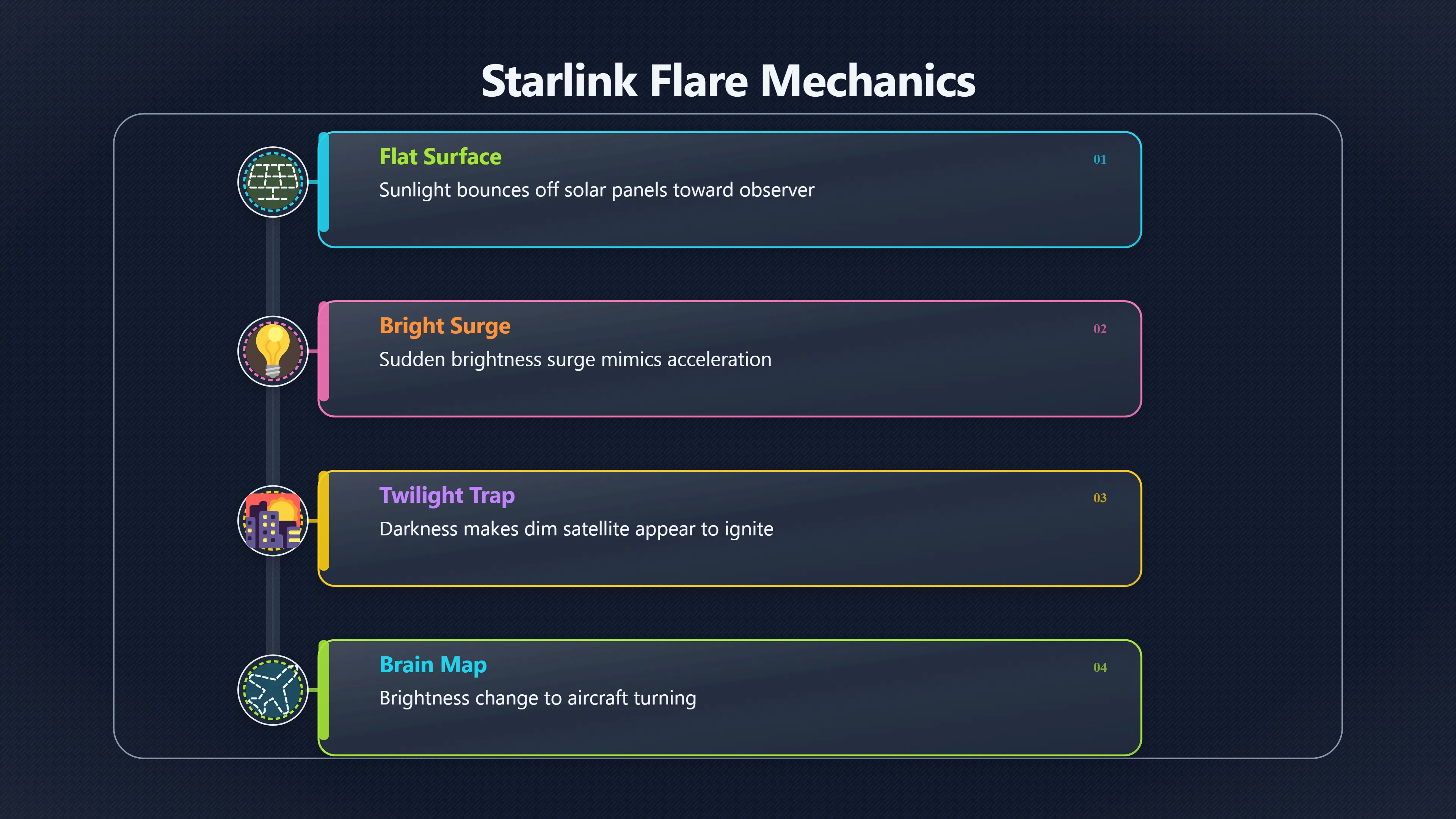
A Starlink satellite does not need to change course to appear to perform a manoeuvre. The effect usually comes from specular reflection: sunlight briefly bouncing from a flat surface such as a satellite chassis or solar panel directly toward the observer. When the geometry aligns correctly, brightness can surge dramatically for a few seconds and then fade just as quickly.[SatFleet Live]satfleetlive.comSat Fleet Live Why Are Satellites So Bright?Understanding…A satellite flare is a sudden, brief increase in brightness caused when a flat, mirror-like surface — typically a solar…
Human perception treats brightening objects differently from dim ones. Against a dark sky with few reference points:
- A suddenly bright object often appears closer.
- A fading object can seem to recede or change direction.
- A light that disappears abruptly may be interpreted as “instant acceleration”.
- Multiple satellites flaring sequentially can look like coordinated movement.
This becomes more convincing when observers are already primed to expect aircraft behaviour. Aircraft normally change brightness when banking or turning, so the brain can unconsciously map the same interpretation onto satellites.
Researchers studying Starlink brightness behaviour have shown that the satellites’ flat-panel geometry produces unusually angle-sensitive reflections. Small changes in observer position or satellite orientation can produce very large apparent brightness swings without any orbital change at all.[arXiv]arxiv.orgarXiv Extreme Flaring of Starlink SatellitesarXiv Extreme Flaring of Starlink Satellites
In practical UFO case analysis, this means that a witness statement such as “the object suddenly veered away” cannot automatically be treated as evidence of a real course correction unless the report also includes stable positional references, video tracking, or corroborating instrument data.
How reflection changes create apparent motion
Sudden brightening can imitate acceleration
One common illusion occurs when a dim satellite suddenly flares brightly. Because brighter objects are often perceived as nearer, the observer may feel the object has surged toward them or increased speed.
This is particularly deceptive during twilight. The observer may already be in darkness while the satellite remains strongly illuminated high above Earth. Starlink satellites can therefore appear to “ignite” in mid-flight even though they were continuously present and moving steadily the entire time.[Wikipedia]WikipediaSatellite flareSatellite flare
AARO, the US Department of Defense office investigating unidentified anomalous phenomena, noted that simultaneous Starlink flares may appear as glowing objects that disappear and reappear or trace unusual geometric patterns within a small region of sky.[AARO]aaro.milCorrelations of Starlink Satellite Flaring with UAPCorrelations of Starlink Satellite Flaring with UAP…April 22, 2025 — by A An · 2024 — These flares are orders of magnitude brighte…
Sequential flares can imitate turning formations
In some sightings, witnesses describe one light “breaking formation” or “peeling away”. This can happen when several satellites in nearby orbital paths flare at different times.
Instead of seeing multiple independent satellites brighten sequentially, the observer perceives a single object moving unpredictably between positions. The effect is strongest when:
- The satellites are low on the horizon.
- The observer lacks foreground reference points.
- The flare durations overlap.
- The viewing angle is close to the hidden Sun below the horizon.
This can produce reports of zig-zagging lights, rotating triangles, or lights “orbiting” each other despite no real interaction between the satellites.[AARO]aaro.milCorrelations of Starlink Satellite Flaring with UAPCorrelations of Starlink Satellite Flaring with UAP…April 22, 2025 — by A An · 2024 — These flares are orders of magnitude brighte…
Disappearance can resemble impossible speed
A satellite flare can fade from visible to invisible within seconds once the reflection angle changes. To a witness, this may resemble:
- Instant acceleration.
- Cloaking or disappearance.
- A sharp turn away from view.
- Entry into cloud despite clear skies.
The effect is psychologically persuasive because the observer assumes the object itself changed behaviour rather than the illumination geometry changing.
Older Iridium satellites produced famous predictable flares, but Starlink reflections are often more confusing because they can repeat across large constellations and occur in clusters.[Wikipedia]WikipediaStarlinkStarlink is a satellite internet constellation operated by Starlink Services, LLC, an international telecommunications provide…

Why pilots and experienced observers can still be misled
Experience does not eliminate these errors. In some ways it can make them more convincing.
Pilots and regular skywatchers know what ordinary aircraft, stars, and satellites usually look like. When a light behaves outside those expectations, they may conclude that something genuinely unusual is occurring. The problem is that Starlink flare behaviour is still relatively unfamiliar compared with decades of conventional night-sky experience.
A 2024 study on extreme Starlink flaring examined reports from commercial airline pilots who interpreted exceptionally bright reflections as possible UAP events. The authors concluded that under certain geometries, Starlink satellites could become bright enough to trigger serious misidentification even among trained observers.[arXiv]arxiv.orgarXiv Extreme Flaring of Starlink SatellitesarXiv Extreme Flaring of Starlink Satellites
Pilots are also in a uniquely vulnerable viewing position:
- They operate above much atmospheric haze.
- They often face the twilight zone during cruise flight.
- They may observe large areas of sky with little ground reference.
- Reflections can appear near the hidden Sun below the horizon.
This has led to what some observers call “racetrack” flare patterns, where repeated reflections from multiple satellites seem to move along structured paths. Wikipedia Metabunk Even amateur astronomers can misjudge apparent motion because the visual system naturally links brightness variation with physical behaviour.[metabunk.org]metabunk.orgwhy are starlink racetrack flares mostly reported from planes.12720why are starlink racetrack flares mostly reported from planes.12720 A dim light becoming suddenly brilliant feels active and intentional even when orbital tracking shows completely steady motion.
What AI-assisted investigation can check quickly
Automated UFO investigation workflows are particularly effective at testing flare-based explanations because the geometry is predictable.
A useful screening pipeline can compare:
- Witness time and location.
- Sun elevation below the horizon.
- Known Starlink orbital tracks.
- Predicted visibility windows.
- Satellite azimuth and elevation.
- Recorded flare windows where available.
If a reported “turn” or “disappearance” coincides with the point where a satellite entered or exited a reflective angle, confidence in the flare explanation increases substantially.
AI-assisted correlation systems can also compare the wording of new witness reports against earlier confirmed Starlink cases. Descriptions such as:
- “Shot off instantly”
- “Vanished without trace”
- “Lights peeled away”
- “Objects merged”
- “Formation broke apart”
often recur in satellite-flare reports despite there being no true manoeuvring behaviour.[Wikipedia]WikipediaSatellite flareSatellite flare
Video analysis can help further. Frame-by-frame tracking sometimes reveals that the object maintained constant angular velocity while only brightness changed. Human observers frequently remember the opposite.

Red flags that make a Starlink explanation weaker
Not every report involving bright lights in formation is explainable as Starlink flaring. Some details make the satellite hypothesis less convincing and deserve closer scrutiny.
A Starlink explanation becomes weaker when:
- The object shows clear low-altitude structure.
- Multiple independent observers report different trajectories from different positions.
- Radar data confirms atmospheric manoeuvring.
- The sighting occurs in full darkness long after twilight visibility should have ended.
- The object performs sustained angular changes inconsistent with orbital motion.
- Witnesses record sharp directional changes against fixed stars on stable video.
- Sound, wake effects, or ground interaction are reported credibly.
Likewise, a genuine satellite flare normally produces smooth motion overall. A witness describing repeated stop-start motion across large sections of sky may be observing something else entirely, or may be combining several perception effects at once.
Good investigation practice therefore treats Starlink as a strong candidate explanation rather than an automatic dismissal. The goal is not to force every report into a satellite category, but to determine whether the timing, geometry, and visual behaviour fit the known characteristics of orbital reflections better than alternative explanations.
Why this matters for modern UFO reporting
Before mega-constellations, dramatic satellite reflections were relatively uncommon. Today, thousands of Starlink satellites create many more opportunities for observers to encounter unfamiliar optical behaviour.[Wikipedia]WikipediaSatellite flareSatellite flare
This changes the baseline problem for UFO investigation. A report that once might have seemed extraordinary now requires careful satellite-correlation checks before stronger conclusions are justified.
The important point is not that witnesses are careless or dishonest. Many flare-based sightings are genuinely startling in real time. The combination of darkness, silence, precise motion, sudden brightening, and abrupt disappearance can look highly artificial or intelligently controlled.
AI-assisted investigation is valuable precisely because it separates perceived manoeuvres from measurable trajectories. By reconstructing orbital geometry rather than relying only on memory and impression, investigators can often explain why a perfectly ordinary satellite appeared to behave in extraordinary ways.
Amazon book picks
Further Reading
Books and field guides related to When satellite flares look like turns. Use these as the next step if you want deeper reading beyond the article.

The Practical Astronomer
Helps explain observational illusions caused by brightness changes.
eBay marketplace picks
Marketplace Samples
Example marketplace items related to this page. Use the search link to explore similar finds on eBay.


Endnotes
1.
Source: aaro.mil
Title: Correlations of Starlink Satellite Flaring with UAP
Link:https://www.aaro.mil/Portals/136/PDFs/Information%20Papers/AARO_Satellite_Flaring_Paper_508_FINAL_04222025.pdf
Source snippet
Correlations of Starlink Satellite Flaring with UAP...April 22, 2025 — by A An · 2024 — These flares are orders of magnitude brighte...
Published: April 22, 2025
2.
Source: arxiv.org
Title: arXiv Extreme Flaring of Starlink Satellites
Link:https://arxiv.org/abs/2405.13091
3.
Source: Wikipedia
Title: Satellite flare
Link:https://en.wikipedia.org/wiki/Satellite_flare
4.
Source: arxiv.org
Link:https://arxiv.org/abs/2003.07805
5.
Source: arxiv.org
Link:https://arxiv.org/abs/2111.09735
6.
Source: arxiv.org
Title: arXiv Starlink Satellite Brightness Before Visor Sat
Link:https://arxiv.org/abs/2006.08422
7.
Source: metabunk.org
Title: why are starlink racetrack flares mostly reported from planes.12720
Link:https://www.metabunk.org/threads/why-are-starlink-racetrack-flares-mostly-reported-from-planes.12720/
8.
Source: arxiv.org
Link:https://arxiv.org/pdf/2405.13091
Source snippet
Extreme Flaring of Starlink Satellitesby A Mallama · 2024 · Cited by 2 — Abstract. Starlink satellites can become extremely bright w...
9.
Source: starlink.com
Link:https://starlink.com/?srsltid=AfmBOoqTsKNhWQltLk-wz_vA4Tnuieuo_N4IEUovPcxNFhfjOup7cTe4
Source snippet
Internet for travel, road trips, and commutes. High-speed internet that moves with you, even in dead zones. In-motion use availab...
10.
Source: Wikipedia
Link:https://en.wikipedia.org/wiki/Starlink
Source snippet
StarlinkStarlink is a satellite internet constellation operated by Starlink Services, LLC, an international telecommunications provide...
11.
Source: satfleetlive.com
Title: Sat Fleet Live Why Are Satellites So Bright?
Link:https://satfleetlive.com/blogs/why-are-satellites-so-bright/
Source snippet
Understanding...A satellite flare is a sudden, brief increase in brightness caused when a flat, mirror-like surface — typically a solar...
Additional References
12.
Source: facebook.com
Link:https://www.facebook.com/groups/blueridgemountainlife/posts/3807018919435087/
Source snippet
Satellite panel flares in night skyThe perceived brightness of each flare is fairly predictable and under ideal conditions can reach magn...
13.
Source: currys.co.uk
Link:https://www.currys.co.uk/brand/starlink/starlink.html
Source snippet
Starlink InternetStarlink delivers high-speed, low latency internet to the most rural and remote locations around the world. Stream movie...
14.
Source: facebook.com
Link:https://www.facebook.com/groups/2365809903441367/posts/25740628552199506/
Source snippet
Starlink satellites appear bright after launchAs differential drag and orbit raising spread them out and attitudes change, those favorabl...
15.
Source: youtube.com
Link:https://www.youtube.com/watch?v=aWpeN3cU17Q
Source snippet
SpaceX's Starlink, satellite flares, and spectacular twilight...The geometry behind satellite flare and how you can see sunlight and ref...
16.
Source: skyandtelescope.org
Title: starlink flares can fool anyone even airline pilots
Link:https://skyandtelescope.org/[astronomy
Source snippet
Starlink Flares Can Fool Anyone — Even Airline Pilots10 Jun 2024 — Earth's shadow is outlined in satellite flares, reflections from satel...
17.
Source: news.ycombinator.com
Title: In both cases, I was casually looking at the sky
Link:https://news.ycombinator.com/item?id=26310845
Source snippet
people don't know that you can actually see some of...The larger the change in perceived speed, the lower the altitude, while constant s...
18.
Source: space.com
Title: x starlink satellites
Link:https://www.space.com/spacex-starlink-satellites.html
Source snippet
Starlink satellites: Facts, tracking and impact on astronomy5 May 2026 — Starlink is the name of a satellite network developed by the pri...
Published: May 2026
19.
Source: universetoday.com
Title: starlinks can produce surprisingly bright flares to pilots
Link:https://www.universetoday.com/articles/starlinks-can-produce-surprisingly-bright-flares-to-pilots
Source snippet
In one instance they were reported as Unidentified Aerial Phenomenon...Read more...
20.
Source: reddit.com
Link:https://www.reddit.com/r/Stargazing/comments/17997ac/pulsing_satellitelike_object_that_took_a_90/
Source snippet
"Pulsing" satellite-like object that took a 90 degree turnApparently as the tumble through space, for each revolution, light glints off t...
21.
Source: nature.com
Link:https://www.nature.com/articles/s41586-026-10260-w
Source snippet
Satellite imagery reveals increasing volatility in human...by T Li · 2026 · Cited by 1 — This evidence of increasing volatility in human...
Topic Tree