Within Geometry
How high was the light really?
Rough sky-angle methods can be useful, but overconfident elevation numbers can make a sighting look more certain than it is.
On this page
- Fist and finger sky estimates
- Treelines, horizons and the Moon as reference points
- Why false precision weakens a case file
Page outline Jump by section
Introduction
A UFO sighting becomes easier to investigate when the witness can describe not just the direction of the object, but also how high it appeared in the sky. Elevation is the vertical angle between the horizon and the object: 0° at the horizon, 90° directly overhead. In AI-assisted UFO investigation, even rough elevation estimates can help compare a report against aircraft approach paths, satellite tracks, bright planets, drones or cloud layers.[The Open University]open.eduThe Open University3.2 The Altitude-Azimuth systemIf it is directly overhead (a point referred to as the zenith) then it has an altitude…
 The problem is that many reports accidentally introduce false precision. A witness who says “roughly two fists above the horizon” is often giving stronger evidence than someone who later claims “43° elevation” from memory alone. Overconfident numbers can make a case file look mathematically precise while actually hiding uncertainty. Good investigation practice therefore treats elevation as an estimate with margins, not a perfect measurement.
Fist-and-finger sky estimates
The simplest practical method for estimating elevation is the same rough angular system used in amateur astronomy. With the arm fully extended:
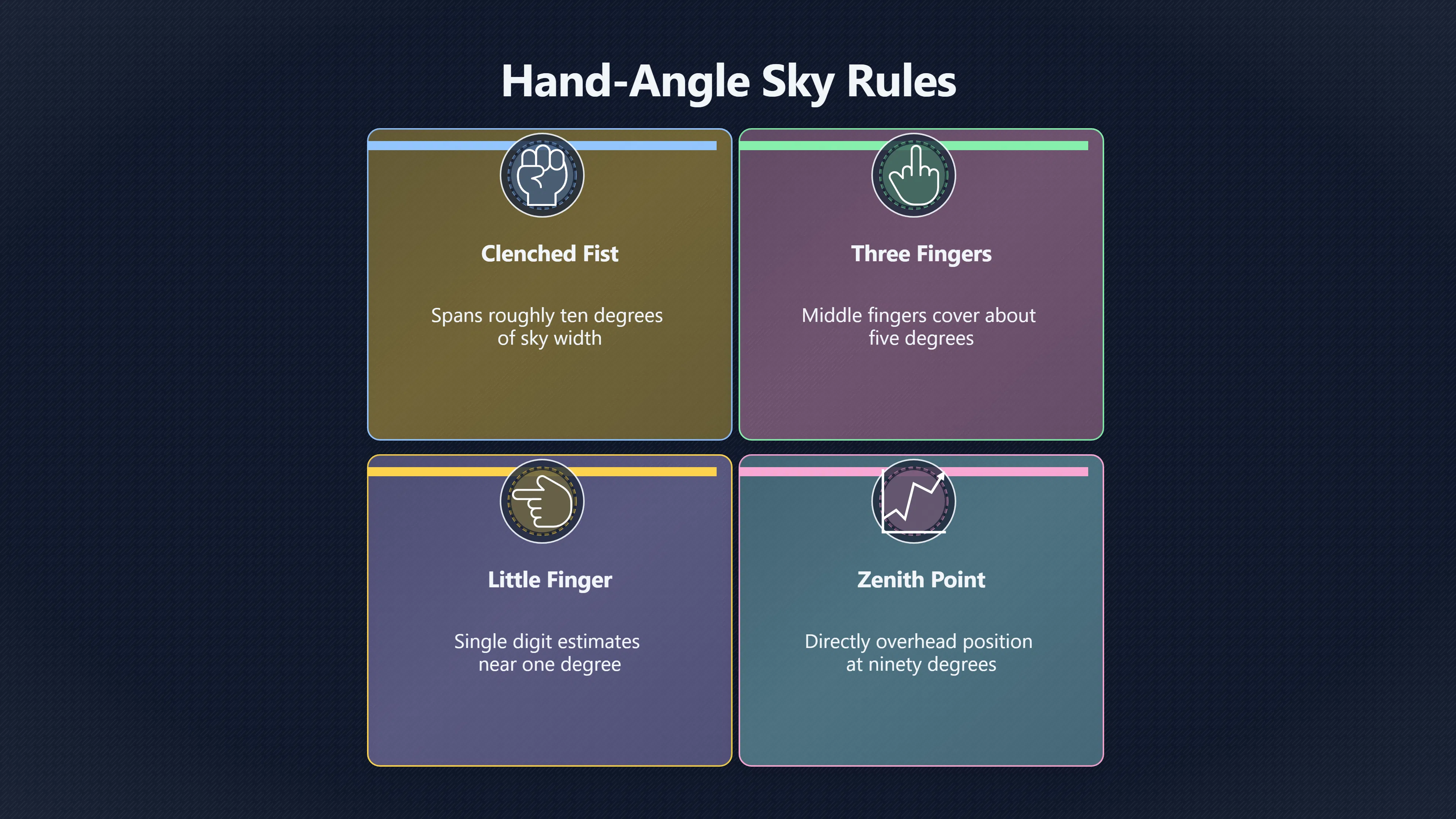
- a clenched fist spans about 10° of sky
- three middle fingers together cover roughly 5°
- a little finger is close to 1° to 2° depending on the method used Chandra Observatory[EarthSky]earthsky.orgSky measurements: Degrees, arcminutes and arcseconds1 Jan 2026 — The general rule amateur astronomers use is that the width of yo…[ABC News]abc.net.auMeasure the sky with your hands27 July 2009 — Raise your three middle fingers to measure 5 degrees. Clench your fist or hold your hand li…
This matters because most UFO witnesses do not carry calibrated angle-measuring equipment. Investigators therefore need estimates that ordinary people can reproduce in the field.
A useful witness statement might read:
“The light appeared about three fists above the horizon and slightly left of the Moon.”
That description is imperfect, but it is operationally useful. It places the object near 30° elevation rather than vaguely “high in the sky”. AI-assisted reconstruction systems can combine that estimate with bearing, timestamp and terrain data to narrow candidate explanations.
What weakens a case is unnecessary exactness. Human perception is not naturally trained for precise angular judgement, especially at night or during surprising events. Research in visual angle perception shows that people do not reliably perceive angular relationships with instrument-level accuracy.[JOV]jov.arvojournals.orgThe human visual system estimates angle features in an…by ZX Xu · 2018 · Cited by 22 — This study provides a new computational fram…[East China Normal University]pure.ecnu.edu.cnthe human visual system estimates angle features in an internal rEast China Normal UniversityThe human visual system estimates angle features in an…by ZX Xu · 2018 · Cited by 22 — This study provides…
In practice, this means a report claiming “47° elevation” without a measuring device should usually be interpreted as a broad range, perhaps somewhere between 35° and 55°. Better UFO case files preserve that uncertainty instead of hiding it.
Why rough estimates are often enough
Many mundane explanations only require approximate geometry to test.
For example:
- Venus low in the west after sunset is usually under about 20° elevation.
- Aircraft on approach often maintain predictable elevation changes relative to known airports.
- Satellites crossing overhead move differently from low-elevation aircraft lights.
- Drones are commonly reported at moderate elevations above nearby treelines rather than near the zenith.
An estimate accurate to within 10° can already eliminate some explanations while supporting others. Exactness is less important than honesty about uncertainty.
Treelines, horizons and the Moon as reference points
Witnesses often estimate elevation more reliably when they anchor the object to something visible. This is usually stronger evidence than a free-floating number.
Useful reference points include:
- hill ridges
- rooftops
- treelines
- power pylons
- cloud layers
- the Moon
- bright stars or planets
A statement such as “the object sat just above the treeline” may initially sound vague, but investigators can sometimes reconstruct the viewing geometry surprisingly well if the observer position is known.
For instance, a ridge line 8 km away subtends a measurable angle from the witness location. If the object appeared “one fist above the ridge”, the elevation can be estimated retrospectively with mapping software and terrain models.
The Moon is especially useful because many people instinctively remember an object’s position relative to it. The Moon’s apparent width is about half a degree, providing a familiar angular reference. Even imperfect comparisons can help investigators estimate scale and height relationships.
AI-assisted workflows increasingly use this type of contextual geometry automatically. A modern case-analysis system can combine:
- witness coordinates
- terrain elevation models
- horizon profiles
- astronomical sky maps
- weather cloud-base data
- phone metadata
- known aircraft paths
to test whether the reported elevation fits ordinary traffic or known celestial objects.
The key point is that the reconstruction should preserve uncertainty bands. A witness recalling an object “between the treeline and halfway overhead” should not be converted into a fake exact number merely because software can generate one.
Why false precision weakens a case file
False precision creates two major problems in UFO investigation.
The first is analytical distortion. If a report states that an object was observed at “exactly 52° elevation”, later investigators may treat that value as instrument-grade data. Automated systems can then exclude plausible explanations incorrectly because the input appears more certain than it really is.
The second problem is credibility. Experienced investigators, pilots and astronomers quickly recognise when a witness description sounds artificially exact. Ironically, exaggerated precision can make a report look less trustworthy rather than more scientific.
This issue appears frequently in retrospective UFO stories. A witness may originally describe “a bright object fairly high in the sky”, but years later retell the event using highly specific angles, speeds and distances. Memory research consistently shows that confidence and accuracy are not the same thing in eyewitness recall.[PubMed]pubmed.ncbi.nlm.nih.govRethinking the Reliability of Eyewitness MemoryWe argue here that, like DNA evidence and other kinds of scientifically validated fo…[British Psychological Society]bps.org.ukrethinking reliability eyewitness testimonyHasan Hussain (Birmingham City University) on 'fragments of truth'. 23 July 2025…Read more…
A stronger investigative approach is to record uncertainty openly:
- “estimated elevation 20°–30°”
- “approximately halfway between horizon and zenith”
- “about two fists above the ridge line”
- “possibly near overhead”
This may look less dramatic, but it produces more reliable geometry.
Precision should match the measurement method
Good UFO case handling asks a simple question: how was the elevation obtained?
Different methods deserve different confidence levels:
MethodTypical reliabilityCasual memory hours laterLowHand-span estimate at the sceneModeratePhoto or video frame with landmarksModerate to highSmartphone inclinometer properly calibratedVariableSurveyed instrument or astronomical mountHigh
A case file should reflect that hierarchy clearly.
For example, a witness using a calibrated astronomy app during observation can justify a narrower uncertainty range than someone reconstructing the event days later from memory.
Elevation errors that repeatedly mislead investigations
Several recurring mistakes appear in UFO reports.
Low objects often feel higher at night
Bright lights against a dark sky can appear elevated more steeply than they really are. Aircraft landing lights near the horizon are especially prone to this effect because observers lack visual depth cues.
This matters because many dramatic reports describe objects “high overhead” that later turn out to have been relatively low-angle lights viewed across long distances.

Witnesses confuse steepness with altitude
An object moving rapidly upward in the visual field can feel physically high even when its actual elevation is moderate. This commonly affects reports involving drones, lanterns or nearby helicopters.
Hills distort the perceived horizon
In mountainous or urban areas, people often use a local ridge or rooftop as their practical horizon instead of the true astronomical horizon. That can shift elevation estimates substantially.
A UFO appearing “20° above the horizon” in a valley may actually be much lower relative to true level ground.
“Directly overhead” is usually approximate
Witnesses frequently describe objects as being overhead when they were merely high in the sky. In geometric reconstruction, true zenith sightings are uncommon and important because they constrain possible flight paths strongly.
Investigators therefore usually treat “overhead” as a broad category unless supported by video or multiple aligned witness accounts.
Better AI workflows avoid fake certainty
One of the most useful developments in AI-assisted UFO investigation is the shift away from single-point geometry.
Older approaches often attempted to reconstruct a sighting using one exact bearing and one exact elevation. Modern systems increasingly model probability ranges instead.
A well-designed workflow might treat a witness statement like this:
“About three fists above the horizon, maybe a little higher.”
not as 30°, but as a zone such as 25°–40°.
That uncertainty band can then be compared against:
- ADS-B aircraft tracking data
- satellite ephemerides
- astronomical object positions
- cloud ceilings
- drone operating ranges
- local terrain masking
This approach is less visually dramatic than drawing razor-thin lines across a map, but it is usually more scientifically defensible.
In many UFO investigations, the strongest outcome is not perfect certainty but the ability to say:
- the geometry strongly matches a known explanation
- the geometry weakly fits several explanations
- the geometry conflicts with ordinary candidates
- the available evidence is too uncertain for confident identification
That distinction is far more valuable than pretending a witness estimated sky angles with surveyor-level precision.
eBay marketplace picks
Marketplace Samples
Example marketplace items related to this page. Use the search link to explore similar finds on eBay.


Endnotes
1.
Source: open.edu
Link:https://www.open.edu/openlearn/mod/oucontent/view.php?id=114762§ion=3.2
2.
Source: earthsky.org
Link:https://earthsky.org/astronomy-essentials/sky-measurements-degrees-arc-minutes-arc-seconds/
Source snippet
Sky measurements: Degrees, arcminutes and arcseconds1 Jan 2026 — The general rule amateur astronomers use is that the width of yo...
3.
Source: jov.arvojournals.org
Link:https://jov.arvojournals.org/article.aspx?articleid=2718450
Source snippet
The human visual system estimates angle features in an...by ZX Xu · 2018 · Cited by 22 — This study provides a new computational fram...
4.
Source: astronomy.org
Link:https://astronomy.org/moravian/C16-Sky%20Literacy.pdf
Source snippet
SKY LITERACY USING FINGER ANGLES TO MEASURE...loose fist with your thumb on top, the angular distance that your fist and thumb will subt...
5.
Source: abc.net.au
Link:https://www.abc.net.au/science/articles/2009/07/27/3169109.htm
Source snippet
Measure the sky with your hands27 July 2009 — Raise your three middle fingers to measure 5 degrees. Clench your fist or hold your hand li...
Published: July 2009
6.
Source: pure.ecnu.edu.cn
Title: the human visual system estimates angle features in an internal r
Link:https://pure.ecnu.edu.cn/en/publications/the-human-visual-system-estimates-angle-features-in-an-internal-r/
Source snippet
East China Normal UniversityThe human visual system estimates angle features in an...by ZX Xu · 2018 · Cited by 22 — This study provides...
7.
Source: pubmed.ncbi.nlm.nih.gov
Link:https://pubmed.ncbi.nlm.nih.gov/29716454/
Source snippet
Rethinking the Reliability of Eyewitness MemoryWe argue here that, like DNA evidence and other kinds of scientifically validated fo...
8.
Source: bps.org.uk
Title: rethinking reliability eyewitness testimony
Link:https://www.bps.org.uk/psychologist/rethinking-reliability-eyewitness-testimony
Source snippet
Hasan Hussain (Birmingham City University) on 'fragments of truth'. 23 July 2025...Read more...
Published: July 2025
9.
Source: sr-research.com
Title: Visual Angle
Link:https://www.sr-research.com/eye-tracking-blog/background/visual-angle/
Source snippet
Fast, Accurate, Reliable Eye TrackingLearn how to calculate degrees of visual angle, and why it is such an important concept in so many d...
Additional References
10.
Source: researchgate.net
Link:https://www.researchgate.net/publication/329679611_The_human_visual_system_estimates_angle_features_in_an_internal_reference_frame_A_computational_and_psychophysical_study
Source snippet
(PDF) The human visual system estimates angle features...27 Feb 2026 — This study provides a new computational framework for angle discr...
11.
Source: astro4edu.org
Link:https://astro4edu.org/resources/glossary/term/6/
Source snippet
Glossary term: AltitudeAn object on the horizon would have an altitude of 0°, and an object that is directly overhead, "at the zenith," w...
12.
Source: university.open.ac.uk
Link:https://university.open.ac.uk/research-centres/herc/blog/what-can-visual-attention-research-tell-us-about-reliability-eyewitness-evidence
Source snippet
Open UniversityWhat can visual attention research tell us about...Research on visual attention helps to highlight how what we perceive m...
13.
Source: timeanddate.com
Link:https://www.timeanddate.com/astronomy/measuring-the-sky-by-hand.html
Source snippet
A Handy Guide to Measuring the SkyThe width of your fist will approximately be 10 degrees. This means that any two objects that are on th...
14.
Source: youtube.com
Link:https://www.youtube.com/watch?v=9U0-Ro7dtFE
Source snippet
Hand AstronomyIn this video we are going to learn how to measure the sky with our hands. Once you learn this skill it will help you not o...
15.
Source: skyandtelescope.org
Link:https://skyandtelescope.org/astronomy-resources/right-ascension-declination-celestial-coordinates/
Source snippet
nd overhead point, while from the poles the celestial equator encircles the horizon...Read more...
16.
Source: facebook.com
Title: Sky measurements: Degrees, arcminutes and arcseconds
Link:https://www.facebook.com/EarthSky/posts/how-do-you-describe-how-far-apart-something-is-in-the-sky-the-handiest-measuring/635302238639487/
Source snippet
May 21, 2023 — They're approximately 3 degrees apart, as measured by holding your hand arm distance away and holding up your three middle...
Published: May 21, 2023
17.
Source: facebook.com
Link:https://www.facebook.com/transformazing.official/posts/how-to-calculate-the-distances-in-the-sky-using-your-hand/891302179927419/
Source snippet
Hold your fist at arm's length and that's a 10 degree width.Read more...
18.
Source: itu.physics.uiowa.edu
Title: Activities take place on the roof of Van Allen Hall on in the lab room.Read more
Link:https://itu.physics.uiowa.edu/labs/foundational/measuring-and-exploring-sky/part-2-estimating-angles
Source snippet
2: Estimating Angles - Imaging the UniverseIt is a handy guide for estimating angles with your hand when held at arm's length...
19.
Source: abingdonsciencepartnership.org
Link:https://www.abingdonsciencepartnership.org/wp-content/uploads/2020/10/GCSE_Astronomy_Topic_Guide_Celestial_Sphere.pdf
Source snippet
Topic Guide: The Celestial SphereAltitude is the angle of the object measured upwards from the observable horizon...
Topic Tree