Within Unresolved Cases
Why AI Certainty Can Exceed the Actual UFO Evidence
Probability scores can look authoritative even when the underlying evidence is incomplete or badly degraded.
On this page
- How pattern matching creates false confidence
- Why training data shapes UFO classifications
- What human reviewers must challenge before conclusions
Page outline Jump by section
Introduction
AI systems used in UFO or UAP investigations often produce confidence scores that look precise and scientific: “92% likely aircraft”, “87% likely satellite”, or “high-confidence classification”. The problem is that these numbers can appear far more reliable than the underlying evidence actually is.
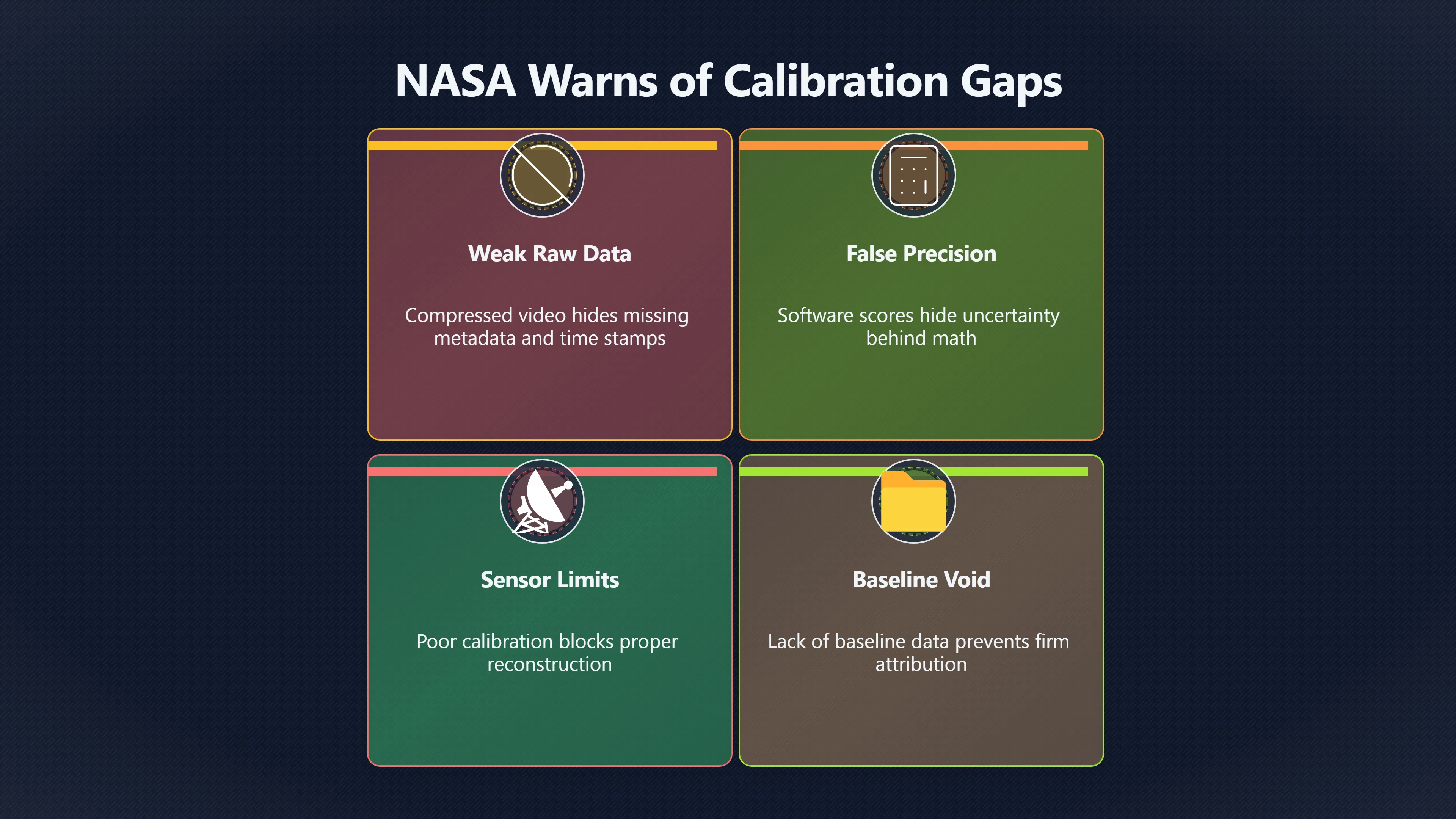
 In many UFO investigations, the raw material is weak from the start: compressed phone video, missing metadata, uncertain timestamps, witness memory gaps, atmospheric distortion, or incomplete radar information. NASA’s independent UAP study warned that current analysis is frequently limited by poor sensor calibration, missing metadata, lack of multiple measurements, and weak baseline data. NASA Science[Space In that environment]space.comsensor metadata, and the lack of baseline data," the report states.Read moreNASA UFO report finds no evidence of 'extraterrestrial…14 Sept 2023 — "At present, analysis of UAP data is hampered by poor senso…, an AI-generated confidence score can create a false impression that uncertainty has been solved mathematically when it has merely been hidden behind software output.
This matters because UFO investigations are unusually vulnerable to premature certainty. A weakly supported “likely explanation” can harden into accepted fact once an automated system assigns a high probability to it. At the same time, inflated confidence can also push ambiguous footage into sensational territory by overstating how unusual a sighting appears. In both directions, the score itself can become more persuasive than the evidence.
How Pattern Matching Creates False Confidence
Most AI-assisted UFO analysis systems work through pattern matching. They compare a new sighting against known examples: aircraft lights, drones, balloons, satellites, lens artefacts, birds, atmospheric optics, launch debris, and previously catalogued cases.
That process is useful. It can rapidly eliminate many ordinary explanations that would otherwise consume investigator time. But pattern matching systems are designed to produce classifications even when the input quality is poor.
A blurred infrared video may still be forced into a category because the model has been trained to output a ranked answer regardless of ambiguity. In machine learning, this is known as an overconfidence problem: systems can generate probabilities that exceed their real reliability. Research on AI calibration repeatedly shows that modern neural networks often report confidence levels that do not accurately reflect their true accuracy. arXiv 3arXiv[IBM]ibm.comMore formally, calibration means…Read more…
In UFO analysis, several conditions make this especially risky:
- Low-resolution footage removes important shape details.
- Compression artefacts can mimic movement or luminosity.
- Missing range data makes speed estimates unstable.
- Lack of sensor metadata prevents proper reconstruction.
- Night-time imagery reduces contextual cues.
- Witness reports may already contain interpretation errors.
Despite these weaknesses, the software may still produce a crisp-looking probability score.
Why “95% likely” may not mean much
A confidence score is not the same thing as verified truth. In many systems, the score only measures how strongly the model prefers one category over competing categories inside its training set.
That distinction matters enormously in UFO investigations.
If an AI system was trained mostly on aircraft, drones, birds, balloons, and satellites, then it may classify a genuinely unusual visual pattern as “92% aircraft” simply because aircraft is the closest available category. The score does not necessarily mean the system has strong evidence for an aircraft. It may only mean the alternatives fit even worse.
This becomes more dangerous when the footage itself is degraded. Deep-learning systems are known to become confidently wrong when operating outside the conditions they were trained on.[arXiv]arxiv.orgUnderstanding the Effects of Miscalibrated AI Confidence…26 Sept 2025 — Confidence calibration refers to the degree to which conf… 2arXiv A dark, noisy phone clip recorded through haze may sit far outside the clean datasets used during model development.
The result is a form of statistical theatre: uncertainty disguised as precision.
UFO investigations amplify automation bias
Human investigators are not immune to the persuasive effect of numerical output. Studies across many industries show that people tend to trust algorithmic systems more once probabilities and confidence labels are displayed. In UFO analysis, this creates a strong automation bias.
An investigator reviewing dozens of sightings may unconsciously defer to the machine-generated score, especially when:
- the software output appears mathematically detailed;
- the evidence is time-consuming to inspect manually;
- the system has correctly solved previous cases;
- the reviewer lacks specialist expertise in optics or imaging.
This can quietly shift the investigation process from evidence-led reasoning to software-led reasoning.
A weak case then becomes “resolved” not because the evidence improved, but because the AI classification looked authoritative.
Why Training Data Shapes UFO Classifications
AI confidence scores are heavily shaped by the data used to train the system. This is one of the least visible but most important limitations in automated UFO analysis.
A model trained primarily on conventional aerial objects will naturally push ambiguous sightings toward conventional explanations. That can be useful when screening large volumes of reports, but it also means the output reflects the assumptions built into the training set.
The model only recognises what it has learned
Imagine a system trained on:
- commercial aircraft;
- military jets;
- helicopters;
- satellites;
- drones;
- birds;
- balloons;
- lens flares;
- known atmospheric effects.
That system may become highly effective at recognising familiar objects. But when it encounters something outside those categories, it still attempts classification.
This is a well-known machine-learning problem called out-of-distribution behaviour. The system may produce high-confidence guesses even when the input differs substantially from its training environment. arXiv[IBM]ibm.comMore formally, calibration means…Read more…
In practical UFO work, this means:
- unusual camera artefacts may be labelled as drones;
- atmospheric distortions may resemble structured craft;
- rare astronomical effects may be mistaken for aircraft manoeuvres;
- partially obscured objects may inherit the wrong class entirely.
The danger is not just misclassification. It is misplaced certainty.

Bias toward “ordinary” explanations can hide unresolved cases
Public debate around UFOs often focuses on sensational overstatement, but automated systems can also distort investigations in the opposite direction.
A model heavily trained on mundane objects may aggressively collapse ambiguous sightings into ordinary categories. That may reduce false positives, but it can also erase legitimate uncertainty.
Official UAP reporting has repeatedly stressed that many cases remain unresolved specifically because available data is insufficient for firm attribution. The US intelligence community’s 2022 annual report stated that many reports “lack enough detailed data to enable attribution” with high certainty.[Director of National Intelligence]dni.govUAP with high certainty.Read moreDirector of National Intelligence2022 Annual Report on Unidentified Aerial Phenomena25 Jun 2021 — Regardless of the collection or reporti… AARO has likewise described cases where footage contains a real physical object but available information is still inadequate for conclusive identification.[AARO]aaro.milUAP ImageryAARO will continue to investigate this case should further information become available to enable a more conclusive attrib…
That distinction is important. “Likely aircraft” and “insufficient information” are not interchangeable conclusions.
When AI systems overstate confidence, they can pressure investigators to choose a category prematurely instead of preserving the more accurate unresolved status.
Bias toward “anomalous” explanations can happen too
The opposite failure mode also exists.
If a training set contains disproportionate numbers of dramatic UFO clips, heavily edited footage, or enthusiast-labelled material, the system may begin associating ordinary ambiguity with anomalous behaviour.
For example:
- autofocus pulsing may be interpreted as shape-shifting;
- rolling-shutter distortion may resemble impossible manoeuvres;
- sensor blooming may appear as luminous energy emission;
- tracking glitches may create false acceleration.
An AI system trained on sensationalised examples can become biased toward anomaly detection even when the raw evidence is weak.
This is especially dangerous in social-media-driven investigations, where viral clips often circulate without original files, metadata, or independent corroboration.
What Human Reviewers Must Challenge Before Conclusions
AI confidence scores are most useful when treated as prompts for further investigation rather than final answers.
A disciplined UFO workflow should require human reviewers to interrogate the basis of any automated classification before accepting it.
Key questions investigators should ask
Before treating a confidence score as meaningful, investigators should verify:
- Was the original media available, or only a compressed upload?
- Is the timestamp precise and independently confirmed?
- Was viewing direction reconstructed properly?
- Are weather and atmospheric conditions known?
- Was nearby aviation activity checked?
- Was satellite or astronomical activity correlated?
- Does the model explain why it produced the classification?
- Has the system been tested against degraded or ambiguous footage?
- Is the confidence calibrated against real-world error rates?
- Could the footage fall outside the model’s training distribution?
Without those checks, a numerical score may simply reflect software certainty rather than evidential strength.

Confidence should decrease when evidence quality decreases
One of the clearest warning signs in UFO analysis is when a system produces strong certainty from weak material.
A reliable investigative workflow should behave in the opposite way:
- poor-quality evidence should increase uncertainty;
- missing metadata should reduce confidence;
- single-source observations should remain provisional;
- compressed footage should trigger caution flags.
NASA’s UAP study repeatedly emphasised that better calibration, multiple measurements, and improved metadata collection are essential for meaningful analysis.[NASA Science]science.nasa.govScience Independent Study Team ReportNASA ScienceIndependent Study Team ReportSeptember 13, 2023 — At present, analysis of UAP data is hampered by poor sensor calibration, th…[NASA]science.nasa.govScience Independent Study Team ReportNASA ScienceIndependent Study Team ReportSeptember 13, 2023 — At present, analysis of UAP data is hampered by poor sensor calibration, th…
In practice, that means an honest AI-assisted investigation may end with:
- “plausible aircraft”;
- “possible satellite flare”;
- “insufficient data for attribution”;
- “unresolved pending additional evidence”.
Those outcomes may feel less satisfying than a definitive answer, but they are often more faithful to the evidence.
Why Some UFO Cases Should Remain Unresolved
The pressure to resolve every UFO report is understandable. Automated systems are built to classify, rank, and conclude. But unresolved cases are not necessarily investigative failures.
Sometimes the evidence simply does not justify a confident answer.
Poor footage, incomplete telemetry, missing environmental context, uncertain witness timelines, and degraded sensor data can all make attribution unreliable. In those situations, a high AI confidence score may reveal more about the model’s design than about the object itself.
This is why unresolved classifications remain important in responsible UFO investigation. They preserve the distinction between:
- evidence that genuinely supports an explanation;
- evidence that merely resembles one;
- and evidence too weak for reliable interpretation.
AI systems can help investigators process large numbers of sightings, identify patterns, correlate environmental data, and eliminate many ordinary explanations quickly. But confidence scores should be treated as provisional analytical aids, not as substitutes for evidential certainty.
A UFO case does not become solved because software expresses confidence. It becomes solved when the available evidence genuinely supports the conclusion.
Amazon book picks
Further Reading
Books and field guides related to Why AI Certainty Can Exceed the Actual UFO Evidence. Use these as the next step if you want deeper reading beyond the article.
The Demon-Haunted World
Supports disciplined scepticism around confident extraordinary claims.
eBay marketplace picks
Marketplace Samples
Example marketplace items related to this page. Use the search link to explore similar finds on eBay.




Endnotes
1.
Source: science.nasa.gov
Title: Science Independent Study Team Report
Link:https://science.nasa.gov/wp-content/uploads/2023/09/uap-independent-study-team-final-report.pdf
Source snippet
NASA ScienceIndependent Study Team ReportSeptember 13, 2023 — At present, analysis of UAP data is hampered by poor sensor calibration, th...
Published: September 13, 2023
2.
Source: space.com
Title: sensor metadata, and the lack of baseline data,” the report states.Read more
Link:https://www.space.com/nasa-ufo-uap-study-team-first-results-revealed
Source snippet
NASA UFO report finds no evidence of 'extraterrestrial...14 Sept 2023 — "At present, analysis of UAP data is hampered by poor senso...
3.
Source: nasa.gov
Title: update nasa shares uap independent study report names director
Link:https://www.nasa.gov/news-release/update-nasa-shares-uap-independent-study-report-names-director/
Source snippet
UPDATE: NASA Shares UAP Independent Study Report14 Sept 2023 — We found that NASA can help the whole-of-government UAP effort through sys...
4.
Source: arxiv.org
Link:https://arxiv.org/html/2402.07632v4
Source snippet
Understanding the Effects of Miscalibrated AI Confidence...26 Sept 2025 — Confidence calibration refers to the degree to which conf...
5.
Source: ibm.com
Link:https://www.ibm.com/think/topics/uncertainty-quantification
Source snippet
More formally, calibration means...Read more...
6.
Source: arxiv.org
Title: arXiv Being Bayesian, Even Just a Bit, Fixes Overconfidence in Re LU Networks
Link:https://arxiv.org/abs/2002.10118
7.
Source: arxiv.org
Title: arXiv On double-descent in uncertainty quantification in overparametrized models
Link:https://arxiv.org/abs/2210.12760
Source snippet
On double-descent in uncertainty quantification in overparametrized modelsOctober 23, 2022...
Published: October 23, 2022
8.
Source: aaro.mil
Link:https://www.aaro.mil/UAP-Cases/Official-UAP-Imagery/
Source snippet
UAP ImageryAARO will continue to investigate this case should further information become available to enable a more conclusive attrib...
9.
Source: aaro.org
Link:https://aaro.org/
Source snippet
Association of Americans Resident Overseas: AAROThe Association of Americans Resident Overseas (AARO), founded in 1973 is a global, non-p...
10.
Source: aaro.mil
Title: UAP Records
Link:https://www.aaro.mil/UAP-Records/
Source snippet
/Information Papers13 Feb 2026 — In August 2025, AARO sponsored a workshop on UAP Narrative Data, Infrastructures, and Analysis in partne...
Published: August 2025
11.
Source: aaro.mil
Link:https://www.aaro.mil/
Source snippet
AARO HomeUAP Case Resolution Reports... Commercial or military aircraft: Misidentified conventional aircraft—particularly when viewed fr...
12.
Source: dni.gov
Title: UAP with high certainty.Read more
Link:https://www.dni.gov/files/ODNI/documents/assessments/Unclassified-2022-Annual-Report-UAP.pdf
Source snippet
Director of National Intelligence2022 Annual Report on Unidentified Aerial Phenomena25 Jun 2021 — Regardless of the collection or reporti...
13.
Source: dictionary.cambridge.org
Link:https://dictionary.cambridge.org/dictionary/english/confidence
Source snippet
English meaning - Cambridge Dictionarya feeling of having little doubt about yourself and your abilities, or a feeling of trust in some...
14.
Source: Wikipedia
Link:https://en.wikipedia.org/wiki/Confidence
Source snippet
ConfidenceConfidence is the feeling of belief or trust that a person or thing is reliable. [1] Self-confidence is trust in oneself.Rea...
15.
Source: dvidshub.net
Link:https://www.dvidshub.net/video/988675/pr-017-unresolved-uap-report-europe-2024
Source snippet
PR-017, Unresolved UAP Report, Europe 2024This unresolved report contributes to AARO's historical and locational trend analyses. VIDEO IN...
16.
Source: dvidshub.net
Link:https://www.dvidshub.net/video/977839/pr-008-unresolved-uap-report-europe-2022
Source snippet
PR-008, Unresolved UAP Report, Europe 2022The United States European Command submitted a report of an unidentified anomalous phenomenon t...
Additional References
17.
Source: reddit.com
Link:https://www.reddit.com/r/UFOs/comments/1b9wlqy/calling_out_aaros_bullshit_in_detail/
Source snippet
Calling out AARO's bullshit in detail: r/UFOsAlthough many cases remain unsolved—primarily because of the lack of actionable and researc...
18.
Source: managingexpectations.net
Link:https://managingexpectations.net/blog/articles/nasa-uap-study-managing-expectations.html
Source snippet
NASA's UAP Study: What It Did — and Did Not — ConcludeThe panel said UAP analysis is hampered by “poor sensor calibration,” a lack of mul...
19.
Source: merriam-webster.com
Link:https://www.merriam-webster.com/dictionary/confidence
20.
Source: zhihu.com
Link:https://www.zhihu.com/en/answer/3211845828
21.
Source: facebook.com
Link:https://www.facebook.com/newshour/posts/the-us-in-2022-launched-the-all-domain-anomaly-resolution-office-aaro-as-part-of/1149122250416353/
Source snippet
The U.S. in 2022 launched the All-Domain Anomaly...Congress established AARO to investigate and report on UAPs, but the office continues...
22.
Source: media.defense.gov
Title: DOPSR 2024 0263 AARO HISTORICAL RECORD REPORT VOLUME 1 2024
Link:https://media.defense.gov/2024/Mar/08/2003409233/-1/-1/0/DOPSR-2024-0263-AARO-HISTORICAL-RECORD-REPORT-VOLUME-1-2024.PDF
Source snippet
Historical Record Report Volume 18 Mar 2024 — • Although many UAP/UFO cases remain unsolved, based on the lack of evidence of the extrate...
23.
Source: thenationalnews.com
Title: nasas ufo report advises us government on how to detect mysterious objects
Link:https://www.thenationalnews.com/world/us-news/2023/09/14/nasas-ufo-report-advises-us-government-on-how-to-detect-mysterious-objects/
Source snippet
Nasa's UFO report reveals how public can help hunt for...14 Sept 2023 — Released online on Thursday, the 36-page document says that exis...
24.
Source: war.gov
Link:https://www.war.gov/ufo/
Source snippet
the Department of War welcomes the application of private-sector analysis...Read more...
25.
Source: cameronrwolfe.substack.com
Title: confidence calibration for deep networks why and how e2cd4fe4a086
Link:https://cameronrwolfe.substack.com/p/confidence-calibration-for-deep-networks-why-and-how-e2cd4fe4a086
Source snippet
Calibration for Deep Networks: Why and How?Confidence calibration is defined as the ability of some model to provide an accurate probabil...
26.
Source: aclanthology.org
Link:https://aclanthology.org/2024.naacl-long.366.pdf
Source snippet
o facets of a single principle: higher con- fidence corresponds to lower uncertainty (Xiao.Read more...
Topic Tree