Within Review
What Should Be Challenged Before a UFO Verdict?
Structured human challenges can stop weak AI explanations from becoming public claims presented as settled facts.
On this page
- Checking time, direction and elevation claims
- Separating estimates from measured facts
- Testing whether another reviewer would agree
Page outline Jump by section
Introduction
Before an AI-assisted UFO conclusion is published, the most important question is often not “what did the model find?” but “what survived human challenge?” A polished AI summary can make a weak explanation sound settled, especially when the underlying sighting contains uncertain timings, guessed distances, incomplete metadata or ambiguous imagery. In UFO and UAP investigations, that matters because public conclusions can quickly harden into online “facts” even when the evidence base is thin.
 A strong pre-publication review process treats every AI-generated conclusion as provisional until a human reviewer has tested the assumptions underneath it. That review is not about blocking unusual findings by default. It is about checking whether the proposed explanation actually matches the known evidence, whether uncertainty has been stated honestly, and whether another investigator could independently reach the same conclusion from the same case file. NASA’s independent UAP study stressed that current analysis is frequently weakened by poor calibration, missing metadata and lack of multiple measurements, while AARO has repeatedly noted that many unresolved cases remain unresolved because available data cannot support a conclusive interpretation.[NASA Science]science.nasa.govScience Independent Study Team ReportNASA ScienceIndependent Study Team ReportSeptember 13, 2023 — At present, analysis of UAP data is hampered by poor sensor calibration, th…[AARO]aaro.mila physical source. The available…Read more…
Why AI UFO Conclusions Need Adversarial Review
AI systems are good at producing coherent narratives from incomplete information. That strength becomes a risk when a UFO investigation moves from internal analysis to public release. A model can confidently connect a witness report to an aircraft track, satellite pass or atmospheric explanation even when critical variables are uncertain or missing.
Human review therefore acts as a deliberate friction point. The reviewer’s role is to challenge the draft conclusion as if they were trying to disprove it. A useful test is simple: would the same conclusion still survive if the uncertain assumptions were removed or altered?
For example, a sighting classified by AI as “likely Starlink” may depend on an assumed observation time accurate to within one minute. If the witness time estimate could realistically be wrong by ten minutes, the satellite match may collapse. Similarly, an AI system might classify a moving light as an aircraft because a flight path existed nearby, while ignoring that the witness described silent hovering inconsistent with the identified track.
This is especially important because UFO investigations routinely involve:
- estimated rather than measured distances
- uncertain witness timing
- incomplete direction and elevation estimates
- compressed or stabilised video
- missing camera metadata
- single-source testimony without corroboration
NASA’s UAP report repeatedly emphasised that reliable conclusions depend on calibrated and well-characterised data rather than isolated visual impressions.[NASA Science]science.nasa.govScience Independent Study Team ReportNASA ScienceIndependent Study Team ReportSeptember 13, 2023 — At present, analysis of UAP data is hampered by poor sensor calibration, th…[Wikisource]en.wikisource.orgPage:UAP Independent Study Team - Final Report.pdf/512 Nov 2023 — At present, analysis of UAP data is hampered by poor sensor…
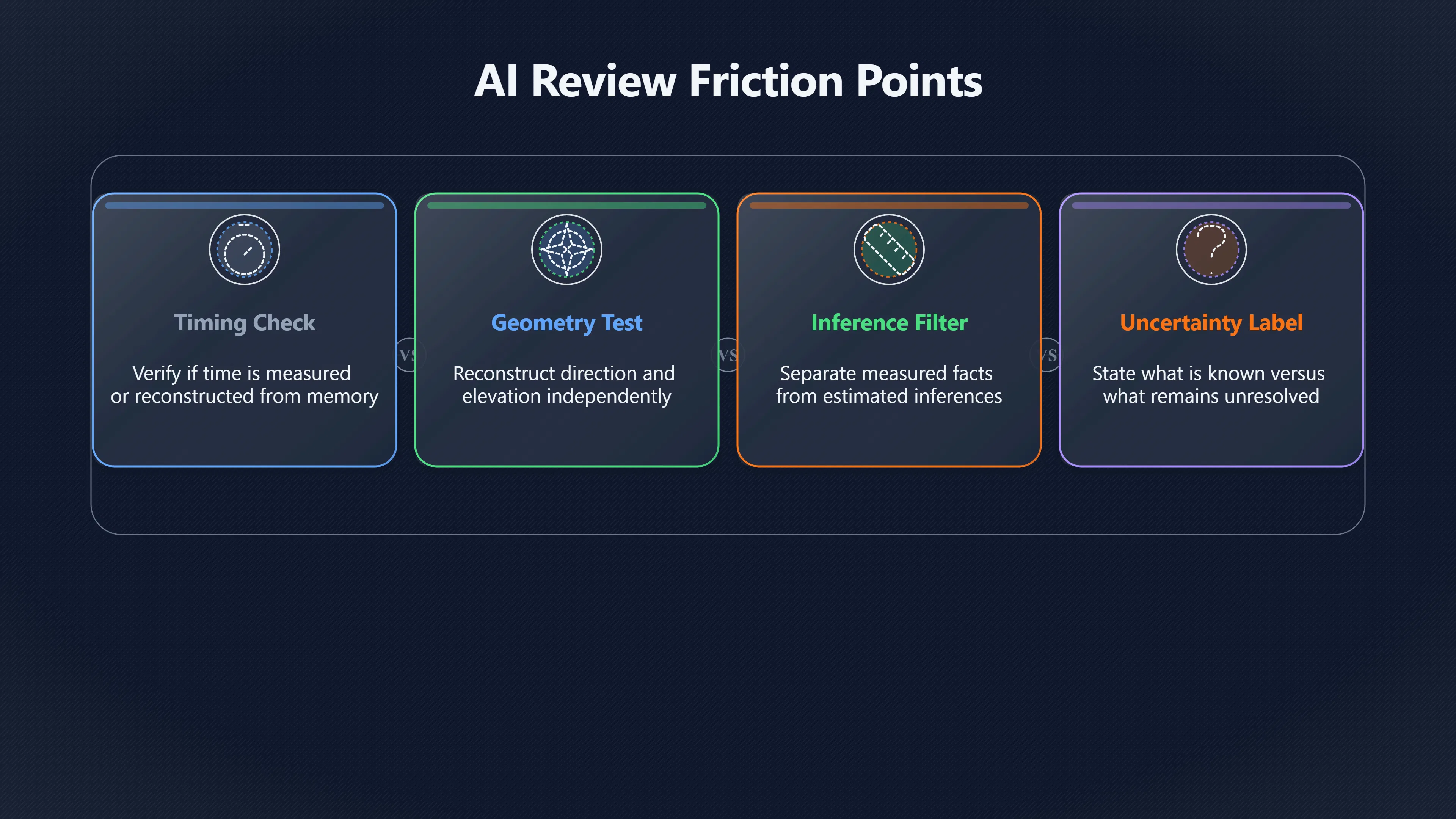
Checking Time, Direction and Elevation Claims
Was the timing independently verified?
One of the most important pre-publication questions is whether the reported time was measured or remembered. Witnesses commonly estimate times after the event, especially during surprising or stressful observations. AI systems may silently treat those estimates as exact timestamps.
A reviewer should therefore ask:
- Is the time taken from device metadata, CCTV, telemetry or logs?
- Was the time reconstructed from memory?
- Was there a time-zone conversion?
- Could the witness have rounded the time?
- Was the duration estimated or recorded?
This matters because many AI explanation systems rely heavily on temporal matching. A satellite flare, aircraft pass or meteor prediction may appear convincing only because the model assumed an unrealistically precise timestamp.
A practical safeguard is to require explicit timing confidence labels in the case file:
- exact recorded time
- approximate time
- reconstructed estimate
- unknown timing precision
Without that distinction, an AI-generated explanation can look stronger than the evidence actually allows.
Did the direction and elevation survive basic geometry checks?
Witnesses are often poor at estimating altitude, angular size and elevation above the horizon. A bright object near the horizon can appear overhead. A distant aircraft can seem stationary. Venus can appear surprisingly elevated depending on terrain and observer orientation.
Pre-publication reviewers should therefore ask whether the geometry has been reconstructed independently rather than accepted from narrative description alone.
Key challenge questions include:
- Was the viewing direction measured from maps or only verbally described?
- Did the witness face true north, magnetic north or an assumed direction?
- Was elevation estimated visually or derived from imagery?
- Could terrain, buildings or hills distort the reported angle?
- Does the claimed movement remain plausible after correcting for observer motion?
These checks are especially important in AI-assisted reconstruction tools that generate flight-path overlays or celestial matches. A visually persuasive overlay can still be wrong if the original orientation estimate was inaccurate.
A reviewer should also test whether small changes in observer position materially change the conclusion. If shifting the assumed viewpoint by a few hundred metres breaks the explanation, the explanation may be too fragile to present confidently.
Separating Estimates From Measured Facts
Has the AI confused inference with evidence?
Many UFO reports contain statements that sound factual but are actually layered estimates. “The object was travelling thousands of miles per hour” often rests on an assumed distance rather than measured range data.
AI systems can unintentionally amplify this problem because they are trained to produce smooth explanatory prose. They may convert tentative witness impressions into declarative statements.
Human reviewers should isolate every claim that depends on inference rather than direct measurement.
Important review questions include:
- Was speed directly measured or inferred from assumed distance?
- Was size estimated from apparent brightness?
- Was altitude calculated or guessed?
- Was acceleration visible in raw footage or introduced by zoom and tracking?
- Did the AI distinguish between “appeared stationary” and “was stationary”?
This distinction is central to avoiding exaggerated conclusions. A nearby insect crossing a night-vision camera can appear as a high-speed anomalous object if range assumptions are wrong. A distant aircraft viewed head-on can appear motionless. Compression artefacts can create false shape changes in infrared footage.
AARO has repeatedly noted that birds, balloons and sensor artefacts can appear anomalous because of electro-optical distortion, compression and limited contextual data.[Metabunk]metabunk.orgaaro 2024 annual report on uap.13762AARO 2024 Annual Report on UAP14 Nov 2024 — In many other cases, birds are commonly misidentified as UAP due to sensor artifacts…[AARO]aaro.milAARO HomeWelcome to the website for the All-domain Anomaly Resolution Office (AARO). Our team of experts leads the U.S. government's effo…
Are uncertainty ranges visible to the reader?
One of the clearest signs of weak review is a published UFO conclusion without uncertainty language. Responsible case files should state what is known, what is estimated and what remains unresolved.
A reviewer should challenge any sentence that sounds more certain than the underlying evidence justifies.
For example:
- “The object accelerated instantly” may need revision to “the object appeared to accelerate based on apparent angular motion”.
- “No aircraft were present” may need revision to “no aircraft were identified in available civilian flight-tracking data”.
- “The object emitted no sound” may need revision to “the witness reported no audible sound from their position”.
These distinctions matter because readers often remember simplified conclusions while forgetting the limitations attached to them.
Research on scientific review processes repeatedly shows that strong review pressure improves reliability by forcing claims to stay proportional to evidence rather than rhetorical confidence.[arXiv]arxiv.orgDemanding peer review is associated with higher impact in published scienceApril 15, 2026…
Testing Whether Another Reviewer Would Agree
Could an independent reviewer reproduce the conclusion?
A useful safeguard is reproducibility review. Another investigator should be able to follow the same data trail and reach a similar assessment.
That means the case file should preserve:
- source datasets
- timestamps
- map coordinates
- software versions
- weather records
- astronomy calculations
- flight and satellite queries
- image-processing steps
- confidence scores
If the conclusion depends on undocumented assumptions inside a proprietary AI workflow, the review has failed.
This standard is particularly important in UFO investigations because many online claims spread without preserved methodology. Public audiences often see only the final assertion rather than the chain of reasoning behind it.
A reviewer should therefore ask:
- Can another analyst rerun the environmental checks?
- Were excluded explanations documented?
- Were contradictory details preserved?
- Does the reasoning rely on hidden prompts or undocumented filtering?
- Would a sceptical reviewer identify missing steps?
Did reviewers actively test rival explanations?
Weak reviews often ask whether an explanation fits. Strong reviews ask whether competing explanations fit equally well or better.
For example, before publishing “likely drone”, reviewers should compare:
- drone plausibility
- aircraft plausibility
- balloon plausibility
- astronomical plausibility
- hoax plausibility
- sensor artefact plausibility
The question is not whether the preferred explanation is possible. It is whether it is materially stronger than alternatives.
This is where adversarial review becomes valuable. One reviewer may try to falsify the AI’s preferred explanation while another attempts to defend it. If both agree after challenge, confidence increases. If they disagree sharply, the public conclusion may need softer wording such as “plausible explanation” rather than “resolved”.
Scientific peer review research increasingly focuses on grounding claims directly against evidence rather than rhetorical fluency alone, partly because AI-generated text can appear convincing even when poorly supported.[arXiv]arxiv.orgDemanding peer review is associated with higher impact in published scienceApril 15, 2026…
Questions That Should Block Publication
Some warning signs should trigger escalation or delay rather than immediate publication.
A UFO conclusion deserves extra scrutiny when:
- the explanation depends on a single uncertain variable
- metadata is missing
- the original media has been heavily compressed
- the AI system ignored contradictory witness details
- the proposed explanation changed repeatedly between model runs
- no independent reviewer signed off
- environmental checks were incomplete
- the conclusion relies on unavailable classified data
- confidence language exceeds evidential quality
- alternative explanations were not documented
Cases should also be paused when the public summary contains stronger language than the technical analysis underneath it. This often happens when communications teams simplify nuanced findings into headlines that overstate certainty.
A careful review process protects against both sensationalism and overconfident debunking. Some UFO cases are eventually resolved as ordinary objects after better contextual analysis becomes available. Others remain unresolved because the evidence quality is genuinely insufficient for a stable conclusion. AARO has publicly stated that many archived cases remain open precisely because available data does not support a definitive interpretation.[DefenseScoop]defensescoop.comuap aaro chief unveils pentagon annual caseload analysis new effortsDefenseScoop'The truly anomalous': New AARO chief unveils Pentagon's…14 Nov 2024 — “AARO has successfully resolved hundreds of cases i…[AARO]aaro.mila physical source. The available…Read more…
The Most Important Final Question
Before publication, every AI-assisted UFO conclusion should face one final challenge:
Would the wording still look fair and evidence-led if the preferred explanation later proved wrong?
That question forces reviewers to separate confidence from speculation. It discourages definitive language built on weak assumptions. It also protects genuinely unusual cases from being prematurely forced into an ordinary explanation simply because the AI system produced a plausible match.
In practice, the best public-facing UFO investigations are not the ones that sound most certain. They are the ones that clearly distinguish measured facts, interpreted correlations, plausible explanations and unresolved uncertainty.
eBay marketplace picks
Marketplace Samples
Example marketplace items related to this page. Use the search link to explore similar finds on eBay.




Endnotes
1.
Source: science.nasa.gov
Title: Science Independent Study Team Report
Link:https://science.nasa.gov/wp-content/uploads/2023/09/uap-independent-study-team-final-report.pdf
Source snippet
NASA ScienceIndependent Study Team ReportSeptember 13, 2023 — At present, analysis of UAP data is hampered by poor sensor calibration, th...
Published: September 13, 2023
2.
Source: aaro.mil
Link:https://www.aaro.mil/UAP-Cases/Official-UAP-Imagery/
Source snippet
a physical source. The available...Read more...
3.
Source: nasa.gov
Title: update nasa shares uap independent study report names director
Link:https://www.nasa.gov/news-release/update-nasa-shares-uap-independent-study-report-names-director/
Source snippet
UPDATE: NASA Shares UAP Independent Study Report14 Sept 2023 — We found that NASA can help the whole-of-government UAP effort through sys...
4.
Source: en.wikisource.org
Link:https://en.wikisource.org/wiki/Page%3AUAP_Independent_Study_Team_-_Final_Report.pdf/5
Source snippet
Page:UAP Independent Study Team - Final Report.pdf/512 Nov 2023 — At present, analysis of UAP data is hampered by poor sensor...
5.
Source: metabunk.org
Title: aaro 2024 annual report on uap.13762
Link:https://www.metabunk.org/threads/aaro-2024-annual-report-on-uap.13762/
Source snippet
AARO 2024 Annual Report on UAP14 Nov 2024 — In many other cases, birds are commonly misidentified as UAP due to sensor artifacts...
6.
Source: arxiv.org
Link:https://arxiv.org/abs/2604.14047
Source snippet
Demanding peer review is associated with higher impact in published scienceApril 15, 2026...
Published: April 15, 2026
7.
Source: arxiv.org
Link:https://arxiv.org/abs/2601.04350
8.
Source: arxiv.org
Title: arXiv Peerispect: Claim Verification in Scientific Peer Reviews
Link:https://arxiv.org/abs/2604.17667
Source snippet
Peerispect: Claim Verification in Scientific Peer ReviewsApril 20, 2026...
Published: April 20, 2026
9.
Source: arxiv.org
Title: arXiv CLAIMCHECK: How Grounded are LLM Critiques of Scientific Papers?
Link:https://arxiv.org/abs/2503.21717
10.
Source: defensescoop.com
Title: uap aaro chief unveils pentagon annual caseload analysis new efforts
Link:https://defensescoop.com/2024/11/14/uap-aaro-chief-unveils-pentagon-annual-caseload-analysis-new-efforts/
Source snippet
DefenseScoop'The truly anomalous': New AARO chief unveils Pentagon's...14 Nov 2024 — “AARO has successfully resolved hundreds of cases i...
11.
Source: aaro.mil
Link:https://www.aaro.mil/
Source snippet
AARO HomeWelcome to the website for the All-domain Anomaly Resolution Office (AARO). Our team of experts leads the U.S. government's effo...
12.
Source: en.wikisource.org
Title: Responses to Statement of Task
Link:https://en.wikisource.org/wiki/NASA_Unidentified_Anomalous_Phenomena%3A_Independent_Study_Team_Report/Responses_to_Statement_of_Task
Source snippet
UAP is hampered by sensor calibration challenges and a lack of sensor metadata.... Artificial intelligence (AI) and machine learning (ML...
13.
Source: arxiv.org
Link:https://arxiv.org/html/2506.00125v1
Source snippet
1 Introduction30 May 2025 — A system designed for the comprehensive scientific study of aerial phenomena which integrates multiple sensor...
Published: May 2025
14.
Source: media.defense.gov
Title: DOPSR 2024 0263 AARO HISTORICAL RECORD REPORT VOLUME 1 2024
Link:https://media.defense.gov/2024/Mar/08/2003409233/-1/-1/0/DOPSR-2024-0263-AARO-HISTORICAL-RECORD-REPORT-VOLUME-1-2024.PDF
Source snippet
Historical Record Report Volume 18 Mar 2024 — AARO Investigating Unresolved Historical Nuclear-Related UAP Cases... aberrations, sensor...
Additional References
15.
Source: pmc.ncbi.nlm.nih.gov
Link:https://pmc.ncbi.nlm.nih.gov/articles/PMC3938539/
Source snippet
nih.govQuality, Reliability, and Reproducibility in Biomedical Researchby WL Kraus · 2014 · Cited by 19 — We should place a much higher s...
16.
Source: reddit.com
Link:https://www.reddit.com/r/UFOs/comments/166dk0u/according_to_aaros_new_website_the_flir_gimbal/
Source snippet
According to AARO's new website, the FLIR, Gimbal and...AARO has posted another unresolved case (video): "This footage, captured by an i...
17.
Source: reddit.com
Link:https://www.reddit.com/r/nasa/comments/16ij1ym/nasa_has_released_the_unidentified_anomalous/
Source snippet
NASA has released the Unidentified Anomalous...DOD and NASA now both say there are objects in the air that they can't identify. This UAP...
18.
Source: reddit.com
Link:https://www.reddit.com/r/skeptic/comments/15pfqbp/extraordinary_claims_require_extraordinary/
19.
Source: zhihu.com
Link:https://www.zhihu.com/en/answer/3211845828
20.
Source: twz.com
Title: balloons no ufos found by satellites shoot down video coming says aaro chief
Link:https://www.twz.com/balloons-no-ufos-found-by-satellites-shoot-down-video-coming-says-aaro-chief
Source snippet
Balloons, No UFOs, Found By Satellites, Shoot Down...31 Oct 2023 — The head of AARO said that he has all the overhead imagery he needs t...
21.
Source: youtube.com
Link:https://www.youtube.com/watch?v=TQcqOW39ksk
Source snippet
Unidentified Anomalous Phenomena Independent Study ReportNASA commissioned an independent study team to examine unidentified anomalous ph...
22.
Source: news.clearancejobs.com
Title: ufos or u s secrets the mystery behind the pentagons 757 new uap reports
Link:https://news.clearancejobs.com/2024/11/20/ufos-or-u-s-secrets-the-mystery-behind-the-pentagons-757-new-uap-reports/
Source snippet
or U.S. Secrets? The Mystery Behind the Pentagon's...20 Nov 2024 — The Pentagon's latest UAP report tackles 757 mysterious sightings, re...
23.
Source: war.gov
Title: dod examining unidentified anomalous phenomena
Link:https://www.war.gov/News/News-Stories/Article/Article/3965403/dod-examining-unidentified-anomalous-phenomena/
Source snippet
14 Nov 2024 — "AARO has successfully resolved hundreds of cases in its holdings to commonplace objects such as balloons, birds, drones, s...
24.
Source: meritalk.com
Title: nasa urged to take more permanent role in uap research effort
Link:https://www.meritalk.com/articles/nasa-urged-to-take-more-permanent-role-in-uap-research-effort/
Source snippet
NASA Urged to Take More Permanent Role in UAP...15 Sept 2023 — The study team found that most UAP data is “hampered by poor sensor calib...
Topic Tree