Within Orbital Data
Why nearest satellite is not always the answer
A good UFO report should say how strong the satellite fit is, not just name the nearest object.
On this page
- Track, timing and brightness checks
- Separating strong candidates from weak correlations
- Report wording that avoids false closure
Page outline Jump by section
Introduction
A good UFO investigation does not simply ask, “Was there a satellite nearby?” It asks how well the satellite explanation actually fits the sighting. In many weak investigations, the nearest catalogued object becomes the assumed answer even when the timing, sky position, brightness behaviour, or orbital reliability are poor. That creates false closure: a report gets labelled “probably Starlink” when the evidence only supports “possible satellite correlation”.
 Confidence scoring is designed to stop that problem. In an AI-assisted UFO workflow, automated systems should rank candidate satellite explanations according to evidence quality, orbital reliability, geometry, and observational consistency rather than returning a single definitive label. This becomes especially important when analysing historical sightings using older orbital data, manoeuvring satellites, incomplete witness accounts, or uncertain flare events.
The practical goal is not mathematical perfection. It is transparent uncertainty handling. Readers, investigators, journalists, and witnesses should be able to see whether a proposed satellite explanation is strong, moderate, weak, or speculative — and why.
Why nearest satellite is not always the answer
A common failure mode in UFO analysis software is proximity bias. The system finds the closest object in orbital databases and assumes it explains the sighting. In reality, visible satellite identification depends on several independent conditions aligning at the same time:
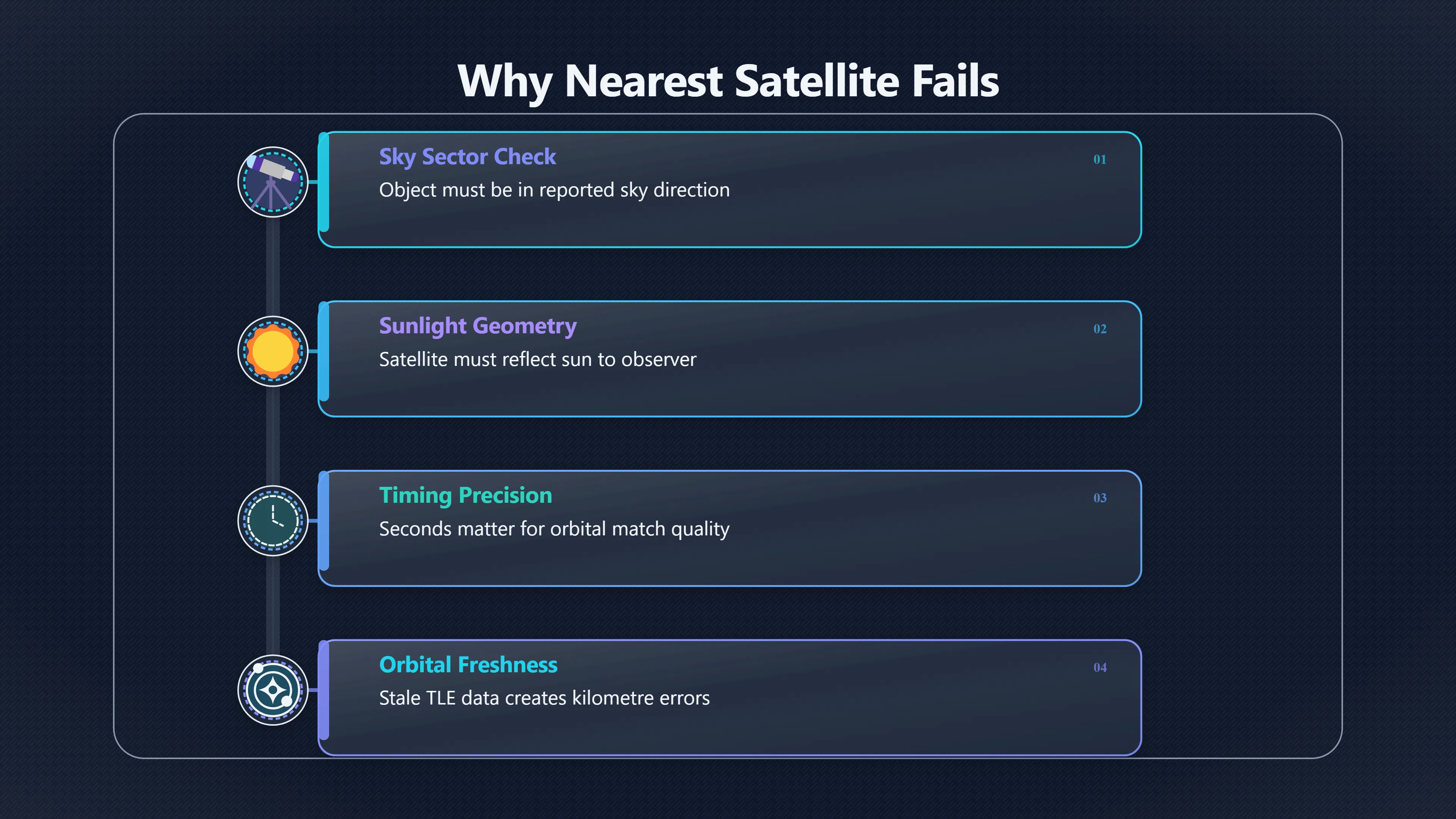
- The satellite must actually have been in the reported sky sector.
- The timing must match closely.
- The satellite must have been illuminated by sunlight.
- The observer must have been positioned within the visible reflection geometry.
- The brightness must be plausible for that object type.
- The orbital data must still have been reliable for that date.
If any of those conditions fail, the confidence should fall sharply.
This matters because publicly available orbital predictions drift over time. Standard Two-Line Element (TLE) predictions propagated through SGP4 models can accumulate kilometre-scale errors within days, especially for low Earth orbit satellites and manoeuvring constellations such as Starlink.[arXiv]arxiv.orgHow long can you trust a Starlink TLE? An empirical comparison of SGP4 and high-fidelity propagation against operator-updated truth…[PMC]pmc.ncbi.nlm.nih.govOrbit Determination for Continuously Maneuvering Starlink…by A Lang · 2025 · Cited by 2 — Compared to infrequently maneuvering spac…[MDPI]mdpi.comResearch on Enhanced Orbit Prediction Techniques…by J Chen · 2023 · Cited by 22 — The research reveals that SGP4 achieved OP errors of… Even a small positional error can move a predicted pass far enough across the sky to create a false visual “match”.
Modern mega-constellations complicate this further because satellites regularly alter orbit. Research on Starlink tracking has shown that public prediction errors can grow substantially over time and that manoeuvre activity degrades long-term reliability.[Raa Journal]raa-journal.orgAlso, the SGP4 model is not able to accurately account for the continuous low thrust effect on the…Read more…[ScienceDirect For UFO case review]sciencedirect.comManeuver strategies of Starlink satellite based on SpaceX…by A Liu · 2024 · Cited by 24 — This paper uses Starlink ephemerides release…, that means “nearest object” should usually be treated as the start of the investigation, not the conclusion.
Track, timing and brightness checks
A credible confidence system should evaluate multiple independent factors rather than relying on a single orbital overlap.
Track consistency
The predicted track should align with the witness description in a meaningful way:
- Direction of travel
- Elevation angle
- Apparent speed
- Entry and exit points
- Duration of visibility
A satellite moving north-east across the southern sky is not a strong explanation for a witness describing a stationary western light that suddenly accelerated upward.
AI systems can score track consistency numerically by comparing reconstructed witness geometry against propagated orbital paths. However, the system should also flag witness uncertainty separately. A vague recollection like “moving roughly east” should not be weighted as heavily as calibrated camera footage or a fixed reference bearing.
Timing confidence
Timing quality is one of the strongest predictors of explanation reliability.
High-confidence matches usually involve:
- witness timing accurate within seconds or a minute
- fresh orbital elements close to the sighting epoch
- agreement between multiple tracking datasets
Low-confidence matches often involve:
- estimates such as “around 10 pm”
- historical reconstructions years after the event
- stale TLE data
- manoeuvring objects
- uncertain timezone conversions
Research into TLE propagation accuracy consistently shows prediction quality degrades with time from the orbital epoch.[arXiv]arxiv.orgHow long can you trust a Starlink TLE? An empirical comparison of SGP4 and high-fidelity propagation against operator-updated truth…[3ScienceDirect 3Inside]sciencedirect.comManeuver strategies of Starlink satellite based on SpaceX…by A Liu · 2024 · Cited by 24 — This paper uses Starlink ephemerides release… GNSS](#endnote-18 “Snippet: ENTER LEO on the GNSS Stage: Navigation with Starlink…Nov 29, 2021 — The tradeoff is in satellite position accuracy: the SGP4 propagat…”) A robust scoring system therefore needs to penalise explanations built on old or weak orbital assumptions.
Brightness and illumination checks
Many false satellite identifications ignore a basic visibility question: could the object realistically have appeared that bright?
Satellites do not emit visible light themselves. They reflect sunlight. Visibility therefore depends on solar geometry, atmospheric conditions, observer position, and spacecraft orientation.[SatFleet Live]satfleetlive.comSat Fleet Live Why Are Satellites So Bright?satellites reflect sunlight and produce no light of their own, entering the shadow makes them immediately invisibl…[Wikipedia]WikipediaSatellite flareSatellite flareSatellite flare, also known as satellite glint, is a brief and bright "flare" in visibility of an satellite. It is caus… This is especially important in flare cases. Bright satellite glints can appear suddenly and disappear within seconds, producing dramatic reports that resemble UFO behaviour. Iridium flares became famous examples because highly reflective antennas created narrow reflection zones visible only from certain ground positions.[ScienceDirect]sciencedirect.comManeuver strategies of Starlink satellite based on SpaceX…by A Liu · 2024 · Cited by 24 — This paper uses Starlink ephemerides release…
Modern Starlink satellites can also produce strong flares under specific geometries.[arXiv]arxiv.orgHow long can you trust a Starlink TLE? An empirical comparison of SGP4 and high-fidelity propagation against operator-updated truth… But not every Starlink pass produces visible brightness. A weakly illuminated object below naked-eye visibility should not receive a high-confidence identification score simply because its orbit crossed the area.
Good scoring systems therefore separate:
- orbital proximity
- probable visibility
- probable brightness
- flare plausibility
Those are related but not identical questions.
Separating strong candidates from weak correlations
A useful public-facing investigation system should avoid binary labels such as “identified” versus “unidentified”. Real-world evidence is usually messier.
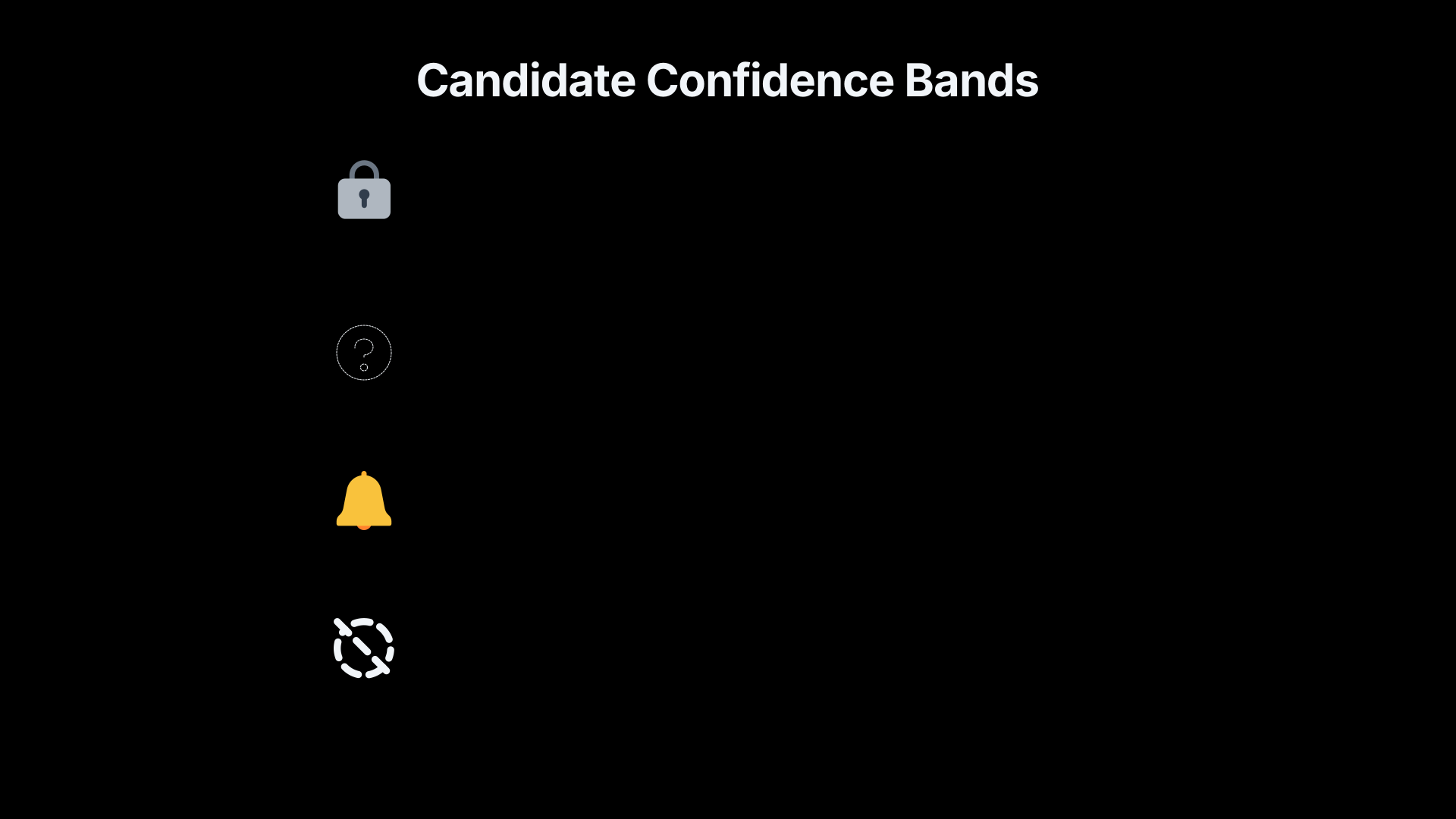
Instead, explanations work better when grouped into transparent confidence bands.
Strong candidate
A strong satellite explanation usually includes:
- close timing agreement
- good track alignment
- visibility geometry consistent with sunlight conditions
- brightness behaviour matching known satellite characteristics
- reliable orbital data close to epoch
- no major contradictory witness detail
An example would be a dusk sighting matching a well-documented Starlink train crossing the exact sky region at the exact reported minute.
Plausible but uncertain
This category is often the most honest outcome.
The satellite may fit the general direction and timing, but:
- witness timing may be uncertain
- orbital data may be stale
- brightness estimates may not fully align
- the track may only partially overlap
This should not be presented as solved. It is better framed as “a plausible satellite correlation requiring caution”.

Weak correlation
Weak matches occur when systems force a satellite explanation despite major inconsistencies.
Typical warning signs include:
- large timing offsets
- major sky-position mismatch
- impossible brightness
- incompatible motion
- daylight visibility contradictions
- poor orbital reliability
- overreliance on “nearest object” logic
These are common in automated bulk-screening systems that prioritise explanation generation over evidence quality.
No credible satellite fit
Sometimes the correct outcome is simply that no convincing satellite candidate exists in available records.
That does not automatically make a sighting extraordinary. Other explanations may remain possible:
- aircraft
- drones
- balloons
- atmospheric optics
- witness misperception
- incomplete data
But forcing a poor satellite explanation can damage the credibility of the wider investigation process.
Why AI systems need explainable scoring
AI-assisted UFO analysis can process far more orbital data than human investigators alone. It can automatically compare thousands of objects against a sighting window and rank likely candidates within seconds.
The danger is opacity.
If a system outputs:
“Likely Starlink match: 92% confidence”
without explaining the basis for that score, users cannot judge whether the conclusion is robust or misleading.
A better implementation exposes the reasoning components individually:
- orbital freshness score
- trajectory overlap score
- timing confidence
- illumination confidence
- brightness plausibility
- witness reliability weighting
- environmental visibility conditions
This matters because different uncertainties compound differently.
For example:
- a precise witness report plus weak orbital data produces a different uncertainty profile from
- weak witness timing plus highly reliable orbital telemetry
Those cases should not collapse into the same confidence number.
Research into improving orbital prediction models shows that even advanced propagation techniques still face substantial uncertainty when relying on public TLE data alone. ScienceDirect Springer That makes transparency essential. Investigators should be able to see whether uncertainty comes from the witness account[link.springer.com]link.springer.composition error from 2.5 km to approximately 200 m for Orbcomm satellitesNetwork-based precise orbit determination of broadband LEO…by A Allahvirdi-Zadeh · 2026 — Third, real-time LEO satellite POD i…, the orbital model, or the visibility reconstruction.
Report wording that avoids false closure
The wording used in public UFO reports matters almost as much as the underlying analysis.
Overconfident phrasing can make uncertain matches sound definitive:
- “The object was identified as Starlink.”
- “The sighting was explained by a satellite.”
- “The AI confirmed a satellite pass.”
Those statements imply certainty that often does not exist.
Better reporting language separates confidence levels clearly.
Better phrasing examples
Instead of:
- “The object was definitely a satellite.”
Use:
- “A satellite explanation is plausible based on partial timing and trajectory overlap.”
Instead of:
- “Starlink identified.”
Use:
- “A Starlink satellite passed near the reported sky position, although the timing uncertainty and brightness mismatch reduce confidence.”
Instead of:
- “Case solved.”
Use:
- “Available orbital data support a possible satellite correlation, but the evidence is not strong enough for a definitive identification.”
This style of wording helps preserve analytical honesty while still communicating useful investigative findings.
The value of uncertainty in UFO investigation
Uncertainty is not a weakness in serious UFO analysis. It is evidence that the investigation process is functioning properly.
Satellite databases are imperfect. Witnesses are imperfect. Historical reconstruction is imperfect. Modern AI systems can improve correlation speed dramatically, but they cannot eliminate ambiguity where the underlying data are weak or incomplete.
A well-designed confidence-scoring system therefore does something more useful than declaring quick answers. It shows:
- how strong a satellite explanation really is
- where the evidence fits
- where the evidence breaks down
- how much uncertainty remains
That distinction is crucial in AI-assisted UFO investigation because the most misleading outcome is often not an unresolved sighting. It is a weak explanation presented with unjustified certainty.
Amazon book picks
Further Reading
Books and field guides related to Why nearest satellite is not always the answer. Use these as the next step if you want deeper reading beyond the article.
The Signal and the Noise
Best fit for distinguishing strong satellite matches from weak correlations.
The Practical Astronomer
Supports practical checks of track, brightness and sky direction.
Superforecasting
Fits avoiding false closure when the nearest satellite only partly fits.
eBay marketplace picks
Marketplace Samples
Example marketplace items related to this page. Use the search link to explore similar finds on eBay.


Endnotes
1.
Source: pmc.ncbi.nlm.nih.gov
Link:https://pmc.ncbi.nlm.nih.gov/articles/PMC12252113/
Source snippet
Orbit Determination for Continuously Maneuvering Starlink...by A Lang · 2025 · Cited by 2 — Compared to infrequently maneuvering spac...
2.
Source: mdpi.com
Link:https://www.mdpi.com/2226-4310/10/6/532
Source snippet
Research on Enhanced Orbit Prediction Techniques...by J Chen · 2023 · Cited by 22 — The research reveals that SGP4 achieved OP errors of...
3.
Source: arxiv.org
Link:https://arxiv.org/abs/2605.19850
Source snippet
How long can you trust a Starlink TLE? An empirical comparison of SGP4 and high-fidelity propagation against operator-updated truth...
4.
Source: raa-journal.org
Link:https://www.raa-journal.org/issues/all/2022/v22n11/202211/P020221110639422377110.pdf
Source snippet
Also, the SGP4 model is not able to accurately account for the continuous low thrust effect on the...Read more...
5.
Source: sciencedirect.com
Link:https://www.sciencedirect.com/science/article/abs/pii/S027311772400615X
Source snippet
Maneuver strategies of Starlink satellite based on SpaceX...by A Liu · 2024 · Cited by 24 — This paper uses Starlink ephemerides release...
6.
Source: arxiv.org
Link:https://arxiv.org/abs/2505.13752
7.
Source: sciencedirect.com
Link:https://www.sciencedirect.com/science/article/abs/pii/S0273117708006121
Source snippet
The Simplified General Perturbations-4 (SGP4) propagator was used.Read more...
8.
Source: Wikipedia
Title: Satellite flare
Link:https://en.wikipedia.org/wiki/Satellite_flare
Source snippet
Satellite flareSatellite flare, also known as satellite glint, is a brief and bright "flare" in visibility of an satellite. It is caus...
9.
Source: sciencedirect.com
Title: ScienceDirect The visual appearance of the Iridium® satellites
Link:https://www.sciencedirect.com/science/article/abs/pii/S0094576502001273
Source snippet
The cause of the...
10.
Source: arxiv.org
Title: arXiv Extreme Flaring of Starlink Satellites
Link:https://arxiv.org/abs/2405.13091
Source snippet
Extreme Flaring of Starlink SatellitesMay 21, 2024...
Published: May 21, 2024
11.
Source: sciencedirect.com
Link:https://www.sciencedirect.com/science/article/pii/S0094576524006374
Source snippet
Closing the gap between SGP4 and high-precision...by G Acciarini · 2025 · Cited by 16 — We showed how the new propagation m...
12.
Source: link.springer.com
Title: position error from 2.5 km to approximately 200 m for Orbcomm satellites
Link:https://link.springer.com/article/10.1007/s10291-025-01963-0
Source snippet
Network-based precise orbit determination of broadband LEO...by A Allahvirdi-Zadeh · 2026 — Third, real-time LEO satellite POD i...
13.
Source: mdpi.com
Link:https://www.mdpi.com/1424-8220/25/13/4079
Source snippet
Orbit Determination for Continuously Maneuvering Starlink...by A Lang · 2025 · Cited by 3 — Compared to infrequently maneuvering space t...
14.
Source: mdpi.com
Link:https://www.mdpi.com/2076-3417/11/21/10181
Source snippet
Simplified Approach to Detect Satellite Maneuvers Using...by A Mukundan · 2021 · Cited by 42 — In this study, an algorithm to identify t...
15.
Source: sciencedirect.com
Link:https://www.sciencedirect.com/science/article/abs/pii/S0273117716306251
Source snippet
Analytical representations of precise orbit predictions for...by J Sang · 2017 · Cited by 22 — The fitting errors of the 7-day orbit pos...
16.
Source: arxiv.org
Link:https://arxiv.org/pdf/2402.04830
Source snippet
closing the gap between sgp4 and high-precision...by G Acciarini · 2024 · Cited by 16 — Then, we also conduct an experiment on a group o...
17.
Source: arxiv.org
Link:https://arxiv.org/html/2402.04830v2
Source snippet
Closing the Gap Between SGP4 and High-Precision...Feb 26, 2024 — In the context of SGP4, most of the proposed techniques focus on creati...
18.
Source: satfleetlive.com
Title: Sat Fleet Live Why Are Satellites So Bright?
Link:https://satfleetlive.com/blogs/why-are-satellites-so-bright/
Source snippet
satellites reflect sunlight and produce no light of their own, entering the shadow makes them immediately invisibl...
Additional References
19.
Source: researchgate.net
Link:https://www.researchgate.net/publication/259899828_Accuracy_Assessment_of_SGP4_Orbit_Information_Conversion_into_Osculating_Elements
Source snippet
(PDF) Accuracy Assessment of SGP4 Orbit Information...Mar 12, 2022 — The satellite ephemeris derived from the TLE-SGP4 model may contain...
20.
Source: amostech.com
Link:https://amostech.com/TechnicalPapers/2023/Poster/Constant.pdf
Source snippet
Analysis of Mega-Constellation Data Time-Series Charles CoOur investigation into TLE latencies and locations aimed to ascertain whether t...
21.
Source: catchingtime.com
Link:https://catchingtime.com/starlink-satellite-swarm-from-37n-latitude/
Source snippet
4/10/24: Starlink Satellite Swarm from 37°N latitudeFlares of this type are essentially direct specular reflections of the sun (which lie...
22.
Source: celestrak.org
Link:https://www.celestrak.org/NORAD/elements/supplemental/
Source snippet
Current Supplemental GP Element SetsThe 31 Space Track GPEs show an average error of 7.54 km over this period with a maximum error (for P...
23.
Source: space-track.org
Link:https://www.space-track.org/documentation
Source snippet
Help DocumentationThe general perturbations (GP) class is an efficient listing of the newest SGP4 keplerian element set for each man-made...
24.
Source: facebook.com
Link:https://www.facebook.com/groups/2365809903441367/posts/7829632610392375/
25.
Source: satspy.com
Link:https://satspy.com/when-to-look-satellite.html
Source snippet
When are the best times to look?Satellites are visible when the observer is in darkness, but the satellite is still illuminated by sunlig...
26.
Source: facebook.com
Link:https://www.facebook.com/groups/Satellite.apt.group/posts/3151860448330702/
Source snippet
Some info was send to me concering the TLE's drawn...CelesTrak was accurate. H-A wasn't. Today I compared a prediction using yesterday's...
27.
Source: kids.kiddle.co
Link:https://kids.kiddle.co/Satellite_flare
Source snippet
flare Facts for KidsIt happens when sunlight bounces off a man-made satellite and reflects directly back to Earth. Imagine a mirror catch...
28.
Source: satobs.org
Link:https://www.satobs.org/iridium.html
Source snippet
Satellites ObserverIridium FlaresThe plate or MMA can provide a direct (specular) reflection of the sun's disk. This specular reflection...
Topic Tree