Within Re entry Breakups
Why Some 'Meteor' UFOs Stay Visible For Minutes
Witness reports lasting close to a minute often fit shallow re-entry physics better than ordinary meteor fireballs.
On this page
- Typical meteor versus re entry durations
- How shallow descent changes sky movement
- Using witness timing in UFO case triage
Page outline Jump by section
Introduction
A fireball that stays visible for 30 seconds, a minute, or even longer is one of the strongest clues that a reported “meteor UFO” may actually be orbital debris re-entering the atmosphere. In UFO case investigation, witness timing matters far more than many people realise. Ordinary meteors usually cross the visible sky in only a few seconds because they strike the atmosphere at enormous speeds. Re-entering satellites and rocket bodies arrive on much shallower paths and at lower orbital velocities, producing slower, horizon-spanning breakups that can resemble burning formations or fleets of lights.[The Aerospace Corporation]aerospace.orgThe Aerospace CorporationWhat Does a Reentry Look LikeThe general rule-of-thumb is that natural meteor reentries happen quickly and typic…[The Aerospace Corporation]aerospace.orgThe Aerospace CorporationWhat Does a Reentry Look LikeThe general rule-of-thumb is that natural meteor reentries happen quickly and typic…
 This distinction is valuable for AI-assisted UFO analysis because duration is one of the easiest witness details to extract and compare across reports. If dozens of witnesses independently describe a glowing object remaining visible long enough to fetch a phone, call family members outside, or watch multiple fragmentation stages, the case rapidly shifts toward a probable re-entry scenario rather than a conventional meteor event. That does not solve every sighting automatically, but it changes which datasets, orbital records, and environmental correlations investigators should prioritise first.
Typical Meteor Versus Re-entry Durations
The clearest separation between meteors and orbital debris often comes down to time.
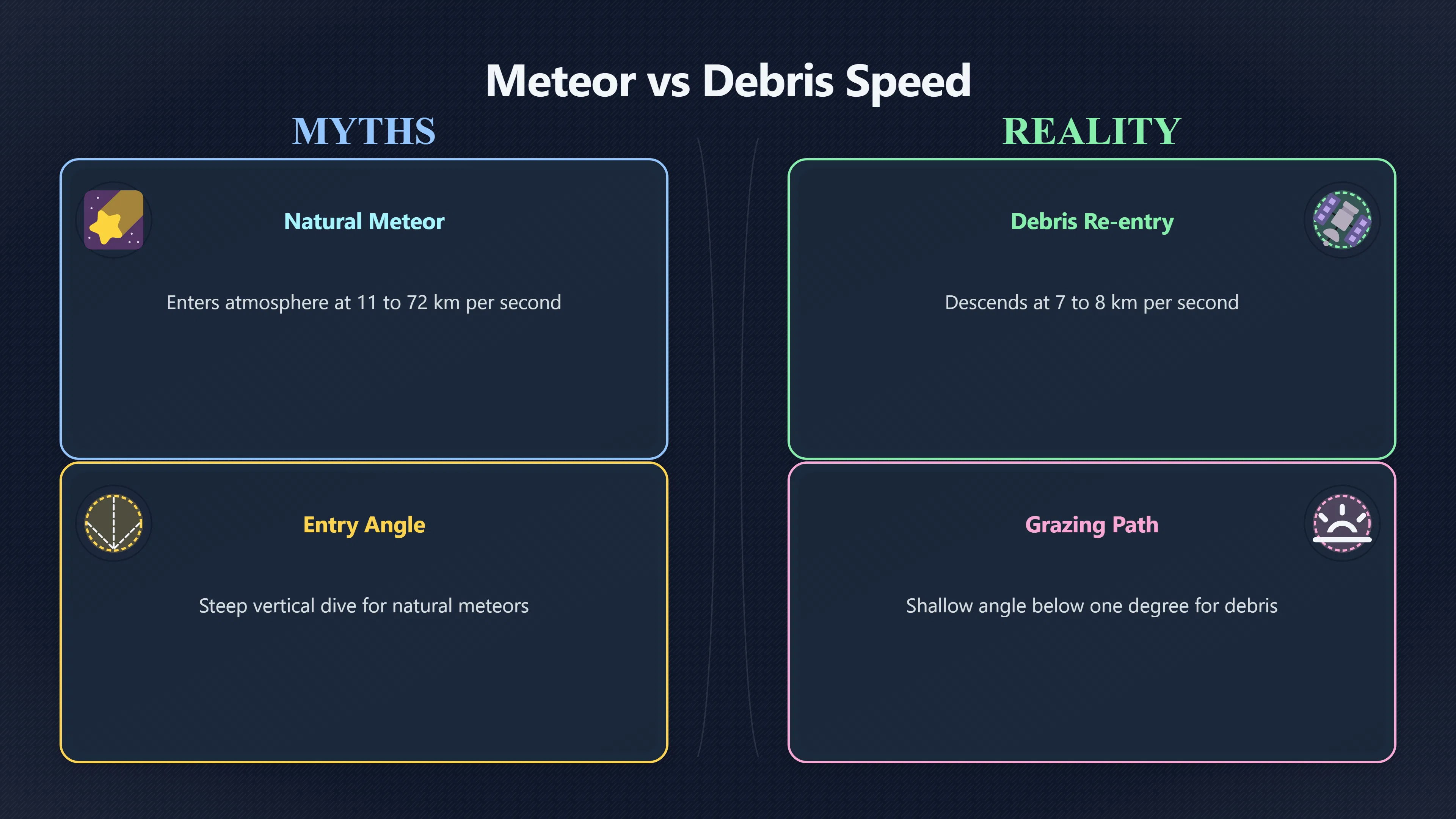
Natural meteors usually enter the atmosphere at roughly 11 to 72 kilometres per second. Their visible fireball phase is commonly over within a few seconds. Even bright bolides that fragment dramatically are normally fast and abrupt. The American Meteor Society notes that large meteoroids can break apart violently under aerodynamic stress, often losing coherence quickly once fragmentation begins.[American Meteor Society]amsmeteors.orgAmerican Meteor SocietyFireball FAQsLarger meteoroids, particularly the stone variety, tend to break up between 7 and 17 miles (11 to 27…
Re-entering spacecraft debris behaves differently because the object is already orbiting Earth and descends gradually from low Earth orbit. Human-made debris typically travels at around 7 to 8 kilometres per second during re-entry, substantially slower than many meteors.[The Aerospace Corporation]aerospace.orgThe Aerospace CorporationWhat Does a Reentry Look LikeThe general rule-of-thumb is that natural meteor reentries happen quickly and typic…[Space Academy]spaceacademy.net.auSpace AcademyHazards of Reentering Space DebrisUncontrolled reentries are always at very low grazing angles (<1 deg). The reentering obje…
That lower speed combines with a shallow entry angle to produce much longer visible tracks. The Aerospace Corporation’s public guidance on re-entry identification states that meteors “typically last less than a few seconds”, while human-made re-entries “can last 20–90 seconds or more”.[The Aerospace Corporation]aerospace.orgThe Aerospace CorporationWhat Does a Reentry Look LikeThe general rule-of-thumb is that natural meteor reentries happen quickly and typic…
This difference changes the entire witness experience:
- A meteor is often described as a sudden flash or streak.
- A re-entry is often described as a slow-moving procession.
- Meteors commonly vanish before witnesses fully react.
- Re-entries frequently stay visible long enough for filming, social media posts, or multiple eyewitness calls.
Astronomers interviewed by ABC Australia summarised the practical distinction in simple observational terms: a five-second fireball may still be a meteor, but something visible for “minutes” strongly suggests space debris.[ABC News]abc.net.aufireballs meteorites space junk desert networkABC NewsMeteors vs space junk: Are we seeing more fireballs in…Oct 22, 2024 — "Something five or six seconds long, that's probably a f…
For UFO investigators, this is one of the most useful first-pass filters available from witness testimony alone.
How Shallow Descent Changes Sky Movement
The physics behind long-duration re-entries explains why they look so unusual to ground observers.
Uncontrolled orbital re-entries generally approach at extremely shallow grazing angles. One re-entry analysis describes many uncontrolled descents as occurring below roughly one degree relative to the atmosphere.[Space Academy]spaceacademy.net.auSpace AcademyHazards of Reentering Space DebrisUncontrolled reentries are always at very low grazing angles (<1 deg). The reentering obje…
That shallow geometry produces several effects that witnesses commonly interpret as anomalous:
- The object appears to travel horizontally rather than “fall”.
- The fireball can span a huge section of sky.
- Fragmentation unfolds gradually instead of explosively.
- Different glowing pieces remain visible simultaneously.
- The object may seem to “pace” the horizon.
From the ground, this can look surprisingly unlike a stereotypical shooting star. Witnesses often report that the object looked controlled, escorted, formation-like, or intelligently manoeuvring simply because the trajectory remains stable for so long.
Some re-entries also appear to slow dramatically as fragmentation increases. The International Astronomical Center describes a common pattern in which a single bright object gradually separates into multiple glowing pieces over 20 seconds to a minute or more.[International Astronomical Center]astronomycenter.netInternational Astronomical CenterInternational Astronomical Center (IAC)Jun 12, 2021 — The whole process, depending upon when you first s…
This progressive breakup is important in UFO case analysis because it differs from many cinematic assumptions about meteors. A witness expecting a meteor to behave like a brief diagonal streak may instead interpret a slow-moving debris train as something artificial or extraordinary.
Ironically, in this case the “artificial” explanation is correct — but not in the way UFO witnesses first assume. The object is artificial because it is human-made orbital hardware returning to Earth.
Why Witnesses Often Overestimate “Hovering” Or Controlled Motion
Long-duration fireballs generate a recurring perception problem in UFO reports: observers often feel the object was moving slowly enough to hover, turn, or maintain position.
Several visual factors contribute to this mistake:
- High altitude compresses apparent motion.
- Long viewing times encourage subjective reinterpretation.
- Fragment trains create the illusion of coordinated movement.
- The shallow path reduces the impression of downward fall.
- Perspective changes near the horizon distort speed estimates.
A re-entry crossing hundreds of kilometres overhead may remain visible for close to a minute while changing position only gradually relative to the landscape. This can feel incompatible with a “meteor”, leading witnesses toward more exotic interpretations.
AI-assisted investigation systems can reduce this confusion by comparing witness descriptions against known re-entry behaviour patterns. Reports containing phrases such as:
- “It looked too slow to be a meteor”
- “It stayed in the sky forever”
- “It looked like burning debris”
- “It split into many lights”
- “It travelled across the whole horizon”
are statistically more compatible with orbital debris re-entry than with ordinary meteor events.[The Aerospace Corporation]aerospace.orgThe Aerospace CorporationWhat Does a Reentry Look LikeThe general rule-of-thumb is that natural meteor reentries happen quickly and typic…[International Astronomical Center]astronomycenter.netInternational Astronomical CenterInternational Astronomical Center (IAC)Jun 12, 2021 — The whole process, depending upon when you first s…
This does not mean duration alone proves a re-entry. Some shallow-angle meteors can also produce unusually long fireballs. NASA’s meteorite fall records include genuine meteoroid events described as “long-lasting” and “shallow angle”.[ares.jsc.nasa.gov]ares.jsc.nasa.govMeteorite Falls | Recent EventsJune 24, 2025. This event was a long-lasting, shallow angle fireball that fragmented and visibly slowed near the terminus. Learn More.Rea…
The key point is that long duration sharply changes the probability balance in triage.
Using Witness Timing In UFO Case Triage
In practical UFO investigation workflows, timing is one of the fastest ways to prioritise explanations.
A structured intake form should capture:
- Estimated total duration
- Whether witnesses had time to record video
- Whether fragmentation happened instantly or progressively
- Whether the object crossed a small or large section of sky
- Whether multiple witnesses independently timed the event
- Whether the object remained visible behind clouds or horizon layers
AI-assisted systems can then compare these descriptions against known re-entry signatures and orbital event databases.
Timing Thresholds That Raise Re-entry Probability
While there is no absolute cut-off, certain ranges are highly suggestive:
Reported visibilityInvestigative implicationUnder 3 secondsMore consistent with ordinary meteor5–10 secondsCould fit bright bolide or shallow meteor20–60 secondsStrongly compatible with orbital debris re-entryMore than 1 minuteRe-entry becomes increasingly likely
These are not hard scientific boundaries, but they are useful triage heuristics supported by aerospace guidance and observational experience.[The Aerospace Corporation]aerospace.orgThe Aerospace CorporationWhat Does a Reentry Look LikeThe general rule-of-thumb is that natural meteor reentries happen quickly and typic…[International Astronomical Center]astronomycenter.netInternational Astronomical CenterInternational Astronomical Center (IAC)Jun 12, 2021 — The whole process, depending upon when you first s…
AI systems can also cross-check witness timing against:
- Satellite decay predictions
- Aerospace re-entry alerts
- ESA re-entry monitoring
- Public orbital tracking data
- Known rocket stage disposals
- Social media report clustering
The European Space Agency maintains public re-entry prediction resources because large orbital objects return regularly. ESA notes that objects above one tonne re-enter on average every couple of weeks.[ESA Re-Entry Predictions]reentry.esoc.esa.intESA Re-Entry PredictionsESA's re-entry predictionsOn average an object with mass above one ton re-enters the Earth's atmosphere every two…
That frequency matters for UFO investigation because many dramatic “mystery fireball” sightings occur during entirely expected orbital decay events.
The Human Factor: Why Re-entries Become UFO Stories
Long-duration fireballs create ideal conditions for UFO rumours because they combine spectacle with ambiguity.
Unlike ordinary meteors, re-entries are slow enough for witnesses to:
- Discuss the event while it is still happening
- Film it from multiple locations
- Share interpretations in real time
- Notice unusual fragmentation details
- Feel that the object is behaving intentionally
This produces a social amplification effect. A meteor that flashes for two seconds rarely develops into a sustained public mystery. A glowing debris train crossing the sky for nearly a minute can generate hundreds of reports before official identification appears.
The delay between observation and confirmation also matters. Even when a re-entry is eventually matched to a known satellite or rocket body, prediction windows can initially span many hours because atmospheric drag changes constantly. ESA and Aerospace Corporation guidance both note that precise re-entry timing is difficult until shortly before atmospheric breakup.[Medium]medium.comA Quick Guide to Understanding Orbital Debris Reentry…November 3, 2022 — The current prediction window for reentry of the CZ-5B…[2blogs.esa.int]blogs.esa.intER S-2 reentry – live updates – Rocket ScienceERS-2 reentry – live updates – Rocket Science - ESA's blogsFeb 5, 2024 — *This post provides live updates from ESA's Space Debris Office…
That uncertainty creates a temporary information gap in which UFO speculation flourishes.
For AI-assisted UFO analysis, the goal is not to dismiss witnesses but to rapidly test whether the reported behaviour matches known atmospheric re-entry mechanics. Long visibility duration is one of the strongest early indicators that it probably does.
Amazon book picks
Further Reading
Books and field guides related to Why Some 'Meteor' UFOs Stay Visible For Minutes. Use these as the next step if you want deeper reading beyond the article.
NightWatch
Strong fit for identifying meteors, satellites and re-entry-like sky events.
The Practical Astronomer
Useful for comparing duration and movement of night-sky phenomena.
The Demon-Haunted World
Encourages testing dramatic fireballs against natural and aerospace explanations.
eBay marketplace picks
Marketplace Samples
Example marketplace items related to this page. Use the search link to explore similar finds on eBay.


Endnotes
1.
Source: aerospace.org
Link:https://aerospace.org/article/what-does-reentry-look-like
Source snippet
The Aerospace CorporationWhat Does a Reentry Look LikeThe general rule-of-thumb is that natural meteor reentries happen quickly and typic...
2.
Source: aerospace.org
Link:https://aerospace.org/node/44081/printable/print
Source snippet
These reentries can often look like shooting stars (meteors) with a bright central body followed by a long...Read more...
3.
Source: nasa.gov
Title: It’s Fireball Season!
Link:https://www.nasa.gov/blogs/watch-the-skies/2026/03/26/its-fireball-season-answering-your-meteor-questions/
Source snippet
Answering Your Meteor QuestionsMar 26, 2026 — The fireball – caused by a small asteroid nearly 6 feet in diameter and weighing about 7 to...
4.
Source: ares.jsc.nasa.gov
Title: Meteorite Falls | Recent Events
Link:https://ares.jsc.nasa.gov/meteorite-falls/events/
Source snippet
June 24, 2025. This event was a long-lasting, shallow angle fireball that fragmented and visibly slowed near the terminus. Learn More.Rea...
Published: June 24, 2025
5.
Source: reentry.esoc.esa.int
Link:https://reentry.esoc.esa.int/
Source snippet
ESA Re-Entry PredictionsESA's re-entry predictionsOn average an object with mass above one ton re-enters the Earth's atmosphere every two...
6.
Source: blogs.esa.int
Title: ER S-2 reentry – live updates – Rocket Science
Link:https://blogs.esa.int/rocketscience/2024/02/05/ers-2-reentry-live-updates/
Source snippet
ERS-2 reentry – live updates – Rocket Science - ESA's blogsFeb 5, 2024 — *This post provides live updates from ESA's Space Debris Office...
7.
Source: medium.com
Link:https://medium.com/the-aerospace-corporation/a-quick-guide-to-understanding-orbital-debris-reentry-predictions-4b84a8e2bd04
Source snippet
A Quick Guide to Understanding Orbital Debris Reentry...November 3, 2022 — The current prediction window for reentry of the CZ-5B...
Published: November 3, 2022
8.
Source: space.com
Link:https://www.space.com/13036-nasa-satellite-falling-earth-skywatching-light-show.html
Source snippet
Falling NASA Satellite Could Spark Stunning Light ShowSep 21, 2011 — But even two hours before re-entry, the average time uncertainty amo...
9.
Source: ntrs.nasa.gov
Link:https://ntrs.nasa.gov/citations/19840002101
Source snippet
comparison of measured and theoretical predictions for...by F Garcia Jr · 1983 · Cited by 1 — A comparison of measured and theoretical p...
10.
Source: ntrs.nasa.gov
Link:https://ntrs.nasa.gov/api/citations/20210018893/downloads/Space_debris_Tellus_2021.pdf
Source snippet
Debris: Overview and Hazardby B Cooke · 2021 — High speed meteoroids (~50 km s-1) can induce electrical anomalies in spacecraft through d...
11.
Source: orbitaldebris.jsc.nasa.gov
Link:https://orbitaldebris.jsc.nasa.gov/quarterly-news/pdfs/odqnv20i4.pdf
Source snippet
News4 Oct 2016 — All debris are in orbits similar to the parent object, with a maximum change in period of 0.5 minutes and change in incl...
12.
Source: jpl.nasa.gov
Link:https://www.jpl.nasa.gov/news/us-space-force-releases-decades-of-bolide-data-to-nasa-for-planetary-defense-studies/
Source snippet
Space Force Releases Decades of Bolide Data to...Apr 7, 2022 — The newly released data is composed of information on the changing bright...
13.
Source: ntrs.nasa.gov
Link:https://ntrs.nasa.gov/api/citations/19790006807/downloads/19790006807.pdf
Source snippet
Entry and Fragmentation of Dense Meteoroidsby TD Bess · 1979 · Cited by 1 — These anomalies also show up in the meteor light curve in tha...
14.
Source: esa.int
Link:https://www.esa.int/ESA_Multimedia/Videos/2026/03/Fireball_over_Europe_8_March_2026
Source snippet
Fireball over Europe, 8 March 20268 Mar 2026 — The fireball glowed for approximately six seconds, leaving a visible trail in the sk...
15.
Source: aerospace.org
Link:https://aerospace.org/reentries
Source snippet
ReentriesThe Center for Orbital and Reentry Debris Studies (CORDS) Reentry Database documents objects and payloads that have reentered ea...
16.
Source: spaceacademy.net.au
Link:https://www.spaceacademy.net.au/watch/debris/reentryhaz.htm
Source snippet
Space AcademyHazards of Reentering Space DebrisUncontrolled reentries are always at very low grazing angles (<1 deg). The reentering obje...
17.
Source: amsmeteors.org
Link:https://amsmeteors.org/fireballs/faqf/
Source snippet
American Meteor SocietyFireball FAQsLarger meteoroids, particularly the stone variety, tend to break up between 7 and 17 miles (11 to 27...
18.
Source: abc.net.au
Title: fireballs meteorites space junk desert network
Link:https://www.abc.net.au/news/science/2024-10-23/fireballs-meteorites-space-junk-desert-network/104418550
Source snippet
ABC NewsMeteors vs space junk: Are we seeing more fireballs in...Oct 22, 2024 — "Something five or six seconds long, that's probably a f...
19.
Source: astronomycenter.net
Link:https://astronomycenter.net/srw/index.html
Source snippet
International Astronomical CenterInternational Astronomical Center (IAC)Jun 12, 2021 — The whole process, depending upon when you first s...
20.
Source: youtube.com
Link:https://www.youtube.com/watch?v=fFpL36n68eY
Source snippet
July 27th, 2016 Fireball "Meteor" Space Junk CZ-7 Re-entry...It appears to be either a meteor a meteor or a satellite that was reenterin...
Additional References
21.
Source: facebook.com
Link:https://www.facebook.com/ABCNews/posts/a-1323-pound-nasa-satellite-is-expected-to-re-enter-earths-atmosphere-tuesday-at/1350391693614374/
Source snippet
A 1323-pound NASA satellite is expected to re-enter...A 1323-pound NASA satellite is expected to re-enter Earth's atmosphere Tuesday at...
22.
Source: iaaspace.org
Link:https://iaaspace.org/wp-content/uploads/iaa/Scientific%20Activity/debris6.pdf
Source snippet
The drag force that such objects experience is due to their interaction with the few air...Read more...
23.
Source: khmertimeskh.com
Title: meteors vs space junk are we seeing more fireballs in the sky
Link:https://www.khmertimeskh.com/501579036/meteors-vs-space-junk-are-we-seeing-more-fireballs-in-the-sky/
Source snippet
Meteors vs space junk Are we seeing more fireballs in the...Oct 24, 2024 — “Something five or six seconds long, that's probably a fireba...
24.
Source: facebook.com
Link:https://www.facebook.com/groups/meteoriteclub/posts/10158220197551620/
Source snippet
So what's the generally accepted speed of a meteor falling...Aug 18, 2020 — Space debris reentry is about 4 - 5 miles/sec or 6...
25.
Source: spacewatch.lpl.arizona.edu
Title: i saw something moving across sky last night what was it
Link:https://spacewatch.lpl.arizona.edu/faq/i-saw-something-moving-across-sky-last-night-what-was-it
Source snippet
What was it?Usually, fireballs streak across the sky in a matter of seconds, but can leave a faint ionization trail visible for minutes...
26.
Source: reddit.com
Link:https://www.reddit.com/r/spaceporn/comments/1b7y4sb/tips_to_tell_the_difference_between_a_meteor_and/
Source snippet
d typically last less than a few seconds, while human-made reentries...Read more...
27.
Source: pauldmaley.com
Title: FINA L PHASE OF SPACE SHUTTLE REENTRIES
Link:https://pauldmaley.com/caron/
Source snippet
FINAL PHASE OF SPACE SHUTTLE REENTRIES - Paul MaleyApr 17, 2018 — The main idea is to start the tape recorder about some minutes before t...
28.
Source: reddit.com
Title: My stupid layman thought is
Link:https://www.reddit.com/r/explainlikeimfive/comments/1bjmeiy/eli5_why_do_rockets_have_to_hit_the_atmosphere_at/
Source snippet
Why do rockets have to hit the atmosphere at an angle on...I remember this from Apollo 13, they had to hit the atmosphere at an angle, i...
29.
Source: researchgate.net
Link:https://www.researchgate.net/publication/245393117_Spacecraft_re-entry_strategies_Meeting_debris_mitigation_and_ground_safety_requirements
Source snippet
d evidence that large, hazardous objects survive, highlights current...Read more...
30.
Source: forum.nasaspaceflight.com
Link:https://forum.nasaspaceflight.com/index.php?topic=59942.0
Source snippet
vs reentry of Space DebrisNov 23, 2023 — This lasted a good 2 or 3 seconds after I got my eyes to it - so given the time it must have tak...
Topic Tree