Within Lenticulars
Why Some 'Flying Saucers' Stay Fixed Above Mountains
Stable airflow over ridges can generate stationary lenticular clouds that closely match classic hovering UFO reports.
On this page
- Standing waves and cloud regeneration
- Why strong winds can produce motionless clouds
- Terrain and ridge clues investigators should check
Page outline Jump by section
Introduction
Some of the most convincing “hovering UFO” reports are linked to a very specific weather mechanism: mountain-wave airflow. In the right conditions, strong winds crossing hills or mountain ridges create invisible standing waves in the atmosphere. If enough moisture is present, smooth lens-shaped clouds form at the crests of those waves. These are lenticular clouds, and they can appear astonishingly artificial — metallic, layered, symmetrical and apparently motionless. Meteorological agencies including the UK Met Office explicitly note that they are a common explanation for flying-saucer sightings.[Met Office]weather.metoffice.gov.ukMet OfficeUnusual cloud formations… lenticular clouds are believed to be one of the most common explanations for UFO sightings across t…[Center for Science Education]scied.ucar.eduCenter for Science EducationLenticular Clouds - UCAR Center for Science EducationLenticular, or lee wave, clouds form downwind of an obst…
 For AI-assisted UFO sighting investigation, mountain-wave patterns matter because they produce a repeatable environmental signature. A report of a silent object hovering over high ground can often be checked against terrain orientation, upper-level wind direction, atmospheric stability, cloud imagery and local weather observations. When these elements line up, the “mystery craft” may turn out to be a natural standing-wave cloud regenerating continuously in one fixed location.
Standing Waves And Cloud Regeneration
The key to understanding these clouds is that the air is moving quickly even when the cloud appears stationary.
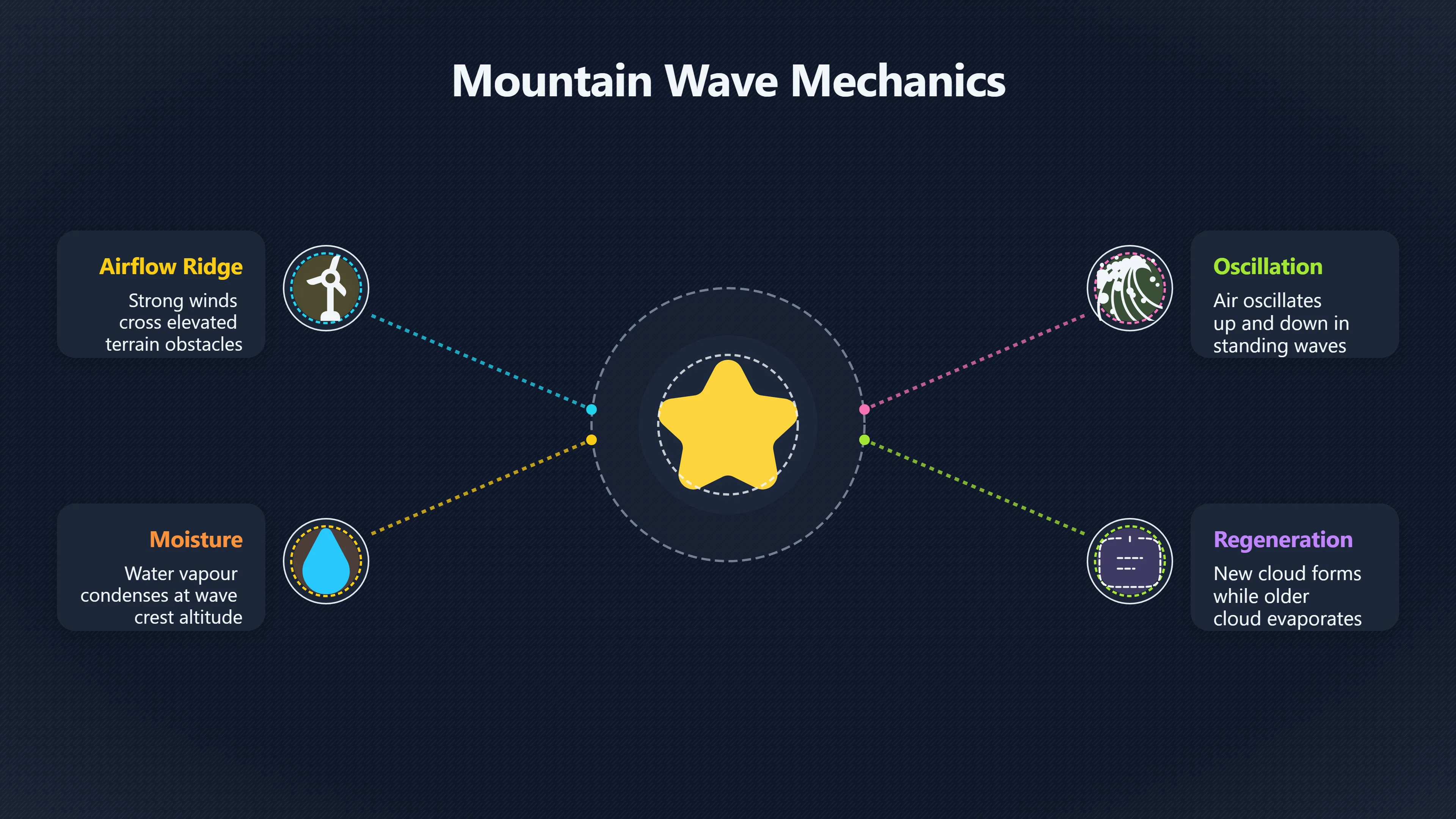
When stable air flows across a mountain ridge, the atmosphere can behave like water flowing over a submerged rock in a river. The air rises over the ridge, then oscillates up and down downstream in a repeating wave pattern known as a mountain wave or lee wave. These waves can remain locked to the terrain instead of travelling away with the wind.[Embry-Riddle Aeronautical University]wx.erau.eduEmbry-Riddle Aeronautical Universitymountain_wavesMountain waves are standing atmospheric waves caused by airflow over mountains, analogo…[2avmet.navcanada.ca]avmet.navcanada.caMountain WaveMountain waves are associated with downslope windstorms like chinooks. They can produce rotors, standing lenticular clouds…
If moist air reaches the upward part of the wave, it cools enough for water vapour to condense into cloud. As the airflow descends again, the cloud evaporates. New cloud continuously forms at roughly the same point in the wave crest while older cloud dissipates farther downstream. To an observer on the ground, the visible shape appears fixed in space even though air is racing through it.[Center for Science Education]scied.ucar.eduCenter for Science EducationLenticular Clouds - UCAR Center for Science EducationLenticular, or lee wave, clouds form downwind of an obst…[Weather.gov]weather.metoffice.gov.ukMet OfficeUnusual cloud formations… lenticular clouds are believed to be one of the most common explanations for UFO sightings across t…
This regeneration effect is one reason witnesses sometimes reject ordinary cloud explanations. People expect clouds to drift across the sky. A lenticular cloud instead behaves more like a hovering object:
- It may remain over the same ridge for long periods.
- It can keep a sharply defined outline.
- It sometimes changes shape slowly rather than moving position.
- Multiple wave crests can create stacked-disc appearances.
- Sunset lighting can produce metallic or glowing edges.
Meteorological and aviation guidance repeatedly describe these formations as “standing lenticular” clouds because their apparent stillness is one of their defining features.[AOPA]aopa.orgtraining tip standing up for turbulenceTraining Tip: Standing up for turbulenceOct 19, 2020 — If enough moisture is present, lenticular clouds can form to give a visual ind…[Mount Washington Observatory]mountwashington.orgMount Washington ObservatoryLenticular CloudsA lenticular cloud is a type of stationary lens shaped cloud that forms at high altitudes, t…
Why Strong Winds Can Produce Motionless Clouds
One of the most counterintuitive aspects of lenticular clouds is that they are often associated with strong upper-level winds rather than calm conditions.
The mountain-wave mechanism works best when several ingredients combine:[aerocrewnews.com]aerocrewnews.commountain wave turbulenceApr 1, 2023 — If sufficient moisture is in place, altocumulus standing lenticular clouds (ACSL) can develop at the top of individual wave…
- Strong airflow crossing a ridge line.
- Stable atmospheric layers that encourage oscillation instead of turbulent mixing.
- Wind roughly perpendicular to the terrain.
- Sufficient moisture near the wave crest altitude.
Under these conditions, the wave itself stays anchored to the mountain while the air streams through it. The stronger the airflow, the more dramatic and sharply defined the wave cloud may become.[avmet.navcanada.ca]avmet.navcanada.caMountain WaveMountain waves are associated with downslope windstorms like chinooks. They can produce rotors, standing lenticular clouds…[Aero Crew News]aerocrewnews.commountain wave turbulenceApr 1, 2023 — If sufficient moisture is in place, altocumulus standing lenticular clouds (ACSL) can develop at the top of individual wave…
This creates a strange visual contradiction for witnesses. Trees or lower clouds may show obvious wind movement while the saucer-shaped formation above appears frozen in place. That mismatch can strongly reinforce the impression of an intelligently controlled object.
Pilots know these clouds as important indicators of mountain-wave turbulence. The FAA and other aviation authorities treat standing lenticular clouds as warning signs because severe vertical air movement may exist nearby even when the cloud itself looks smooth and stable.[Federal Aviation Administration]faa.govFederal Aviation Administration Hazardous Mountain WindsIn Figure 6-20, the aircraft flew beneath an area of standing lenticular clouds.Read more…[Weather.gov]weather.govThe most telling clue that a mountain wave exists is the presence of ACSL clouds…Read more…
The cloud’s smooth appearance also contributes to UFO interpretations. Ordinary cumulus clouds often look ragged or irregular, but lenticular clouds form within stable airflow layers that produce unusually clean edges. Some resemble polished discs or flattened domes rather than typical cloud masses.[Met Office]weather.metoffice.gov.ukMet OfficeUnusual cloud formations… lenticular clouds are believed to be one of the most common explanations for UFO sightings across t…
Why Mountain Terrain Matters So Much
Many famous “UFO cloud” photographs come from places where ridge-driven airflow is common.
Mountain-wave lenticulars are especially associated with:[avmet.navcanada.ca]avmet.navcanada.caMountain WaveMountain waves are associated with downslope windstorms like chinooks. They can produce rotors, standing lenticular clouds…
- The Rockies in Colorado and Wyoming.
- Mount Rainier and the Cascade Range.
- Mount Fuji in Japan.
- The Southern Alps of New Zealand.
- Isolated uplands and ridge systems in parts of the UK.
The terrain acts as the trigger for the standing-wave pattern. Investigators examining a UFO report should therefore ask whether the object was observed downwind of elevated terrain. Even relatively modest ridges can generate wave clouds under the right atmospheric setup.[Center for Science Education]scied.ucar.eduCenter for Science EducationLenticular Clouds - UCAR Center for Science EducationLenticular, or lee wave, clouds form downwind of an obst…[2avmet.navcanada.ca]avmet.navcanada.caMountain WaveMountain waves are associated with downslope windstorms like chinooks. They can produce rotors, standing lenticular clouds…
A useful clue is repetition. Some regions repeatedly generate similar “hovering saucer” sightings because the same airflow geometry recurs seasonally. New Zealand’s long-observed “Taieri Pet” cloud is a well-known example: a stationary lenticular formation that repeatedly appears near the same mountain range and has been mistaken for a UFO for generations.[The Sun]thesun.co.ukThe phenomenon, captured by a NASA satellite in September and last seen by an Air New Zealand pilot in 2020, is an elongated altocumulus…
The orientation of the cloud can also matter. Lenticular formations often align parallel to the ridge producing the wave. In satellite imagery or witness photos, this alignment can reveal that the cloud is tied to airflow and terrain rather than independent motion.

Terrain And Ridge Clues Investigators Should Check
In a structured UFO investigation workflow, mountain-wave assessment can often be automated surprisingly effectively.
AI-assisted screening systems can compare witness reports against topographic and meteorological data to identify whether lenticular formation conditions existed at the reported time. Important checks include:
- Nearby ridge lines or mountains.
- Wind direction at multiple altitudes.
- Stability layers in weather soundings.
- Satellite cloud imagery.[nesdis.noaa.gov]nesdis.noaa.govwave cloudsClouds | NESDIS - NOAASatellite imagery shows us rippled cloud patterns called wave clouds, or gravity waves. These form when stable air…
- Presence of other wave-cloud formations nearby.
- Time of day and low-angle sunlight effects.
- Repeated local reports from the same terrain corridor.
A report becomes more consistent with a lenticular explanation if the object:
- Remained fixed relative to terrain.
- Changed shape gradually instead of manoeuvring sharply.
- Showed no independent acceleration.
- Appeared near or downwind of ridges.
- Matched known wind directions.
- Was visible during strong cross-mountain airflow events.
Conversely, some details weaken the explanation:
- Rapid directional movement unrelated to wind.
- Abrupt acceleration.
- Movement against stable wave orientation.
- Low-altitude interaction with terrain or structures.
- Radar-confirmed solid targets.
- Multi-angle footage showing true translational motion.
The goal is not to dismiss witnesses automatically but to classify how well the environmental evidence matches a known atmospheric mechanism.
Why Lenticular Clouds Can Look Artificial In Photographs
Modern UFO reports increasingly involve phone cameras, traffic cameras and social-media clips rather than only eyewitness testimony. Lenticular clouds remain highly relevant because cameras often exaggerate their apparent solidity.
Several effects contribute:
- Telephoto compression makes the cloud appear closer to terrain.
- Sunset lighting creates metallic shading.
- Isolated clouds against clear sky resemble discrete objects.
- Layered lenticulars can mimic structured craft designs.
- Slight camera shake creates apparent hovering motion.
Some images also lose depth cues entirely. A witness may know the cloud is large and distant, but a cropped online image can make it resemble a compact object suspended above the landscape.
AI-based image analysis systems therefore need environmental context rather than shape analysis alone. A smooth disc silhouette by itself is weak evidence. Correlation with mountain-wave conditions is often more informative than the image appearance.
The Investigative Value Of “Ordinary But Rare” Explanations
Lenticular clouds occupy an important middle ground in UFO investigation. They are completely natural, yet genuinely strange-looking. This combination explains why sincere witnesses can produce dramatic reports without fabrication or hallucination.
The rarity of the phenomenon in flatter regions also matters. Someone in lowland southern England or urban central Europe may go years without seeing a classic standing lenticular cloud. Encountering one suddenly over a ridge at sunset can feel genuinely uncanny.
For investigators, the lesson is not merely “clouds explain UFOs”. The more useful point is that atmospheric mechanics can generate visual behaviour many people assume is impossible for weather:
- Clouds that appear stationary in strong winds.[mountwashington.org]mountwashington.orgMount Washington ObservatoryLenticular CloudsA lenticular cloud is a type of stationary lens shaped cloud that forms at high altitudes, t…
- Disc-like symmetrical structures.
- Repeated formations in the same location.
- Smooth layered “craft-like” silhouettes.
- Apparently hovering objects above mountains.
Mountain-wave analysis therefore becomes one of the fastest and most evidence-based screening tools available in saucer-shaped UFO cases, especially when reports cluster around upland terrain and stable cross-ridge airflow conditions.
Amazon book picks
Further Reading
Books and field guides related to Why Some 'Flying Saucers' Stay Fixed Above Mountains. Use these as the next step if you want deeper reading beyond the article.
UFOs
NEW YORK TIMES BESTSELLER • Impeccably researched, this riveting journalistic investigation separates fact from fiction, and documents th...
The UFO Experience
Cited by the New York Review of Books as "the best brief for visitation," this classic study presents an analysis of UFO reports and conc...
eBay marketplace picks
Marketplace Samples
Example marketplace items related to this page. Use the search link to explore similar finds on eBay.


Endnotes
1.
Source: weather.metoffice.gov.uk
Link:https://weather.metoffice.gov.uk/learn-about/weather/types-of-weather/clouds/unusual-cloud-formations
Source snippet
Met OfficeUnusual cloud formations... lenticular clouds are believed to be one of the most common explanations for UFO sightings across t...
2.
Source: weather.gov
Link:https://www.weather.gov/abq/features_acsl
Source snippet
The most telling clue that a mountain wave exists is the presence of ACSL clouds...Read more...
3.
Source: avmet.navcanada.ca
Link:https://avmet.navcanada.ca/en/mountain-wave.aspx
4.
Source: faa.gov
Title: Federal Aviation Administration Hazardous Mountain Winds
Link:https://www.faa.gov/documentLibrary/media/Advisory_Circular/AC_00-57.pdf
Source snippet
In Figure 6-20, the [aircraft]({{ 'aircraft/' | relative_url }}) flew beneath an area of standing lenticular clouds.Read more...
5.
Source: weather.gov
Link:https://www.weather.gov/source/zhu/ZHU_Training_Page/turbulence_stuff/turbulence/turbulence.htm
6.
Source: aopa.org
Title: training tip standing up for turbulence
Link:https://www.aopa.org/news-and-media/all-news/2020/october/19/training-tip-standing-up-for-turbulence
Source snippet
Training Tip: Standing up for turbulenceOct 19, 2020 — If enough moisture is present, lenticular clouds can form to give a visual ind...
7.
Source: weather.gov
Link:https://www.weather.gov/media/aly/stormbuster/Spring17SB.pdf
Source snippet
Spring, 2017Lenticular clouds – Often referred to as “mountain wave clouds” or “standing lenticular” (SL), these bright, stand-out clouds...
8.
Source: weather.gov
Link:https://www.weather.gov/hfo/lenticular
Source snippet
clouds Big Island 11/25/2003Nov 25, 2003 — Here is a simple little "cartoon" schematic of how a lenticular cloud forms. Note the wavelike...
9.
Source: forecast.weather.gov
Link:https://forecast.weather.gov/glossary.php?word=A
Source snippet
weather.govNOAA's National Weather Service - GlossaryACCAS clouds are a sign of instability aloft, and may precede the rapid development...
10.
Source: nationalarchives.gov.uk
Link:https://www.nationalarchives.gov.uk/explore-the-collection/explore-by-time-period/postwar/ufo-reports/
Source snippet
UFO reportsSightings of unidentified flying objects (UFOs) have been reported over our skies for decades. The Ministry of Defence has kep...
11.
Source: weather.metoffice.gov.uk
Link:https://weather.metoffice.gov.uk/learn-about/weather/optical-effects
Source snippet
effects: nature's light showHaloes appear when sunlight or moonlight interacts with tiny ice crystals in high cirrus clouds or cirrostrat...
12.
Source: scied.ucar.edu
Link:https://scied.ucar.edu/image/lenticular-clouds
Source snippet
Center for Science EducationLenticular Clouds - UCAR Center for Science EducationLenticular, or lee wave, clouds form downwind of an obst...
13.
Source: wx.erau.edu
Link:https://wx.erau.edu/faculty/mullerb/Wx365/Mountain_waves/mountain_waves.html
Source snippet
Embry-Riddle Aeronautical Universitymountain_wavesMountain waves are standing atmospheric waves caused by airflow over mountains, analogo...
14.
Source: mountwashington.org
Link:https://mountwashington.org/lenticular-clouds/
Source snippet
Mount Washington ObservatoryLenticular CloudsA lenticular cloud is a type of stationary lens shaped cloud that forms at high altitudes, t...
15.
Source: aerocrewnews.com
Title: mountain wave turbulence
Link:https://aerocrewnews.com/2023/04/01/mountain-wave-turbulence/
Source snippet
Apr 1, 2023 — If sufficient moisture is in place, altocumulus standing lenticular clouds (ACSL) can develop at the top of individual wave...
16.
Source: thesun.co.uk
Link:https://www.thesun.co.uk/tech/31236444/ufo-cloud-taieri-pet-new-zealand-nasa-satellite-image/
Source snippet
The phenomenon, captured by a NASA satellite in September and last seen by an Air New Zealand pilot in 2020, is an elongated altocumulus...
17.
Source: nesdis.noaa.gov
Title: wave clouds
Link:https://www.nesdis.noaa.gov/our-environment/clouds/wave-clouds
Source snippet
Clouds | NESDIS - NOAASatellite imagery shows us rippled cloud patterns called wave clouds, or gravity waves. These form when stable air...
18.
Source: Wikipedia
Title: Lenticular cloud
Link:https://en.wikipedia.org/wiki/Lenticular_cloud
Source snippet
Lenticular cloudLenticular clouds are stationary clouds that form mostly in the troposphere, typically in parallel alignment to the wi...
19.
Source: mountwashington.org
Link:https://mountwashington.org/a-closer-look-at-lenticular-clouds/
Additional References
20.
Source: noaa.gov
Link:https://www.noaa.gov/sites/default/files/2023-02/surface_plot_key.pdf
Source snippet
Weather Map SymbolsAlong the center, the cloud types are indicated. The top symbol is the high-level cloud type followed by the mid-level...
21.
Source: fly8ma.com
Link:https://fly8ma.com/topic/mountain-weather/
Source snippet
Mountain WeatherRotor clouds are caused by the same weather pattern as lenticular clouds, stable air blowing perpendicularly across a mou...
22.
Source: premierflightct.com
Link:https://www.premierflightct.com/newsletters/TrainingArticles/StandingLenticularClouds.html
Source snippet
Standing Lenticular CloudsStanding lenticular clouds are associated with a phenomenon known as mountain wave turbulence. But first: A qui...
23.
Source: skybrary.aero
Link:https://skybrary.aero/articles/mountain-waves
24.
Source: journals.ametsoc.org
Title: Furthermore, we suggest that the lenticular clouds may not be formed in all wave
Link:https://journals.ametsoc.org/view/journals/mwre/145/1/mwr-d-16-0031.1.xml
Source snippet
Modeling Study of a Trapped Lee-Wave Event over the...by M Udina · 2017 · Cited by 24 — Although mountain waves are stationary, a time o...
25.
Source: facebook.com
Link:https://www.facebook.com/NorthYorkshireWeatherUpdates/posts/1900-michael-spotted-these-brilliant-lenticular-ufo-clouds-over-garsdale-this-ev/1291394406468853/
Source snippet
☁️ NOT an alien invasion! These are Lenticular Clouds looking south from York, PA early this afternoon.Read more...
26.
Source: youtube.com
Link:https://www.youtube.com/watch?v=KgO7Kyq3q-U
Source snippet
Lenticular CloudsLenticular clouds are also known as lenticularis because they are shaped like a lens. They are common over mountains whe...
27.
Source: markhorrell.com
Title: 7 mountain weather phenomena a quick intro courtesy of tristan gooley
Link:https://www.markhorrell.com/blog/2024/7-mountain-weather-phenomena-a-quick-intro-courtesy-of-tristan-gooley/
Source snippet
Lens clouds... Also known as lenticular clouds, and by the Latin name altocumulus lenticularis, lens clouds occur when winds hit the sum...
28.
Source: noaa.gov
Title: jetstream max surface weather plot symbols
Link:https://www.noaa.gov/jetstream/wxmaps-max/jetstream-max-surface-weather-plot-symbols
Source snippet
JetStream Max: Surface Weather Plot Symbols10 Feb 2025 — The following are the 100 symbols used in meteorology to describe the present we...
29.
Source: sciencedirect.com
Link:https://www.sciencedirect.com/science/chapter/bookseries/pii/S0074614210099171
Source snippet
Directly to the lee of the higher peaks, the flow descends abruptly to the plains [elevation]({{ 'elevation/' | relative_url }})...
Topic Tree