Within UFO Case AI
Why Clear UFO Videos Can Still Mislead
A clear clip can still be weak evidence when distance, scale, lens settings, and camera movement are unknown.
On this page
- Distance, scale, and camera motion
- Metadata and original files
- Sensor artefacts and edited clips
Page outline Jump by section
Introduction
A clear UFO video can still be weak evidence. It may prove that something appeared in the camera’s field of view, but it often does not prove what the object was, how far away it was, how large it was, how fast it moved, or whether its strange behaviour came from the object rather than the camera. That is why AI-assisted UFO sighting investigation should treat video as one evidence layer inside a structured case file, not as a conclusion in itself.
The strongest video evidence is not simply the sharpest clip. It is the clip with the original file, reliable time and location, known camera settings, stable reference points, unbroken context before and after the sighting, and independent checks against aircraft, satellites, balloons, weather, astronomy and other sensors. NASA’s UAP study made the same basic point: UAP analysis is hampered by poor sensor calibration, lack of multiple measurements, missing sensor metadata and lack of baseline data.[NASA Science]science.nasa.govScience Independent Study Team ReportNASA ScienceIndependent Study Team ReportSeptember 13, 2023 — At present, analysis of UAP data is hampered by poor sensor calibration, th…
Why “clear” does not mean “measured”
A persuasive UFO clip often gives the viewer a strong impression: a white dot races across the sky, a dark shape seems to rotate, a glowing object appears to split, or a light seems to hover against a blank background. The problem is that the human eye treats a screen image as if it contains depth, scale and speed. In many sky videos, those quantities are precisely what the clip does not contain.
A small object close to the camera, a large object far away, a bird crossing the frame, a balloon drifting with the wind, and an aircraft seen nearly head-on can all look similar if there are no reference points. The video may be visually clean and still lack the geometry needed for identification. In a UFO case file, the key question is therefore not “does the clip look real?” but “what measurements can be extracted from it?”
A useful AI-assisted workflow should separate:
- Image presence: whether a visible object or light is genuinely present in the frames.
- Scene reconstruction: where the camera was, where it was pointing, and how it moved.
- Object constraints: possible distance, size, altitude, bearing, angular speed and direction of travel.
- Candidate matches: aircraft, drones, balloons, birds, satellites, meteors, launches, re-entry debris, atmospheric effects or sensor artefacts.
- Residual uncertainty: what remains unknown after the measurable checks are complete.
This distinction matters because an object can be genuinely filmed and still be misinterpreted. AARO’s public imagery page includes cases where infrared clips were later assessed as balloons, birds, commercial aircraft, or non-anomalous objects, as well as cases that remain unresolved because the available data does not support a confident identification.[AARO]aaro.milOfficial UAP ImageryUAP Imagery… video footage from an infrared sensor aboard a U.S. military platform in 2024…. sensor artifact resultant of video…
Distance, scale and camera motion
The parallax trap
Parallax is one of the most important failure modes in UFO video analysis. It occurs when the observer or camera is moving, making nearer objects appear to move faster across the field of view than distant objects. From a moving aircraft, car, drone or handheld phone, a slow object can seem to streak across the background if the geometry is misunderstood.
AARO’s paper on forced perspective and parallax explains that observers positioned far from an object while moving relative to it can misread apparent size and speed. Under those conditions, what looks like rapid object motion may partly be the motion of the observing platform or camera.[AARO]aaro.milEffect of Forced Perspective and Parallax View on UAP…May 8, 2024 — This paper provides a basic overview of these phenomena and th…
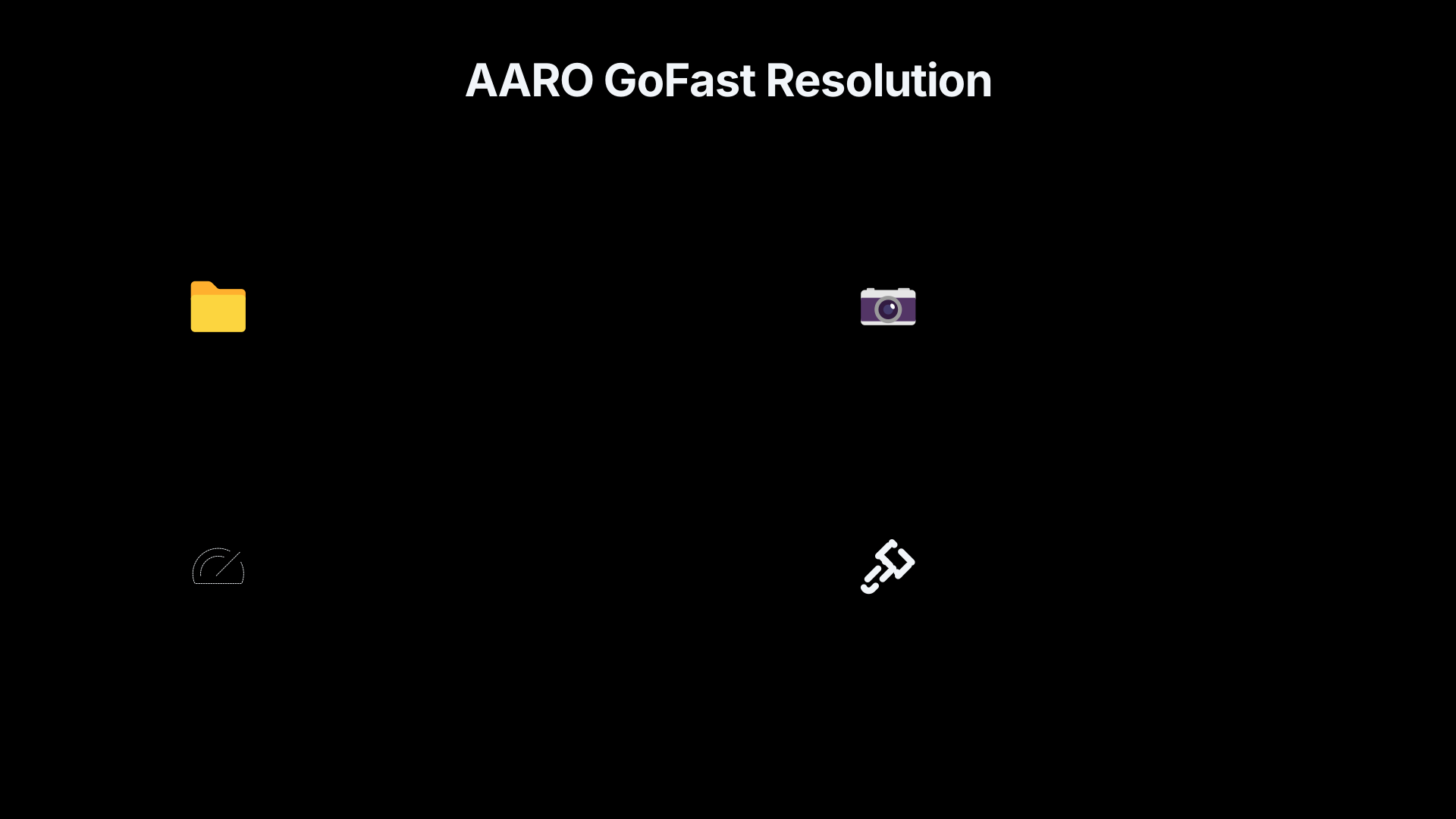
The “GoFast” Navy video is the clearest public example of why this matters. The clip became famous because the tracked object appears to skim rapidly above the ocean. AARO’s 2025 case resolution states that it analysed the publicly available 34-second FLIR video because the original file and metadata were no longer available, but that the display data still gave enough information to assess the object’s altitude and range of possible speeds. The conclusion was that the object was not moving at extraordinary speed; the striking apparent motion was consistent with parallax and the object’s estimated altitude and speed.[AARO]aaro.milGo Fast Case ResolutionGo Fast Case Resolution
For a public viewer, this is counter-intuitive. The object really does cross the screen quickly. The error is in treating screen speed as object speed. Without distance, camera angle, platform motion and field of view, a fast-looking dot is only a fast-looking dot.
Why angular speed is not enough
Most public UFO videos provide angular motion: how quickly something moves across the frame. That is not the same as physical speed. A plane 40 kilometres away and a bird 40 metres away can produce similar angular movement. A balloon can appear to move rapidly if filmed from a fast aircraft. A stationary light can appear to move if the camera pans, zooms, stabilises digitally, or loses and regains focus.
AI can help by estimating angular speed frame by frame, detecting camera shake, identifying horizon lines, and modelling possible object paths. But it should not output a confident speed unless the case file also contains distance or enough geometry to constrain it. A model that says “the object crossed 15 degrees in two seconds” is giving a useful measurement. A model that says “the object travelled at 3,000 mph” without distance is inventing precision.
In practice, a useful UFO video review asks:
- Is the camera stationary, handheld, mounted on a moving vehicle, or mounted on an aircraft?
- Is the horizon visible?
- Are stars, buildings, clouds, coastline, terrain, aircraft lights or other reference points visible?
- Is the zoom level known?
- Is the object tracked by optical stabilisation, military sensor lock, or manual panning?
- Does the clip include enough before-and-after footage to understand the camera movement?
When these answers are missing, the video may remain interesting but weak. It can support a witness account, but it cannot carry a strong claim about size, speed or altitude by itself.
Metadata and original files
Why the original file matters more than the viral clip
A UFO video shared through social media is usually not the original evidence. It may have been cropped, recompressed, stabilised, slowed down, brightened, screen-recorded, captioned, edited into a compilation, or stripped of metadata. Each step can remove information or add misleading artefacts.
Digital forensic guidance stresses the importance of interrogating the file to determine recording properties, comparing results from multiple tools, documenting discrepancies and, where needed, manually examining the file structure. The Scientific Working Group on Digital Evidence’s best-practice guidance for digital forensic video analysis treats file properties and discrepancies as part of the evidence, not as optional technical details.[SWGDE - SWGDE]swgde.orgBest Practices for Digital Forensic Video AnalysisBest Practices for Digital Forensic Video Analysis
For UFO investigation, the original file can help establish:
- the creation time recorded by the device;
- camera make and model;
- frame rate and resolution;
- lens or focal length data where available;
- GPS location if retained;
- whether the file was exported from an app;
- whether the video has been re-encoded;
- whether audio, missing frames or abrupt cuts suggest editing;
- whether the clip is a screen recording rather than direct camera footage.
This does not mean metadata is always truthful. Device clocks can be wrong, GPS can be absent, and metadata can be altered. But missing metadata is itself important because it limits what can be tested. The case file should record whether the original file was obtained, whether a hash was made to preserve it unchanged, and whether later analysis used a copy.
Chain of custody for public UFO clips
Open-source investigators working in human rights and conflict documentation have developed practical habits that transfer well to UFO video handling: find the earliest upload, preserve the content, document where it came from, verify time and place, and avoid treating a repost as the source. The Berkeley Protocol describes professional standards for identifying, collecting, preserving, analysing and presenting digital open-source information.[United Nations Human Rights Office]ohchr.orgUnited Nations Human Rights Office Berkeley ProtocolUnited Nations Human Rights Office Berkeley Protocol
Bellingcat’s video verification guidance similarly starts with checking whether the footage has appeared before, while Amnesty’s Citizen Evidence Lab explains that reverse image search can reveal whether a visual claim is recycled from an earlier event.[bellingcat]bellingcat.comAdvanced Guide on Verifying Video ContentAdvanced Guide on Verifying Video Content
In UFO sighting analysis, this protects against common failures:
- an old meteor or rocket re-entry video being reposted as a new local sighting;
- footage from another country being attached to a fresh witness claim;
- a cropped clip removing the aircraft, drone lights or balloon release visible earlier;
- a screen recording hiding the original camera data;
- a dramatic caption adding speed, altitude or military context not present in the video.
AI can assist by extracting keyframes, searching for earlier versions, comparing captions across uploads, detecting edits and building a timeline of circulation. But it should not treat the most popular upload as the evidential source.
Sensor artefacts and edited clips
Cameras make objects look stranger than they are
Many UFO clips are not ordinary colour videos. They may come from infrared sensors, night-vision devices, aircraft targeting pods, CCTV cameras, dashcams, doorbell cameras, phone cameras using digital zoom, or social media copies of any of these. Each sensor has its own distortions.
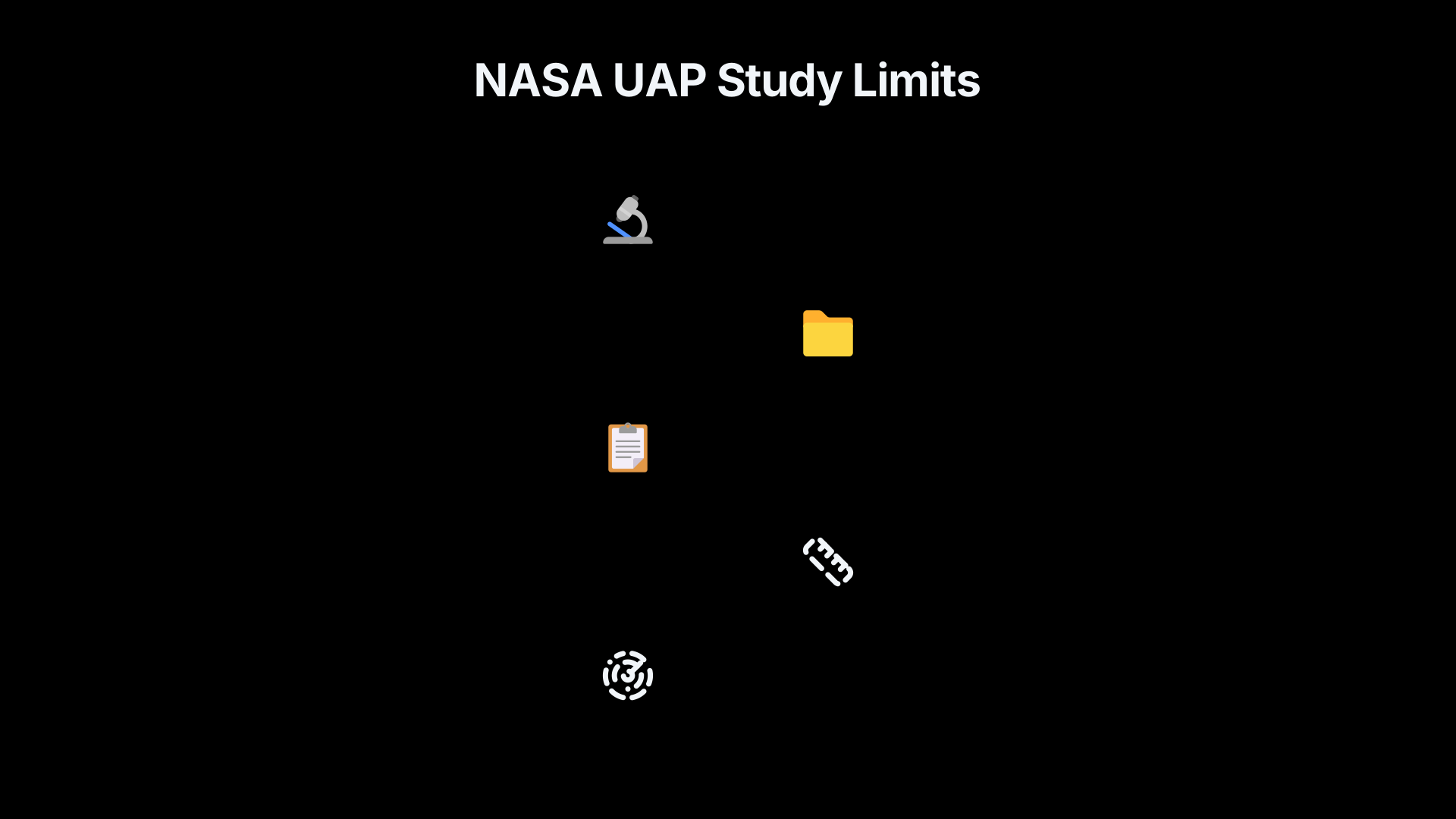
NASA’s UAP report notes that metadata about sensor type, manufacturer details, noise characteristics and time of acquisition is needed to characterise both the observed object and the sensor. It also notes that some apparent UAP have been shown to be sensor artefacts once calibration and metadata were examined.[Wikisource]en.wikisource.orgResponses to Statement of TaskResponses to Statement of Task
AARO’s public cases show how this plays out in practice. In one “Atmospheric Wake” case, AARO assessed that an infrared video likely showed a commercial aircraft and that the trailing wake-like effect was a sensor artefact caused by video compression. In another “Western U.S. Objects” case, full-motion video combined with commercial flight data led AARO to assess that small dots in the infrared footage were three separate commercial aircraft at significant distance from the sensor.[AARO]aaro.milOpen source on aaro.mil.
That is a crucial lesson for public-facing UFO investigation: the weirdest-looking part of a video may belong to the imaging chain rather than the sky.
Compression can add and remove detail
Video compression is especially treacherous because it does not merely blur an image. It can remove real information, create false edges, smear motion, generate blocky shapes, and make small lights pulse or split. In low-light sky footage, where the object may be only a few pixels wide, compression can become a major part of what the viewer sees.
Forensic video analysts warn that compression artefacts can cause both loss and addition of visual information, making it hard to distinguish real detail from artefact in surveillance footage.[Amped Blog]blog.ampedsoftware.comAmped Blog Video Compression Artifacts in Surveillance FootageAmped Blog Video Compression Artifacts in Surveillance Footage This is directly relevant to UFO clips because many public videos show tiny objects against dark sky, cloud, sea or sensor noise — exactly the conditions where compression has room to mislead.
AI can make this worse if used carelessly. Upscaling, sharpening, frame interpolation and denoising can produce attractive images that look more informative than the original. A sharpened “craft edge” may be an algorithmic guess. A slowed-down “acceleration” may be frame interpolation. A stabilised clip may hide the camera motion that explains the object’s apparent movement. Enhancement should therefore be logged as a derivative product, not treated as the evidence itself.
A good case file should preserve three layers:
- Original file: untouched, with hash and acquisition notes.
- Working copy: used for measurements, frame extraction and annotation.
- Enhanced copy: clearly labelled as interpretive, not primary evidence.
What AI can extract, and what it cannot infer
AI is useful in video-based UFO investigation when it narrows uncertainty rather than pretending to remove it. It can track a point across frames, estimate the camera’s movement, detect cuts, extract timestamps, identify visible stars, match terrain or buildings, compare aircraft light patterns, and flag likely artefacts. It can also help build a structured evidence table from messy public material.
But AI cannot recover facts that were never recorded. If the video lacks distance cues, AI cannot know whether the object is a nearby insect, a distant aircraft, a balloon, or an object at extreme altitude. If the original file is gone, AI cannot reliably reconstruct missing metadata. If the clip is a cropped social media repost, AI cannot know what happened outside the frame unless other evidence is found.
This is where the wording of conclusions matters. The system should prefer constrained language:
- “The video confirms a bright point moving across the frame.”
- “The object’s distance is not constrained by the clip.”
- “The apparent speed is consistent with parallax from camera motion.”
- “The file appears to be a recompressed copy, so metadata-based claims are weak.”
- “The object remains unidentified in this video, but no anomalous performance is demonstrated.”
- “The clip is unresolved because necessary measurements are missing, not because extraordinary behaviour is established.”
That final distinction is one of the most important in UFO analysis. “Unidentified” is not the same as “anomalous”. A video can fail to identify an object while also failing to show anything physically extraordinary.
How video evidence should be weighted in a case file
Video evidence is strongest when it is matched with independent, time-aligned context. A shaky clip of a light over a town becomes more useful if the case file also contains witness location, viewing direction, exact time, weather, aircraft tracks, satellite passes, astronomical checks, wind profiles, nearby events, and other witnesses from different positions.
A video becomes weaker when it stands alone. A cropped, silent, reposted clip with no original file, no location, no timestamp, no horizon, no reference points and no camera data may still be worth logging, but it should not drive a high-confidence conclusion. The right status may be “insufficient data”, not “mysterious object”.
A practical weighting scale for AI-assisted investigation could look like this:
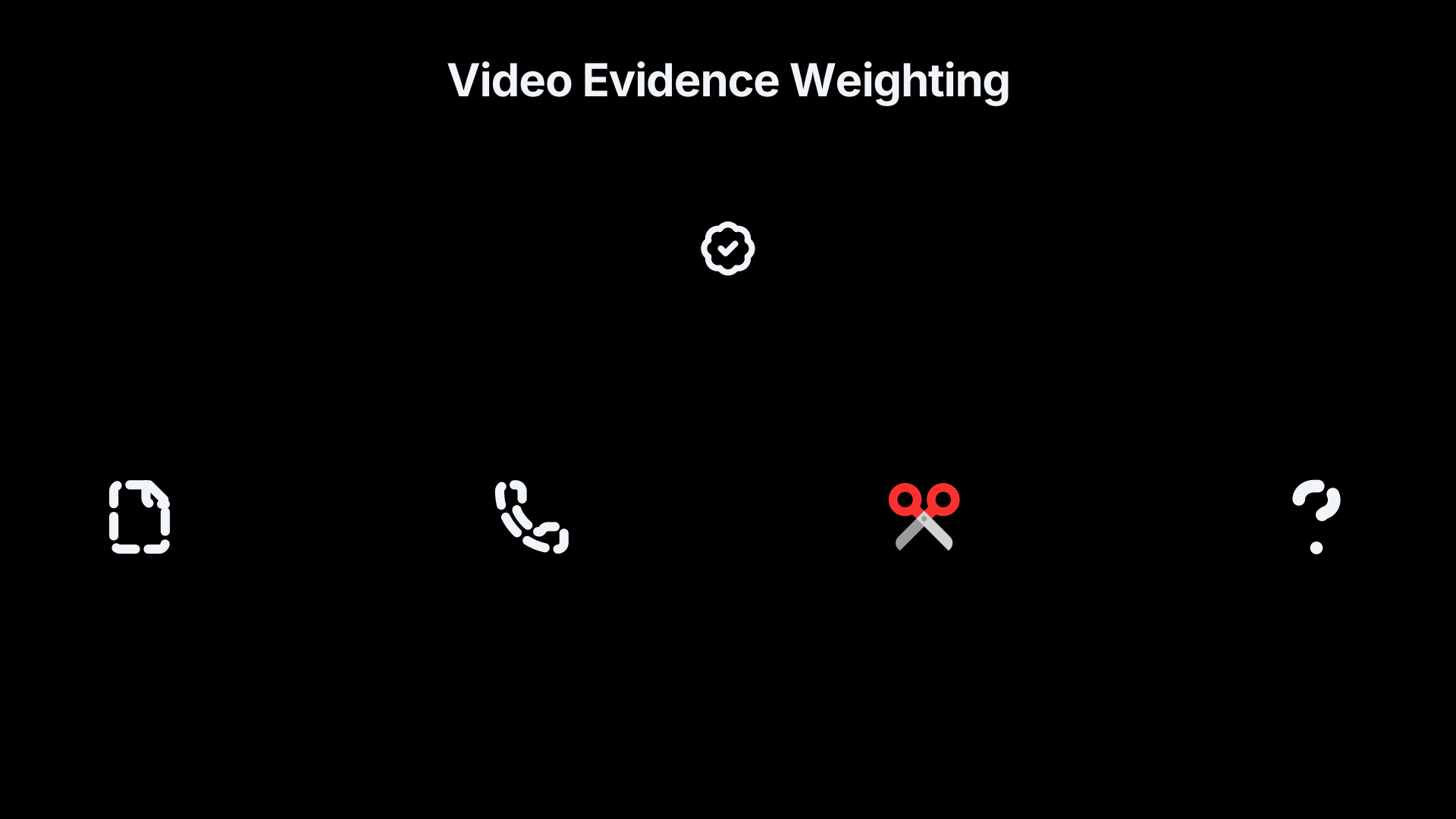
- Strong video evidence: original file available; time and location verified; camera settings known; stable reference points visible; object track measurable; independent data checked; mundane matches tested.
- Moderate video evidence: original or near-original file available; time and location plausible; some reference points; limited camera metadata; candidate explanations can be compared but not fully resolved.
- Weak video evidence: social media copy only; missing metadata; uncertain time or place; no scale cues; short duration; heavy zoom, compression or editing.
- Illustrative evidence only: reposted, cropped, enhanced or compilation footage that may show what a witness claims but cannot support measurement.
This does not dismiss witness video. It places it in the right evidential role. In many cases, video is a trigger for investigation rather than proof of identity.
A practical review path for UFO videos
For an AI-assisted UFO sighting workflow, the video review should begin with preservation and context before interpretation. The safest order is:
- Secure the original file if possible. Record who supplied it, how it was transferred, whether metadata is intact, and whether a hash has been created.
- Document the viewing geometry. Establish camera location, direction, elevation angle, horizon, zoom, lens type, field of view and whether the camera or observer was moving.
- Make a frame-by-frame object track. Separate object motion from camera motion, stabilisation, zoom and sensor lock.
- Check for edits and compression. Identify cuts, missing frames, re-encoding, platform compression and enhancement.
- Cross-check the sky. Compare the time and direction with aircraft, drones where data exists, satellites, astronomical objects, balloons, weather, launches and re-entry reports.
- Record confidence honestly. State what the video proves, what it suggests, and what it cannot establish.
The outcome should not be a binary label such as “debunked” or “real”. Better case statuses are more precise: “likely aircraft”, “consistent with balloon”, “probable sensor artefact”, “physical object unresolved”, “insufficient metadata”, “unverified repost”, or “unusual after basic screening”.
When a video still matters
The limits of UFO video evidence do not make video useless. A clip can confirm timing, preserve witness reaction, show direction of travel, reveal light patterns, document weather or cloud conditions, and create a testable lead for further analysis. In rare cases, video from multiple independent positions can support triangulation. Video paired with radar, ADS-B, satellite data, weather records or other sensors can be far more valuable than video alone.
The key is to resist the emotional force of a clear image. A sharp object with unknown distance may be less informative than a blurry object with known geometry. A dramatic short clip may be weaker than a dull long recording with a visible horizon and original metadata. For AI-assisted UFO sighting investigation, the best use of video is not to make the mystery look more impressive. It is to turn the clip into measured claims, test those claims against ordinary explanations, and leave a clear record of what remains uncertain.
Amazon book picks
Further Reading
Books and field guides related to Why Clear UFO Videos Can Still Mislead. Use these as the next step if you want deeper reading beyond the article.
The Visual Display of Quantitative Information
Encourages disciplined evidence assessment.
eBay marketplace picks
Marketplace Samples
Example marketplace items related to this page. Use the search link to explore similar finds on eBay.


Endnotes
1.
Source: science.nasa.gov
Title: Science Independent Study Team Report
Link:https://science.nasa.gov/wp-content/uploads/2023/09/uap-independent-study-team-final-report.pdf
Source snippet
NASA ScienceIndependent Study Team ReportSeptember 13, 2023 — At present, analysis of UAP data is hampered by poor sensor calibration, th...
Published: September 13, 2023
2.
Source: aaro.mil
Title: Official UAP Imagery
Link:https://www.aaro.mil/UAP-Cases/Official-UAP-Imagery/
Source snippet
UAP Imagery... video footage from an infrared sensor aboard a U.S. military platform in 2024.... sensor artifact resultant of video...
3.
Source: aaro.mil
Link:https://www.aaro.mil/Portals/136/PDFs/Information%20Papers/AARO_Effect_of_Forced_Perspective_and_Parallax_View_on_UAP_Observations_2024.pdf
Source snippet
Effect of Forced Perspective and Parallax View on UAP...May 8, 2024 — This paper provides a basic overview of these phenomena and th...
Published: May 8, 2024
4.
Source: aaro.mil
Title: [Go Fast]({{ ‘go-fast/’ | relative_url }}) Case Resolution
Link:https://www.aaro.mil/Portals/136/PDFs/case_resolution_reports/AARO_GoFast_Case_Resolution_Card_Methodology_Final.pdf
5.
Source: swgde.org
Title: Best Practices for Digital Forensic Video Analysis
Link:https://swgde.org/wp-content/uploads/2025/12/2025-12-10-Best-Practices-for-Digital-Forensic-Video-Analysis-18-V-001-2.0.pdf
6.
Source: bellingcat.com
Title: Advanced Guide on Verifying Video Content
Link:https://www.bellingcat.com/resources/how-tos/2017/06/30/advanced-guide-verifying-video-content/
7.
Source: en.wikisource.org
Title: Responses to Statement of Task
Link:https://en.wikisource.org/wiki/NASA_Unidentified_Anomalous_Phenomena%3A_Independent_Study_Team_Report/Responses_to_Statement_of_Task
8.
Source: bellingcat.com
Link:https://www.bellingcat.com/tag/verification/
9.
Source: bellingcat.com
Link:https://www.bellingcat.com/resources/2023/05/08/chronolocation-determining-when-a-photo-was-taken-using-facebook-google-street-view-and-assorted-tiny-details/
10.
Source: bellingcat.com
Title: searching the earth essential [geolocation]({{ ‘geolocation/’ | relative_url }}) tools for verification
Link:https://www.bellingcat.com/resources/how-tos/2015/07/25/searching-the-earth-essential-geolocation-tools-for-verification/
11.
Source: bellingcat.com
Title: a beginners guide to social media verification
Link:https://www.bellingcat.com/resources/2021/11/01/a-beginners-guide-to-social-media-verification/
12.
Source: bellingcat.com
Title: using the sun and the shadows for geolocation
Link:https://www.bellingcat.com/resources/2020/12/03/using-the-sun-and-the-shadows-for-geolocation/
13.
Source: amnesty.org
Link:https://www.amnesty.org/en/latest/press-release/2019/12/amnesty-international-updates-citizen-evidence-lab-for-cutting-edge-open-source-human-rights-investigations/
14.
Source: aaro.mil
Link:https://www.aaro.mil/
15.
Source: lab.witness.org
Link:https://lab.witness.org/portfolio_page/verification/
16.
Source: humanrights.berkeley.edu
Title: protocol on digital open source investigations
Link:https://humanrights.berkeley.edu/publications/berkeley-protocol-on-digital-open-source-investigations/
17.
Source: ohchr.org
Title: United Nations Human Rights Office Berkeley Protocol
Link:https://www.ohchr.org/sites/default/files/2024-01/OHCHR_BerkeleyProtocol.pdf
18.
Source: blog.ampedsoftware.com
Title: Amped Blog Video Compression Artifacts in Surveillance Footage
Link:https://blog.ampedsoftware.com/2021/04/13/video-compression-artifacts
19.
Source: zenodo.org
Link:https://zenodo.org/records/7844175
20.
Source: zenodo.org
Link:https://zenodo.org/records/20137882
21.
Source: digitallibrary.un.org
Link:https://digitallibrary.un.org/record/3973652?ln=en
22.
Source: scribd.com
Title: Bellingcat s Online Investigation Toolkit
Link:https://www.scribd.com/document/784989239/Bellingcat-s-Online-Investigation-Toolkit
Additional References
23.
Source: arxiv.org
Link:https://arxiv.org/html/2312.00558v3
24.
Source: youtube.com
Title: Understanding Lens Flares and Camera Artifacts in UFO Videos
Link:https://www.youtube.com/watch?v=0BjG_J4c75c
Source snippet
Parallax Effect: Why Objects in the Sky Seem to Move Fast...
25.
Source: youtube.com
Title: The Physics of Infrared Imaging and UAP Misidentification
Link:https://www.youtube.com/watch?v=tOQG6h1f7xQ
Source snippet
How to Scientifically Analyze Aerial Phenomena Videos...
26.
Source: youtube.com
Title: Parallax Effect: Why Objects in the Sky Seem to Move Fast
Link:https://www.youtube.com/watch?v=kO1-l1P1-3g
Source snippet
Why Your Camera Can't Always Tell the Truth...
27.
Source: facebook.com
Link:https://www.facebook.com/thesocialctv/posts/nasa-has-released-a-report-detailing-how-it-tracks-unidentified-anomalous-phenom/850192826467495/
28.
Source: pbs.org
Link:https://www.pbs.org/newshour/science/3-ways-scientists-use-math-to-help-debunk-ufo-videos
29.
Source: researchgate.net
Link:https://www.researchgate.net/publication/392920789_Forensic_Value_of_Exif_Data_An_Analytical_Evaluation_of_Metadata_Integrity_across_Image_Transfer_Methods
30.
Source: reddit.com
Link:https://www.reddit.com/r/UFOs/comments/166dk0u/according_to_aaros_new_website_the_flir_gimbal/
31.
Source: gijn.org
Link:https://gijn.org/stories/amnesty-internationals-sam-dubberley-on-digital-verification-and-human-rights/
32.
Source: instagram.com
Link:https://www.instagram.com/reel/Cp6ymCnjAlq/
Topic Tree
Follow this branch
Parent topic
UFO Case AIRelated pages 9
- Aircraft Was It an Aircraft or Drone?
- Astronomy Was the UFO Really in the Sky Map?
- Case File What Makes a UFO Report Investigable?
- Case Match Has This UFO Sighting Happened Before?
- Confidence How Certain Can a UFO Explanation Be?
- Review Who Checks the AI UFO Verdict?
- Satellites Could It Be Starlink or a Satellite?
- Timeline What Else Was Happening During the Sighting?
- +1 more in sidebar