Within Satellites
Could That Sudden Flash Have Been A Satellite Flare?
A bright flash that seems impossible can often be tested against known satellite reflection geometry and shadow timing.
On this page
- How reflective glints create sudden brightness
- Matching flare geometry to witness timelines
- Why low horizon flares can appear stationary
Page outline Jump by section
Introduction
A sudden flash in the night sky can feel deeply unnatural to a witness, especially when it appears brighter than nearby stars, remains silent, and vanishes within seconds. In UFO case reconstruction, however, brief bright flashes are among the most testable observations because satellite reflections follow predictable geometry. A well-timed flare from a reflective satellite surface can produce a short-lived burst of light that closely matches many “instant appearance” or “flash then vanish” UFO descriptions. The investigative question is not simply whether a satellite was overhead, but whether the timing, brightness curve, direction, elevation angle, and sunlight geometry fit the witness account closely enough to explain the event.[Wikipedia]WikipediaSatellite flareSatellite flare[Satellites Observer]satobs.orgSatellites ObserverIridium FlaresA relatively small communications satellite has been providing spectacular visible reflective flares/gli…
 This matters because flare timing checks are one of the fastest ways AI-assisted UFO investigation can eliminate a mundane explanation without relying on guesswork. Unlike vague visual impressions, satellite passes can be reconstructed against orbital data, twilight conditions, Earth shadow position, and observer location with high precision. When the timing lines up within seconds, the case often shifts from “unexplained flash” to “known optical reflection event”. When it does not line up, investigators gain a clearer basis for treating the sighting as unresolved rather than prematurely dismissed.
How Reflective Glints Create Sudden Brightness
A satellite flare happens when sunlight reflects from a flat or highly reflective surface directly toward a small region on Earth. The effect is similar to sunlight briefly reflecting from a mirror. Most satellites are too dim to notice with the naked eye, but under the right geometry they can brighten dramatically for a few seconds before fading again.[Wikipedia]WikipediaSatellite flareSatellite flare[Houston Astronomical Society]astronomyhouston.orgThese events…Read more…
The classic example was the first-generation Iridium communications satellites. Their large polished antennas produced extremely bright and highly predictable flashes. Some reached magnitude −8 or brighter, briefly outshining every star and even Venus. Observers often described them as lights that “switched on”, “exploded into brightness”, or “appeared suddenly out of nowhere”.[Wikipedia]WikipediaSatellite flareSatellite flare[Space In practical UFO timeline analysis]space.com6898 reflections space spot iridium flaresReflections from Space: Spot Iridium Flares28 Jun 2009 — At the Earth's surface, the specular reflection is probably less than 50 miles w…, the key point is that flares are not random. They depend on a precise three-way alignment:
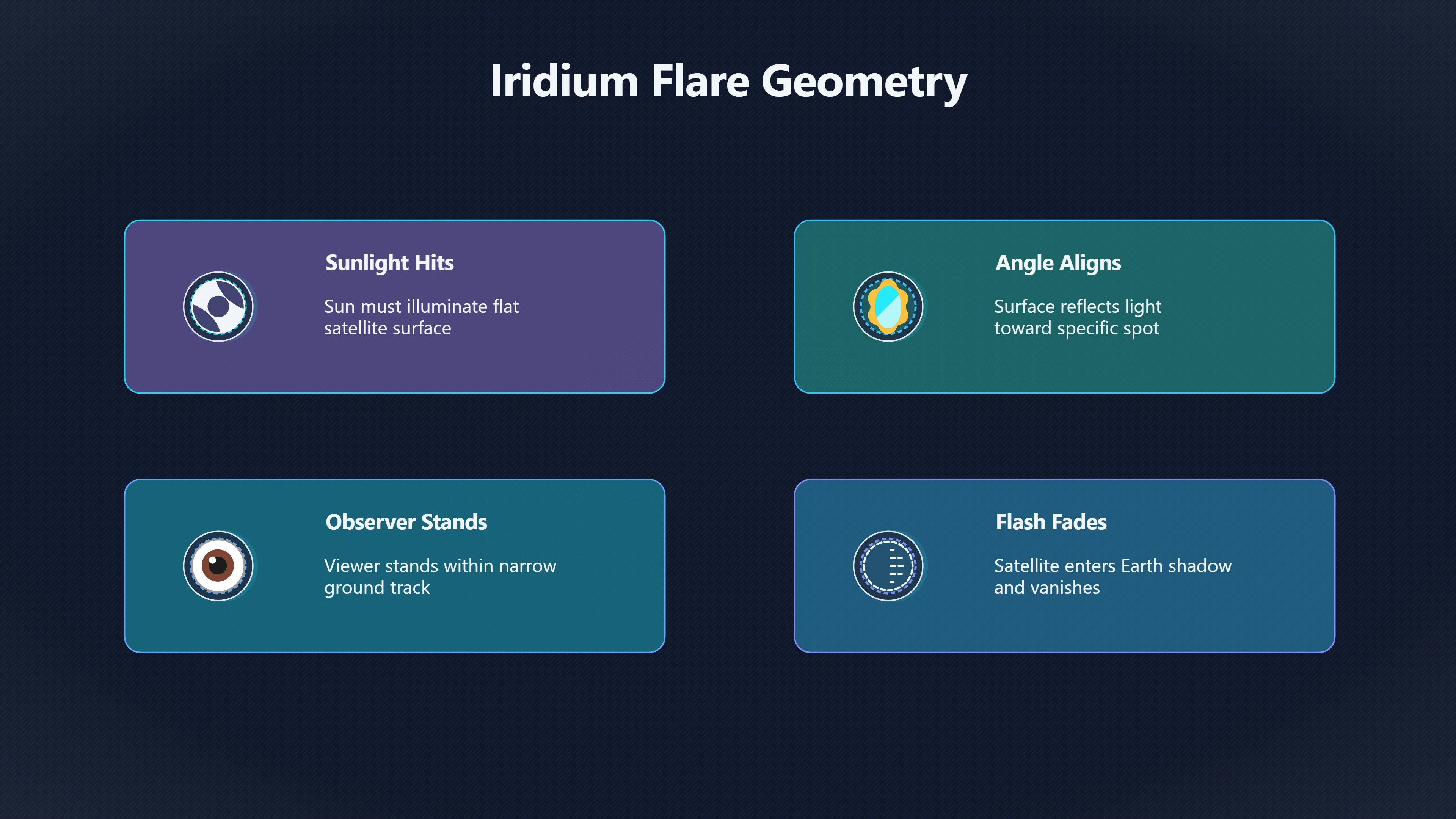
- The Sun must still illuminate the satellite.
- The satellite surface must reflect light at the correct angle.
- The observer must stand within the narrow ground track of that reflected beam.
If any of those conditions fail, the flare never becomes visible. This is why one witness may report an extraordinary flash while someone a few kilometres away sees nothing at all. Iridium flare footprints were sometimes only around 10 kilometres wide at peak brightness.[Wikipedia]WikipediaSatellite flareSatellite flare
Modern satellites still produce glints even though the original Iridium fleet has been retired. Starlink satellites, tumbling rocket bodies, large solar arrays, and reflective spacecraft surfaces can all generate sudden brightness surges. The difference is that many modern flares are less predictable because spacecraft orientation changes more dynamically.[SatFleet Live]satfleetlive.comSat Fleet Live Why Are Satellites So Bright?Understanding…A satellite flare is a sudden, brief increase in brightness caused when a flat, mirror-like surface — typically a solar…
Matching Flare Geometry To Witness Timelines
In UFO reconstruction work, the strongest satellite-flare matches usually emerge from timeline precision rather than visual similarity alone. A witness may say a light flashed brightly “around 10:17 pm” for “roughly five seconds”. Investigators then compare that claim against satellite ephemeris data, observer coordinates, and solar geometry.
The reconstruction process typically checks five linked variables:
- Exact witness time window.
- Observer latitude, longitude, and viewing direction.
- Satellite orbital track.
- Solar illumination conditions.[apollosat.com]apollosat.comApollo SatelliteIridium Coverage Map Live View of SatellitesVisibility Conditions To See An Iridium Flare · Dark sky: it should be night…
- Earth shadow boundary at that moment.
A credible flare match normally requires several of these factors to align simultaneously.
For example, a satellite flare explanation becomes much stronger when:[Wikipedia]WikipediaSatellite flareSatellite flare
- The predicted flare occurs within seconds of the reported sighting.
- The witness direction matches the satellite azimuth and elevation.
- The duration resembles a known flare profile.
- The brightness peaks sharply then fades symmetrically.
- The satellite enters Earth’s shadow shortly afterward. Wikipedia+2Heavens-Above[Wikipedia]WikipediaSatellite flareSatellite flare
AI-assisted workflows are particularly useful here because orbital calculations involve large moving datasets. Automated systems can ingest Two-Line Element sets (TLEs), reconstruct historical sky conditions, and test many candidate satellites simultaneously. Rather than manually checking one spacecraft at a time, an automated pipeline can rapidly identify which objects were capable of producing a visible flare from the observer’s exact location.
This changes the quality of UFO analysis in an important way. Investigators stop asking the broad question “were satellites overhead?” and instead ask the narrower forensic question “could this exact satellite produce this exact brightness behaviour at this exact time?”
That distinction matters because many sightings occur when satellites are present but geometrically incapable of creating a visible flash.
Why Timing Precision Often Decides The Case
Small timing errors can completely change a flare assessment. A discrepancy of even one or two minutes may shift a satellite from full sunlight into Earth’s shadow, making the reflection impossible. Likewise, a witness clock that is several minutes wrong can accidentally eliminate the correct candidate.
For this reason, investigators usually rank timing confidence before interpreting the visual description itself.
Useful corroborating markers include:
- CCTV timestamps.
- Mobile phone metadata.
- smart-home device logs.
- vehicle dashcam clocks.
- social media upload times.
- aircraft tracking records used as synchronisation anchors.
A reconstructed timeline often reveals that witnesses unintentionally compress or expand event duration. A five-second flare may later be remembered as lasting “half a minute” because the brightness spike was emotionally striking. AI-assisted comparison systems can flag these common distortions by comparing witness narratives against known flare profiles from prior reports.
The shape of the brightness curve is also important. Classic satellite flares usually show:
- rapid brightening,
- a short peak,
- then gradual fading.
A light that remains equally bright for several minutes generally fits ordinary satellite visibility better than a specular flare. A light that changes direction abruptly or performs structured manoeuvres does not fit known flare geometry well and requires separate investigation.

Why Low-Horizon Flares Can Look Stationary
One of the more confusing features in UFO reports is the claim that a bright object “hovered motionless” before disappearing. Satellite flares near the horizon can create exactly that illusion.
When a satellite approaches the observer at a shallow angle, its apparent movement across the sky slows dramatically from the viewer’s perspective. At the same time, atmospheric haze near the horizon can obscure the dimmer portions of the pass while leaving only the bright flare visible. The result is a light that appears fixed in place for several seconds before abruptly fading away.
This effect becomes even stronger during twilight, when:
- the ground observer is already in darkness,
- the satellite remains sunlit at altitude,
- and contrast against the sky is high.[Apollo Satellite]apollosat.comApollo SatelliteIridium Coverage Map Live View of SatellitesVisibility Conditions To See An Iridium Flare · Dark sky: it should be night…[Phys.org]phys.org2021 03 dont chance sight distant orbitalIf skies are clear, don't miss a chance to catch sight of these…19 Mar 2021 — Right around equinox in March or September is a good tim…
In witness testimony, this often becomes:
- “it stayed still then vanished”,
- “it blinked on and off”,
- or “it hung in one position”.
A timing reconstruction may show instead that the satellite was moving normally while only the brightest reflective phase was visible to the observer.
This is especially relevant in cases where witnesses report:
- no audible sound,
- no visible structure,
- no coloured navigation lights,
- and no apparent acceleration beyond the sudden disappearance itself.
Those characteristics strongly overlap with known satellite flare behaviour.[Wikipedia]WikipediaSatellite flareSatellite flare
Earth Shadow Checks And Instant Disappearance
A classic satellite clue in UFO reports is instantaneous disappearance without visible descent. This often occurs when a spacecraft crosses into Earth’s shadow.
Satellites in low Earth orbit remain illuminated after sunset because they are still high enough to catch sunlight. As they continue along their orbital path, they eventually pass into the dark cone behind Earth and stop reflecting sunlight toward the observer. The disappearance can appear extremely abrupt.[Wikipedia]WikipediaSatellite flareSatellite flare[Phys.org]phys.org2021 03 dont chance sight distant orbitalIf skies are clear, don't miss a chance to catch sight of these…19 Mar 2021 — Right around equinox in March or September is a good tim…
In reconstruction work, Earth-shadow modelling is therefore one of the most valuable automated checks.
If a witness reports:
- a bright flash,
- followed by several seconds of dim movement,
- then total disappearance at a fixed point in the sky,
investigators can test whether the satellite crossed the shadow boundary at that exact moment.
When the timing matches closely, confidence in the satellite explanation rises sharply because the disappearance mechanism is physically understood and independently predictable.
Cases become more difficult when:
- the reported object remained visible deep into full night despite impossible illumination geometry,
- brightness behaviour contradicts predicted reflection angles,
- or no candidate satellite path intersects the reported location and time.
Those are the moments where investigators must avoid forcing a satellite explanation simply because satellites were present in the broader sky.

Where Flare Timing Checks Commonly Fail
Satellite flare matching is powerful, but it is not foolproof.(#endnote-1 “Endnote 1”)[Wikipedia]WikipediaSatellite flareSatellite flare
Several complications regularly appear in UFO case reconstruction:
- witness clocks may be inaccurate,
- online orbital archives may contain incomplete historical data,
- tumbling debris can create irregular flashing patterns,
- and some satellites change orientation unpredictably.
The retirement of the original Iridium satellites also removed one of the easiest flare systems to predict precisely. Modern flare events are often less regular and harder to model.[Heavens-Above]heavens-above.comSatellite predictions and other astronomical data customised for your location… Planets · Solar system chart · Comets · A…[Reddit]reddit.comash visible from Earth, created by specular solar reflection off of their flat…
Another major complication is overfitting. Investigators can sometimes find a satellite pass vaguely near a sighting and treat that as a solved case even when the geometry is weak. Good reconstruction practice avoids this by separating:
- possible coincidence,
- plausible match,
- strong timing correlation,
- and high-confidence explanation.
A satellite merely being visible somewhere overhead is not enough. The flare geometry, timing, and observer perspective must fit the reported behaviour in detail.
Why Satellite Flare Checks Matter In UFO Investigation
Satellite flare analysis demonstrates one of the clearest advantages of AI-assisted UFO investigation: some dramatic-looking events become highly testable once timing and geometry are reconstructed properly.
A bright flash that initially appears mysterious can often be traced to:
- a reflective antenna,
- a solar panel glint,[twanight.org]twanight.orgIridium FlareSatellite flare or satellite glint is the phenomenon caused by the reflective surfaces on satellites (such as antennas or so…
- or a satellite entering Earth’s shadow.
These explanations are not speculative debunks. They are repeatable optical events governed by known orbital mechanics and lighting geometry. ScienceDirect[Wikipedia At the same time]WikipediaSatellite flareSatellite flare, rigorous flare checking also protects against premature dismissal. When timing, direction, and illumination fail to match known satellites, investigators gain a stronger evidential basis for classifying the sighting as unresolved rather than casually explained away.
That balance is central to evidence-led UFO reconstruction: using automation to rule out ordinary explanations quickly where the data genuinely supports them, while preserving uncertainty where the fit remains weak.
Amazon book picks
Further Reading
Books and field guides related to Could That Sudden Flash Have Been A Satellite Flare?. Use these as the next step if you want deeper reading beyond the article.
The Practical Astronomer
Supports practical checks for flare timing and viewing geometry.
The Demon-Haunted World
Encourages testing sudden flashes before calling them anomalous.
eBay marketplace picks
Marketplace Samples
Example marketplace items related to this page. Use the search link to explore similar finds on eBay.


Endnotes
1.
Source: Wikipedia
Title: Satellite flare
Link:https://en.wikipedia.org/wiki/Satellite_flare
2.
Source: sciencedirect.com
Link:https://www.sciencedirect.com/science/article/abs/pii/S0273117722010936
Source snippet
Space debris spectroscopy: Specular reflections at LEO...by D Žilková · 2023 · Cited by 18 — In orbit satellites can reflec...
3.
Source: space.com
Title: 6898 reflections space spot iridium flares
Link:https://www.space.com/6898-reflections-space-spot-iridium-flares.html
Source snippet
Reflections from Space: Spot Iridium Flares28 Jun 2009 — At the Earth's surface, the specular reflection is probably less than 50 miles w...
4.
Source: sciencedirect.com
Link:https://www.sciencedirect.com/science/article/abs/pii/S0094576502001273
Source snippet
The visual appearance of the Iridium® satellitesby PD Maley · 2003 · Cited by 15 — Iridium flares (Maley and Pizzicaroli, 2003) known to...
5.
Source: reddit.com
Link:https://www.reddit.com/r/space/comments/xnpx5d/last_of_the_iridium_flashes_i_captured_the_once/
Source snippet
ash visible from Earth, created by specular solar reflection off of their flat...
6.
Source: heavens-above.com
Link:https://www.heavens-above.com/
Source snippet
Satellite predictions and other astronomical data customised for your location... Planets · Solar system chart · Comets · A...
7.
Source: heavens-above.com
Link:https://www.heavens-above.com/faq.aspx?alt=100&cul=en&lat=44.813792&lng=-76.515932&loc=Cygnus+Hill+Observatory&tz=EST
Source snippet
re not in the nominal orbit and/or attitude. However...Read more...
8.
Source: phys.org
Title: 2021 03 dont chance sight distant orbital
Link:https://phys.org/news/2021-03-dont-chance-sight-distant-orbital.html
Source snippet
If skies are clear, don't miss a chance to catch sight of these...19 Mar 2021 — Right around equinox in March or September is a good tim...
9.
Source: heavens-above.com
Title: Iridium Demise.aspx
Link:https://heavens-above.com/IridiumDemise.aspx
Source snippet
The end of Iridium flares?15 May 2018 — Several people have reported Iridium Flares not showing up as predicted in the last...
Published: May 2018
10.
Source: reddit.com
Link:https://www.reddit.com/r/heavensabove/comments/tqr1k4/iridiums/
11.
Source: satobs.org
Link:https://www.satobs.org/iridium.html
Source snippet
Satellites ObserverIridium FlaresA relatively small communications satellite has been providing spectacular visible reflective flares/gli...
12.
Source: astronomyhouston.org
Link:https://www.astronomyhouston.org/newsletters/guidestar/iridium-flares%E2%80%94-bright-light-sky
Source snippet
These events...Read more...
13.
Source: satfleetlive.com
Title: Sat Fleet Live Why Are Satellites So Bright?
Link:https://satfleetlive.com/blogs/why-are-satellites-so-bright/
Source snippet
Understanding...A satellite flare is a sudden, brief increase in brightness caused when a flat, mirror-like surface — typically a solar...
14.
Source: apollosat.com
Link:https://apollosat.com/iridium-coverage-map/
Source snippet
Apollo SatelliteIridium Coverage Map Live View of SatellitesVisibility Conditions To See An Iridium Flare · Dark sky: it should be night...
15.
Source: stargazerslounge.com
Title: Heavens Above!
Link:https://stargazerslounge.com/topic/41681-heavens-above-this-things-not-working/
Source snippet
This things not working?29 Apr 2009 — When I got to the Iridium flares, I made sure I was looking in the right direction at the right tim...
Additional References
16.
Source: science.nasa.gov
Link:https://science.nasa.gov/earth/earth-observatory/the-science-of-sunglint-84333/
Source snippet
NASA ScienceThe Science of SunglintThat gleam is caused by sunglint, an optical phenomenon that occurs when sunlight reflects off the sur...
17.
Source: skyandtelescope.org
Link:https://skyandtelescope.org/stargazing-and-observing/celestial-objects-to-watch/observing-iridium-flares/
Source snippet
How to Catch an Iridium FlareNote that you can see some Iridium flares in daylight if your skies are very clear and you look in precisely...
18.
Source: researchgate.net
Link:https://www.researchgate.net/publication/253833933_Predicting_Iridium_Flares
Source snippet
Predicting Iridium FlaresSuch a solar reflection, called an "Iridium flare," typically happens several times a day to any Earth-fixed loc...
19.
Source: twanight.org
Link:https://twanight.org/gallery/iridium-flare-2/
Source snippet
Iridium FlareSatellite flare or satellite glint is the phenomenon caused by the reflective surfaces on satellites (such as antennas or so...
20.
Source: smithsonianmag.com
Link:https://www.smithsonianmag.com/science-nature/giant-mirrors-in-space-could-bring-sunlight-after-dark-one-startup-says-and-astronomers-are-concerned-180987781/
Source snippet
Giant Mirrors in Space Could Bring Sunlight After Dark...Dec 3, 2025 — Critics argue the satellites, billed as a way to harness solar en...
21.
Source: flatearth.ws
Link:https://flatearth.ws/t/iridium-flare
22.
Source: youtube.com
Link:https://www.youtube.com/watch?v=8EOOOWYtqhM
23.
Source: lens.monash.edu
Link:https://lens.monash.edu/a-us-startup-plans-to-deliver-sunlight-on-demand-after-dark-can-it-work-and-would-we-want-it-to/
Source snippet
Well, for a single 54-metre satellite it will be 15,000 times fainter than the midday sun, but...Read more...
24.
Source: science.nasa.gov
Link:https://science.nasa.gov/earth/human-dimensions/earth-at-night/nasa-night-light-imagery-tracks-us-energy-transition-global-volatility/
Source snippet
Night-light Imagery Tracks US Energy Transition...5 days ago — Gold, purple, and white points of light brighten up a globe shrouded in d...
25.
Source: xt8dob.wordpress.com
Title: crash course in heavens above part three iridium flares
Link:https://xt8dob.wordpress.com/2015/06/04/crash-course-in-heavens-above-part-three-iridium-flares/
Source snippet
Course in Heavens-Above: Part Three – Iridium Flares4 Jun 2015 — When one of these Iridium satellites passes over your location, sunlight...
Topic Tree