Within Video timeline
Why Witness Memory And File History Diverge
A strong UFO reconstruction keeps memory, camera behaviour, edits, and environmental evidence in separate timeline layers.
On this page
- Separating subjective recollection from file events
- Mapping zoom exposure and clip gaps
- Cross checking timelines with external anchors
Page outline Jump by section
Introduction
A strong UFO reconstruction does not force every piece of evidence into a single storyline. It builds several timelines in parallel and then compares them. The witness remembers one sequence of events. The camera sensor records another. The file system adds its own history through saves, edits, exports, uploads, and compression. AI-assisted investigation becomes more reliable when those layers stay separate instead of being blended into one assumed chronology.
 This matters because people often remember an event as continuous and dramatic even when the file history shows pauses, zoom adjustments, dropped frames, or missing sections. Equally, a damaged or recompressed video may hide useful timing clues even when the witness account is broadly accurate. Modern forensic guidance treats digital video as a structured evidence object with independent timing behaviour, not just a moving image.[NIST]nist.govOSAC 2022-S-0031 Standard Guide for Forensic Digital…January 2, 2024 — For example, processing includes tasks to transcode, enhanc…[NIST]nist.govDigital ForensicsDigital evidence includes data on computers and mobile devices, including audio, video, and image files as well as softw…
In practical UFO case work, the goal is not to “catch out” witnesses. It is to separate subjective recollection from independently verifiable file events so investigators can identify where memory, device behaviour, and external reality align or diverge.
Why witness memory and file history diverge
Witnesses rarely experience a sighting as a clean linear timeline. Attention narrows during surprising events. Time estimates drift. Emotional intensity changes recall quality. Cognitive psychology research has repeatedly shown that memory is reconstructive rather than perfectly replayed, especially after stress, discussion, or repeated retelling.[Abertay University]rke.abertay.ac.ukCognitive Interview arose out of a need to examine ways of improving witness memory. (cognitive factors) as well as addressing some of th…[University of Southampton Web Archive]web-archive.southampton.ac.ukUniversity of Southampton Web ArchiveEyewitness performance in Cognitive and Structured…by A Memon · Cited by 103 — This paper address…[PMC]pmc.ncbi.nlm.nih.govThe impact of recall timing on the preservation of eyewitness…by C Chevroulet · 2021 · Cited by 13 — As a witness' memory of the ev…
In UFO investigations, this creates several recurring problems:
- A witness may remember an object “hovering for ten minutes” while the recorded clip lasts forty seconds.
- The observer may recall smooth movement even though the camera repeatedly loses focus.
- A bright object may appear to “shoot away” at the exact moment autofocus or exposure changes.
- The witness may believe recording began immediately, while phone logs show the camera app opened much later.
These differences do not automatically imply dishonesty. Human recall and device behaviour operate differently. A phone records measurable file events. A person reconstructs an experience using attention, expectation, stress, conversation, and later interpretation.
Research on eyewitness interviewing shows that recall changes over time and becomes more vulnerable to post-event influence, including online discussion and repeated retelling. PMC NCACIA That issue becomes especially important in UFO cases because witnesses often watch their own footage repeatedly before formal documentation b[ncacia.org]ncacia.orginside forensic interviewing exploring the basics about the various modelsInside Forensic Interviewing: Exploring the Basics About…25 Apr 2024 — The Cognitive Interviewing Model is a research-backed approach… egins.
A parallel timeline approach therefore treats the witness narrative and the file history as two evidence streams that may partially overlap without being identical.
Separating subjective recollection from file events
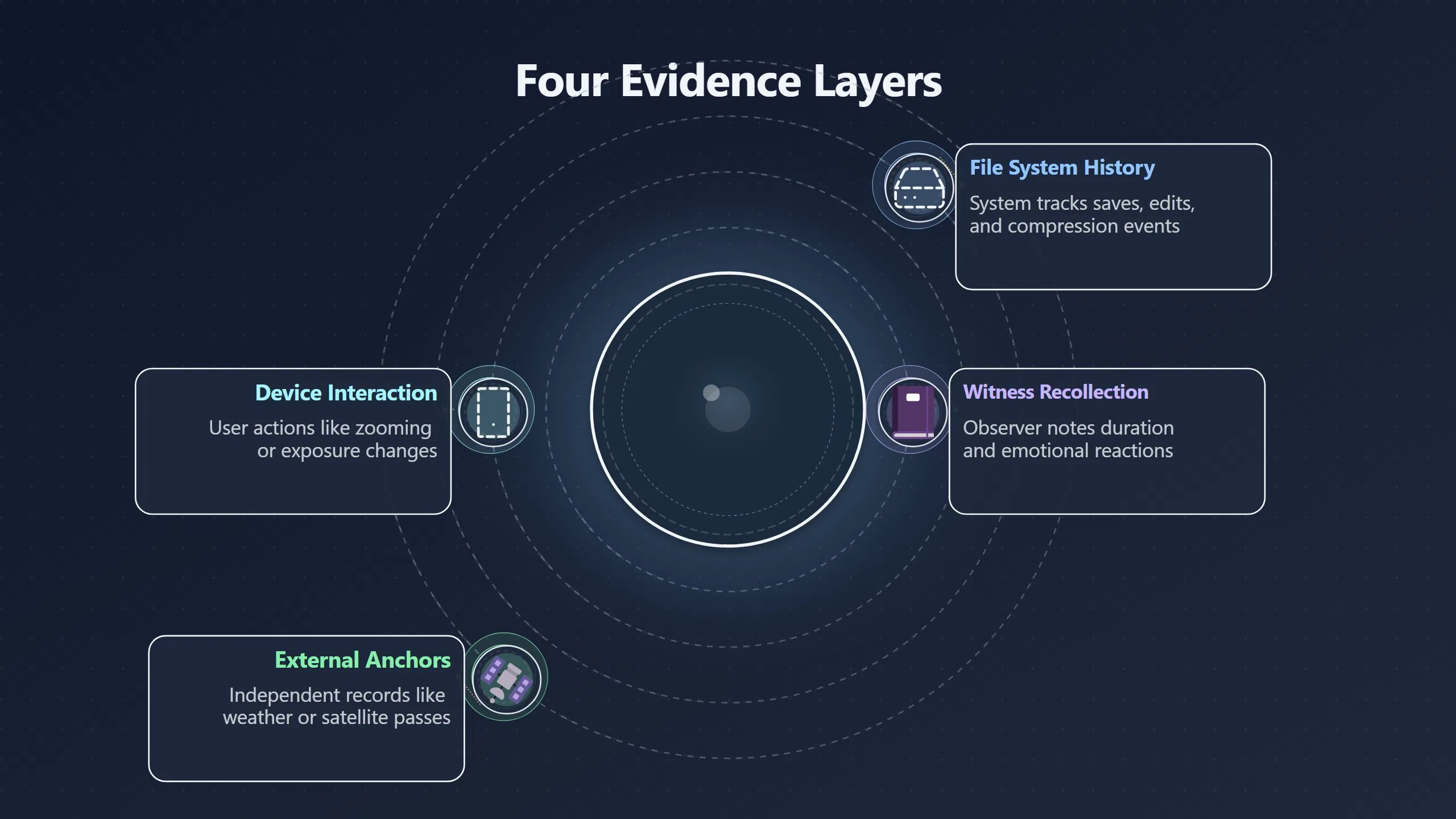
A useful reconstruction normally creates at least four independent timeline layers.
Witness recollection timeline
This layer contains what the observer believes happened and in what order. It may include:
- First sighting moment.
- Estimated duration.
- Emotional reactions.
- Perceived speed or direction changes.
- Claimed disappearances or accelerations.
- Statements about sound, weather, or lighting.
This layer should preserve original wording wherever possible before discussion forums, social media comments, or AI-generated summaries begin reshaping the account.
Investigators increasingly use structured timeline interviewing methods because free conversation tends to jumble sequence order. Cognitive interview research shows that timeline-based recall methods improve sequencing and contextual detail.[Crest Research]crestresearch.ac.uka timeline helps interviewees recall and report eventsCrest ResearchA timeline helps interviewees recall and report events18 Jan 2016 — The Timeline Technique helps interviewees recall and re…[University of Southampton Web Archive]web-archive.southampton.ac.ukUniversity of Southampton Web ArchiveEyewitness performance in Cognitive and Structured…by A Memon · Cited by 103 — This paper address…
In UFO work, this means recording statements like:
- “I zoomed after it brightened.”
- “The object vanished behind cloud.”
- “I stopped recording when it moved overhead.”
Those statements later become comparison points against the actual file behaviour.
Device interaction timeline
This layer records what the user physically did with the device:
- Camera app opened.
- Recording started.
- Zoom activated.
- Lens switched.
- Exposure changed.
- Recording paused.
- Screen orientation changed.
- Flashlight enabled.
- Recording stopped.
Modern phones constantly alter imaging behaviour automatically. Exposure compensation, image stabilisation, autofocus hunting, HDR processing, and lens switching can create apparent motion or brightness changes that witnesses never consciously noticed.
A witness may sincerely remember a stable glowing object while the file shows repeated autofocus breathing and digital sharpening artefacts.
File-system timeline
This layer tracks the digital object’s history after recording:
- Original creation timestamp.
- Modification timestamps.
- Export events.
- Edits.
- Re-encodes.
- Cloud sync actions.
- Messaging transfers.
- Social uploads.
Forensic guidance stresses that video processing workflows can alter metadata and timing structure.[NIST]nvlpubs.nist.govNIST PublicationsDigital Investigation Techniques: A NIST Scientific Foundation…KEY TAKEAWAY #2.5: Every digital forensic technique sh… Social-media systems often strip metadata entirely or recompress media into new file structures.[RemoveMD]removemd.comDoes WhatsApp Remove Photo Metadata? (GPS, EXIFWhatsApp strips GPS and most EXIF data from photos — but not always. Instagram and Faceboo…[SCIEPublish]sciepublish.comsocial media, aggressive compression algorithms strip Exif metadata. Although a basic thumbnail or downscaled resolution value may remain…[Magnet Forensics]magnetforensics.comgetting to the source understanding metadata removal on social mediaGetting to the…
An AI-assisted workflow should therefore maintain provenance chains showing exactly which copy came from which source.
External anchor timeline
This final layer contains independently verifiable environmental anchors:
- Aircraft transponder records.
- Satellite passes.
- Weather radar.
- Lightning data.
- Astronomical positions.
- CCTV timestamps.
- Police or emergency logs.
- Power outage records.
- Train or church-bell audio.
These anchors often become the decisive factor when witness memory and file metadata conflict.
Mapping zoom, exposure, and clip gaps
Many “high strangeness” moments in UFO videos occur at transition points inside the recording process itself rather than in the external scene.
Zoom transitions
Digital zoom can radically alter apparent motion. When a witness rapidly zooms into a distant light source:
- Hand shake becomes exaggerated.
- Atmospheric distortion increases.
- Stabilisation systems overcorrect.
- Pixel interpolation creates shimmering edges.
An object may appear to dart or oscillate when the movement actually comes from camera amplification.
A proper file-event timeline therefore marks every zoom state change. AI systems can often estimate these transitions even when explicit metadata is missing by analysing focal shifts and frame geometry.
This matters because witnesses frequently remember the object moving first and the zoom adjustment second, while frame analysis may show the opposite sequence.
Exposure and brightness shifts
Phone cameras constantly rebalance exposure. Bright objects against dark skies create difficult conditions for mobile sensors.
A timeline should therefore mark:
- Exposure compensation jumps.
- ISO changes.
- White balance shifts.
- HDR transitions.
- Frame-brightness spikes.
Without this separation, ordinary camera behaviour may be mistaken for luminosity changes in the object itself.
A common example occurs when a bright planet or aircraft light suddenly “dims out” as the camera adjusts exposure after nearby streetlights enter frame. The witness experiences disappearance; the file records automatic compensation.
Missing clip segments
Witnesses often describe continuous observation while the recording contains gaps.
These gaps may result from:
- Manual stopping and restarting.
- Buffer delays.
- Overheating.
- Battery warnings.
- Failed saves.
- Messaging exports.
- Screen recordings replacing originals.
OSAC and NIST forensic guidance emphasise preserving original frame structure because transcoding and screen capture can alter temporal sequencing.[NIST]nist.govscience disciplines as well as scientific research, measurement science.Read more…
A timeline that clearly labels clip discontinuities prevents investigators from unintentionally treating separate recording periods as uninterrupted evidence.
Cross-checking timelines with external anchors
The strongest UFO reconstructions rely on independent anchors that neither the witness nor the file can easily influence.
Astronomy checks
Astronomical anchors are especially valuable because celestial objects move predictably.
If a witness reports:
- Sudden hovering.
- Bright stationary lights.
- Slow drifting movement.
- Colour changes near the horizon.
Investigators can compare the claimed timeline against:
- Venus visibility.
- Jupiter altitude.
- Star positions.
- Iridium flare histories.
- Meteor showers.
- Satellite passes.
When witness memory claims erratic manoeuvres but frame analysis shows consistent sidereal drift, the divergence becomes important.
Aviation and drone correlation
Aircraft and drone checks benefit from parallel timelines because witnesses often compress time during exciting events.
For example:
- A witness recalls a silent hovering triangle.
- ADS-B data shows an aircraft circling.
- The file timeline reveals multiple pauses.
- The apparent “hover” occurred during recording gaps.
That does not automatically solve the case, but it changes the evidential picture dramatically.
Weather and atmospheric anchors
Cloud movement, wind direction, fog layers, and lightning flashes provide useful synchronisation points.
A file may lack trustworthy timestamps, yet:
- Cloud drift can estimate elapsed time.
- Thunder delay can estimate distance.
- Rain onset can align with radar archives.
- Wind direction can test balloon hypotheses.
This approach becomes especially useful when circulated clips have lost metadata through social sharing.
How AI helps compare the layers
AI systems are most useful when they preserve uncertainty rather than collapsing everything into a single confidence score.
Sequence alignment
Machine-learning systems can align:
- Witness transcript statements.
- Video frame changes.
- Audio peaks.
- Metadata events.
- External environmental records.
The result is a synchronised multi-track timeline rather than a simple narrative summary.
An investigator might then see:
Time LayerEventWitness memory“Object accelerated suddenly”Video analysisDigital zoom activatedFile metadataLens switch eventADS-B feedAircraft turns toward observerWeatherThin cloud passes moon
That structure helps distinguish genuine unexplained behaviour from compounded perception effects.

Contradiction detection
AI can also flag contradictions without declaring deception.
Examples include:
- Witness reports continuous filming despite missing GOP frame sequences.
- Claimed single clip actually consists of multiple exports.
- Witness says no editing occurred but recompression signatures indicate social-media processing.
Video forensic research increasingly uses metadata structure, compression signatures, and transcoding traces to identify editing history and re-encoding events.[arXiv]arxiv.orgarXiv Forensic Analysis of Video Files Using MetadataarXiv Forensic Analysis of Video Files Using Metadata
The important point is interpretive restraint. Recompression may reflect ordinary sharing behaviour rather than fabrication.
Confidence layering instead of binary judgment
A mature UFO workflow should avoid simplistic labels like “real” or “fake”.
Instead, each timeline relationship can receive separate confidence assessments:
- High confidence: original capture time.
- Medium confidence: witness duration estimate.
- Low confidence: claimed acceleration.
- High confidence: weather alignment.
- Unresolved: missing 19-second gap.
This preserves evidential nuance.
Why timeline separation improves credibility
Many UFO investigations fail because memory and media become fused into one emotionally satisfying narrative.
Once merged, it becomes difficult to distinguish:
- What was directly observed.
- What the file independently demonstrates.
- What later interpretation added.
- What social-media discussion reshaped.
Parallel timelines reduce that contamination risk.
They also improve credibility with sceptical audiences because the method openly documents uncertainty, edits, recompression, and contradictions rather than hiding them.
Importantly, this approach does not automatically debunk sightings. Some cases remain difficult even after rigorous separation of witness memory and file history. The value lies in making the remaining anomaly clearer by stripping away artefacts introduced by recall drift, camera automation, and platform processing.
Where investigators commonly make mistakes
Several recurring errors appear in public UFO reconstructions.
Treating uploaded clips as originals
Investigators often analyse TikTok, YouTube, or messaging copies without documenting the file chain. Yet social platforms frequently alter metadata and recompress media.[SCIEPublish]sciepublish.comsocial media, aggressive compression algorithms strip Exif metadata. Although a basic thumbnail or downscaled resolution value may remain…[Magnet Forensics]magnetforensics.comgetting to the source understanding metadata removal on social mediaGetting to the…
This can destroy timing precision.
Using AI summaries as evidence
Large language models can unintentionally reshape witness narratives through suggestive questioning or summarisation.
Research has already shown that conversational AI systems can amplify false memory formation during interview-style interactions.[arXiv]arxiv.orgarXiv Forensic Analysis of Video Files Using MetadataarXiv Forensic Analysis of Video Files Using Metadata
For UFO investigations, that means AI tools should assist comparison and organisation, not overwrite raw testimony.
Ignoring camera behaviour
Many amateur analyses discuss only the object while ignoring:
- Stabilisation artefacts.
- Rolling shutter effects.
- Autofocus drift.
- Frame interpolation.
- Noise reduction.
- Compression macroblocking.
These mechanisms can dramatically change perceived motion and shape.
Compressing uncertainty into a single story
A disciplined reconstruction keeps competing possibilities visible simultaneously.
A proper timeline system should allow statements such as:
- “Witness memory supports abrupt acceleration.”
- “Frame analysis suggests zoom-induced apparent motion.”
- “Available evidence does not conclusively resolve the difference.”
That is often more honest than forcing premature certainty.
The practical value of parallel timelines
The central advantage of parallel witness and file-event timelines is not merely technical accuracy. It is investigative clarity.
When memory, device behaviour, edits, environmental anchors, and external databases remain separated, investigators can identify which parts of a UFO report are strongly supported, weakly supported, contradicted, or genuinely unresolved.
That structure also makes future review easier. As new aircraft data, satellite archives, or forensic methods emerge, investigators can revisit the case without rebuilding the entire chronology from scratch.
In AI-assisted UFO investigation, the timeline is therefore not just a chronology. It is a layered evidence model showing how perception, recording technology, and digital history interact around a single reported event.
Amazon book picks
Further Reading
Books and field guides related to Why Witness Memory And File History Diverge. Use these as the next step if you want deeper reading beyond the article.
Thinking, Fast and Slow
Fits divergence between recollection and recorded file events.
How to Read a Photograph
Supports separating what a file shows from what a witness recalls.
eBay marketplace picks
Marketplace Samples
Example marketplace items related to this page. Use the search link to explore similar finds on eBay.


Endnotes
1.
Source: nist.gov
Link:https://www.nist.gov/document/osac-2022-s-0031-standard-guide-forensic-digital-video-examination-workflow-version-20
Source snippet
OSAC 2022-S-0031 Standard Guide for Forensic Digital...January 2, 2024 — For example, processing includes tasks to transcode, enhanc...
Published: January 2, 2024
2.
Source: nist.gov
Link:https://www.nist.gov/itl/ssd/digital-forensics
Source snippet
Digital ForensicsDigital evidence includes data on computers and mobile devices, including audio, video, and image files as well as softw...
3.
Source: arxiv.org
Title: arXiv Forensic Analysis of Video Files Using Metadata
Link:https://arxiv.org/abs/2105.06361
4.
Source: pmc.ncbi.nlm.nih.gov
Link:https://pmc.ncbi.nlm.nih.gov/articles/PMC9225701/
Source snippet
The impact of recall timing on the preservation of eyewitness...by C Chevroulet · 2021 · Cited by 13 — As a witness' memory of the ev...
5.
Source: ncacia.org
Title: inside forensic interviewing exploring the basics about the various models
Link:https://www.ncacia.org/post/inside-forensic-interviewing-exploring-the-basics-about-the-various-models
Source snippet
Inside Forensic Interviewing: Exploring the Basics About...25 Apr 2024 — The Cognitive Interviewing Model is a research-backed approach...
6.
Source: nvlpubs.nist.gov
Link:https://nvlpubs.nist.gov/nistpubs/ir/2022/NIST.IR.8354.pdf
Source snippet
NIST PublicationsDigital Investigation Techniques: A NIST Scientific Foundation...KEY TAKEAWAY #2.5: Every digital forensic technique sh...
7.
Source: sciepublish.com
Link:https://www.sciepublish.com/article/pii/567
Source snippet
social media, aggressive compression algorithms strip Exif metadata. Although a basic thumbnail or downscaled resolution value may remain...
8.
Source: removemd.com
Link:https://www.removemd.com/blog/whatsapp-instagram-facebook-metadata-removal
Source snippet
Does WhatsApp Remove Photo Metadata? (GPS, EXIFWhatsApp strips GPS and most EXIF data from photos — but not always. Instagram and Faceboo...
9.
Source: nist.gov
Link:https://www.nist.gov/document/standard-practice-data-retrieval-digital-cctv-systems
Source snippet
science disciplines as well as scientific research, measurement science.Read more...
10.
Source: arxiv.org
Link:https://arxiv.org/abs/2403.07891
11.
Source: arxiv.org
Link:https://arxiv.org/abs/2408.04681
Source snippet
Conversational AI Powered by Large Language Models Amplifies False Memories in Witness InterviewsAugust 8, 2024...
Published: August 8, 2024
12.
Source: youtube.com
Link:https://www.youtube.com/watch?v=m6aY9Wr-xjI
Source snippet
Eyewitness Testimony*** 1. What reconstructive memory is and why it makes eyewitness testimony unreliable. * How our minds rebuild memori...
13.
Source: youtube.com
Link:https://www.youtube.com/watch?v=ee7g5SR7McA
Source snippet
ion that an eyewitness can retrieve about a crime...
14.
Source: youtube.com
Title: Cognitive Psychology and Witness Memory Reliability
Link:https://www.youtube.com/watch?v=Jb-k-3_gU3w
Source snippet
Introduction to Forensic Video Analysis...
15.
Source: youtube.com
Link:https://www.youtube.com/watch?v=vVj4u_3n2Hw
Source snippet
How Eyewitness Testimony Can Be Misleading...
16.
Source: youtube.com
Title: How Eyewitness Testimony Can Be Misleading
Link:https://www.youtube.com/watch?v=R39pS_41c6E
Source snippet
Understanding Digital Video Metadata and Timestamps...
17.
Source: youtube.com
Title: Understanding Digital Video Metadata and Timestamps
Link:https://www.youtube.com/watch?v=x-720-YwY2E
Source snippet
Reconstructing Events from Disparate Data Sources...
18.
Source: youtube.com
Title: Reconstructing Events from Disparate Data Sources
Link:https://www.youtube.com/watch?v=aG-F7L43r0I
19.
Source: web-archive.southampton.ac.uk
Link:https://web-archive.southampton.ac.uk/cogprints.org/646/1/memon.memory.html
Source snippet
University of Southampton Web ArchiveEyewitness performance in Cognitive and Structured...by A Memon · Cited by 103 — This paper address...
20.
Source: rke.abertay.ac.uk
Link:https://rke.abertay.ac.uk/ws/portalfiles/portal/85813741/Gawrylowicz_TheCognitiveInterview_Accepted_2018.pdf
Source snippet
Cognitive Interview arose out of a need to examine ways of improving witness memory. (cognitive factors) as well as addressing some of th...
21.
Source: crestresearch.ac.uk
Title: a timeline helps interviewees recall and report events
Link:https://crestresearch.ac.uk/resources/a-timeline-helps-interviewees-recall-and-report-events/
Source snippet
Crest ResearchA timeline helps interviewees recall and report events18 Jan 2016 — The Timeline Technique helps interviewees recall and re...
22.
Source: magnetforensics.com
Title: getting to the source understanding metadata removal on social media
Link:https://www.magnetforensics.com/blog/getting-to-the-source-understanding-metadata-removal-on-social-media/
Source snippet
Getting to the...
23.
Source: tutor2u.net
Title: cognitive interview
Link:https://www.tutor2u.net/psychology/reference/cognitive-interview?srsltid=AfmBOop5LEen_Iqr4BkaNXoRycFin9q-rIr9sWg7Dwuj5RTiEePIU7H4
Source snippet
Reference Library | Psychology22 Mar 2021 — A new questioning methodology - the cognitive interview - to achieve more detailed and accura...
Additional References
24.
Source: researchgate.net
Link:https://www.researchgate.net/publication/392730673_Investigating_methods_for_forensic_analysis_of_social_media_data_to_support_criminal_investigations
Source snippet
(PDF) Investigating methods for forensic analysis of social...16 Jun 2025 — This research evaluates the effectiveness of existing forens...
25.
Source: linkedin.com
Link:https://www.linkedin.com/pulse/understanding-metadata-digital-forensics-html-vfsvc
Source snippet
Understanding Metadata in Digital Forensics: HTML vs. EXIFSocial media platforms have specific ways of handling both image and vi...
26.
Source: simplypsychology.org
Link:https://www.simplypsychology.org/cognitive-interview.html
Source snippet
Cognitive Interview Techniqueby S McLeod · Cited by 1 — Conclusion: The cognitive interview leads to better memory of events, with witnes...
27.
Source: psychstory.co.uk
Link:https://www.psychstory.co.uk/memory/eye-witness-testimony
Source snippet
factors affecting the accuracy of eye witness testimonyThese theories have shown that memory is not a perfect recording of events but a r...
28.
Source: techfusion.com
Link:https://techfusion.com/metadata-forensics-digital-trail/
29.
Source: powellpath.com
Link:https://powellpath.com/photo-video-audio-authenticity-review.php
30.
Source: university.open.ac.uk
Link:https://university.open.ac.uk/research-centres/herc/blog/what-can-visual-attention-research-tell-us-about-reliability-eyewitness-evidence
Source snippet
can visual attention research tell us about...In this article, Gemma Briggs and Louise Westmarland discuss research on visual attention...
31.
Source: forensicfocus.com
Title: amped authenticates video mode raising the bar for forensic video analysis
Link:https://www.forensicfocus.com/articles/amped-authenticates-video-mode-raising-the-bar-for-forensic-video-analysis/
Source snippet
Amped Authenticate's Video Mode: Raising The Bar For...28 Aug 2025 — Learn how to use Amped Authenticate's new Video Mode to verify vide...
32.
Source: lcgdiscovery.com
Link:https://lcgdiscovery.com/beyond-the-screen-part-6-video-evidence-under-the-microscope-metadata-and-manipulation/
Source snippet
A video file is more than pictures in motion. It is a container of data and metadata, recorded by a...Read more...
33.
Source: eclipseforensics.com
Title: the role of metadata in forensic video investigations
Link:https://eclipseforensics.com/the-role-of-metadata-in-forensic-video-investigations/
Source snippet
1 Sept 2025 — Understanding metadata in video forensics helps clarify events and establish authenticity, supporting investigations throug...
Topic Tree