Within UFO Case AI
What Makes a UFO Report Investigable?
A strong case file turns a vague sighting story into dated, located evidence that AI tools can check without overstating certainty.
On this page
- Minimum fields for a usable report
- Separating confirmed data from witness claims
- Status labels from ruled out to anomalous
Page outline Jump by section
Introduction
A UFO report becomes investigable when it stops being only a striking story and becomes a dated, located, testable case file. The essential shift is simple: record what was seen, when and where it was seen, how it moved, what evidence exists, and which parts are confirmed rather than assumed. That is what allows AI-assisted UFO sighting investigation to work responsibly. AI can help organise the report, detect missing fields, compare the sighting with known aircraft, satellites, astronomy and weather, and surface mundane explanations quickly. It cannot rescue a case that lacks time, location, direction, duration or original evidence.
This matters because official and scientific UAP work keeps returning to the same problem: unresolved does not automatically mean extraordinary. NASA’s independent UAP study found that analysis is often hampered by poor sensor calibration, lack of multiple measurements, missing sensor metadata and weak baseline data, while AARO’s public case examples show that even video evidence may be resolved as birds or balloons, left unresolved for lack of detail, or closed as not anomalous when performance does not justify further analysis.[NASA Science]science.nasa.govNASA Science…
Minimum fields for a usable report
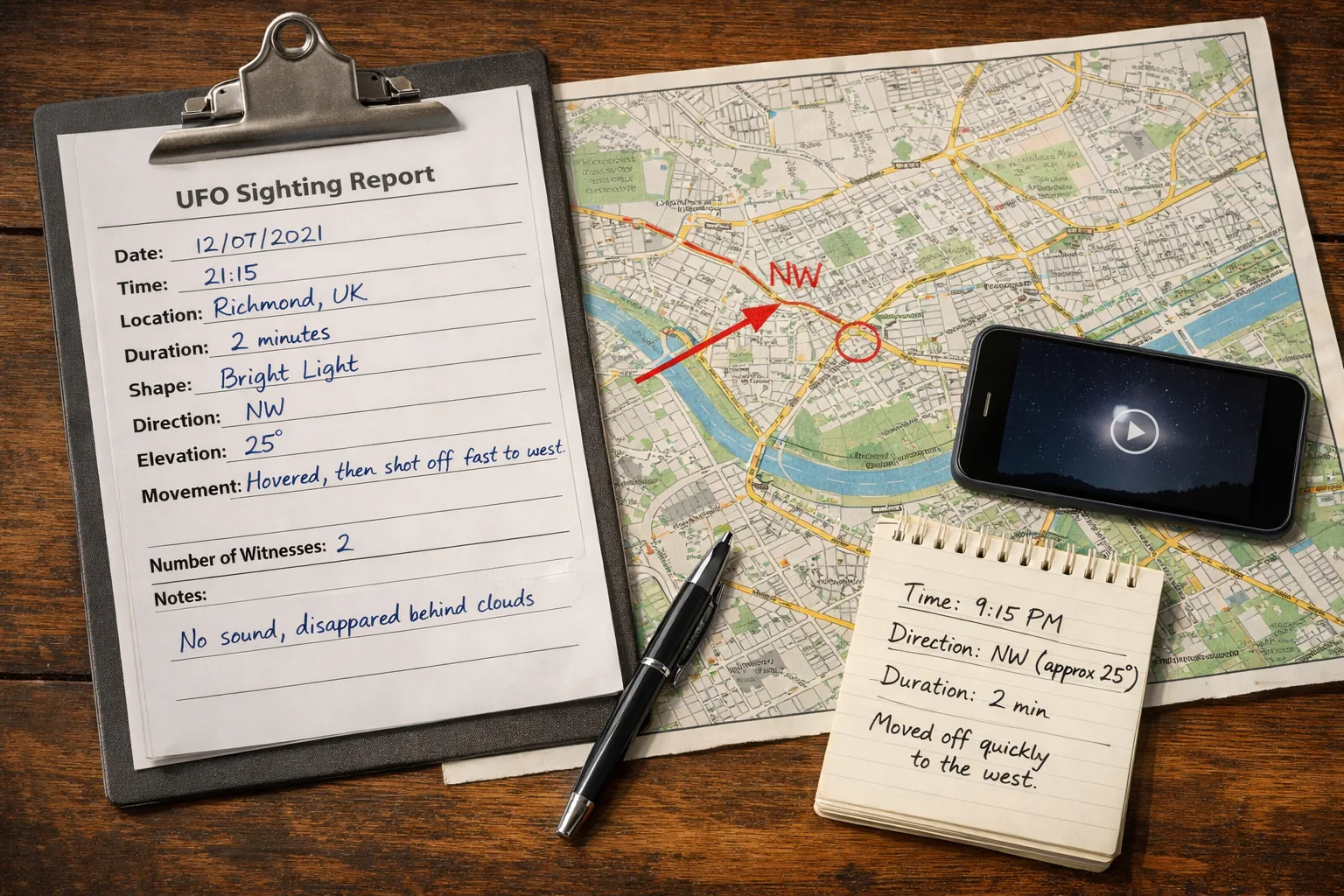
A usable UFO case file begins with enough fixed information for another person, or an automated workflow, to recreate the observation conditions. The National UFO Reporting Center’s current report form is a useful public example of the minimum intake logic: it asks for sighting date, time, whether those are approximate, duration, number of witnesses, precise location, sighting context, shape, colour, number of objects, elevation angle, direction from the viewer, direction of travel, estimated distance, size, speed, behaviour and supporting images or video.[NUFORC]nuforc.orgUFO Sighting Report Form | NUFORCUFO Sighting Report Form | NUFORC…
For an AI-assisted investigation, those fields are not clerical details. They are the handles that allow the sighting to be tested. A light reported at “about 9pm somewhere west of town” may be impossible to check against aircraft tracks or satellite passes. A light reported at 21:07 BST from a named viewpoint, looking west-north-west at roughly 25 degrees elevation for 80 seconds, can be screened against flight data, satellite ephemerides, Moon and planet positions, weather, visibility and local geography.
The minimum practical case file should include:
- Event anchor: date, local time, time zone, duration, location, witness position, viewing direction and elevation angle.
- Observed behaviour: apparent path, speed, stops, turns, changes in brightness or colour, sound, formation, disappearance and whether the object crossed known landmarks.
- Evidence record: original photo or video, unedited file, metadata, device model, zoom setting, exposure, frame rate, screenshots only as secondary copies, and notes on any edits or compression.
- Witness context: number of witnesses, whether they were together or independent, whether they discussed the sighting before writing statements, and any relevant sky-watching, aviation or photography experience.
- Environmental context: cloud cover, visibility, wind, precipitation, temperature, astronomical conditions, nearby airports, launch activity, drones, balloons, fireworks, emergency activity and local obstructions.
- Investigation log: every data source checked, time of check, assumptions used, match quality, and unresolved gaps.
A case file should also keep uncertainty visible. “Time: 21:03, phone clock automatic” is stronger than “around nine”. “Direction: north-west by phone compass, uncertainty ±10 degrees” is stronger than “towards the hills”. “Object disappeared behind cloud” is different from “object vanished”. These distinctions matter because AI systems are good at sorting structured claims, but they can amplify false precision if vague witness language is converted into exact-looking data too early.

Why a case file must separate fact, claim and inference
The central rule is to separate what is confirmed from what is reported and what is inferred. A video may confirm that a bright point appears in a frame. It may not confirm that the point is large, close, fast, metallic, silent or under intelligent control. A witness may honestly describe “impossible acceleration”, but without distance and scale the investigator may only be able to confirm rapid angular motion across the field of view.
NASA’s UAP study makes this distinction sharply by stressing metadata, calibration and contextual information. It notes that metadata such as time, location, observing mode, sensor type, manufacturer details, noise characteristics and acquisition conditions are needed to characterise both a possible UAP and the sensor itself. It also states that some apparent UAP have been shown to be sensor artefacts once calibration and metadata were scrutinised.[NASA Science]science.nasa.govNASA Science…
A strong case file should therefore use layered language:
Confirmed data is information that can be independently inspected: the original file, embedded timestamp, GPS coordinates, a weather station reading, a flight-track record, a satellite prediction, a police log, a radar record or a second independent video.
Witness claims are what the observer reports: colour, sound, shape, emotional reaction, perceived size, apparent speed, direction, disappearance, unusual manoeuvres or effects on animals, vehicles or electronics.
Analyst inferences are reasoned estimates: likely bearing, angular speed, possible altitude range, object class, match to a known aircraft, match to a satellite pass, possible balloon drift, lens flare geometry or atmospheric-optics candidate.
Case status is the current judgement: ruled out, plausible, weak, unresolved or anomalous. It should be changeable when better information arrives.
This layered approach protects both the witness and the analysis. It avoids dismissing a sincere report simply because it has a possible ordinary explanation, but it also avoids treating human perception as a measuring instrument. GEIPAN, the French public UAP body within CNES, explicitly notes that it works from human testimony, often a single witness, and that testimony can be affected by vision, perception errors, emotion, memory, later interpretation and cultural framing.[Geipan]cnes.frSource details in endnotes.
The intake interview should preserve the first account
The first witness account is valuable because it is closest in time to the event. Later interviews can add detail, but they can also add contamination: media coverage, online suggestions, comments from friends, star-tracker screenshots, local rumours or the witness’s own attempt to make sense of what happened. This is not a criticism of witnesses. It is a normal problem in any investigation that relies on memory.
A practical UFO case file should therefore preserve the first statement exactly as given, then create a cleaned investigative version beside it. The raw account might say, “It shot upwards and disappeared.” The structured record might translate that into: “Witness reports rapid upward apparent motion followed by loss of visibility; no confirmed distance, altitude or speed.” That second version is less dramatic, but it is more testable.
AI can help here by asking neutral follow-up questions rather than leading ones. “What direction were you facing?” is better than “Did it move against the wind?” “Did it pass in front of or behind any clouds?” is better than “Did it hide in the clouds?” “Was the sound absent, masked by traffic, or not noticed?” is better than recording “silent” as a confirmed property.
The interview should also note whether witnesses were independent. Three people standing together and discussing a light for ten minutes are not the same evidential unit as three people in different locations who filed reports before hearing about each other. Independent timing, direction and video can turn a weak anecdote into a triangulable event; shared discussion can make several accounts less independent than they first appear.
Make the timeline precise enough to test
Time is the backbone of a sighting case file. It determines which aircraft were overhead, which satellites were visible, whether Venus or Jupiter was in the relevant part of the sky, what the weather was doing, and whether local events such as fireworks, launches or emergency responses were plausible. A one-hour uncertainty window may produce dozens of candidate matches; a one-minute window may produce only one.
The file should record local time, time zone, whether daylight saving time applied, how the time was obtained, and whether the timestamp comes from memory, a phone, a camera file, a call log, a message, a doorbell camera, CCTV or emergency report. For videos, the file should distinguish between the time the file was created, the time recording began, the time the observed object appears, and the time it disappears.
This is where AI can be useful but dangerous. It can convert “last Thursday just after dinner” into a likely date range and prompt the witness for confirmation. It can also over-normalise uncertainty into a false exact time. A good case file keeps both the best estimate and the uncertainty range: “21:12–21:17, based on WhatsApp message sent immediately after sighting” is more honest than pretending the event began at exactly 21:14.
For longer events, a timeline should include phases: first noticed, brightest point, change in direction, loss of sight, start and end of recording, and any interruptions. If a witness looked away, went indoors or changed position, that should be marked. These gaps often explain why an object appears to “vanish” when the more cautious finding is simply “lost from view”.
Location, bearing and elevation turn a story into geometry
A UFO report becomes much more testable when the observer’s position and viewing geometry are recorded. Location alone is not enough. Investigators need to know where the witness stood, which way they faced, the approximate elevation above the horizon, and what landmarks the object crossed. A light seen low in the south-west has a very different explanation space from one seen overhead or rising in the north-east.
The report should capture location at two levels. The private case file can store precise coordinates or an address, with consent and privacy controls. The public case summary can generalise the location to a town, district or approximate map cell. NUFORC’s form reflects this privacy tension by asking for precise location while allowing exact address omission from the public report.[NUFORC]nuforc.orgreport a uforeport a ufo
Useful geometry fields include:
- observer latitude, longitude and elevation if available;[ssd.jpl.nasa.gov]ssd.jpl.nasa.govSource details in endnotes.
- viewing direction as compass bearing, with uncertainty;
- elevation angle above the horizon;
- start and end bearings if the object moved;
- landmark references such as rooftops, pylons, hills, roads or stars;
- camera orientation, zoom, field of view and whether the image is mirrored or cropped;
- whether the object passed in front of clouds, behind clouds, behind trees, behind buildings or in clear sky.
A simple sketch can be more useful than a polished narrative. Marking “object started above church tower, moved towards radio mast, disappeared behind cloud bank” allows a human analyst or mapping tool to reconstruct likely lines of sight. Multiple sketches from independent witnesses can sometimes narrow an object’s apparent path, even when no video exists.

Evidence files need chain-of-custody, not just attachment storage
Photos and videos are often treated as the strongest evidence, but they are only as useful as their provenance. A copied social-media clip with no original file, no timestamp, no location and unknown compression history may show something interesting while remaining weak as evidence. The original file matters because metadata, frame timing, resolution, exposure, focal length, stabilisation, audio and compression artefacts can all change interpretation.
A case file should therefore store evidence in tiers. The strongest tier is the original unedited file directly from the recording device, with metadata preserved. The next tier includes exported copies, screenshots, platform downloads and edited clips. The weakest tier includes reposted clips, cropped images, screen recordings and stills with unknown origin. Each tier can still be useful, but it should not be treated equally.
NASA’s report points to this same problem at a higher technical level: many observations are captured by sensors not designed or calibrated for UAP work, and missing metadata can prevent conclusive characterisation of size, movement or nature even when imagery exists. It also notes that standardised crowd-sourced smartphone observations could be useful if they captured imaging, sound and sensor metadata in ways that support triangulation and later analysis.[NASA Science]science.nasa.govNASA Science…
The case file should log who supplied each file, when it was received, whether it was renamed, whether checksums were created, and whether any copies were made for analysis. This may sound forensic, but it prevents later confusion. A public-facing UFO investigation does not need courtroom language, but it does need to know whether analysts are looking at the first-generation file or a compressed copy that has already passed through three apps.
Context checks should be built into the case file
A testable UFO case file is not complete until it records what has been checked around the sighting. This is where AI-assisted workflows can add real value: not by deciding what the object was, but by making sure obvious comparison checks are not missed.
The most useful checks are usually mundane:
Aviation: Aircraft, helicopters, gliders and military traffic can produce lights, apparent hovering, rapid angular motion and unusual sound patterns. ADS-B Exchange says its archive has captured aircraft positions and related ADS-B, MLAT and Mode S parameters worldwide at five-second intervals since March 2020, which makes historical flight comparison a powerful first screen where aircraft broadcast or can be multilaterated.[ADS-B Exchange]adsbexchange.comADS-B Exchange Sample DataADS-B Exchange Sample Data
Astronomy: The Moon, Venus, Jupiter, bright stars, meteors and re-entering debris are frequent sources of misidentification. JPL Horizons provides observer-specific ephemerides for solar-system objects as a function of time and location, allowing a sighting to be checked against what was actually visible from the witness’s position.[JPL Solar System Dynamics]ssd.jpl.nasa.govJPL Solar System Dynamics Horizons SystemJPL Solar System Dynamics Horizons System
Satellites and orbital objects: Starlink trains, individual satellite passes, flares and re-entries can look strange, especially when seen low on the horizon or through cloud gaps. The case file should record which orbital data source and prediction time were used, because satellite positions depend on the age and quality of orbital elements.
Weather and visibility: Cloud base, wind direction, visibility, haze, rain, temperature, pressure and local storm activity can change the explanation space. In the UK, Met Office observations provide hourly data from around 150 sites for recent conditions, while the MIDAS Open archive includes hourly UK weather observations such as wind, cloud, visibility and temperature across historical station records.[Met Office]weather.metoffice.gov.ukMet Office Latest weather observations guideMet Office Latest weather observations guide
Local sources: Drones, balloons, lanterns, fireworks, searchlights, emergency helicopters, stadium lights, film shoots, military exercises and local events should be logged when documentable. These checks are often low-tech but high-yield.
The case file should not merely state “aircraft checked” or “weather checked”. It should record the query window, radius, data source, result and uncertainty. “No ADS-B aircraft within 10 km at 21:10–21:15” is useful but limited; it does not exclude non-broadcasting aircraft, low-level drones, military traffic with restricted data, or a time error in the witness account.
AI can standardise, compare and challenge, but not declare certainty
AI is most useful in the case-file stage when it acts as a disciplined clerk, pattern matcher and sceptical assistant. It can turn free text into structured fields, identify missing inputs, detect contradictions, translate vague descriptions into testable questions, compare sighting descriptions with known categories, and search historical databases for similar reports.
NASA’s UAP study explicitly says AI and machine learning can be essential for finding rare occurrences in large datasets, but only when applied to well-characterised data gathered to strong standards. It also emphasises that data collection, curation and distribution are paramount.[NASA Science]science.nasa.govNASA Science…
In practice, this means AI should support tasks such as:
- flagging that a report lacks direction, elevation or duration;
- extracting “orange lights moving NW to SE” into structured motion fields;
- comparing the sighting window with flight, satellite and weather data;
- clustering similar reports by time, location, motion and description;
- spotting language that implies unsupported inference, such as “craft”, “accelerated to hypersonic speed” or “under intelligent control”;
- producing a transparent explanation matrix rather than a single verdict.
The danger is that AI can make a weak case look tidy. A polished summary with fields, maps and confidence scores may still rest on one uncertain witness time and a compressed video. A responsible workflow should therefore attach confidence to the inputs before attaching confidence to the explanation. A case with precise time, two independent videos and matching weather data deserves a different status from a case with a vivid narrative but no fixed geometry.
Status labels from ruled out to anomalous
Status labels are useful only if they describe the evidence, not the emotional force of the sighting. A strong case file should allow a report to move between labels as new information appears, and it should avoid using “unexplained” as a synonym for extraordinary.
A practical public-facing scale can work like this:
Ruled out means the reported object has been matched to a specific ordinary source with strong evidence. For example, a video might match a known aircraft track, a documented balloon release, a satellite pass or a celestial object at the recorded bearing and time.
Plausible means an ordinary explanation fits the main facts but is not confirmed. A balloon drifting with the wind, a drone near a known event, or Venus in the right direction may be plausible if the timing and geometry line up but no direct identification is available.
Weak means the case lacks enough information to test properly. It may be sincere and interesting, but without time, location, direction, duration or original evidence it cannot support much analysis. Many older or second-hand reports fall here.
Unresolved means the case has enough information to check major ordinary explanations, yet no explanation currently fits cleanly. This is not a claim of exotic origin. It is a disciplined statement that the file remains open.
Anomalous should be reserved for cases with stronger evidence of unusual characteristics after ordinary explanations have been seriously tested: multiple independent observations, calibrated or well-described sensors, reliable timing, geometry, environmental context and no good match to known aircraft, drones, balloons, satellites, astronomy, weather or artefacts.
AARO’s public imagery page shows why these distinctions matter. Some cases are resolved with high confidence as birds or balloons; some are unresolved because footage is insufficient to assess performance; some depict a likely physical object whose features are described as unremarkable; and one case is closed as not anomalous even though AARO cannot attribute the object to a specific origin.[AARO]aaro.milOfficial UAP ImageryUAP Imagery…
GEIPAN’s public method also supports a careful status culture. It publishes sighting reports and investigation conclusions while maintaining witness anonymity, says it is not a body seeking extraterrestrial explanations, and stresses that explained and unexplained cases are both useful because they improve understanding of how unusual sky reports arise.[Geipan]cnes.frSource details in endnotes.
What makes a report still interesting after basic screening
A report remains interesting after screening when the case file contains enough reliable data to make common explanations unlikely, not merely when the witness description sounds strange. The strongest files usually have precise timing, clear geometry, original media, independent witnesses, documented environmental conditions and a transparent log of failed candidate explanations.
Several features raise investigative value:
- Independent corroboration: separate witnesses or sensors from different positions.
- Good geometry: known observer position, bearing, elevation and object path.
- Original evidence: unedited files with metadata and known capture conditions.
- Environmental constraints: cloud, wind, visibility and terrain that limit possible explanations.
- Negative checks with clear scope: aircraft, satellites, astronomy and weather tested within defined time and location windows.
- Repeatable reasoning: another analyst can follow the file and reach the same provisional result.
The most important word is “provisional”. A case can be unusual today and explained tomorrow when better aircraft data, a local drone operator, a weather-balloon record, a second video or a satellite re-entry analysis appears. GEIPAN makes a similar point in its classification discussion: some phenomena have been explained later as scientific knowledge and accumulated investigative experience improved.[Geipan]cnes.frSource details in endnotes.
A testable case file is therefore not designed to win an argument. It is designed to survive correction. It records enough detail for AI tools to search, compare and challenge the report; enough uncertainty for human reviewers not to overclaim; and enough transparency for readers to see why a sighting was ruled out, considered plausible, left weak, kept unresolved or treated as genuinely anomalous.
Amazon book picks
Further Reading
Books and field guides related to What Makes a UFO Report Investigable?. Use these as the next step if you want deeper reading beyond the article.
UFOs: Generals, Pilots, and Government Officials Go on the Re...
Strong emphasis on documented cases, witnesses and investigative standards.
eBay marketplace picks
Marketplace Samples
Example marketplace items related to this page. Use the search link to explore similar finds on eBay.


Endnotes
1.
Source: science.nasa.gov
Link:https://science.nasa.gov/wp-content/uploads/2023/09/uap-independent-study-team-final-report.pdf
Source snippet
NASA Science...
2.
Source: aaro.mil
Title: Official UAP Imagery
Link:https://www.aaro.mil/UAP-Cases/Official-UAP-Imagery/
Source snippet
UAP Imagery...
3.
Source: nuforc.org
Title: UFO Sighting Report Form | NUFORC
Link:https://nuforc.org/reportform/
Source snippet
UFO Sighting Report Form | NUFORC...
4.
Source: ssd.jpl.nasa.gov
Title: JPL Solar System Dynamics Horizons System
Link:https://ssd.jpl.nasa.gov/horizons/manual.html
5.
Source: science.nasa.gov
Link:https://science.nasa.gov/uap/
6.
Source: nasa.gov
Title: update nasa shares uap independent study report names director
Link:https://www.nasa.gov/news-release/update-nasa-shares-uap-independent-study-report-names-director/
7.
Source: ssd.jpl.nasa.gov
Link:https://ssd.jpl.nasa.gov/horizons/tutorial.html
8.
Source: ssd.jpl.nasa.gov
Link:https://ssd.jpl.nasa.gov/announcements/an20210929.html
9.
Source: ssd.jpl.nasa.gov
Link:https://ssd.jpl.nasa.gov/horizons/news.html
10.
Source: nuforc.org
Title: report a ufo
Link:https://nuforc.org/report-a-ufo/
11.
Source: nuforc.org
Link:https://nuforc.org/
12.
Source: nuforc.org
Link:https://nuforc.org/sighting/?id=197755
13.
Source: cnes.fr
Link:https://cnes.fr/en/projects/geipan
14.
Source: aaro.mil
Title: UAP Records
Link:https://www.aaro.mil/UAP-Records/
15.
Source: aaro.mil
Link:https://www.aaro.mil/Portals/136/PDFs/FOIA/2024%20FOIAs/24-F-0266.pdf
16.
Source: aaro.mil
Title: UNCLASSIFIED FY23 Consolidated Annual Report on UAP Oct 25 2023 1236
Link:https://www.aaro.mil/Portals/136/PDFs/UNCLASSIFIED-FY23_Consolidated_Annual_Report_on_UAP-Oct_25_2023_1236.pdf
17.
Source: aaro.mil
Link:https://www.aaro.mil/
18.
Source: archive.org
Link:https://archive.org/stream/ProjectBlueBookSpecialReport14/pbbsr14_djvu.txt
19.
Source: cnes-geipan.fr
Title: Geipan Methodology | GEIPAN
Link:https://www.cnes-geipan.fr/en/node/58788
20.
Source: adsbexchange.com
Title: ADS-B Exchange Sample Data
Link:https://www.adsbexchange.com/data-products/sample-data/
21.
Source: weather.metoffice.gov.uk
Title: Met Office Latest weather observations guide
Link:https://weather.metoffice.gov.uk/guides/observations/observations
22.
Source: cnes-geipan.fr
Title: Geipan Mission & Geipan | GEIPAN
Link:https://www.cnes-geipan.fr/en/missions-methodes-et-resultats
23.
Source: cnes-geipan.fr
Title: Geipan Classification | GEIPAN
Link:https://www.cnes-geipan.fr/en/node/58787
24.
Source: globe.adsbexchange.com
Link:https://globe.adsbexchange.com/
25.
Source: adsbexchange.com
Link:https://www.adsbexchange.com/about/
26.
Source: adsbexchange.com
Link:https://www.adsbexchange.com/
27.
Source: adsbexchange.com
Link:https://www.adsbexchange.com/data-products/
28.
Source: metoffice.gov.uk
Link:https://www.metoffice.gov.uk/research/climate/maps-and-data/historic-station-data
29.
Source: metoffice.gov.uk
Link:https://www.metoffice.gov.uk/research/climate/maps-and-data/data
30.
Source: wow.metoffice.gov.uk
Title: metoffice.gov.uk Met Office WOW
Link:https://wow.metoffice.gov.uk/
31.
Source: metoffice.gov.uk
Title: Daily Weather
Link:https://www.metoffice.gov.uk/research/library-and-archive/publications/daily-weather-summary
32.
Source: metoffice.gov.uk
Link:https://www.metoffice.gov.uk/research/climate/maps-and-data/uk-synoptic-and-climate-stations
33.
Source: metoffice.gov.uk
Link:https://www.metoffice.gov.uk/research/library-and-archive/archive
34.
Source: dvidshub.net
Link:https://www.dvidshub.net/video/988675/pr-017-unresolved-uap-report-europe-2024
Additional References
35.
Source: cia.gov
Link:https://www.cia.gov/readingroom/docs/CIA-RDP81R00560R000100060001-5.pdf
36.
Source: war.gov
Title: department of defense releases the annual report on unidentified anomalous phen
Link:https://www.war.gov/News/Releases/Release/Article/3964824/department-of-defense-releases-the-annual-report-on-unidentified-anomalous-phen/
37.
Source: war.gov
Title: dr jon kosloski director aaro media roundtable on the fy24 consolidated annual
Link:https://www.war.gov/News/Transcripts/Transcript/Article/3965734/dr-jon-kosloski-director-aaro-media-roundtable-on-the-fy24-consolidated-annual/
38.
Source: facebook.com
Link:https://www.facebook.com/thesocialctv/posts/nasa-has-released-a-report-detailing-how-it-tracks-unidentified-anomalous-phenom/850192826467495/
39.
Source: mufon.com
Link:https://mufon.com/research/
40.
Source: celestrak.org
Link:https://www.celestrak.org/NORAD/documentation/gp-data-formats.php
41.
Source: facebook.com
Link:https://www.facebook.com/TheFrenchHistoryPodcast/posts/a-drawing-from-the-files-at-the-french-ufo-department/1337099231754482/
42.
Source: facebook.com
Link:https://www.facebook.com/gefmongooseiom/posts/an-foi-request-has-suggested-the-doi-may-have-info-on-ufo-sightings-isleofman/589935623139602/
43.
Source: mufon.com
Link:https://mufon.com/cms-ifo-info/
44.
Source: celestrak.org
Link:https://www.celestrak.org/NORAD/elements/supplemental/
Topic Tree
Follow this branch
Parent topic
UFO Case AIRelated pages 9
- Aircraft Was It an Aircraft or Drone?
- Astronomy Was the UFO Really in the Sky Map?
- Case Match Has This UFO Sighting Happened Before?
- Confidence How Certain Can a UFO Explanation Be?
- Review Who Checks the AI UFO Verdict?
- Satellites Could It Be Starlink or a Satellite?
- Timeline What Else Was Happening During the Sighting?
- Video Limits Why Clear UFO Videos Can Still Mislead
- +1 more in sidebar