Within UFO Case AI
Can Weather Make a UFO Look Stranger?
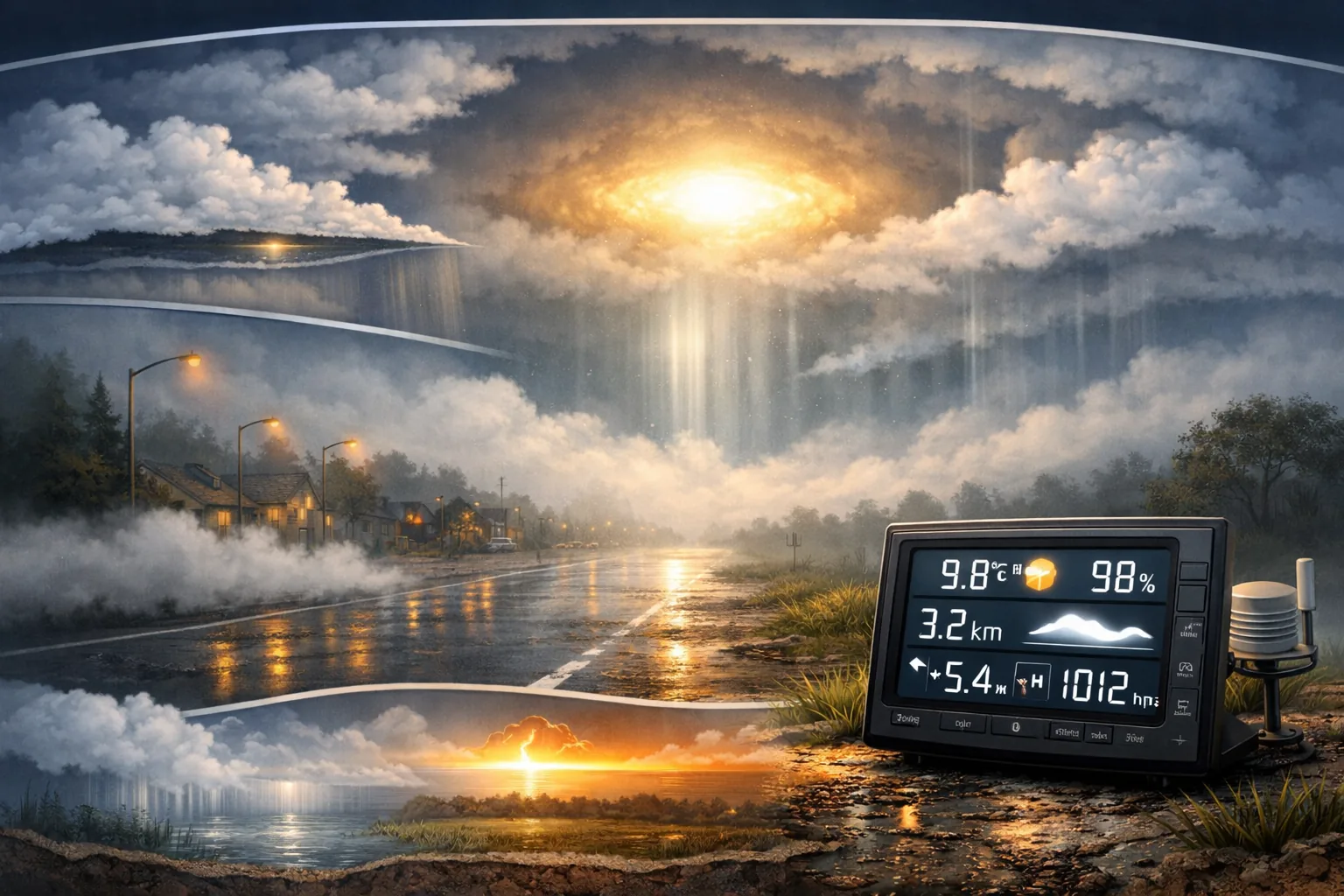
Cloud, fog, ice crystals, lightning phenomena, inversions, and reflections can change how ordinary lights appear in the sky.
On this page
- Cloud, fog, and visibility checks
- Sprites, reflections, and optical effects
- Weather data as supporting evidence
Page outline Jump by section
Introduction
Yes. Weather can make a UFO report look much stranger than the object or light that started it. Cloud layers can hide reference points, fog can enlarge and soften lights, ice crystals can create pillars and halos, thunderstorms can produce brief upper-atmosphere flashes, and temperature inversions can bend light or confuse older radar returns. In an AI-assisted UFO sighting investigation, weather is therefore not a side note; it is one of the first checks that determines whether a raw sighting becomes a solved case, a plausible mundane explanation, or a genuinely unresolved event.
The key is not to dismiss witnesses with “it was just weather”. Atmospheric effects can be real, photographable and surprising. Some are rare enough that a reasonable observer may never have seen them before. A good case file treats weather as supporting evidence: it asks whether the reported shape, colour, motion, brightness, duration and direction match the atmospheric conditions at that exact place and time.
Cloud, fog, and visibility checks
Cloud and fog matter because they change what the witness can see around the light. A bright aircraft, drone, planet, searchlight or ground light looks very different when seen through broken cloud, low mist or haze. Edges blur, colours spread, motion becomes harder to judge, and distance cues disappear. A light behind moving cloud may appear to pulse, vanish, accelerate or hover even when the source itself is steady.
This is especially important in short witness accounts. Phrases such as “it disappeared into a cloud”, “it was glowing inside the mist”, “it hovered above the hill”, or “it had no visible body” should trigger a visibility check before more unusual explanations are considered. Fog is not merely “bad weather”; aviation meteorology treats it as a cloud at the surface that can seriously reduce visibility, and official aviation weather systems track visibility, cloud base, wind, temperature, dew point and precipitation precisely because those conditions affect what pilots and observers can see.[navcanada.ca]navcanada.caaviation weather services guideAugust 11, 2017 — AWOS has a full suite of sensors that measures cloud base height, sky cover, visibility, temperature, dew point, wind v…
For UFO investigation, the practical weather questions are simple:
- Was there low cloud, fog, mist, haze, rain, snow or blowing dust near the sighting line?
- Was the reported object near the horizon, where haze and refraction are strongest?
- Were there bright ground lights, aircraft lights, floodlights, ships, towers or vehicles in the same direction?
- Did the witness have clear reference points, or was the object seen against a blank sky?
- Did the object vanish when cloud moved, or when the viewing angle changed?
Lenticular clouds are the most visually obvious cloud-related example. The Met Office notes that these smooth, lens-shaped clouds form downwind of hills or mountains when moist air rides over standing waves, and that their “flying saucer” shape has made them one of the common explanations for UFO sightings worldwide. They can look artificial because they are smooth, isolated and apparently stationary, even though the air is moving through the wave.[Met Office]weather.metoffice.gov.ukSource details in endnotes.
That does not mean every saucer-shaped report is a lenticular cloud. The match is strongest when the sighting occurs near mountains or hills, in windy stable air, with a smooth oval or stacked-disc shape that remains fixed relative to the terrain. It is weaker when the report describes sharp turns, close-range structure, sound, multiple independent angles, radar correlation, or movement inconsistent with local wind and cloud behaviour. AI can help by comparing the witness description with terrain, wind direction, cloud type, satellite imagery and nearby reports, but it should keep the result as “consistent with lenticular cloud” rather than overstate it as proof.
Sprites, reflections, and optical effects
Atmospheric optics can make ordinary light appear displaced, stretched, multiplied or suspended in the sky. The most common mechanisms involve refraction, reflection, scattering and diffraction: light bends through layers of air, reflects from ice crystals, scatters through droplets, or spreads around tiny particles. These effects can be dramatic because the observer sees a real optical image, not a hallucination.
Ice-crystal effects are especially relevant for UFO reports because they can create shapes away from the obvious light source. The Met Office explains that common 22-degree halos form when light passes through hexagonal ice crystals, while the US National Weather Service describes halos, sundogs and sun pillars as products of sunlight interacting with ice crystals in thin cirrus cloud. Similar geometry can involve moonlight or artificial lights at night.[Met Office]weather.metoffice.gov.ukSource details in endnotes.
Light pillars are a useful case type for investigators. They can look like vertical beams, columns or hovering luminous shafts, sometimes in colours matching streetlights, industrial lights or vehicle lights below. Space.com reported that Niagara Falls light pillars have been linked to UFO reports because mist and upward-facing spotlights can interact with cold-air ice crystals, while atmospheric-optics specialist material explains that artificial-light pillars are produced by reflection from tiny plate-like ice crystals between the observer and the light source.[Space]space.comAlien Glow? Brilliant Light Pillars Appear Over CanadaAlien Glow? Brilliant Light Pillars Appear Over Canada
A strong light-pillar hypothesis usually needs cold air, calm conditions, ice crystals or freezing fog, and a plausible ground light source below the apparent column. It becomes less convincing if the object moves independently across the sky, passes in front of clouds, changes bearing relative to the ground lights, or is observed from widely separated positions without the geometry lining up.
Temperature inversions are another classic mechanism. In a normal lower atmosphere, air generally cools with height. In an inversion, warmer air sits above cooler air near the surface, which can bend light and radio waves in unusual ways. The 1952 Washington, DC UFO events are often discussed in this context: The Guardian summarised the US Air Force explanation that temperature inversion could produce visual and radar mirage effects, with distant ground lights appearing as shimmering aerial objects.[The Guardian]theguardian.comThe Guardian Weatherwatch: UFOs or temperature?The Guardian Weatherwatch: UFOs or temperature?
This remains disputed in some historical cases, and that is precisely why a modern workflow should not use “inversion” as a magic answer. It should test whether the reported geometry fits: horizon-level viewing, distant bright sources, stable air, strong temperature gradients, and returns or lights that behave like ducted or refracted signals rather than solid objects. The case status may end up as “plausible inversion effect”, “weak weather match”, or “unresolved after inversion check”.
Sprites, elves and other transient luminous events belong in a different category. They are not reflections of ordinary lights, but brief electrical phenomena above thunderstorms. NOAA’s National Severe Storms Laboratory describes sprites as large, weak, usually red discharges above active thunderstorms, often linked to powerful positive cloud-to-ground lightning, extending up to around 60 miles from the cloud top and lasting no more than a few seconds.[NOAA National Severe Storms Laboratory]nssl.noaa.govSource details in endnotes.
For a witness, such a flash can seem otherworldly: high above a storm, silent, coloured, and gone almost instantly. For an investigator, the check is highly specific. Was there a thunderstorm in the right direction? Was there major lightning at the same moment? Did the report describe a red, jellyfish-like, column-like, ring-like or branching flash rather than a continuous craft? If yes, an AI workflow can correlate the sighting time with lightning detection networks, weather radar and storm-cell position. If not, sprites should not be forced into the explanation.

Weather data as supporting evidence
Weather data does not identify a UFO by itself. It changes the confidence level of candidate explanations. A report of “a glowing disc above the hills” is very different if the local record shows strong winds over upland terrain and lenticular cloud formation. A report of “vertical alien beams” changes if the temperature was far below freezing, fog or ice crystals were present, and the beams lined up with floodlights. A report of “red flashes above a storm” changes if lightning data places a severe thunderstorm under the viewing direction.
The strongest weather reconstruction combines several layers:
- Surface observations: temperature, dew point, wind, visibility, precipitation, cloud base and pressure near the witness.
- Aviation reports: METARs, SPECIs, terminal forecasts and pilot reports where available, because they record visibility and cloud conditions in a disciplined format.
- Radar and satellite imagery: cloud cover, storm cells, precipitation bands, fog, snow cover and high cloud.
- Lightning data: timing and location of strikes, especially for sprites and other transient luminous events.
- Local geography: hills, coastlines, valleys, industrial lights, airports, water surfaces and reflective snow or ice.
- Witness geometry: bearing, elevation, line of sight, obstructions and whether the object was near the horizon.
NASA’s UAP study stressed that progress depends on better data, robust collection and well-characterised observations rather than isolated anecdotes; it also noted that satellite and environmental data can help provide context around reported events. That principle applies directly to weather: atmospheric conditions should be captured as structured case-file fields, not added later as a vague afterthought.[NASA Science]science.nasa.govSource details in endnotes.[NASA Science]science.nasa.govSource details in endnotes.
AI is useful here because the work is repetitive and time-sensitive. It can pull the nearest weather station data, fetch archived radar frames, check cloud and visibility reports, flag inversion risk, look for lightning within a time window, and compare the sighting description with known optical mechanisms. It can also warn the investigator when the available data are too coarse: a weather station 30 miles away may not describe fog in a valley, and a clear surface report may miss high cirrus capable of producing halos.
The most important output is not a single label, but a transparent confidence note. A good weather module might say: “Low cloud and mist were present; the object was reported near the horizon; a bright airport approach path lay in the same direction; apparent pulsing could be consistent with aircraft lights seen through cloud. Weather explanation: plausible, not confirmed.” That is more useful than either credulous mystery-making or premature debunking.
When weather explains the strangeness — and when it does not
Weather explanations are strongest when they predict the odd details rather than merely coexist with them. A fog bank should explain softness, glow, fading and poor distance judgement. Ice crystals should explain pillars, halos, sundogs or repeated vertical beams tied to light sources. A temperature inversion should explain horizon effects, shimmering, displacement or possible radar propagation issues. A thunderstorm should explain brief upper-atmosphere flashes.
They are weaker when they only explain one small part of a richer report. If witnesses describe a structured object passing overhead at close range, casting shadows, making sound, being filmed from multiple locations with consistent triangulation, or moving against wind and cloud patterns, then weather may still matter but cannot carry the explanation alone. It may have affected visibility while another source — aircraft, drone, balloon, satellite, flare, launch, hoax, camera artefact, or unresolved object — did the rest.
This is where AI-assisted investigation needs careful language. “Weather was present” is not the same as “weather caused the sighting”. “Consistent with a halo” is not the same as “identified”. “No local fog report found” is not the same as “visibility was clear along the witness’s line of sight”. A balanced workflow should keep confirmed data, witness claims, analyst inference and case status separate.
Weather can make a UFO look stranger, but it can also make an investigation better. It gives analysts testable mechanisms, time-stamped records and physical constraints. When the atmospheric match is strong, it can resolve a case without insulting the witness. When the match is weak, it helps narrow what remains unusual. Either way, weather and atmospheric optics belong near the top of the screening process for any dated, located UFO or UAP sighting.
eBay marketplace picks
Marketplace Samples
Example marketplace items related to this page. Use the search link to explore similar finds on eBay.


Endnotes
1.
Source: navcanada.ca
Title: aviation weather services guide
Link:https://www.navcanada.ca/en/aviation-weather-services-guide.pdf
Source snippet
August 11, 2017 — AWOS has a full suite of sensors that measures cloud base height, sky cover, visibility, temperature, dew point, wind v...
Published: August 11, 2017
2.
Source: weather.gov
Link:https://www.weather.gov/arx/why_halos_sundogs_pillars
3.
Source: space.com
Title: Alien Glow? Brilliant Light Pillars Appear Over Canada
Link:https://www.space.com/amp/35324-light-pillars-photo-ontario.html
4.
Source: nssl.noaa.gov
Link:https://www.nssl.noaa.gov/education/svrwx101/lightning/types/
5.
Source: science.nasa.gov
Link:https://science.nasa.gov/uap/
6.
Source: science.nasa.gov
Link:https://science.nasa.gov/wp-content/uploads/2023/09/uap-independent-study-team-final-report.pdf
7.
Source: nasa.gov
Title: nasa to release discuss unidentified anomalous phenomena report
Link:https://www.nasa.gov/news-release/nasa-to-release-discuss-unidentified-anomalous-phenomena-report/
8.
Source: noaa.gov
Title: types of weather phenomena
Link:https://www.noaa.gov/jetstream/synoptic/types-of-weather-phenomena
9.
Source: nesdis.noaa.gov
Title: silent threat how noaa satellites help save lives low visibility and fog
Link:https://www.nesdis.noaa.gov/news/silent-threat-how-noaa-satellites-help-save-lives-low-visibility-and-fog
10.
Source: weather.gov
Link:https://www.weather.gov/otx/full_weather_glossary
11.
Source: weather.metoffice.gov.uk
Link:https://weather.metoffice.gov.uk/learn-about/weather/types-of-weather/clouds/unusual-cloud-formations
12.
Source: weather.metoffice.gov.uk
Link:https://weather.metoffice.gov.uk/learn-about/weather/optical-effects
13.
Source: atoptics.org.uk
Title: Light Pillars
Link:https://www.atoptics.org.uk/halo/lpil.htm
14.
Source: theguardian.com
Title: The Guardian Weatherwatch: UFOs or temperature?
Link:https://www.theguardian.com/news/2011/jul/13/weatherwatch-flying-saucers
15.
Source: Wikipedia
Title: Atmospheric optics
Link:https://en.wikipedia.org/wiki/Atmospheric_optics
16.
Source: x.com
Link:https://x.com/Daily_Record/status/1768307457271509191
17.
Source: blog.metservice.com
Title: atmospheric optics
Link:https://blog.metservice.com/atmospheric-optics
18.
Source: hyperphysics.phy-astr.gsu.edu
Link:https://hyperphysics.phy-astr.gsu.edu/hbase/atmos/mirage.html
Additional References
19.
Source: static.e-publishing.af.mil
Link:https://static.e-publishing.af.mil/production/1/af_a3/publication/afh15-101/afh15-101.pdf
Source snippet
Air Force5 Nov 2019 — The visibility in fog depends on the amount of water vapor available... AWC—Aviation Weather Center. BKFG—Baroklin...
20.
Source: youtube.com
Title: Mirage and [Fata Morgana]({{ ‘fata-morgana/’ | relative_url }}): How Temperature Inversions Trick the Eye
Link:http://www.youtube.com/watch?v=Yp56c3t9c4g
Source snippet
Why Planes Look Like UFOs: The Role of Atmospheric Haze and Light...
21.
Source: aviationweather.gov
Link:https://aviationweather.gov/gfa/help/
22.
Source: faa.gov
Link:https://www.faa.gov/air_traffic/publications/ATpubs/AIM_html/chap7_section_1.html
23.
Source: cia.gov
Link:https://www.cia.gov/readingroom/docs/CIA-RDP81R00560R000100040013-4.pdf
24.
Source: youtube.com
Title: Atmospheric Optics: Why the Sky is Blue and Sunsets are Red
Link:http://www.youtube.com/watch?v=0hK2s-qU9vQ
Source snippet
Light Pillars: The Science Behind the Mystery...
25.
Source: youtube.com
Title: Rare Optical Phenomena in the Atmosphere
Link:http://www.youtube.com/watch?v=kU_Ua0z5j_k
Source snippet
Mirage and Fata Morgana: How Temperature Inversions Trick the Eye...
26.
Source: facebook.com
Link:https://www.facebook.com/mattykjordan/posts/a-fata-morgana-mirage-is-an-optical-illusion-caused-by-the-bending-of-light-rays/10159801582411659/
27.
Source: facebook.com
Link:https://www.facebook.com/DiscoveryChannelIndiaOfficial/posts/a-conspiracy-theory-we-have-could-these-be-ufos-disguised-as-clouds-to-fool-huma/4966295620096980/
28.
Source: byjus.com
Link:https://byjus.com/physics/atmospheric-optical-phenomena/
Topic Tree
Follow this branch
Parent topic
UFO Case AIRelated pages 9
- Aircraft Was It an Aircraft or Drone?
- Astronomy Was the UFO Really in the Sky Map?
- Case File What Makes a UFO Report Investigable?
- Case Match Has This UFO Sighting Happened Before?
- Confidence How Certain Can a UFO Explanation Be?
- Review Who Checks the AI UFO Verdict?
- Satellites Could It Be Starlink or a Satellite?
- Timeline What Else Was Happening During the Sighting?
- +1 more in sidebar