Within Timeline
How weather can reshape a sighting
Cloud, haze, wind, inversions, and visibility can decide whether an explanation fits the exact sighting window.
On this page
- Cloud breaks, haze, and changing visibility
- Why surface wind may not explain balloons
- Weather checks that strengthen or weaken explanations
Page outline Jump by section
Introduction
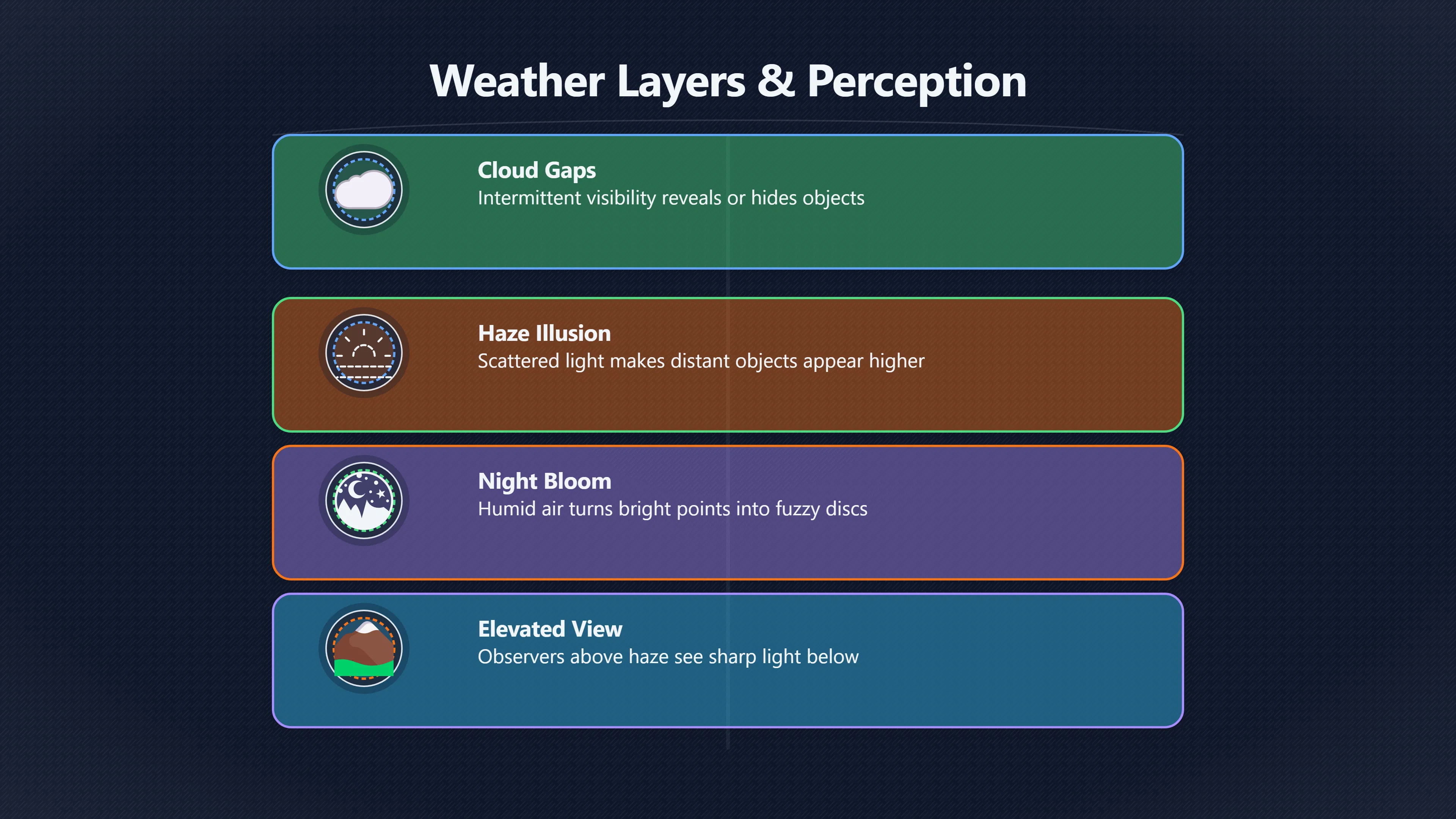
Weather is not background scenery in a UFO investigation. It can decide whether a reported object was even visible, whether its apparent movement makes physical sense, and whether a mundane explanation becomes stronger or weaker. A bright object behind thin cloud can appear to pulse or change shape. A balloon drifting at high altitude may move in a completely different direction from surface wind. A temperature inversion can bend light and distort distant objects into hovering shapes. Haze can make lights appear farther away, slower, larger, or strangely suspended.
 For AI timeline reconstruction, weather therefore becomes a layered evidence problem rather than a simple “clear skies” or “cloudy” label. A useful reconstruction compares witness statements with cloud cover, visibility, upper-air wind, humidity, fog formation, pressure changes, and local atmospheric optics during the exact sighting window. The goal is not to dismiss reports automatically. It is to test whether the reported behaviour matches known environmental effects, and to identify cases where weather conditions either strongly support or weaken conventional explanations.
Cloud breaks, haze, and changing visibility
Many UFO reports depend on transitions rather than stable conditions. Witnesses often describe objects “appearing suddenly”, “vanishing instantly”, or “hovering in and out”. In practice, these descriptions frequently line up with changing visibility layers.
Thin cloud and broken cloud can dramatically alter brightness perception. Aircraft landing lights, planets, helicopters, or satellites may become visible only through temporary gaps in cloud cover. When clouds thicken again, the same object may seem to disappear unnaturally. In a timeline reconstruction, AI systems can compare the reported appearance and disappearance times against cloud movement from satellite imagery and local weather observations.
Haze is particularly important because it changes depth and distance perception. Aviation safety guidance repeatedly notes that atmospheric haze can make objects appear farther away and higher than they really are.[Learn To Fly]learntoflyblog.comLearn To FlyHuman Factors: Optical Illusions - Learn to Fly Blog7 Aug 2017 — Atmospheric haze can create an illusion of being at a greate…[Boldmethod In a UFO context]boldmethod.com8 optical illusions pilots should understandAccording to the FAA, "atmospheric haze can create an illusion of being at a greater distance and height from the runway. As a…Read more…, that distortion matters because witnesses often estimate speed and size from apparent distance. A distant aircraft seen through haze may appear stationary for long periods, then suddenly accelerate once perspective changes.
At night, haze also scatters light. Bright points can bloom into fuzzy discs, coloured halos, or pulsing glows. Under humid conditions, stars and planets near the horizon may appear unstable or “alive” because turbulent air repeatedly bends incoming light. This is especially relevant in reports describing objects that shimmer, morph shape, or cycle through colours without changing position.
An AI-assisted reconstruction can test these effects by correlating:
- Horizontal visibility reports from nearby weather stations
- Humidity and dew point spread
- Aerosol or smoke data
- Cloud ceiling height
- Witness viewing direction relative to the horizon
- Moon phase and ambient illumination
The distinction between surface visibility and elevated visibility also matters. The World Meteorological Organization notes that haze layers can mislead observers because visibility above the layer may appear excellent while visibility inside it is poor.[World Meteorological Organization]community.wmo.intWorld Meteorological Organization AviationWhen a pilot is flying above a low-level haze layer (which…Read more… A witness on elevated terrain may therefore describe a sharp glowing object while another observer below sees only diffuse light.
Why “clear skies” can still mislead
Witnesses often report “perfectly clear skies” even when upper-air conditions were more complex. Thin cirrus cloud, smoke, inversion haze, or humidity layers may not register as obvious cloud cover to a casual observer, yet still alter perception.
Very clear air can also create its own distortions. Aviation studies note that unusually transparent conditions may cause observers to underestimate distance.[Learn To Fly]learntoflyblog.comLearn To FlyHuman Factors: Optical Illusions - Learn to Fly Blog7 Aug 2017 — Atmospheric haze can create an illusion of being at a greate… A light that appears low and nearby may actually be far away and high above the horizon. In UFO reports, this can exaggerate claims of impossible manoeuvres or sudden acceleration because the observer assumes the object is much closer than it really is.
This is one reason AI timeline reconstruction benefits from geographic modelling rather than relying solely on witness description. The same object can appear radically different depending on viewing angle, humidity, background lighting, and terrain.
Why surface wind may not explain balloons
One of the most common mistakes in sighting analysis is assuming that a balloon must follow the wind felt by the witness on the ground. In reality, wind direction and speed often change substantially with altitude.
A witness may report calm conditions while a weather balloon, advertising balloon, or drifting object moves rapidly hundreds or thousands of feet above. Temperature inversions are especially important here because they can separate stable surface air from stronger upper-level flow. NOAA and aviation weather guidance describe inversions as boundaries where warmer air overlays cooler air, often trapping haze and separating wind layers.[NOAA]noaa.govskew t plotsSkew-T Plots28 Mar 2023 — When the normal temperature decrease is "inverted" and the temperature increases with height, this is calle…[Wikipedia]WikipediaInversion (meteorology)In meteorology, an inversion (or temperature inversion) is a phenomenon in which a layer of warmer air overlies…
This matters because many UFO reports involve claims such as:
- “The object moved against the wind”
- “Nothing else in the sky was moving”
- “It hovered despite strong wind”
- “It suddenly changed direction”
Without upper-air data, these claims can be misleading. A balloon may appear stationary when moving directly toward or away from the observer. It may also cross from one wind layer into another and seem to turn sharply without propulsion.
AI reconstruction systems can reduce these errors by incorporating:
- Radiosonde or weather balloon profiles
- Aviation wind forecasts
- Pressure-level wind maps
- Vertical wind shear estimates
- Local terrain effects
Terrain is frequently overlooked. Valleys, coastlines, hills, and urban heat islands can produce localised airflow very different from regional forecasts. A witness standing in sheltered calm air may still observe fast-moving illuminated objects above a ridge line where upper-level winds are much stronger.
Inversions and “hovering” lights
Temperature inversions also influence sound and light propagation. Stable air layers can trap light distortions and reduce visual cues needed for judging movement. They may even alter how aircraft sound travels, making distant helicopters or jets seem strangely silent.
Some inversion conditions create superior mirages known as Fata Morgana effects. These occur when light bends through layered air with different temperatures, producing distorted or elevated images. Aviation safety references describe how inversions can cause distant objects to appear suspended above the horizon.[Skybrary]skybrary.aeroFata Morgana | SKYbrary Aviation SafetySuperior Mirage. A superior mirage occurs when there is a temperature inversion; the air b…
Historically, some UFO reports over water, deserts, or polar regions have later been linked to mirage-like atmospheric conditions. The important point for investigators is not that every unusual sighting is a mirage, but that inversion layers can create visually convincing distortions under the right geometry.
An AI system can flag these conditions by checking:
- Surface and upper-air temperature gradients
- Coastal or desert environments
- Strong radiative cooling after sunset
- Stable nighttime boundary layers
- Reports of fog or low-level haze nearby
Weather effects that distort motion and shape
Human perception becomes less reliable when visual references disappear. Aviation safety literature repeatedly warns that fog, darkness, haze, and low contrast conditions create optical illusions and spatial disorientation.[FAA Safety]faasafety.govFAA Safety Your Senses in the ShadowsNighttime Visual Illusions…By using visual references, the pilot can gather information about distance, speed, and depth. Any conditio…[Federal Aviation Administration]faa.govFederal Aviation Administration Spatial Disorientation: Visual Illusions10% of all general aviation accidents can be attributed to spatial disorientation, and 90% of these accidents are fatal.Read more… Skybrary These effects overlap closely with many UFO descriptions.[skybrary.aero]skybrary.aeroFata Morgana | SKYbrary Aviation SafetySuperior Mirage. A superior mirage occurs when there is a temperature inversion; the air b…
Autokinesis and stationary lights
Autokinesis is a well-known night-time illusion where a stationary light appears to move when stared at against a dark background. Pilots and observers may perceive drifting, zig-zagging, or hovering motion even though the object itself remains fixed.[Medium]medium.comIt's a Confusing World Up There. The Specifics of Spatial…Spatial disorientation can also be caused by visual illusions. Your mi…
In UFO investigations, this becomes relevant when witnesses describe:
- Sudden darting motion
- Small erratic movements
- Hovering lights that “reacted” to observation
- Objects weaving in place
An AI-assisted case review can compare the witness viewing conditions against known autokinesis triggers:
- Single isolated light source
- Long observation duration
- Night-time viewing
- Lack of horizon reference
- Fatigue or stress
- Observation through haze or cloud
This does not invalidate witness sincerity. It simply identifies conditions where visual perception becomes less stable.
Fog and apparent disappearance
Fog can rapidly erase depth cues. Aviation guidance notes that entering shallow fog layers changes perceived orientation and visibility dramatically.[Skybrary]skybrary.aeroVisual Illusions AwarenessEntering a fog layer also creates the perception of a pitch up, thus inducing a tendency to push over a…
For UFO reconstruction, fog matters because it can produce seemingly impossible disappearance events. An object descending into mist may appear to blink out instantly. A light behind patchy fog may pulse or fragment into multiple points.
This becomes especially confusing in phone footage. Consumer cameras constantly adjust exposure and focus in low-contrast conditions. AI reconstruction should therefore compare witness claims with:
- Fog density estimates
- Relative humidity
- Camera exposure changes
- Light bloom artefacts
- Frame-by-frame brightness shifts
Flat light and loss of scale
Low-contrast weather can remove depth perception almost entirely. Aviation accident investigations describe “flat light” conditions where terrain detail disappears and observers lose their sense of distance.[FAA Safety]faasafety.govFAA Safety Your Senses in the ShadowsNighttime Visual Illusions…By using visual references, the pilot can gather information about distance, speed, and depth. Any conditio…
In UFO reports, this may produce exaggerated estimates of:
- Object size
- Altitude
- Acceleration
- Distance travelled
A bright aircraft crossing a featureless overcast sky may appear far larger and slower than it really is because the observer lacks fixed visual references.
Weather checks that strengthen or weaken explanations
Weather analysis is most useful when it changes the plausibility of a candidate explanation rather than merely adding background detail.
Conditions that strengthen conventional explanations
Some weather patterns increase the likelihood of ordinary explanations:
- Strong upper-level winds supporting balloon drift
- Thin cloud causing intermittent visibility
- Temperature inversions supporting mirage conditions[community.wmo.int]community.wmo.intint Guide to Instruments and Methods of Observation (WMO-No8)LATEST VERSION OF THE WMO-No. 8; Chapter 2, Measurement of temperature; Chapter 3, Measurement of atmospheric pressure; Chapter 4, M…
- High humidity producing light scatter and halo effects
- Low visibility increasing distance-estimation errors
- Stable night air favouring autokinesis
- Fog banks matching sudden disappearance timing
When multiple factors align with the witness description, confidence in a mundane explanation rises significantly.
Conditions that weaken simple explanations
Weather can also make ordinary explanations less convincing.
For example:
- Calm upper-air conditions may weaken balloon hypotheses
- Uniform overcast may reduce the chance of astronomical misidentification
- Excellent visibility can weaken claims that haze distorted distance
- Strong turbulence may conflict with reports of perfectly stable hovering
- Wind direction mismatches across multiple altitudes may undermine drift explanations
This is where layered reconstruction becomes valuable. Instead of treating weather as a yes-or-no filter, AI systems can assign weighted confidence to competing explanations.
A report may therefore end with conclusions such as:
- “Aircraft explanation strengthened by cloud-gap timing”
- “Balloon explanation weakened by upper-air wind profile”
- “Astronomical explanation plausible but affected by haze distortion”
- “No strong weather-based contradiction identified”
That approach is more useful than declaring a sighting solved or unexplained too early.
Building weather into an AI sighting timeline
A strong AI-assisted UFO workflow treats weather as a dynamic timeline rather than a static report. Conditions can change minute by minute, especially near sunrise, sunset, coastlines, storms, or frontal boundaries.
For a single sighting event, the most useful weather layers usually include:
Weather layerWhy it mattersCloud cover and cloud heightDetermines whether objects could appear intermittentlyVisibility and hazeAffects size, brightness, and distance perceptionUpper-air windTests balloon and drifting-object hypothesesSurface windHelps compare witness sensation versus actual atmospheric flowTemperature inversion dataFlags mirage and propagation effectsHumidity and dew pointSupports fog, halo, and light-scatter analysisPressure changes and frontsIdentifies unstable viewing conditionsAmbient illuminationChanges how stars, aircraft lights, and reflections appear
The best reconstructions also preserve uncertainty. Weather data may come from airports many miles away, model estimates, satellite interpretation, or sparse observation stations. AI systems should therefore distinguish between measured conditions and inferred local conditions.
That distinction matters because weather can either explain away apparent anomalies or create them in the first place. A sighting that initially appears extraordinary may become less mysterious once haze, cloud gaps, and upper-air wind are reconstructed minute by minute. Equally, some reports remain difficult even after detailed environmental checks, which is precisely why weather analysis belongs inside the broader evidence chain rather than acting as a final verdict.
Amazon book picks
Further Reading
Books and field guides related to How weather can reshape a sighting. Use these as the next step if you want deeper reading beyond the article.
NightWatch: A Practical Guide to Viewing the Universe
Supports weather-informed sky observation.
eBay marketplace picks
Marketplace Samples
Example marketplace items related to this page. Use the search link to explore similar finds on eBay.



Endnotes
1.
Source: boldmethod.com
Title: 8 optical illusions pilots should understand
Link:https://www.boldmethod.com/blog/lists/2025/04/8-optical-illusions-pilots-should-understand/
Source snippet
According to the FAA, "atmospheric haze can create an illusion of being at a greater distance and height from the runway. As a...Read more...
2.
Source: noaa.gov
Title: skew t plots
Link:https://www.noaa.gov/jetstream/upperair/skew-t-plots
Source snippet
Skew-T Plots28 Mar 2023 — When the normal temperature decrease is "inverted" and the temperature increases with height, this is calle...
3.
Source: Wikipedia
Link:https://en.wikipedia.org/wiki/Inversion_%28meteorology%29
Source snippet
Inversion (meteorology)In meteorology, an inversion (or temperature inversion) is a phenomenon in which a layer of warmer air overlies...
4.
Source: skybrary.aero
Link:https://skybrary.aero/articles/fata-morgana
Source snippet
Fata Morgana | SKYbrary Aviation SafetySuperior Mirage. A superior mirage occurs when there is a temperature inversion; the air b...
5.
Source: faa.gov
Title: Federal Aviation Administration Spatial Disorientation: Visual Illusions
Link:https://www.faa.gov/pilots/safety/pilotsafetybrochures/media/spatiald_visillus.pdf
Source snippet
10% of all general aviation accidents can be attributed to spatial disorientation, and 90% of these accidents are fatal.Read more...
6.
Source: skybrary.aero
Link:https://skybrary.aero/sites/default/files/bookshelf/177.pdf
Source snippet
Visual Illusions AwarenessEntering a fog layer also creates the perception of a pitch up, thus inducing a tendency to push over a...
7.
Source: medium.com
Link:https://medium.com/faa/its-a-confusing-world-up-there-5070c1e5806b
Source snippet
It's a Confusing World Up There. The Specifics of Spatial...Spatial disorientation can also be caused by visual illusions. Your mi...
8.
Source: ncei.noaa.gov
Title: dataset search
Link:https://www.ncei.noaa.gov/access/search/dataset-search
Source snippet
Search | National Centers for Environmental...This dataset includes five-minute reports with elements for wind speed and direction, visi...
9.
Source: vos.noaa.gov
Link:https://www.vos.noaa.gov/ObsHB-508/ObservingHandbook1_2010_508_compliant.pdf
Source snippet
Code Symbols with Range of Values1 (NWSOH1) explains how to observe, how to code, and how to transmit weather observations from moving sh...
10.
Source: faa.gov
Link:https://www.faa.gov/air_traffic/publications/atpubs/aim_html/chap7_section_1.html
Source snippet
moke reduces the light intensity arriving at the...Read more...
11.
Source: faa.gov
Title: FAA H 8083 28 Order 8083.28
Link:https://www.faa.gov/documentLibrary/media/Order/FAA-H-8083-28_Order_8083.28.pdf
Source snippet
Aviation Weather Handbook 202225 Nov 2022 — This handbook consolidates the weather information from the following advisory circulars (AC)...
12.
Source: medium.com
Link:https://medium.com/faa/mitigating-the-hazard-of-visual-illusions-fb3c35009471
Source snippet
Mitigating the Hazard of Visual IllusionsA review of aircraft mishaps quickly reveals that visual illusions and/or poor visibility have b...
13.
Source: medium.com
Link:https://medium.com/faa/taking-the-fright-out-of-rotorcraft-night-flight-01ed87194c75
Source snippet
Taking the Fright Out of Rotorcraft Night FlightThreats such as reduced visibility, altered depth perception, and diminished spatial awar...
14.
Source: Wikipedia
Title: Fata Morgana (mirage)
Link:https://en.wikipedia.org/wiki/Fata_Morgana_%28mirage%29
Source snippet
Fata Morgana (mirage)Some UFOs which are seen on radar may also be due to Fata Morgana mirages. Official UFO investigations in France...
15.
Source: weather.gov
Title: Full Weather Glossary CALM
Link:https://www.weather.gov/otx/full_weather_glossary
Source snippet
Full Weather GlossaryCALM - the absence of apparent motion in the air. CAP - Temperature inversion which prevents convection from occurri...
16.
Source: learntoflyblog.com
Link:https://learntoflyblog.com/human-factors-optical-illusions/
Source snippet
Learn To FlyHuman Factors: Optical Illusions - Learn to Fly Blog7 Aug 2017 — Atmospheric haze can create an illusion of being at a greate...
17.
Source: community.wmo.int
Title: World Meteorological Organization Aviation
Link:https://community.wmo.int/site/knowledge-hub/programmes-and-initiatives/aviation/aviation-hazards-low-visibility-and-low-cloud
Source snippet
When a pilot is flying above a low-level haze layer (which...Read more...
18.
Source: faasafety.gov
Title: FAA Safety Your Senses in the Shadows
Link:https://www.faasafety.gov/files/events/SO/SO15/2024/SO15134204/YourSensesInTheShadows.pdf
Source snippet
Nighttime Visual Illusions...By using visual references, the pilot can gather information about distance, speed, and depth. Any conditio...
19.
Source: faasafety.gov
Title: FAA Safety Library Contents
Link:https://www.faasafety.gov/gslac/alc/libview_normal.aspx?id=6844
Source snippet
FAA SafetyLibrary Contents - FAA - FAASTeamThe change in light conditions created flat light. This lack of definition on the shaded side...
Additional References
20.
Source: researchgate.net
Link:https://www.researchgate.net/publication/400385806_Physiology_in_Aviation_Hearing_Vision_Spatial_Disorientation_and_Visual_Illusions
Source snippet
Hearing, Vision, Spatial Disorientation, and Visual Illusions4 Feb 2026 — This paper examines the critical flight physiological factors t...
21.
Source: cfinotebook.net
Link:https://www.cfinotebook.net/notebook/weather-and-atmosphere/obstructions-to-visibility
Source snippet
Obstructions To VisibilityUnderstanding obstructions to visibility helps pilots recognize how phenomena such as fog, haze, smoke, and pre...
22.
Source: cnes-geipan.fr
Link:https://www.cnes-geipan.fr/sites/default/files/Aids_to_identification_of_flying_objects_0.pdf
Source snippet
aids to identification of flying objectsAbout the only pattern noted, other than seasonal changes in the number of sightings, is that UFO...
23.
Source: flightsafety.org
Link:https://flightsafety.org/wp-content/uploads/2016/09/alar_bn5-3-illusions.pdf
Source snippet
Flight Safety FoundationFSF ALAR Briefing Note 5.3 -- Visual IllusionsThe absence of visual references in the pilot's near vision affect...
24.
Source: spaceweather.gov
Link:https://www.spaceweather.gov/
Source snippet
Homepage | NOAA / NWS Space Weather Prediction CenterHome · About Space Weather · Impacts · Electric Power Transmission · GPS Systems · H...
25.
Source: flyaeroguard.com
Link:https://www.flyaeroguard.com/learning-center/visual-illusions/
Source snippet
A narrower than usual runway can create the illusion that the aircraft is in a higher altitude than it actually is.Read more...
26.
Source: epa.gov
Link:https://www.epa.gov/sites/default/files/2020-10/documents/mmgrma_0.pdf
Source snippet
This document updates the June 1987 EPA document, "On-Site Meteorological Program. Guidance for Regulatory Modeling Applications", EPA-45...
Published: June 1987
27.
Source: youtube.com
Link:https://www.youtube.com/watch?v=ueen-XMx3dw
Source snippet
Encountering Haze During VFR FlightIf a VFR pilot encounters haze the conventional advice is to climb to get on top of the haze for impro...
28.
Source: reddit.com
Link:https://www.reddit.com/r/flying/comments/i0f0cn/why_does_haze_have_different_effects_on_visual/
Source snippet
In one case you're more looking at vertical distance, in the other you're looking at horizontal...Read more...
29.
Source: community.wmo.int
Title: int Guide to Instruments and Methods of Observation (WMO-No
Link:https://community.wmo.int/site/knowledge-hub/programmes-and-initiatives/instruments-and-methods-of-observation-programme-imop/guide-instruments-and-methods-of-observation-wmo-no-8
Source snippet
8)LATEST VERSION OF THE WMO-No. 8; Chapter 2, Measurement of temperature; Chapter 3, Measurement of atmospheric pressure; Chapter 4, M...
Topic Tree