Within Bright planets
Why Bright Planets Look Strange On Phone Cameras
Digital zoom and atmospheric shimmer often turn bright planets into pulsating shapes that look structured on video.
On this page
- How digital zoom magnifies atmospheric turbulence
- Common blob and colour fringe patterns in UFO clips
- Comparing raw footage with naked eye observations
Page outline Jump by section
Introduction
Many modern UFO reports now arrive with phone video attached. A witness points a handset at a bright light low in the western sky, zooms in digitally, and records a glowing object that appears to pulse, rotate, change colour or split into structured shapes. In a large number of cases, the underlying object is later identified as Venus or Jupiter rather than an aircraft or unknown craft.
 This mismatch between what the eye sees and what the phone records is a major issue in AI-assisted UFO sighting investigation. Bright planets near the horizon are unusually difficult targets for small phone cameras. Atmospheric turbulence, aggressive image processing, autofocus hunting and digital zoom can turn a single point of light into a moving blob with apparent surface detail. Royal Museums Greenwich notes that Venus near the horizon can produce “amazing flashing colour effects” frequently reported as UFOs.[Royal Museums Greenwich]rmg.co.ukRoyal Museums GreenwichPlanet VenusWhen near the horizon, the 'twinkling' can give rise to amazing flashing colour effects which are ofte…
For investigators, the key lesson is not that witnesses are dishonest or irrational. The more useful point is that phone footage of bright planets is often visually misleading even when the original observation was genuine.
How digital zoom magnifies atmospheric turbulence
A bright planet low in the sky sits behind a thick layer of atmosphere. Warm and cool air pockets bend incoming light constantly, producing scintillation: the same effect that makes stars twinkle. Venus and Jupiter can appear to flicker, stretch, wobble or flash different colours when viewed close to the horizon.[Royal Museums Greenwich]rmg.co.ukRoyal Museums GreenwichPlanet VenusWhen near the horizon, the 'twinkling' can give rise to amazing flashing colour effects which are ofte…
To the naked eye, this usually looks like a bright unstable light. Through a phone camera at high zoom, the effect becomes far stranger.
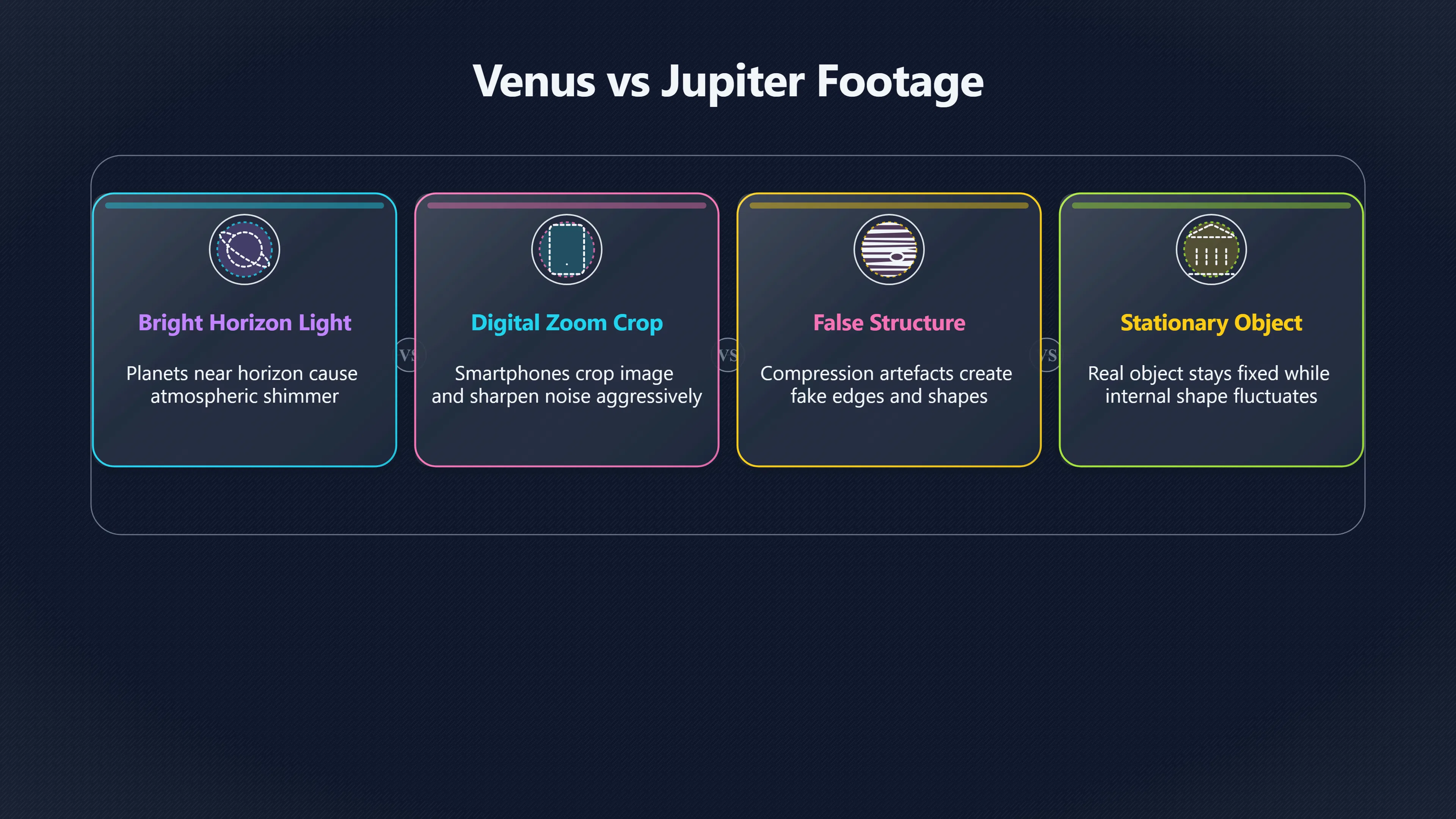
Most smartphones do not use true optical magnification at extreme zoom levels. Instead they crop the image digitally, sharpen it aggressively and attempt to stabilise noise using software. In low light, this creates several distortions at once:
- Atmospheric shimmer becomes exaggerated movement.
- Compression artefacts create false edges and apparent structure.
- Autofocus constantly shifts the shape of the light source.
- Noise reduction smears the bright object into changing forms.
- Frame interpolation can create pulsating motion.
A distant planet that is physically stable therefore appears active on screen. Witnesses often interpret this as intelligent manoeuvring or surface detail.
This effect becomes especially strong when the object occupies only a tiny number of pixels in the original sensor image. The phone is effectively enlarging noise and turbulence rather than resolving real detail.
Astronomers deal with the same atmospheric problem using specialised methods such as “lucky imaging”, where thousands of short exposures are captured and only the sharpest frames are combined.[Wikipedia]WikipediaLucky imagingLucky imaging Consumer phones do the opposite under difficult conditions: they average unstable data in real time, often creating synthetic-looking shapes.
In UFO investigations, this matters because witnesses frequently assume zoom reveals hidden detail. In reality, extreme zoom often manufactures apparent detail that was never optically resolved.
Why Venus footage often looks more dramatic than Jupiter
Venus generates particularly dramatic phone footage because it is exceptionally bright and commonly appears low in twilight skies. When heavily overexposed by a small sensor, the planet blooms into a large glowing area rather than remaining a sharp point.[Royal Museums Greenwich]rmg.co.ukRoyal Museums GreenwichPlanet VenusWhen near the horizon, the 'twinkling' can give rise to amazing flashing colour effects which are ofte…
That overexposure interacts with turbulence and lens behaviour to create recurring UFO-style patterns:
- Pulsating white discs.
- Diamond or triangular shapes.
- Colour-cycling red, blue and green fringes.
- Apparent rotating interiors.
- “Orb” appearances with soft edges.
- Sudden elongation into cigar-like forms.
Jupiter can produce similar effects, though usually with steadier brightness and less severe colour flashing. Venus is bright enough to overwhelm phone exposure systems more easily, especially shortly after sunset when the camera is balancing a bright horizon against a darkening sky.
A recurring pattern in public UFO uploads is that the witness reports a “structured craft” visible only after zooming in. The naked-eye object may have looked like a single bright light, but the recorded video appears to show geometry, layers or rotating features. In many cases, investigators later reproduce nearly identical visuals by filming Venus under similar conditions with ordinary smartphones.
Common blob and colour-fringe patterns in UFO clips
Several visual signatures appear repeatedly in planet-based UFO footage. AI-assisted screening systems can use these patterns as early warning indicators that a sighting may involve an astronomical object rather than a nearby craft.
Defocused glowing blobs
When autofocus fails in low light, planets often become large soft circles with no stable edge definition. Witnesses may interpret these as luminous craft or “energy objects”.
The crucial clue is instability. The outline changes constantly but without coherent directional movement. The object usually remains fixed relative to the horizon while only the internal shape fluctuates.
Red-blue-green flashing
Atmospheric dispersion splits light into colours near the horizon. The effect resembles rapid colour cycling. Venus is especially prone to this appearance.[Royal Museums Greenwich]rmg.co.ukRoyal Museums GreenwichPlanet VenusWhen near the horizon, the 'twinkling' can give rise to amazing flashing colour effects which are ofte…
On phone sensors, colour separation can become exaggerated into dramatic flashing patterns. Witnesses often describe this as a craft “changing modes” or emitting multicoloured light.
Rotating or morphing interiors
Digital sharpening and compression frequently create moving internal textures inside a bright overexposed blob. These textures can resemble spinning machinery or structured surfaces.
Importantly, the patterns usually change when zoom level changes. That is a strong sign the effect originates in image processing rather than in the sky object itself.
Polygonal shapes
Many phone camera apertures and software pipelines produce geometric bokeh patterns when out of focus. Bright planets can therefore appear triangular, hexagonal or diamond-shaped.
These shapes are commonly misinterpreted as engineered craft designs despite matching the camera’s optical behaviour.
“Splitting” or multiple lights
Sensor bloom and atmospheric distortion can temporarily stretch a planet into several adjacent bright regions. Compression artefacts can reinforce the illusion of separate objects flying in formation.
This becomes more common when recording through thin cloud, dirty lenses or heat shimmer above rooftops and roads.

Comparing raw footage with naked-eye observations
One of the most useful investigative checks is comparing what the witness actually saw with what the phone produced.
In many Venus and Jupiter reports, the witness initially describes:
- A stationary bright light.
- Little or no directional travel.
- Visibility for long periods.
- Appearance in the western or south-western sky after sunset.
The phone video then introduces apparent movement and structure not noticed directly by eye.
That mismatch is significant. A genuine nearby object with visible geometry would normally appear more structured to the eye than to a compressed handheld night video. With planets, the opposite often happens: the eye sees a simple bright point while the camera invents complexity.
Investigators can test this by:
- Obtaining the original unedited file rather than social media uploads.
- Checking whether the object remains fixed against stars or landmarks.
- Comparing the reported direction and time against astronomy software.
- Reviewing whether shape changes correlate with zoom changes or autofocus shifts.
- Looking for atmospheric conditions that increase scintillation, including haze, humidity or heat turbulence.
AI-assisted workflows are especially useful here because astronomy checks can be automated rapidly. If Venus or Jupiter occupied the same azimuth and elevation as the reported object during the sighting window, the probability of planetary misidentification rises substantially.
Why social media clips amplify the illusion
Many UFO clips are viewed after multiple rounds of recompression on social platforms. This introduces additional distortion:
- Motion smoothing.
- Sharpening halos.
- Block compression artefacts.
- Frame dropping.
- Artificial contrast enhancement.
The repost cycle can therefore make an ordinary astronomical object appear progressively stranger.
Some viral clips also lose critical contextual information such as:
- Original zoom level.
- Exposure settings.
- Full frame view.
- Witness movement.
- Duration before zooming.
Without that context, viewers see only a cropped glowing object floating in darkness. The absence of scale cues encourages extraordinary interpretations.
This is one reason investigators place high value on uncropped footage showing the surrounding skyline. A stable object fixed above the same rooftop or treeline over several minutes strongly supports a planetary explanation.
What AI can and cannot infer from distorted phone footage
AI image analysis can help classify common distortion patterns, but it cannot reliably recover true object structure from heavily degraded zoom footage.
A system may detect that a clip resembles known Venus recordings under turbulent conditions, especially if the object:
- Remains effectively stationary.
- Shows atmospheric colour dispersion.
- Expands and contracts with autofocus.
- Appears near the western horizon after sunset.
However, AI systems can also overinterpret compression artefacts if trained poorly. Automated enhancement tools may sharpen noise into apparently meaningful shapes, reinforcing false conclusions.
For that reason, responsible UFO investigation separates three different layers clearly:
- The original sky object.
- The camera-generated distortion.
- Later enhancement or editing effects.
Confusing these layers is one of the biggest risks in modern phone-based UFO analysis.
Why this matters in western-sky UFO investigations
Venus and Jupiter remain among the strongest ordinary explanations for western-sky UFO reports because they match several recurring features simultaneously:
- Exceptional brightness.
- Long stationary visibility.
- Strong low-horizon atmospheric distortion.
- Compatibility with common dusk observation times.
- High likelihood of misleading phone footage.
The resulting videos can look genuinely strange even when no unusual aerial object is present. That does not make witnesses foolish or deceptive. It reflects the combination of human perception, turbulent atmosphere and computational photography operating under difficult low-light conditions.
For AI-assisted case analysis, the practical takeaway is straightforward: dramatic phone footage alone is weak evidence unless it survives basic astronomical, optical and environmental screening. Bright planets filmed at high digital zoom should be treated as a routine early-stage comparison category before more exotic explanations are considered.
eBay marketplace picks
Marketplace Samples
Example marketplace items related to this page. Use the search link to explore similar finds on eBay.


Endnotes
1.
Source: rmg.co.uk
Link:https://www.rmg.co.uk/stories/space-astronomy/planet-venus
Source snippet
Royal Museums GreenwichPlanet VenusWhen near the horizon, the 'twinkling' can give rise to amazing flashing colour effects which are ofte...
2.
Source: Wikipedia
Title: Lucky imaging
Link:https://en.wikipedia.org/wiki/Lucky_imaging
3.
Source: visitgreenwich.org.uk
Link:https://www.visitgreenwich.org.uk/information/product-catch-all/royal-museums-greenwich-p1395411
Source snippet
Royal Museums GreenwichA top-10 UK visitor attraction, Royal Museums Greenwich is home to the Royal Observatory and the Prime Meridian, t...
Additional References
4.
Source: facebook.com
Link:https://www.facebook.com/yourDigitalBrain/posts/this-is-a-common-meme-but-it-may-have-an-explanation-most-photos-of-supposed-ufo/1218955780347961/
Source snippet
This is a common meme, but it may have an explanationHey, UFO investigators! If you get UFO photos submitted that depict objects which lo...
5.
Source: facebook.com
Link:https://www.facebook.com/royalmuseumsgreenwich/videos/the-moon-exhibition/1174530019399895/
6.
Source: aldomedia.com
Link:https://www.aldomedia.com/blog/ufo-uap-photography-tips
Source snippet
Once you've captured a UFO or UAP, consider reporting it to organizations like MUFON (Mutual UFO Network) or the National UFO...Read more...
7.
Source: instagram.com
Link:https://www.instagram.com/p/CxY7cp7M8te/
Source snippet
of light detected during missions to Venus may instead be tens of thousands of meteors...Read more...
8.
Source: instagram.com
Title: Smell the Solar System, launch a rocket and even chase light
Link:https://www.instagram.com/royalmuseumsgreenwich/reel/DXw46yKla3c/?hl=zh-cn
Source snippet
alien craft 1-2pm Performance Space 1: Science session delivered by Love Science 2-3pm Performance Space 1: Space-themed storytime session...
9.
Source: reddit.com
Title: The orbs people are photographing are not out of focus
Link:https://www.reddit.com/r/UFOs/comments/1hk6j91/the_orbs_people_are_photographing_are_not_out_of/
Source snippet
alien looks like · r/UFOs - Based on the recent UFO release, on page 99/184. 184. 244. Orbs doing what they do in 1945 · r/UFOs. • 5mo ag...
10.
Source: facebook.com
Link:https://www.facebook.com/royalmuseumsgreenwich/videos/theres-been-a-wealth-of-out-of-this-world-expertise-at-the-royal-observatory-for/1691471681352257/
Source snippet
ory for 350 years, and now more than ever, it's there for everyone...
11.
Source: facebook.com
Link:https://www.facebook.com/groups/lovelandersgroup/posts/1369875577726210/
Source snippet
w this phenomenon and has showed up everyday since. Any thoughts...
12.
Source: instagram.com
Link:https://www.instagram.com/reel/DW2NmawjExy/
Source snippet
t photo you can with a phone camera. 1. Choose a clear location...
13.
Source: facebook.com
Link:https://www.facebook.com/royalmuseumsgreenwich/videos/unboxing-the-universe-at-the-national-maritime-museum/1260868442866938/
Source snippet
d with live demonstrations from Royal Observatory Astronomers...
Topic Tree