Within Layered timeline
Why A UFO Explanation Can Fit Only Partly
A layered timeline can show why an explanation partly fits a sighting without pretending the case is fully solved.
On this page
- How explanations gain and lose support over time
- Why unresolved details do not prove anomalies
- Keeping contradictory evidence visible in the case file
Page outline Jump by section
Introduction
A layered UFO timeline is useful precisely because it allows weak explanations to remain visible instead of being forced into a false choice between “solved” and “mysterious”. In many sightings, one explanation accounts for some parts of the event but fails to explain others. A satellite pass may match the timing and direction but not the reported manoeuvres. A nearby aircraft may explain lights and altitude yet fail to match the observed silence or duration. A handheld camera artefact may explain apparent acceleration in video while leaving open what the witness actually saw with the naked eye.
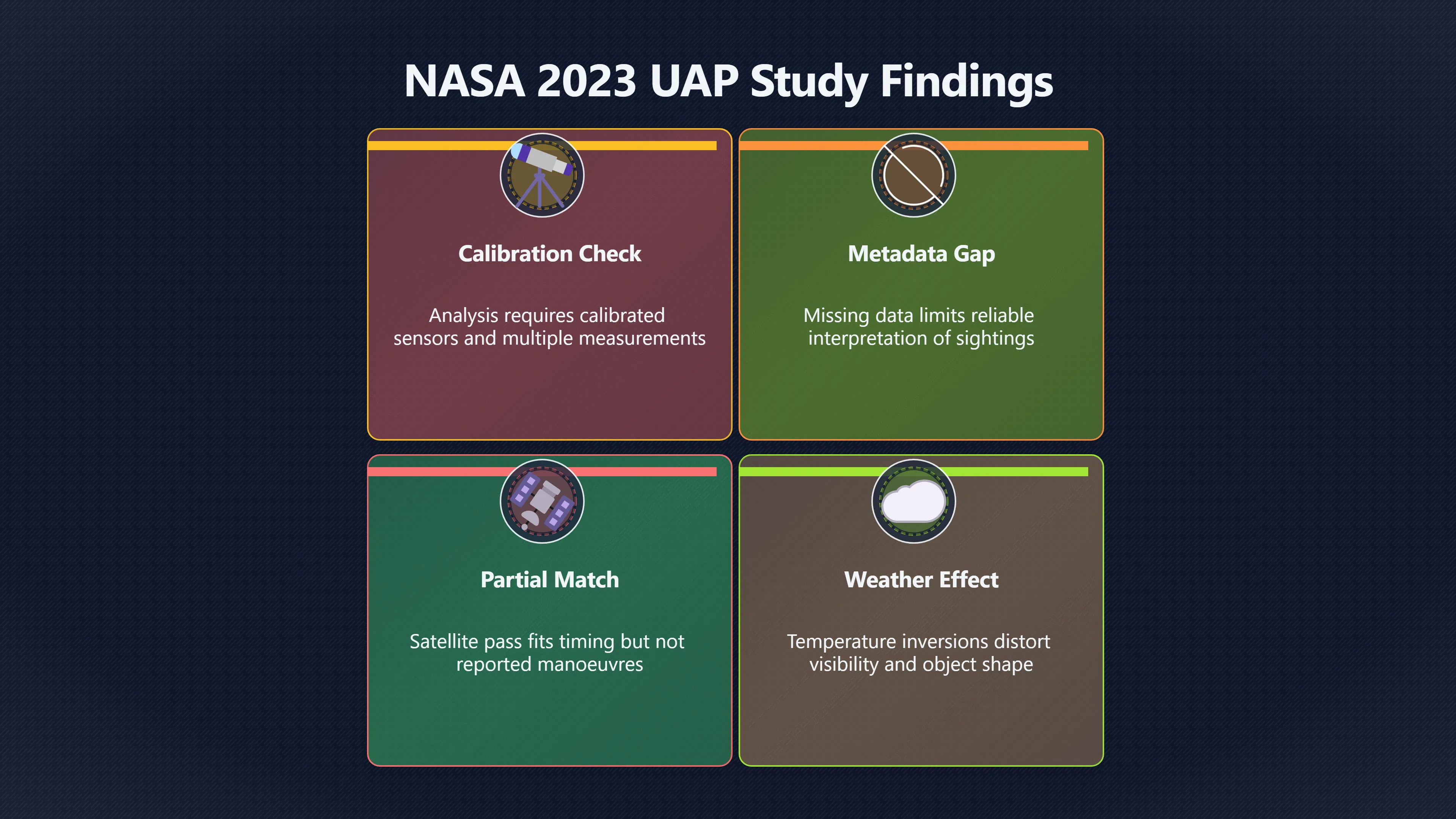
 Careful investigation therefore depends on tracking how explanations gain and lose support as evidence accumulates. NASA’s 2023 UAP study stressed that reliable analysis requires calibrated observations, multiple measurements, and usable metadata rather than isolated impressions.[NASA Science]science.nasa.govNASA ScienceIndependent Study Team ReportAt present, analysis of UAP data is hampered by poor sensor calibration, the lack of multiple me… A layered timeline helps investigators preserve that discipline. Instead of quietly discarding contradictions, it keeps them attached to the record where they can still be tested later.
How explanations gain and lose support over time
A good UFO case file behaves less like a verdict and more like an evolving reconstruction. Each new piece of information changes the strength of competing explanations rather than instantly proving or disproving them.
That distinction matters because many sightings move through several explanatory stages:
- An initial witness report may sound highly unusual.
- Early sky checks may identify a possible aircraft, satellite, or astronomical object.
- Video analysis may weaken some dramatic claims by revealing motion blur or autofocus shifts.
- Environmental checks may later strengthen or weaken those ordinary explanations.
- Additional witnesses may introduce contradictions instead of clarity.
A layered timeline preserves those changes instead of rewriting the case retrospectively.
For example, suppose a witness reports a bright object “hovering silently” over a coastal area for twelve minutes before rapidly departing. An ADS-B aviation check might reveal an aircraft on a matching bearing at the correct time. That strengthens the aircraft hypothesis. But later analysis may show:
- The aircraft was below the horizon line from the witness position.
- The timing only overlaps with the last two minutes of the sighting.
- The witness video contains light behaviour inconsistent with standard navigation lights.
- Weather conditions created strong temperature inversions that could distort visibility.
At that point, the aircraft explanation still matters. It may explain part of the event. But the timeline prevents investigators from overstating its reach.
This is one reason layered reconstruction resembles formal accident investigation practice. The US National Transportation Safety Board describes investigations as a process of piecing together sequences from multiple evidence streams to determine what happened.[NTSB]ntsb.govThe Investigative ProcessDuring this phase, NTSB specialists analyze the information gathered to piece together a sequence of events… Aviation reconstruction manuals similarly emphasise sequence-building from witness accounts, recordings, environmental data, and technical evidence rather than single-source storytelling.[ICAO]icao.intDoc 97569 Jun 2024 — Evidence which facilitated the reconstruction of the sequence of events, such as witness accounts, cockpit voice…
In UFO investigations, the equivalent discipline means an explanation can remain “partially supported” without becoming “confirmed”.
Why early certainty damages UFO investigations
One of the most common failure modes in UFO analysis is premature closure: deciding too early that a case is solved or unsolved.
Research into clinical and investigative reasoning repeatedly identifies premature closure, anchoring, and confirmation bias as major sources of analytical error.[ASM Publications]asmepublications.onlinelibrary.wiley.comASM Publications Closing in on premature closure biasASM PublicationsClosing in on premature closure bias - Medical Education12 Oct 2017 — 1 Premature closure bias occurs when a diagnosis is…[PMC]pmc.ncbi.nlm.nih.govThe pitfalls of premature closure: clinical decision-making in a…by B Kumar · 2011 · Cited by 39 — Premature closure is a type of c…[MSD Manuals]msdmanuals.comThis is one of the most common errors; clinicians make a quick diagnosis (often based…Read more… In practical terms, investigators often lock onto the first plausible explanation and begin interpreting later evidence to support it.
That dynamic appears frequently in UFO discussions.
When sceptical explanations harden too early
An investigator may initially identify Venus, Starlink satellites, lanterns, drones, or a military aircraft as a likely explanation. Those possibilities are often reasonable and statistically important. Most sightings do turn out to involve ordinary causes.
The problem appears when the explanation stops being tested.
For example:
- A satellite explanation may fit the brightness and timing but fail to explain repeated directional changes.
- A drone explanation may fit hovering behaviour but fail range or endurance limits.
- A re-entry explanation may fit reports of fragmentation but fail the reported duration.
Without layered tracking, investigators sometimes compress the entire case into “probably solved” and stop documenting mismatches.
That creates a distorted archive. Future reviewers can no longer tell which parts genuinely matched the explanation and which parts were simply ignored.
When extraordinary claims harden too early
The same problem occurs in the opposite direction.
A witness or community may decide early that a sighting was anomalous or non-human. From then on, ordinary explanations become treated as hostile debunking rather than evidence to test.
A layered timeline resists both extremes by preserving explanatory competition.
Instead of asking:
“Was this definitely a drone or definitely anomalous?”
the investigation asks:
- Which observations does the drone hypothesis explain?
- Which observations remain weakly matched?
- Which observations may result from witness error or camera artefacts?
- Which details remain unresolved because evidence quality is insufficient?
That structure keeps uncertainty visible instead of converting uncertainty into certainty.
Why unresolved details do not prove anomalies
One of the most misunderstood points in UFO investigation is that unresolved details are normal in complex observational events.
A layered timeline makes that easier to see.
Many reports contain fragments that resist clean explanation because the available data is incomplete, contradictory, or low quality. NASA’s UAP study repeatedly highlighted how poor calibration, missing metadata, and lack of multiple measurements limit reliable interpretation.[NASA Science]science.nasa.govNASA ScienceIndependent Study Team ReportAt present, analysis of UAP data is hampered by poor sensor calibration, the lack of multiple me…[NASA]science.nasa.govNASA ScienceIndependent Study Team ReportAt present, analysis of UAP data is hampered by poor sensor calibration, the lack of multiple me…
That means unresolved elements can emerge from several ordinary causes:
- Timing inaccuracies in witness memory.
- Incomplete flight tracking coverage.
- Camera distortion.
- Atmospheric visibility effects.
- Incorrect distance estimation.
- Multiple objects being conflated into one event.
- Gaps in available radar or sensor data.
A layered timeline therefore separates “unresolved” from “anomalous”.
Those are not the same category.

A practical example
Imagine a case where:
- A witness video matches a known satellite flare.
- Astronomical timing aligns closely.
- Brightness behaviour broadly fits the satellite hypothesis.
- But the witness also reports a sudden ninety-degree turn not visible in the footage.
A disciplined case file does not need to pretend the turn either definitely happened or definitely did not happen.
Instead, the timeline can record:
ObservationSatellite hypothesisTimingStrong fitDirectionStrong fitBrightnessModerate-to-strong fitSilent observationNeutralReported sharp turnWeak fitVideo evidence for manoeuvreUnsupported
That approach preserves uncertainty honestly.
The unresolved manoeuvre report does not automatically prove exotic technology. But neither should it be silently erased from the case narrative.
Keeping contradictory evidence visible in the case file
The strongest reason for layered timelines is governance rather than spectacle. They create accountability inside the investigation itself.
Without explicit tracking, case files naturally drift toward narrative simplification. Contradictory details disappear because they are inconvenient, confusing, or difficult to reconcile.
Layered systems counter that drift by preserving evidence status changes over time.
Contradictions often contain the most useful information
In UFO investigations, contradictions are not always flaws. Sometimes they identify the exact point where an explanation weakens.
Examples include:
- A witness reports silence while aviation data suggests a low aircraft flyover.
- Cloud cover records conflict with claimed visibility of stars or planets.
- Satellite predictions fit timing but not observed motion paths.
- Video metadata conflicts with the reported chronology.
- Independent witnesses disagree on colour, speed, or duration.
If these contradictions remain visible, later investigators can revisit them as new data becomes available.
If they are buried or rewritten, the case becomes impossible to audit.
This matters especially in AI-assisted investigation systems. Automated workflows can unintentionally amplify early assumptions if confidence scores are not separated from evidence provenance.
A weakly matched explanation should remain weakly matched inside the timeline rather than becoming “resolved” because an algorithm identified a statistically common object type.

Why provenance matters
A layered timeline also records where each claim originated:
- Witness memory.
- Raw media.
- Automated sky databases.
- Human interpretation.
- AI-generated correlation.
- Later commentary.
That provenance layer prevents analytical contamination.
For example, if an AI system flags a likely Starlink pass, the timeline should preserve:
- Which satellite catalogue produced the match.
- The confidence level.
- The timing tolerance.
- Whether the geometry fully aligned.
- Which observations remained unexplained.
This is especially important because many UFO investigations occur publicly online, where explanations often mutate rapidly through reposts, edited clips, and selective retelling.
Why weak explanations are still valuable
A weak explanation is not a failed investigation outcome. Often it is the most honest available conclusion.
In practice, UFO case files frequently end in one of five states:
- Strongly explained.
- Plausibly explained.
- Partially explained.
- Unresolved due to insufficient data.
- Genuinely unusual after screening.
The middle categories matter most because they prevent overclaiming.
A layered timeline allows investigators to say:
- “This explanation accounts for most of the event.”
- “This explanation fits only the recorded footage.”
- “This explanation matches timing but not behaviour.”
- “This explanation became weaker after weather reconstruction.”
- “No single explanation currently fits all layers.”
That may sound less dramatic than declaring a case solved or extraordinary. But it produces more reliable archives and more reusable evidence.
It also improves future machine-assisted analysis. AI systems trained on nuanced, layered case histories are more likely to recognise partial matches, mixed-cause events, and ambiguous evidence patterns than systems trained on oversimplified “solved versus unsolved” labels.
Why layered timelines improve long-term credibility
The public credibility problem around UFO investigation often comes from overstatement on both sides.
Some commentators present unresolved cases as proof of extraordinary technology. Others dismiss incomplete explanations as sufficient closure even when major inconsistencies remain.
Layered timelines reduce both pressures because they preserve analytical transparency.
Readers can see:
- What was actually observed.
- Which evidence was strongest.[icao.int]icao.intDoc 97569 Jun 2024 — Evidence which facilitated the reconstruction of the sequence of events, such as witness accounts, cockpit voice…
- Which explanations fit well.
- Which explanations weakened over time.
- Which uncertainties remained unresolved.
- Which conclusions depended on interpretation rather than direct measurement.
That visibility is especially important in modern AI-assisted UFO investigation, where automated tools can rapidly correlate aviation traffic, weather, astronomy, and satellite data. Fast correlation is useful, but it also increases the risk of false confidence if the system compresses uncertainty into binary outcomes.
A layered timeline keeps the investigation testable after the first wave of analysis. Weak explanations remain visible, contradictory evidence remains attached to the case, and unresolved details remain separated from extraordinary claims. That structure does not guarantee answers. It makes it harder to pretend answers exist when the evidence only supports partial ones.
Amazon book picks
Further Reading
Books and field guides related to Why A UFO Explanation Can Fit Only Partly. Use these as the next step if you want deeper reading beyond the article.
The Demon-Haunted World
Supports keeping unresolved details separate from anomaly claims.
The Signal and the Noise
Strong fit for explanations that partly fit but fail on contradictions.
eBay marketplace picks
Marketplace Samples
Example marketplace items related to this page. Use the search link to explore similar finds on eBay.




Endnotes
1.
Source: science.nasa.gov
Link:https://science.nasa.gov/wp-content/uploads/2023/09/uap-independent-study-team-final-report.pdf
Source snippet
NASA ScienceIndependent Study Team ReportAt present, analysis of UAP data is hampered by poor sensor calibration, the lack of multiple me...
2.
Source: nasa.gov
Title: update nasa shares uap independent study report names director
Link:https://www.nasa.gov/news-release/update-nasa-shares-uap-independent-study-report-names-director/
Source snippet
UPDATE: NASA Shares UAP Independent Study Report14 Sept 2023 — We found that NASA can help the whole-of-government UAP effort through sys...
3.
Source: ntsb.gov
Link:https://www.ntsb.gov/investigations/process/Pages/default.aspx
Source snippet
The Investigative ProcessDuring this phase, NTSB specialists analyze the information gathered to piece together a sequence of events...
4.
Source: icao.int
Link:https://www.icao.int/sites/default/files/airnavigation/AIG/9756_P4_cons_en.pdf
Source snippet
Doc 97569 Jun 2024 — Evidence which facilitated the reconstruction of the sequence of events, such as witness accounts, cockpit voice...
5.
Source: pmc.ncbi.nlm.nih.gov
Link:https://pmc.ncbi.nlm.nih.gov/articles/PMC3189641/
Source snippet
The pitfalls of premature closure: clinical decision-making in a...by B Kumar · 2011 · Cited by 39 — Premature closure is a type of c...
6.
Source: pmc.ncbi.nlm.nih.gov
Link:https://pmc.ncbi.nlm.nih.gov/articles/PMC8520040/
Source snippet
bias). Premature closure, Arriving at a conclusion or diagnosis too early without considering all possibilities. Confirmation bias, Seeki...
7.
Source: ntsb.gov
Title: i AVIATION INVESTIGATION MANUAL
Link:https://www.ntsb.gov/about/Documents/MajorInvestigationsManualApp.pdf
Source snippet
MAJOR TEAM...This advisory [checklist]({{ 'checklist/' | relative_url }}) is designed to lead an Investigator-in-Charge through most of the administrative steps and many of...
8.
Source: ntsb.gov
Link:https://www.ntsb.gov/investigations/process/Pages/investigativehearings.aspx
Source snippet
NTSB Investigative HearingsAfter the hearing, the NTSB will use the information gathered to complete the investigation, determine probabl...
9.
Source: ntsb.gov
Link:https://www.ntsb.gov/investigations/Pages/Investigations.aspx
Source snippet
InvestigationsInvestigation Process · Investigation Reports · Investigation Dockets... Official Testimony · Congressional and Regulatory...
10.
Source: msdmanuals.com
Link:https://www.msdmanuals.com/professional/special-subjects/clinical-decision-making/cognitive-errors-in-clinical-decision-making
Source snippet
This is one of the most common errors; clinicians make a quick diagnosis (often based...Read more...
11.
Source: asmepublications.onlinelibrary.wiley.com
Title: ASM Publications Closing in on premature closure bias
Link:https://asmepublications.onlinelibrary.wiley.com/doi/full/10.1111/medu.13452
Source snippet
ASM PublicationsClosing in on premature closure bias - Medical Education12 Oct 2017 — 1 Premature closure bias occurs when a diagnosis is...
12.
Source: Wikipedia
Title: National Transportation Safety Board
Link:https://en.wikipedia.org/wiki/National_Transportation_Safety_Board
Source snippet
National Transportation Safety BoardThe National Transportation Safety Board (NTSB) is an independent US government investigative agen...
13.
Source: uapedia.ai
Title: nasas 2023 uap study
Link:https://uapedia.ai/wiki/nasas-2023-uap-study/
Source snippet
NASA's 2023 UAP StudyThe report gives the UAP community a practical playbook: Build a federal reporting pipeline. Instrument it with cali...
Additional References
14.
Source: merckmanuals.com
Link:https://www.merckmanuals.com/professional/special-subjects/clinical-decision-making/cognitive-errors-in-clinical-decision-making
Source snippet
Cognitive Errors in Clinical Decision MakingConfirmation bias is "cherry-picking," which means clinicians selectively accept clinical dat...
15.
Source: strategic-risk-global.com
Link:https://www.strategic-risk-global.com/risk-mitigation/investigating-accidents-using-root-cause-analysis/1361925.article
Source snippet
Investigating Accidents Using Root Cause AnalysisThus, the purpose of the investigation is to clearly identify what happened, determine t...
16.
Source: studocu.com
Link:https://www.studocu.com/en-us/document/harvard-medical-school/estadistica/nasa-uap-independent-study-team-final-report-key-findings-and-recommendations/157385671
Source snippet
NASA UAP Independent Study Team Final ReportAt present, analysis of UAP data is hampered by poor sensor calibration, the. lack of multipl...
17.
Source: managingexpectations.net
Link:https://managingexpectations.net/blog/articles/nasa-uap-study-managing-expectations.html
Source snippet
NASA's UAP Study: What It Did — and Did Not — ConcludeNASA's study team treated UAP as a scientific and data problem: how should reliable...
18.
Source: atsb.gov.au
Link:https://www.atsb.gov.au/about_atsb/investigation-process
Source snippet
The investigation processAll occurrence investigations progress through a series of phases in accordance with the ATSB's investigation me...
19.
Source: ufotransparency.com
Link:https://ufotransparency.com/files/decade-2020s-nasa-uap-independent-study-report-2023-uap-independent-study-team-final-report
Source snippet
NASA Independent UAP Study Final Report, NASA · 20238 May 2026 — At present, analysis of UAP data is hampered by poor sensor calibration...
Published: May 2026
20.
Source: hicaonline.in
Link:https://www.hicaonline.in/pdf/Accident%20investigation%20report.pdf
Source snippet
procedures manual of aircraft accident/incident investigationIt is intended to provide guidance on the process of conducting an investiga...
21.
Source: mchip.net
Link:https://mchip.net/browse/u116E4/242111/Aircraft%20Accident%20Report%20National%20Transportation%20Safety%20Board.pdf
Source snippet
The process begins immediately after an accident, with the NTSB's Accident. Investigation Division (AID) mobilizing a team.Read more...
22.
Source: fhea.com
Title: cognitive errors in clinical diagnosis availability bias and premature closure
Link:https://www.fhea.com/resource-center/cognitive-errors-in-clinical-diagnosis-availability-bias-and-premature-closure/
Source snippet
Cognitive Errors in Clinical Diagnosis: Availability Bias and...24 Sept 2021 — Errors in diagnostic reasoning can occur when clinicians...
23.
Source: safetymaterials.argus.aero
Title: aero NTS B Investigation Process & the Party System• Defining an Accident
Link:https://safetymaterials.argus.aero/wp-content/uploads/2023/05/1868_NTSB-Investigation-Process-and-the-Party-System-2018.pdf
Source snippet
• The Accident Investigation Process. • NTSB Party System. • What to do if your company is involved in an accident. Page 3. Stephen...Re...
Topic Tree