Within Orbital Data
When Starlink is only a weak UFO answer
Starlink satellites can be tempting explanations, but manoeuvres and rapid constellation changes make old sightings harder to verify.
On this page
- Why manoeuvres break simple backtracking
- How multiple Starlinks create false confidence
- When to label a match uncertain
Page outline Jump by section
Introduction
Starlink satellites are now one of the first explanations checked in many UFO or UAP investigations. That is reasonable: the constellation is large, highly visible, and often produces unusual-looking sky behaviour, especially during deployment phases or bright low-angle passes. The problem is that investigators can become overconfident when a tracking app shows “Starlink nearby” for an old sighting. In many historical cases, that answer is only weakly supported.
 Modern Starlink spacecraft manoeuvre frequently, change altitude over time, and operate in dense groups with very similar orbital paths. Public orbital records are useful, but they are not perfect reconstructions of where each spacecraft was at every minute in the past. For AI-assisted UFO investigation, this creates a specific risk: automated systems may produce satellite “matches” that look precise while actually resting on stale orbital data, propagated estimates, or simple constellation ambiguity. A responsible workflow therefore treats many historical Starlink identifications as tentative rather than confirmed.[PMC]pmc.ncbi.nlm.nih.govOrbit Determination for Continuously Maneuvering Starlink…by A Lang · 2025 · Cited by 3 — The proposed method can provide accurate… 2arXiv
Why manoeuvres break simple backtracking
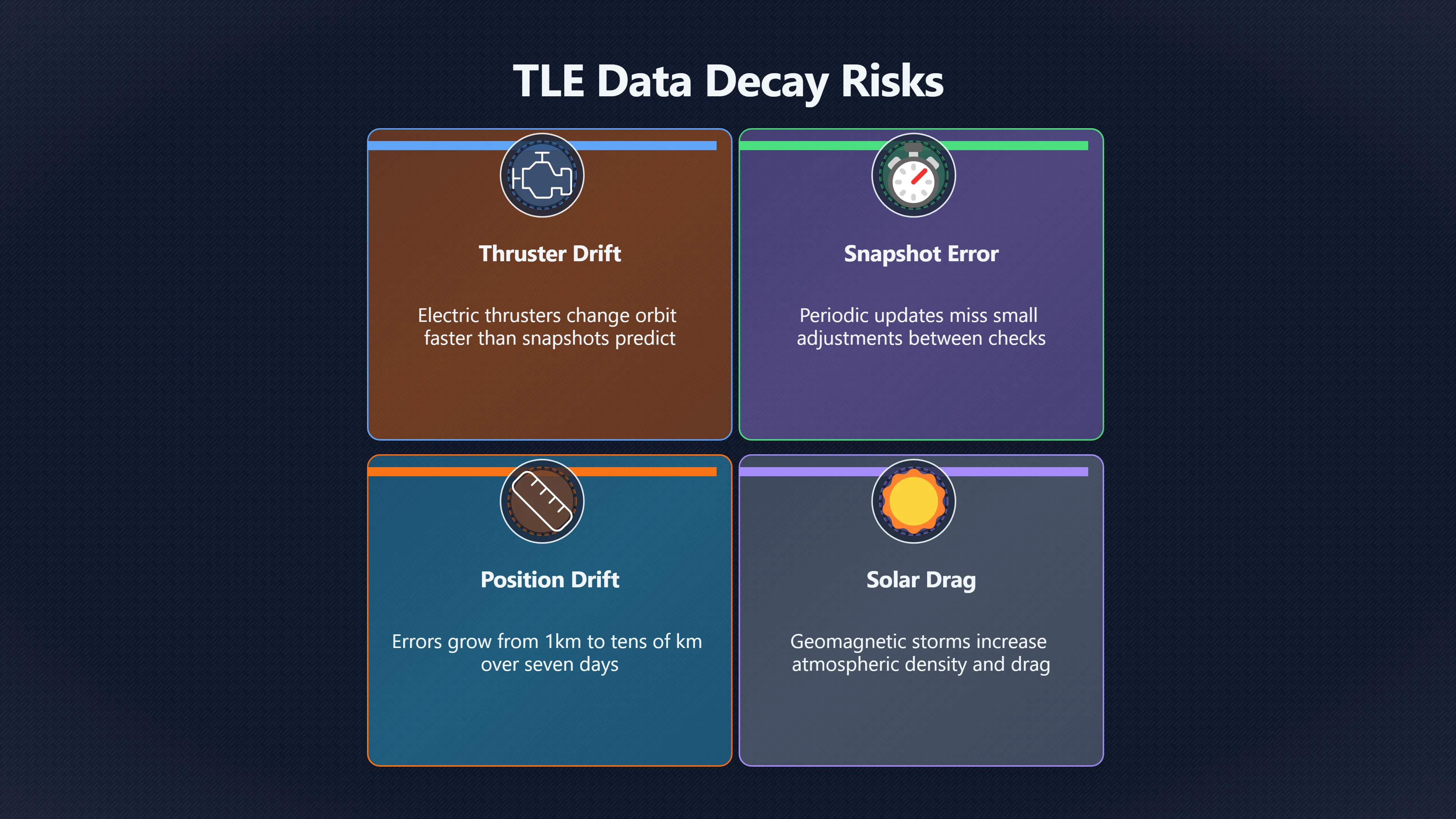
The key issue is that Starlink satellites are not passive objects drifting unchanged through space. They actively manoeuvre using onboard electric propulsion systems, including Hall-effect thrusters designed for orbit raising, station keeping, collision avoidance, and controlled deorbiting.[Spaceflight Now]spaceflightnow.comSpaceflight NowSpaceX unveils first batch of larger upgraded Starlink…Feb 26, 2023 — The Starlink V2 Mini satellites also carry an arg… Wikipedia That matters because most public UFO checks rely on TLEs[Wikipedia]WikipediaOpen source on wikipedia.org., or Two-Line Element sets. A TLE is not a continuous flight recorder. It is a periodic orbital snapshot that software uses to estimate future or past positions with the SGP4 propagation model. If the satellite manoeuvred between updates, the estimate can drift significantly away from reality.[Space Track]space-track.orgSpace TrackHelp DocumentationThe general perturbations (GP) class is an efficient listing of the newest SGP4 keplerian element set for ea… ScienceDirect For ordinary skywatching this may not matter much. A hobbyist only needs to know roughly when a satellite will pass overhead tonight. Histori[sciencedirect.com]sciencedirect.comThe Simplified General Perturbations-4 (SGP4) propagator was used.Read more… cal UFO reconstruction is stricter. The investigator may need to know whether a specific object crossed a precise section of sky at 21:14:32 from a particular viewing angle two years ago.
Recent research focused specifically on Starlink has highlighted how quickly prediction accuracy can degrade. A 2026 analysis comparing public TLE propagation against operator-updated orbital truth data found median position errors growing from around 1 km after six hours to tens of kilometres after seven days, depending on orbital shell and propagation method.[arXiv]arxiv.orgHow long can you trust a Starlink TLE? An empirical comparison of SGP4 and high-fidelity propagation against operator-updated truth…
Those errors matter visually because brightness geometry is extremely sensitive. A satellite can flare brightly for one observer while being nearly invisible from a nearby location minutes later. A small along-track timing error can completely change whether the satellite would have appeared dramatic, dim, stationary-looking, or absent.
Collision avoidance creates hidden uncertainty
Starlink manoeuvres are not rare edge cases. SpaceX has reported tens of thousands of collision-avoidance manoeuvres across the constellation. Space[Space Intel Report]spaceintelreport.comSpaceX: 148696 Starlink collision maneuvers in 6 months…Jan 6, 2026 — LA PLATA, Maryland — SpaceX's Starlink constellation performed 1…
Many of these adjustments are small, but small orbital changes accumulate over time. For historical analysis, this means an investigator cannot safely assume that a public TLE sequence perfectly captured every orbital adjustment that occurred before or after a sighting date.
Academic work on continuously manoeuvring Starlink satellites now treats the constellation as a distinct tracking challenge because conventional orbit determination methods produce larger errors than they do for more stable spacecraft.[PMC]pmc.ncbi.nlm.nih.govOrbit Determination for Continuously Maneuvering Starlink…by A Lang · 2025 · Cited by 3 — The proposed method can provide accurate…
This becomes especially important for sightings investigated long after the event. If a UFO report from 2021 is analysed in 2026 using reconstructed orbital paths, even a visually convincing satellite overlay may only represent a plausible approximation rather than a verified identification.
Solar activity can quietly distort reconstruction
Another complication comes from atmospheric drag and solar activity. Starlink operates in low Earth orbit, where the upper atmosphere still creates measurable drag. During periods of stronger geomagnetic activity, atmospheric density changes and orbital decay rates increase.[Frontiers]frontiersin.orgFrontiersTracking reentries of Starlink satellites during the rising…by DM Oliveira · 2025 · Cited by 11 — In this work, we use two-li…
This can distort backtracking attempts in subtle ways:
- satellites lose altitude faster than expected
- prediction errors grow unevenly
- different spacecraft within the same orbital shell drift differently
- old propagated tracks become less reliable
For UFO analysis, this means that “the satellite should have been here” may depend heavily on which orbital dataset was used and how old that dataset was relative to the sighting.
How multiple Starlinks create false confidence
Even when orbital predictions are reasonably accurate, another problem appears: there are simply many Starlink satellites moving in similar patterns.
This creates a psychological trap in UFO investigation. If an analyst searches a crowded Starlink shell around the right time window, they will often find at least one satellite whose approximate path resembles the witness description. That resemblance can create false confidence.
Dense constellations increase coincidence matches
Traditional satellite identification once involved relatively sparse populations. A bright moving object might plausibly correspond to one or two candidates. Starlink changed that environment completely.
Thousands of spacecraft now occupy related orbital shells, often separated by only small timing or angular differences.[Wikipedia]WikipediaOpen source on wikipedia.org.
For historical UFO checks, this creates several failure modes:
- one satellite is mistaken for another in the same shell
- an approximate pass is treated as an exact match
- software selects the nearest candidate automatically
- analysts ignore uncertainty ranges because the visual overlay “looks right”
A weak match can therefore become rhetorically stronger than the underlying evidence supports.
For example, a witness may report:
- a steady moving light
- low apparent speed
- south-west to north-east travel
- visibility lasting roughly two minutes
In a dense Starlink environment, multiple satellites may roughly satisfy those conditions within a short time window. An AI system that only outputs the “best fit” can accidentally hide the ambiguity from investigators.
AI systems can overstate certainty
This is one of the more important workflow risks in AI-assisted UFO investigation. Automated systems are good at generating candidate explanations quickly, but they can also present probabilistic correlations as if they were hard identifications.
A machine-learning pipeline that scores “satellite likelihood” may not fully represent:
- TLE age
- manoeuvre uncertainty
- propagation drift
- brightness unpredictability
- ambiguity between nearby Starlinks
- missing historical ephemerides
The output can therefore sound stronger than the evidence really is.
This becomes especially misleading in public-facing UFO discussions because “identified as Starlink” sounds definitive to non-specialists. In reality, some cases are only weakly consistent with one or more possible Starlink passes.

When a Starlink match should stay labelled uncertain
The most responsible approach is not to reject Starlink explanations outright, but to classify them carefully.
In UFO investigation workflows, a useful distinction exists between:
- ruled-out explanations
- plausible explanations
- weak matches
- unresolved cases
Many historical Starlink identifications belong in the “plausible but weak” category rather than the “confirmed explanation” category.
Signs that the match is weak
A Starlink explanation should remain tentative when several warning signs appear together:
- the orbital data were generated long after the sighting
- the propagated pass depends on stale TLEs
- the satellite was known to be manoeuvring during that period
- multiple Starlinks fit approximately equally well
- brightness behaviour does not align with the witness description
- timing only matches after widening the uncertainty window
- no historical ephemeris archive confirms the pass independently
This does not mean the explanation is wrong. It means the confidence level should stay modest.
Historical reconstruction is strongest when multiple factors align
A stronger Starlink identification usually combines several independent checks:
- archived historical TLEs from the actual period
- a close positional match
- matching direction and timing
- brightness consistent with solar geometry
- corroboration from multiple tracking datasets
- absence of contradictory witness details
The important point is that the identification should emerge from convergence, not from a single convenient overlay.
Brightness claims deserve extra caution
Witnesses often describe UFO objects as unusually bright, hovering, pulsing, or suddenly vanishing. Starlink satellites can sometimes produce visually dramatic effects, especially during deployment trains or reflective geometry changes, but brightness reconstruction is harder than simple position matching.
Research on Starlink photometry has shown significant variability in observed brightness between spacecraft generations and viewing geometries.[arXiv]arxiv.orgHow long can you trust a Starlink TLE? An empirical comparison of SGP4 and high-fidelity propagation against operator-updated truth…
That means a positional match alone does not automatically explain the witness experience. A dim predicted pass may not plausibly account for reports of intense luminosity or dramatic visual behaviour.
What good UFO workflows do differently
A robust AI-assisted UFO investigation system does not ask only, “Was a Starlink nearby?” It asks a more careful chain of questions:
- Which historical orbital datasets existed closest to the sighting date?
- How stale were the element sets?
- Was the spacecraft likely manoeuvring?
- How many nearby Starlinks could fit the report?
- How sensitive is the result to timing uncertainty?
- Would the object likely have been bright enough to match the witness description?
- Does the explanation remain convincing after uncertainty is honestly represented?
This produces a more useful output than a simple yes-or-no identification.
Instead of claiming:
“Object identified as Starlink satellite.”
A better evidence-aware conclusion may read:
“One or more Starlink satellites were plausibly present in the relevant sky sector, but historical orbital uncertainty and constellation density prevent a high-confidence identification.”
That wording may sound less dramatic, but it is often more scientifically accurate.
Amazon book picks
Further Reading
Books and field guides related to When Starlink is only a weak UFO answer. Use these as the next step if you want deeper reading beyond the article.

The Practical Astronomer
Supports understanding orbital observations and sky tracking.
eBay marketplace picks
Marketplace Samples
Example marketplace items related to this page. Use the search link to explore similar finds on eBay.


Endnotes
1.
Source: pmc.ncbi.nlm.nih.gov
Link:https://pmc.ncbi.nlm.nih.gov/articles/PMC12252113/
Source snippet
Orbit Determination for Continuously Maneuvering Starlink...by A Lang · 2025 · Cited by 3 — The proposed method can provide accurate...
2.
Source: arxiv.org
Link:https://arxiv.org/abs/2605.19850
Source snippet
How long can you trust a Starlink TLE? An empirical comparison of SGP4 and high-fidelity propagation against operator-updated truth...
3.
Source: space-track.org
Link:https://www.space-track.org/documentation
Source snippet
Space TrackHelp DocumentationThe general perturbations (GP) class is an efficient listing of the newest SGP4 keplerian element set for ea...
4.
Source: Wikipedia
Link:https://en.wikipedia.org/wiki/Starlink
5.
Source: sciencedirect.com
Link:https://www.sciencedirect.com/science/article/abs/pii/S0273117708006121
Source snippet
The Simplified General Perturbations-4 (SGP4) propagator was used.Read more...
6.
Source: arxiv.org
Link:https://arxiv.org/html/2605.19850v1
Source snippet
How long can you trust a Starlink TLE? An empirical...8 days ago — We characterise the position-error behaviour of public Two-Line Eleme...
7.
Source: space.com
Title: spacex starlink 50000 collision avoidance maneuvers space safety
Link:https://www.space.com/spacex-starlink-50000-collision-avoidance-maneuvers-space-safety
Source snippet
SpaceX Starlink satellites made 50000 collision-avoidance...Jul 23, 2024 — Satellites in SpaceX's Starlink megaconstellation made n...
8.
Source: space.com
Title: x starlink collision avoidance maneuver growth stalls
Link:https://www.space.com/spacex-starlink-collision-avoidance-maneuver-growth-stalls
Source snippet
Starlink close encounters decrease despite ever-growing...15 Jan 2024 — When the available data show that a Starlink satellite has a pro...
9.
Source: arxiv.org
Link:https://arxiv.org/abs/2505.13752
10.
Source: sciencedirect.com
Link:https://www.sciencedirect.com/science/article/abs/pii/S027311772400615X
Source snippet
Maneuver strategies of Starlink satellite based on SpaceX...by A Liu · 2024 · Cited by 27 — Failure to timely compensate for a satellite...
11.
Source: arxiv.org
Link:https://arxiv.org/abs/2208.03226
Source snippet
Photometric Characterization and Trajectory Accuracy of Starlink Satellites: Implications for Ground-Based Astronomical SurveysAugus...
12.
Source: space.com
Title: x starlink satellites
Link:https://www.space.com/spacex-starlink-satellites.html
Source snippet
Starlink satellites: Facts, tracking and impact on astronomyDec 18, 2025 — According to SpaceX's social media posts, the upgrades include...
13.
Source: sciencedirect.com
Link:https://www.sciencedirect.com/science/article/pii/S0094576523002060
Source snippet
Orbital kinematics of conjuncting objects in Low-Earth...by G Campiti · 2023 · Cited by 23 — Currently, collision avoidance maneuvers ar...
14.
Source: sciencedirect.com
Link:https://www.sciencedirect.com/science/article/abs/pii/S0273117725015224
Source snippet
Energy analysis method for maneuver detection and orbit...by A Liu · 2025 — Chen and Lin (2024) utilized the Starlink ephemeris as refer...
15.
Source: Wikipedia
Title: Two line element set
Link:https://en.wikipedia.org/wiki/Two-line_element_set
Source snippet
Two-line element setFor a body in a typical low Earth orbit, the accuracy that can be obtained with the SGP4 orbit model is on the ord...
16.
Source: spaceflightnow.com
Link:https://spaceflightnow.com/2023/02/26/spacex-unveils-first-batch-of-larger-upgraded-starlink-satellites/
Source snippet
Spaceflight NowSpaceX unveils first batch of larger upgraded Starlink...Feb 26, 2023 — The Starlink V2 Mini satellites also carry an arg...
17.
Source: spaceintelreport.com
Link:https://www.spaceintelreport.com/spacex-148696-starlink-collision-maneuvers-in-6-months-ending-nov-30-continued-issues-with-operators-slipshod-reporting/
Source snippet
SpaceX: 148696 Starlink collision maneuvers in 6 months...Jan 6, 2026 — LA PLATA, Maryland — SpaceX's Starlink constellation performed 1...
18.
Source: frontiersin.org
Link:https://www.frontiersin.org/journals/[astronomy
Source snippet
FrontiersTracking reentries of Starlink satellites during the rising...by DM Oliveira · 2025 · Cited by 11 — In this work, we use two-li...
19.
Source: kureansiklopedi.com
Title: starlink 39f3a
Link:https://kureansiklopedi.com/en/detay/starlink-39f3a
Source snippet
Starlink | KÜRE EncyclopediaDec 21, 2025 — Satellites are equipped with highly efficient Hall-effect thrusters for orbit raising, station...
Additional References
20.
Source: amostech.com
Link:https://amostech.com/TechnicalPapers/2023/Poster/Constant.pdf
Source snippet
Analysis of Mega-Constellation Data Time-Series Charles CoBy assessing Two-Line-Element (TLE) data from cooperative and uncooperative tra...
21.
Source: reddit.com
Link:https://www.reddit.com/r/Starlink/comments/qkmjsp/are_starlink_satellite_movements_very/
Source snippet
Are Starlink satellite movements very deterministicOn the short term they should be fairly reliable, though the Starlink Satellites do ha...
22.
Source: celestrak.org
Link:https://www.celestrak.org/NORAD/elements/supplemental/
Source snippet
Current Supplemental GP Element SetsCelesTrak now offers supplemental GP (General Perturbations) element sets (GPEs) derived directly fro...
23.
Source: eoportal.org
Link:https://www.eoportal.org/satellite-missions/starlink
Source snippet
Starlink Satellite Constellation• Hall-effect thrusters using krypton as the reaction mass, for position adjustment on orbit, altitude ma...
24.
Source: planet4589.org
Link:https://planet4589.org/space/ele.html
Source snippet
Historical TLE Orbital ElementsThis database is useful for historical analysis, but does not contain recent element sets and so cannot be...
25.
Source: reddit.com
Link:https://www.reddit.com/r/SpaceXLounge/comments/1izudtk/spacex_update_on_targeted_reentry_for_starlink/
Source snippet
SpaceX Update on Targeted Re-entry for Starlink satellites...Successful targeted reentry requires maintaining attitude control down to v...
26.
Source: reddit.com
Link:https://www.reddit.com/r/StarlinkEngineering/comments/1ayji8d/the_issue_regarding_the_real_distribution_of/
Source snippet
The issue regarding the real distribution of Starlink satellitesAs shown in the figure, the RAAN of satellites varies, making it difficul...
27.
Source: conference.sdo.esoc.esa.int
Link:https://conference.sdo.esoc.esa.int/proceedings/sdc9/paper/48
Source snippet
Satellite Classification and Orbit Maneuver DetectionIn this paper, first the clustering analysis method is used to classify Starlink sat...
28.
Source: celestrak.org
Link:https://www.celestrak.org/publications/IAC/2025/IAC-25%2CA6%2C7%2C1%2Cx99453%2CPaper.pdf
29.
Source: reddit.com
Link:https://www.reddit.com/r/Starlink/comments/enpdft/which_tracking_site_has_the_correct_info/
Topic Tree