Within AI Clustering
When UFO Buzzwords Trick AI Clustering Systems
Public UFO terminology can cause AI systems to group culturally influenced reports instead of physically related events.
On this page
- How famous UFO terms spread
- Witness language versus physical evidence
- Reducing conclusion leakage in archives
Page outline Jump by section
Introduction
AI systems can compare thousands of UFO sighting reports far faster than any human archive team, but they also inherit the cultural noise embedded in witness language. When a major UFO documentary, Hollywood film, viral TikTok clip, or headline-grabbing military sighting popularises phrases such as “tic-tac”, “black triangle”, “orb swarm”, or “non-human craft”, those terms begin spreading through later reports. A clustering system trained mainly on narrative similarity may then mistake shared vocabulary for shared physical events.
 In AI-assisted UFO sighting investigation, this creates a serious investigative risk. Reports that merely sound alike can be grouped together even when their locations, environmental conditions, flight behaviour, and evidence quality have little in common. At the same time, physically similar events may end up separated because witnesses used different culturally shaped language. The problem is not simply that witnesses influence one another. It is that machine-learning systems can unintentionally amplify that influence at scale. Medium[Wikipedia]WikipediaCultural trackingCultural tracking
How Famous UFO Terms Spread
Popular UFO terminology rarely stays confined to one incident. Once a phrase enters mainstream media, it tends to spread across reporting communities, social platforms, podcasts, documentaries, and online reporting forms. That diffusion changes how later witnesses describe ambiguous sights in the sky.
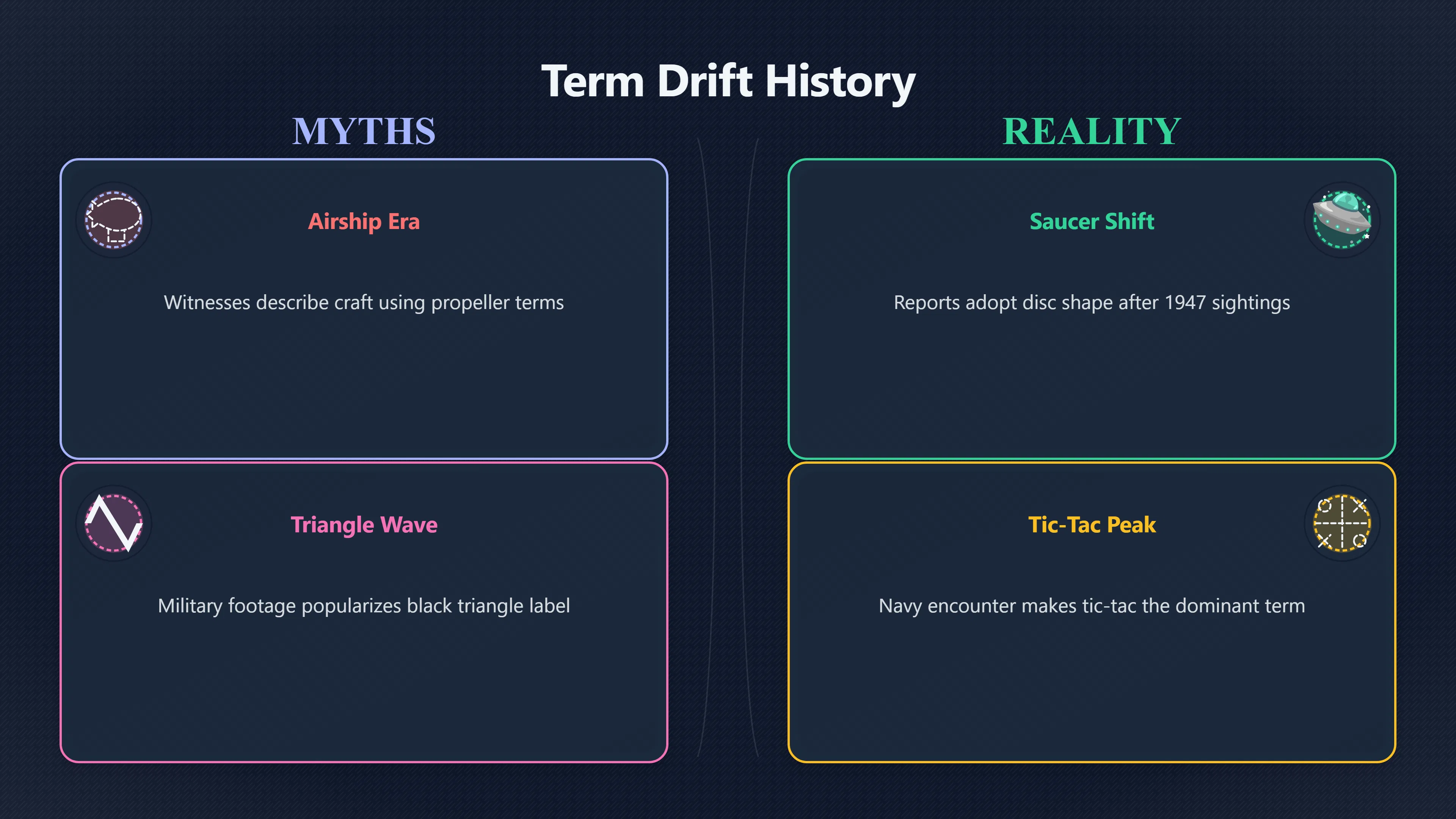
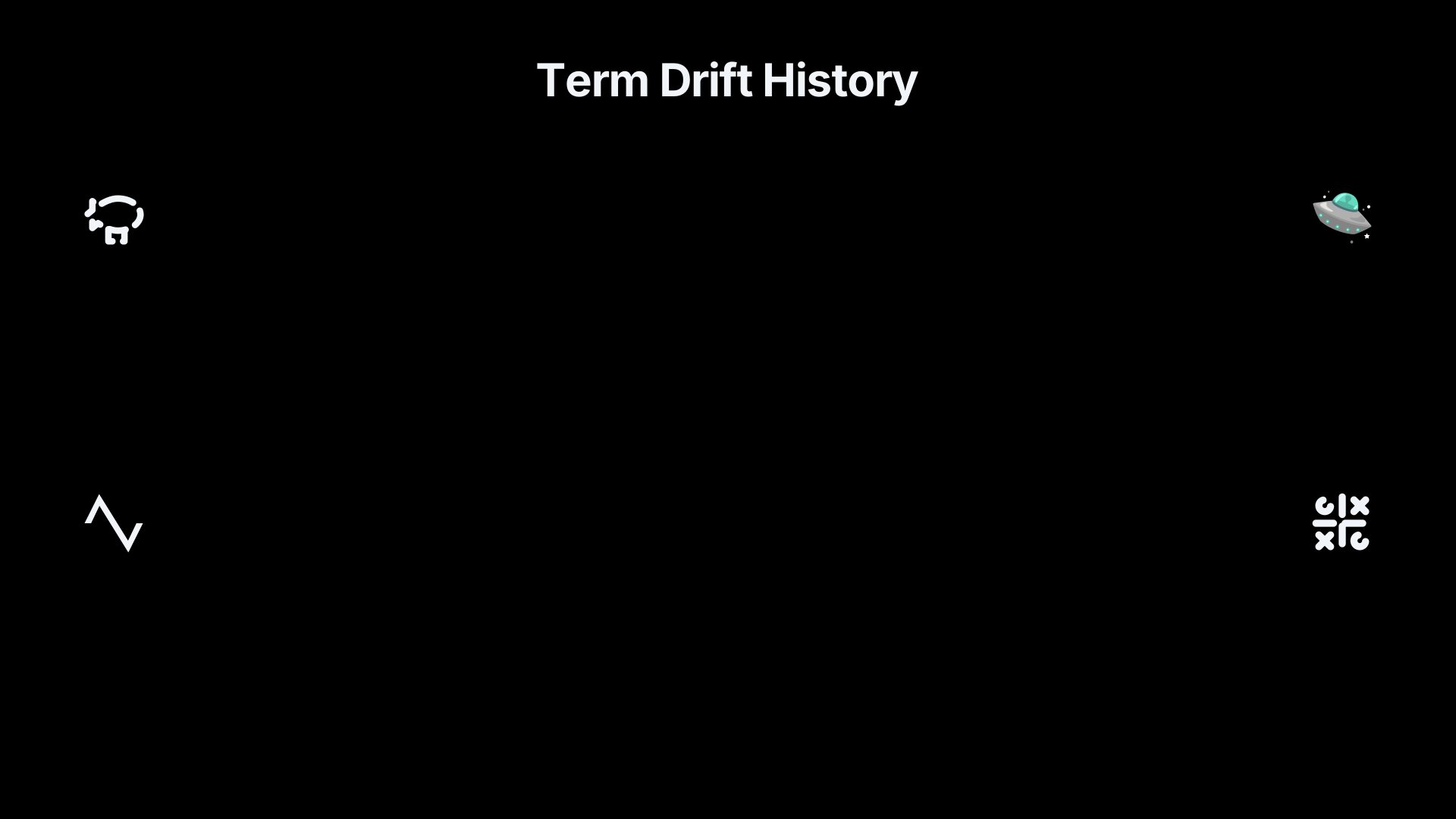
The history of UFO reporting shows repeated examples of this “cultural tracking” effect. During the late nineteenth century, reports often described mysterious “airships” with propellers because that reflected contemporary technology. Later decades produced “flying saucers”, then “triangles”, and more recently “tic-tac” objects after US Navy footage became globally famous. The descriptions evolved alongside cultural expectations rather than forming a stable observational vocabulary.[Wikipedia]WikipediaCultural trackingCultural tracking[2journalofscientificexploration.org]journalofscientificexploration.orgThe Reliability of UFO Witness TestimonyThe major complaint about UFO research and UFO researchers was that a great deal of the evidence…
For clustering systems, this matters because modern language models and vector embeddings are heavily driven by repeated semantic patterns. If thousands of witnesses suddenly begin using the same fashionable phrase, the AI may form a dense similarity cluster around language alone.
A practical example illustrates the problem:
- Before 2017, many witnesses described elongated white objects as “cylinders”, “cigars”, or “capsules”.
- After widespread reporting on the USS Nimitz encounter, “tic-tac” became the dominant phrase for similar descriptions.
- A text-driven clustering engine may incorrectly split older and newer reports into separate categories even if the underlying sightings were visually comparable.
The reverse can also happen. Completely unrelated events may collapse into one cluster because witnesses borrow the same media terminology. A satellite flare, drone formation, balloon train, and distant aircraft lights might all become “orbs” after online UFO discussions popularise that label.
This is especially dangerous in public UFO databases because many witnesses file reports after searching online for similar experiences. By the time they write their account, the wording may already be contaminated by existing UFO narratives.
Witness Language Versus Physical Evidence
Human witnesses do not describe aerial events like calibrated sensors. They interpret what they see through memory, expectation, stress, visibility conditions, and available vocabulary. UFO culture adds another interpretive layer by supplying ready-made descriptive templates.
Psychological research on memory distortion and false recall has repeatedly shown that expectation and framing can alter later recollection. Studies involving alien abduction memories found elevated rates of false recall susceptibility among some participants, demonstrating how strong narrative frameworks can shape remembered experiences.[PubMed]pubmed.ncbi.nlm.nih.govMemory distortion in people reporting abduction by aliensby SA Clancy · 2002 · Cited by 320 — Those reporting recovered and repress…
That does not mean witnesses are dishonest. It means narrative language and perception interact.
In UFO reporting, several common distortions emerge:
- Shape inflation: A distant point of light becomes a structured craft after reflection or later retelling.
- Behaviour inflation: Ordinary movement appears “intelligent” once a witness adopts UFO framing.
- Technological borrowing: Witnesses describe objects using familiar media imagery such as cloaking, portals, anti-gravity motion, or metallic hulls.
- Vocabulary convergence: Multiple unrelated observers independently choose the same fashionable terms.
An AI clustering engine that relies mainly on text embeddings may treat these linguistic similarities as evidence of a shared phenomenon. Yet the underlying physical evidence may be weak or contradictory.
For example, two reports may both contain the phrases:
“silent black triangle hovering overhead”
But structured investigation could reveal major differences:
Report featureCase ACase BTime21:1503:40WeatherClear skyHeavy cloudNearby aviationMilitary corridorNone detectedDuration90 seconds25 minutesWitness distanceSeveral kilometresDirect overheadSupporting evidenceADS-B correlationNo corroboration
A narrative-first clustering system might strongly group these cases. A context-aware system would likely separate them.
This distinction is central to AI-assisted UFO investigation. Language similarity is only a lead. It is not evidence of common origin.
Why Social Media Magnifies the Contamination Problem
Modern UFO reporting is increasingly immediate, networked, and algorithmically amplified. Witnesses no longer submit isolated handwritten reports weeks after an event. They often upload interpretations in real time while simultaneously consuming commentary from others.
That feedback loop changes the structure of the data before investigators even receive it.
A viral clip labelled “orb fleet” can rapidly standardise language across hundreds of unrelated observations. Online discussion threads frequently encourage users to reinterpret uncertain sightings using community-approved terminology. Even reporting databases can unintentionally reinforce this effect through dropdown menus and category labels.
Natural-language clustering systems are especially vulnerable because repeated social phrasing creates dense semantic associations. Modern embedding models are designed to recognise conceptual similarity in wording. If a community repeatedly describes unrelated events using the same narrative frame, the model may produce artificially coherent clusters.[PMC]pmc.ncbi.nlm.nih.govPMCApplication of natural language processing algorithmsby V Ng · 2020 · Cited by 25 — The focus of this article is the application of natural language processing (NLP) for information extra…[CEUR-WS]ceur-ws.orgCIRCLE 2022 paper 32Keywords. Machine…Read more…
This can produce several investigative failures:
- False UFO “waves” driven mainly by vocabulary contagion.
- Artificial spikes in one object category after media attention.
- Apparent geographical patterns caused by online communities rather than physical events.
- Reinforcement loops where clustered results influence future witness wording.
The last problem is particularly important. Once an archive publicly displays a strong “triangle UFO” cluster, future witnesses may unconsciously adopt that terminology when filing reports. The archive then trains its own future data.
The “Orb” Problem in Modern Databases
Few UFO terms illustrate semantic drift better than “orb”.
In contemporary UFO culture, the term can refer to:
- distant aircraft lights,
- planets near the horizon,
- drones,
- out-of-focus camera artefacts,
- ball lightning claims,
- infrared glare,
- lens reflections,
- satellites,
- or genuinely unresolved luminous phenomena.
Yet AI systems often treat “orb” as a meaningful object category because the word appears frequently and clusters strongly in text embeddings.
The result is a misleading archive structure where physically unrelated cases accumulate under one emotionally loaded label.
This matters operationally. If investigators query an archive for “orb sightings near military bases”, the clustering engine may return a mixed collection of unrelated phenomena linked primarily by witness vocabulary. That weakens attempts to identify genuinely recurring physical signatures.
A better system separates:
- witness wording,
- inferred appearance,
- measured behaviour,
- environmental context,
- and independently verified sensor data.
Without that separation, the AI risks modelling UFO folklore rather than aerial events.
Reducing Conclusion Leakage in Archives
The strongest UFO investigation systems treat witness narratives as one layer of evidence rather than the organising centre of the database.
Several practical methods reduce media-language contamination.
Separate raw testimony from derived features
Investigators increasingly preserve original witness wording while extracting structured observational variables separately.
Instead of clustering directly on sentences like:
“metallic tic-tac performing impossible manoeuvres”
the system isolates measurable attributes:
- estimated angular speed,
- direction changes,
- altitude estimate,
- duration,
- light colour,
- sound,
- weather,
- nearby aircraft,
- astronomical visibility,
- and sensor source.
This reduces the influence of culturally fashionable phrases.
Down-rank culturally loaded terms
Certain terms become statistically unreliable after heavy media exposure. Words such as “tic-tac”, “mothership”, “portal”, “probe”, and “non-human” may carry more cultural meaning than observational value.
A robust clustering system can reduce the weighting of these terms during similarity calculations, especially after known publicity spikes.
This is similar to how search engines ignore overly common “stop words”, except here the stop words are culturally contaminated UFO descriptors.
Time-aware linguistic analysis
Vocabulary changes over decades. Good clustering systems account for this temporal drift.
A “flying saucer” report from 1954 may belong in the same behavioural family as a “disc-shaped craft” report from 2025. Conversely, thousands of post-2017 “tic-tac” reports may reflect media adoption rather than a sudden emergence of a new object class.
Time-aware modelling helps distinguish genuine long-term behavioural similarities from short-lived cultural terminology trends.
Prioritise environmental correlation
The most reliable clustering systems compare narrative similarity against independent context:
- ADS-B aviation records,
- satellite tracks,
- launch schedules,
- weather radar,
- astronomical visibility,
- seismic events,
- drone activity,
- and local geography.
If two reports sound alike but occur under incompatible physical conditions, the cluster confidence should decrease.
This keeps the investigation anchored to the actual event rather than the mythology surrounding it.
Why This Matters for “Unresolved” Cases
Media contamination does not merely create false positives. It can also hide genuinely unusual cases.
Suppose a rare atmospheric or aerospace event occurs before it acquires a popular label. Early witnesses may describe it inconsistently using ordinary language. Later reports, after media exposure, converge on a fashionable UFO term.
A language-driven AI may then split the same phenomenon into separate clusters across time periods because the vocabulary changed. Investigators lose continuity.
Conversely, truly unrelated sightings may merge into one giant category simply because witnesses consumed the same documentaries or social media discussions.
That is why unresolved UFO investigation increasingly depends on structured event reconstruction rather than narrative resemblance alone. The most valuable similarities are not usually the loudest or most cinematic descriptions. They are the quieter consistencies hidden underneath:
- repeated flight corridors,
- recurring environmental conditions,
- matching sensor anomalies,
- similar angular movement,
- or correlations with known aerospace activity.
Those patterns survive cultural fashion better than witness buzzwords do.
AI Clustering Works Best When Language Is Treated as Evidence, Not Truth
Language still matters in UFO investigation. Witness narratives can preserve important details about shape, motion, sound, emotional response, and sequencing. Modern NLP systems are useful for sorting vast archives and identifying potentially related reports.[Medium]medium.comMore Than Meets The Eye: Unsupervised Learning on…March 14, 2018 — Using unsupervised text clustering on a UFO report dataset to…[GitHub]github.comExploratory analysis with clustering and NLP of UFO…This project explores the data collected by The National UFO Reporting center in a…
The problem begins when descriptive language becomes the dominant signal.
A public UFO archive naturally accumulates folklore, media influence, internet jargon, and recycled expectations alongside genuine observations. AI systems trained on that material can unintentionally learn the culture of UFO reporting more effectively than the physical characteristics of aerial events.
The strongest investigative workflows therefore separate three different questions:
- What did the witness say?
- What physically happened in the sky?
- How much of the wording may have been shaped by existing UFO culture?
Keeping those layers distinct is essential if clustering systems are meant to identify genuinely comparable sightings rather than simply grouping together people who watched the same documentaries, followed the same online communities, or adopted the same fashionable UFO vocabulary.
Amazon book picks
Further Reading
Books and field guides related to When UFO Buzzwords Trick AI Clustering Systems. Use these as the next step if you want deeper reading beyond the article.
Thinking, Fast and Slow
Explains cognitive shortcuts and framing effects in witness wording.
The Signal and the Noise
Directly supports avoiding false clusters from repeated language.
eBay marketplace picks
Marketplace Samples
Example marketplace items related to this page. Use the search link to explore similar finds on eBay.




Endnotes
1.
Source: medium.com
Link:https://medium.com/%40katie.lazell/more-than-meets-the-eye-unsupervised-learning-on-ufo-reports-part-i-f1f5320cc244
Source snippet
More Than Meets The Eye: Unsupervised Learning on...March 14, 2018 — Using unsupervised text clustering on a UFO report dataset to...
Published: March 14, 2018
2.
Source: Wikipedia
Title: Cultural tracking
Link:https://en.wikipedia.org/wiki/Cultural_tracking
3.
Source: pmc.ncbi.nlm.nih.gov
Link:https://pmc.ncbi.nlm.nih.gov/articles/PMC10796586/
Source snippet
Experimental results demonstrate that our model performs exceptionally...Read more...
4.
Source: journalofscientificexploration.org
Link:https://journalofscientificexploration.org/index.php/jse/article/view/3525/2195
5.
Source: ceur-ws.org
Title: CIRCLE 2022 paper 32
Link:https://ceur-ws.org/Vol-3178/CIRCLE_2022_paper_32.pdf
Source snippet
Keywords. Machine...Read more...
6.
Source: medium.com
Link:https://medium.com/%40piyushkashyap045/text-clustering-and-topic-modeling-with-llms-446dd7657366
Source snippet
Text Clustering and Topic Modeling with LLMsText clustering is an unsupervised machine learning technique that groups similar documents t...
7.
Source: github.com
Link:https://github.com/lazell/ufo_reports
Source snippet
Exploratory analysis with clustering and NLP of UFO...This project explores the data collected by The National UFO Reporting center in a...
8.
Source: pmc.ncbi.nlm.nih.gov
Title: PMCApplication of natural language processing algorithms
Link:https://pmc.ncbi.nlm.nih.gov/articles/PMC7755067/
Source snippet
by V Ng · 2020 · Cited by 25 — The focus of this article is the application of natural language processing (NLP) for information extra...
9.
Source: medium.com
Link:https://medium.com/resonant-archive/close-encounters-and-information-theory-why-ufo-reports-read-like-corrupted-data-2fe7709828ed
Source snippet
Why UFO Reports Read Like Corrupted DataCurrent UFO reports depend on eyewitness testimony. Terrible data source. Augment with better sen...
10.
Source: avi-loeb.medium.com
Link:https://avi-loeb.medium.com/high-quality-data-is-worth-a-thousand-llms-in-resolving-ambiguities-about-ufos-dab9bc74c7c0
Source snippet
medium.comHigh-Quality Data is Worth a Thousand LLMs in Resolving...Recommended from Medium... I Used an LLM to Analyze 140,000 UFO Rep...
11.
Source: joeornstein.github.io
Link:https://joeornstein.github.io/text-as-data/clustering.html
Source snippet
Text As DataBroadly speaking, we can divide the approaches for modeling text data into two camps: supervised learning and unsupervised le...
12.
Source: pubmed.ncbi.nlm.nih.gov
Link:https://pubmed.ncbi.nlm.nih.gov/12150421/
Source snippet
Memory distortion in people reporting abduction by aliensby SA Clancy · 2002 · Cited by 320 — Those reporting recovered and repress...
Additional References
13.
Source: zenodo.org
Link:https://zenodo.org/records/10588816
Source snippet
The Weakest Link in the Chain of UFO EvidenceEyewitness reports of observations of UFOs are still the central argument in all discussions...
14.
Source: levelup.gitconnected.com
Title: i used an llm to analyze 140 000 ufo reports the aliens are real 3d589ec4055d
Link:https://levelup.gitconnected.com/i-used-an-llm-to-analyze-140-000-ufo-reports-the-aliens-are-real-3d589ec4055d
Source snippet
The Aliens...4 Mar 2026 — What happens when you use AI to analyze 140000 UFO reports? A humorous data-driven dive into a world of alien...
15.
Source: researchgate.net
Title: 383878164 Machine Learning Predicts Accuracy in Eyewitnesses’ Voices
Link:https://www.researchgate.net/publication/383878164_Machine_Learning_Predicts_Accuracy_in_Eyewitnesses%27_Voices
Source snippet
Machine Learning Predicts Accuracy in Eyewitnesses' Voices9 Sept 2024 — Taken together, we find that machine learning methods are capable...
16.
Source: researchgate.net
Link:https://www.researchgate.net/publication/373255814_Reliability_of_UFO_Witness_Testimony_in_Extreme_Close_Encounters_Abductees_Contactees
Source snippet
Reliability of UFO Witness Testimony in Extreme Close...“A Brief History of the UFO-Abduction Phenomenon,” in Pritchard A., Pritchard D.E...
17.
Source: ahotcupofjoe.net
Link:https://ahotcupofjoe.net/2006/05/embellishments-of-memory-the-unreliable-nature-of-eyewitness-testimony/
Source snippet
credible evidence for the existence of alien visitation to our...Read more...
18.
Source: researchgate.net
Link:https://www.researchgate.net/publication/403152342_Forecasting_UFO_Sightings_via_Deep_Learning_and_Natural_Language_Generation
Source snippet
The Utilization of Natural Language Processing for Analyzing...Read more...
19.
Source: haraldmerckelbach.nl
Title: Memory distortion in people reporting abduction by aliens.Read more
Link:https://haraldmerckelbach.nl/artikelen_engels/2009/Abducted%20By%20A%20UFO%2C%20Prevalence%20Information%20Affects%20Young%20Children%27s%20False%20Memories%20For%20An%20Implausible%20Event.pdf
Source snippet
Abducted by a UFO: Prevalence Information Affects Young...by H OTGAAR · 2008 · Cited by 128 — individuals who report UFO abductions (Cla...
20.
Source: academia.edu
Title: The Reliability of UFO Witness Testimony
Link:https://www.academia.edu/101922617/The_Reliability_of_UFO_Witness_Testimony
Source snippet
(PDF) The Reliability of UFO Witness Testimony17 May 2023 — The Reliability of UFO Witness Testimony is the first major book to comprehen...
Published: May 2023
21.
Source: dspace.mit.edu
Title: hong jhong47 sm tpp May 2022
Link:https://dspace.mit.edu/bitstream/handle/1721.1/144608/hong-jhong47-sm-tpp-May-2022.pdf?isAllowed=y&sequence=1
Source snippet
Thesis, Allegedly Jisoo Hongby J Hong · 2022 · Cited by 1 — Since 1947, reports of unidentified flying objects and alien en- counters hav...
Published: May 2022
22.
Source: enigmaticideas.com
Title: finding patterns in 152 000 ufo uap sightings
Link:https://enigmaticideas.com/finding-patterns-in-152-000-ufo-uap-sightings/
Source snippet
Using generative AI and natural language processing on multiple UFO sighting databases...Read more...
Topic Tree