Within Sensor Artefacts
Why Phone Cameras Make UFO Lights Seem Erratic
Phone camera stabilisation and digital zoom can make distant lights appear to accelerate or zig-zag unrealistically.
On this page
- What digital zoom does to distant lights
- How stabilisation detaches objects from backgrounds
- Why original footage matters more than uploads
Page outline Jump by section
Introduction
Many modern UFO videos are recorded on phones that quietly modify the image before the user even presses upload. Digital zoom, optical image stabilisation (OIS), electronic image stabilisation (EIS), frame interpolation and rolling-shutter correction all try to make shaky footage look smoother. In night recordings, especially when filming a distant bright light against a dark sky, those corrections can unintentionally create the impression that an object is jumping, zig-zagging or accelerating unnaturally.[Stanford Graphics]graphics.stanford.eduIn professional cameras…Read more…
 This matters in AI-assisted UFO sighting investigation because many apparently dramatic movements are not movements of the object itself. They are movements introduced by the phone’s imaging pipeline. A distant aircraft light, planet, drone or satellite may remain relatively steady in the real world while the phone repeatedly recentres, crops, sharpens and repositions the bright point inside the frame. Without understanding how stabilisation works, investigators can mistake software correction for anomalous flight behaviour.
What digital zoom does to distant lights
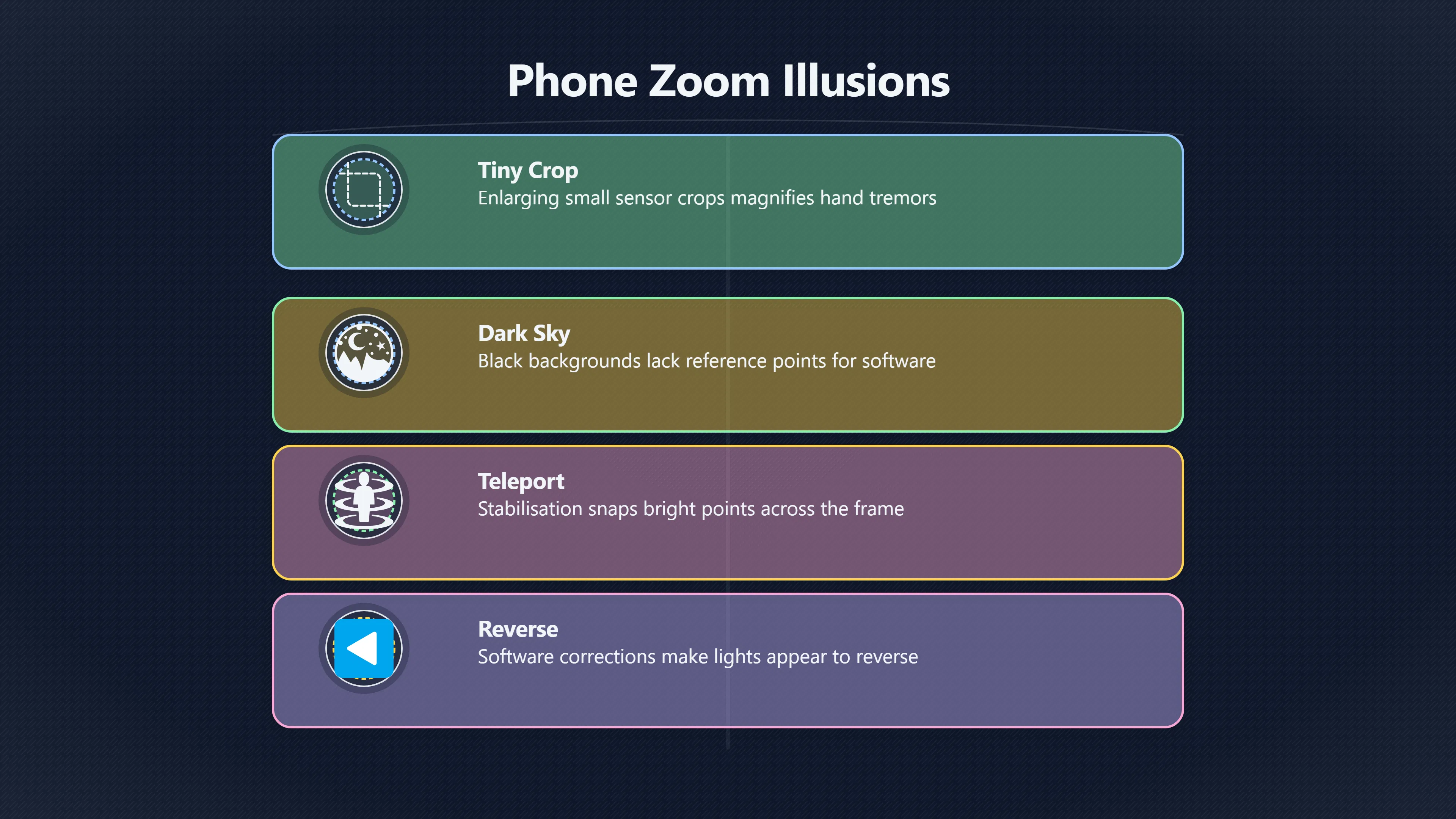
Phone cameras create some of the strongest UFO illusions when digital zoom is combined with low light.
Unlike optical zoom on a dedicated telephoto lens, digital zoom often enlarges a small crop from the sensor. That means a tiny bright point may occupy only a few pixels before the phone enlarges and processes it. Any movement from the user’s hand is magnified along with the image. Even tiny tremors can become dramatic jumps on screen.[Wikipedia]WikipediaImage stabilizationImage stabilization
This effect becomes extreme at night because the camera has very little background detail to anchor the stabilisation system. A bright point against a black sky gives the software almost no reference information apart from the light itself. The result can look bizarre:
- the light appears to “teleport” slightly between frames
- the object seems to reverse direction abruptly
- the background drifts independently from the light
- motion appears faster than the witness remembers
Investigators often overlook how strongly zoom changes perceived motion. A one-degree hand movement may seem minor when filming a landscape, but at high zoom it can throw a distant light completely across the frame. Stabilisation software then tries to compensate by snapping the image back into alignment, producing sudden visual jumps.
This is one reason UFO clips filmed at maximum phone zoom frequently look more erratic than the witness account itself. Witnesses may describe a steady hovering light, while the uploaded video appears to show rapid darting movement.
Why tiny lights confuse phone processing
Most phone camera systems are optimised for faces, landscapes and nearby objects rather than isolated lights in darkness. Bright points can exceed the sensor’s normal contrast assumptions, causing the software to hunt constantly for exposure and focus balance.[Google Help]support.google.comreflection artifacts from bright lights in night videoThese are reflections on flat surfaces of the lens stack, most likely the cover glass.Read more…
When this happens, several processes may occur simultaneously:
- autofocus pulses in and out
- sharpening algorithms exaggerate edges
- noise reduction smears nearby pixels
- stabilisation crops and recentres the frame
- frame averaging blends slightly different positions together
The combined effect can make a steady aircraft beacon look alive. In some clips the light appears to surge sideways every few frames even though surrounding stars or clouds reveal that the apparent motion came from the camera.
How stabilisation detaches objects from backgrounds
Modern phones usually combine optical image stabilisation with electronic stabilisation. Optical systems physically move lens elements or the sensor to counter hand movement, while electronic systems crop and reposition video frames using gyroscope data and software prediction.[Stanford Graphics]graphics.stanford.eduIn professional cameras…Read more…
These systems work well for ordinary filming. Problems appear when the subject is a tiny bright point in darkness.
The “floating light” effect
A stabilised phone video may unintentionally separate the tracked object from the rest of the scene. The software attempts to keep the bright point stable while the background drifts. To viewers, this can resemble independent motion by the object itself.
This is especially common when:
- filming aircraft lights at long distance
- recording Venus or Jupiter near the horizon
- capturing drones at night
- zooming through dirty glass or atmospheric haze
- filming while standing in wind or inside a moving vehicle
Because the stabilisation system predicts motion frame by frame, it can overshoot corrections. The light then appears to lurch suddenly in one direction before snapping back. On social media, these micro-corrections are often interpreted as impossible manoeuvres.
The illusion becomes stronger when the frame lacks stable references such as buildings, trees or the horizon. With no fixed context, the human eye tends to assume the bright object is moving rather than the camera.
Rolling shutter can exaggerate wobble
Most smartphone sensors use rolling shutters rather than capturing the entire frame at one instant. Different parts of the image are recorded milliseconds apart as the sensor scans across the frame.[Wikipedia]WikipediaRolling shutterRolling shutter
If the phone moves during that scan, the image can bend or wobble unnaturally. Researchers and camera engineers often call this the “jello effect”. In UFO footage, this can produce:
- stretched or warped lights
- curved motion trails
- diagonal jumps
- unstable apparent trajectories
A distant blinking aircraft beacon may therefore look like it is changing direction between flashes when the distortion actually comes from sensor timing and stabilisation corrections interacting together.
This matters for automated analysis systems. AI models trained on ordinary daytime footage may incorrectly classify these distortions as genuine object manoeuvres unless the pipeline accounts for rolling-shutter artefacts and stabilisation behaviour.
Why uploads often look worse than the original footage
The uploaded UFO clip seen online is rarely identical to the original recording.
Most social platforms compress video aggressively. Compression removes detail, smooths gradients and introduces new motion artefacts. A stabilised phone clip that already contains slight positional jumps may become even more erratic after upload.
This is particularly damaging for night footage because compression algorithms struggle with:
- isolated bright pixels
- dark low-detail backgrounds
- flashing lights
- grain and sensor noise
Platforms may also alter frame rates or apply additional stabilisation during transcoding. The result can exaggerate apparent acceleration or create smeared motion trails that never existed in the source file.
For investigators, the original file is therefore vastly more valuable than a reposted clip.
What original metadata can reveal
Original phone footage may contain metadata that helps reconstruct what the camera was doing at the time of recording, including:
- focal length and zoom level
- frame rate
- exposure settings
- stabilisation mode
- device model
- orientation changes
- gyroscope information in some formats
That information can help determine whether apparent motion matches likely hand movement. AI-assisted workflows can compare gyroscope shifts against object motion to estimate whether the “UFO” moved independently or simply followed camera corrections.
A heavily recompressed social-media clip removes much of this evidence. Once the original stabilisation and sensor data are stripped away, separating real motion from processing artefacts becomes much harder.
Why witnesses genuinely perceive the movement as real
Phone stabilisation artefacts are persuasive because they align with how humans interpret motion.
The brain expects cameras to represent reality directly. When a bright point shifts sharply on screen, viewers instinctively treat that shift as movement by the object. At night, depth perception is already weak, and the lack of environmental references increases uncertainty.
This means witnesses are not necessarily fabricating or exaggerating what they saw. The phone display itself may already have shown the processed, stabilised version in real time. By the moment recording begins, the software has often started reframing and correcting motion automatically.
That distinction matters in balanced UFO investigation. A stabilisation artefact does not prove a witness was mistaken about seeing something unusual. It simply means the recorded motion cannot automatically be treated as physical manoeuvring by the object.
How AI-assisted investigation can screen for stabilisation artefacts
An effective UFO investigation workflow treats phone stabilisation as a routine technical check rather than a fringe explanation.
Useful screening methods include:
- comparing object motion with edge motion elsewhere in the frame
- checking whether stars or clouds shift in synchrony with the light
- estimating zoom level from metadata
- measuring frame-to-frame correction jumps
- identifying rolling-shutter wobble patterns[Wikipedia]WikipediaRolling shutterRolling shutter
- comparing uploaded footage with original files
- reconstructing hand motion using gyroscope data where available
Machine-learning systems can also be trained to recognise typical stabilisation signatures, such as abrupt recentering or digital crop drift. That helps investigators separate likely sensor artefacts from movements that remain difficult to explain after ordinary camera effects are removed.
In many cases, the result is not that the sighting becomes “solved” outright. Instead, the confidence level attached to the apparent manoeuvres changes. A light that seemed to perform impossible zig-zags may reduce to an unresolved distant object recorded through aggressive phone processing and extreme digital zoom.
Amazon book picks
Further Reading
Books and field guides related to Why Phone Cameras Make UFO Lights Seem Erratic. Use these as the next step if you want deeper reading beyond the article.
The Filmmaker's Handbook
Relevant to stabilisation, zoom, frame motion, and video artefacts.
The Signal and the Noise
Relevant to distinguishing real motion from processing noise.
Read This if You Want to Take Great Photographs
Helps explain why cameras change how lights appear.
Understanding Exposure
Rating: 4.5/5 from 19 Google Books ratings
Provides detailed lessons on the elements of exposure and how each relates to depth of field, freezing and blurring action, and shooting...
eBay marketplace picks
Marketplace Samples
Example marketplace items related to this page. Use the search link to explore similar finds on eBay.


Endnotes
1.
Source: Wikipedia
Title: Image stabilization
Link:https://en.wikipedia.org/wiki/Image_stabilization
2.
Source: graphics.stanford.edu
Link:https://graphics.stanford.edu/papers/stabilization/karpenko_gyro.pdf
Source snippet
In professional cameras...Read more...
3.
Source: Wikipedia
Title: Rolling shutter
Link:https://en.wikipedia.org/wiki/Rolling_shutter
4.
Source: support.google.com
Title: reflection artifacts from bright lights in night video
Link:https://support.google.com/pixelphone/thread/245547360/reflection-artifacts-from-bright-lights-in-night-video?hl=en
Source snippet
These are reflections on flat surfaces of the lens stack, most likely the cover glass.Read more...
Additional References
5.
Source: cia.gov
Link:https://www.cia.gov/readingroom/document/cia-rdp81r00560r000100010001-0
Source snippet
THE NATIONAL INVESTIGATIONS COMMITTEE ON...[Blue Book]({{ 'blue-book/' | relative_url }}) UFO investigation, prepared analyses of UFO data for AF, liaison officer between Da...
6.
Source: dpreview.com
Link:https://www.dpreview.com/videos/8005507960/dpreview-tv-why-electronic-image-stabilization-works-better-on-your-gopro-than-your-camera
Source snippet
DPReview TV: Why electronic image stabilization works better...Chris explains the limits of electronic image stabilization, and why your...
7.
Source: st.com
Link:https://www.st.com/resource/en/white_paper/ois_white_paper.pdf
Source snippet
MicroelectronicsOptical Image Stabilization (OIS)It senses the vibration on the hosting system and compensates for these camera movemen...
8.
Source: reddit.com
Link:https://www.reddit.com/r/aliens/comments/k3ovw2/why_are_ufo_sighting_videos_always_so_blurry/
Source snippet
WHY are UFO Sighting videos always so blurry, wobbly...There is the video of the ufo in Turkey where the ufo and aliens are stationary i...
9.
Source: reddit.com
Link:https://www.reddit.com/r/photography/comments/1pdwpt/weird_light_artefacts_from_led_spotlights/
10.
Source: ppjhh.com
Link:https://ppjhh.com/publication/oissr/oissr.pdf
Source snippet
OISSR: Optical Image Stabilization Based Super Resolution...by H Pan · 2022 · Cited by 5 — In this study, we sought to develop a robust...
11.
Source: forums.wyze.com
Title: camera and recording pixelates at night with bright light
Link:https://forums.wyze.com/t/camera-and-recording-pixelates-at-night-with-bright-light/332907
Source snippet
and Recording Pixelates at night with bright light26 Jun 2025 — The clarity and resolution at night without any vehicle lights shining at...
12.
Source: facebook.com
Link:https://www.facebook.com/ancientwhispers/posts/a-new-video-recently-emerged-online-capturing-what-many-observers-are-calling-on/823427747343315/
Source snippet
ien theorists, who claim this may be one of the best pieces of...Read more...
13.
Source: facebook.com
Link:https://www.facebook.com/ancientwhispers/posts/new-piece-of-footage-circulating-online-has-sparked-fresh-discussion-after-an-un/866132196406203/
Source snippet
New piece of footage circulating online has sparked fresh...So, i took a cool picture of the night sky with my Samsung Galaxy S21 Ultra...
14.
Source: dpreview.com
Title: Wondering what causes these video artifacts?
Link:https://www.dpreview.com/forums/threads/wondering-what-causes-these-video-artifacts-thinking-face.4781152/
Source snippet
🤔21 Oct 2024 — I'm thinking the V30s are too slow? And some kind of compression causing these artifacts? But I also feel like on a differ...
Topic Tree