Within Re entry Breakups
Why Re entry Debris Looks Like Flying Formations
Groups of glowing fragments can appear like coordinated craft even when they are ordinary debris following similar trajectories.
On this page
- How breakup trains create parallel lights
- Why witnesses perceive controlled movement
- Video clues that separate debris from aircraft
Page outline Jump by section
Introduction
One of the most misleading features of a satellite or rocket-body re-entry is the way the debris can resemble an organised formation of aircraft or unknown craft. Witnesses often report “parallel lights”, “objects flying in formation”, or “multiple UFOs moving together” when they are actually watching fragments from a single object breaking apart high above the atmosphere. In UFO investigation work, this matters because formation behaviour is often treated as evidence of controlled flight. In many re-entry cases, however, the apparent coordination comes from physics, viewing geometry, and human perception rather than intelligent manoeuvring.
 For AI-assisted UFO sighting investigation, recognising a fragmentation train is a high-value screening step. Automated comparison against known re-entry signatures, orbital decay predictions, witness timing, and video motion analysis can quickly separate many “fleet” sightings from aircraft, drones, meteors, or genuinely unresolved reports. The visual pattern is distinctive once investigators know what to examine: shallow trajectories, long-duration visibility, multiple fragments maintaining similar spacing, and slow apparent drift across the sky.[The Aerospace Corporation]aerospace.orgThese reentries can often look like shooting stars (meteors) with a bright central body followed by a long…Read more…[UNOOSA]unoosa.orgSpace Debris Reentry HazardsSpace hardware reenters at very shallow angle (<1 degree). • ~40 objects weighing more than 1 ton reent…
How Breakup Trains Create Parallel Lights
When a satellite or rocket stage re-enters the atmosphere, it does not usually explode into random directions all at once. Instead, aerodynamic stress and heat gradually tear the object apart while it continues moving along nearly the same orbital path. The fragments inherit similar momentum, so they remain aligned and travel in broadly parallel trajectories.
To witnesses on the ground, this can look remarkably structured. Several glowing points may appear evenly spaced, moving together at constant speed, sometimes with one brighter “lead” object followed by smaller companions. The Aerospace Corporation notes that re-entries often produce “numerous fragments” behind a bright central body.[The Aerospace Corporation]aerospace.orgThese reentries can often look like shooting stars (meteors) with a bright central body followed by a long…Read more…
The geometry creates several recurring visual effects:
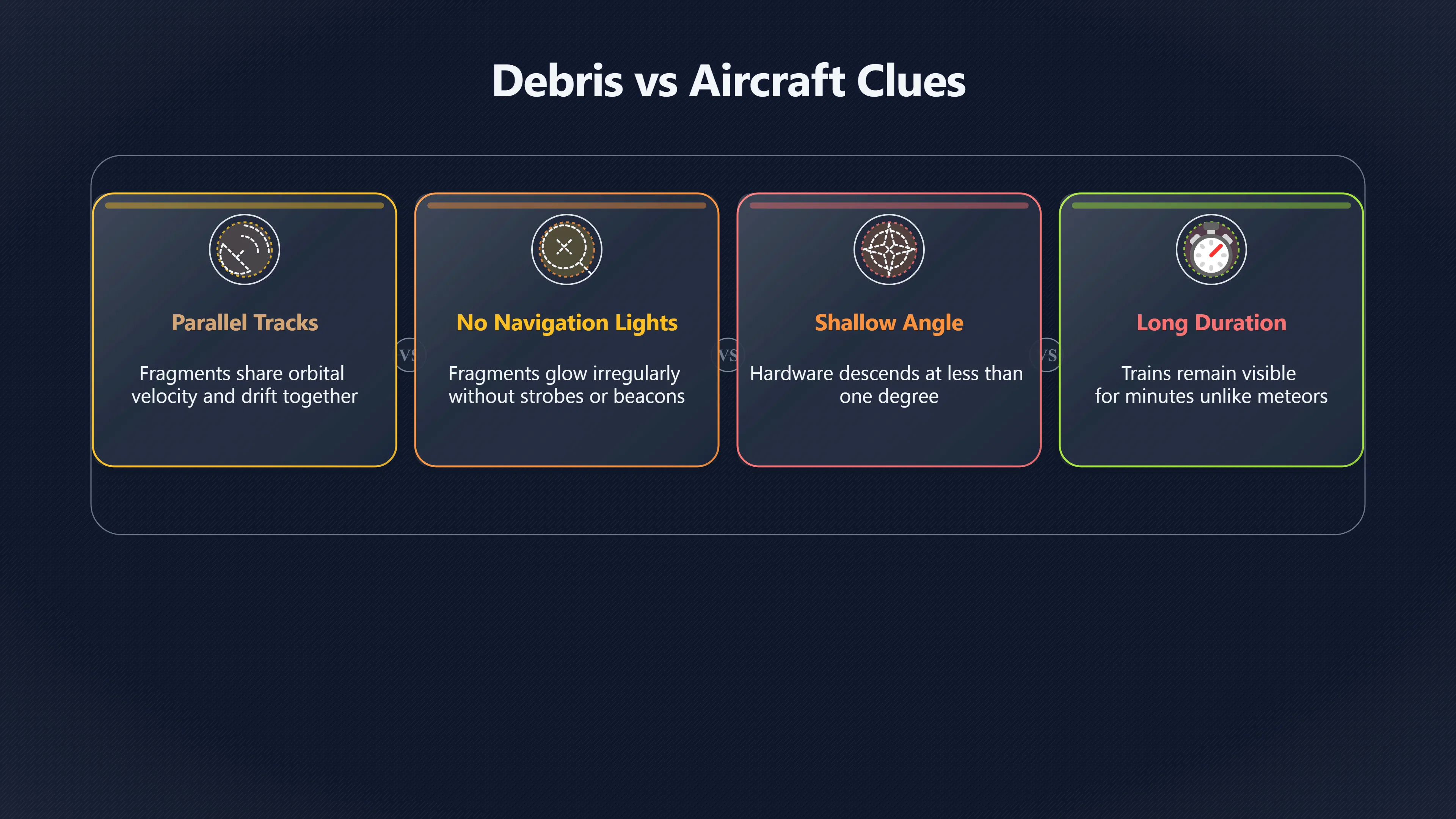
- Parallel tracks: fragments separate slowly while continuing along nearly identical paths.
- Formation spacing: debris pieces may appear evenly distributed because lighter fragments decelerate differently at high altitude.
- Coherent motion: all fragments move in the same direction with minimal apparent divergence.
- Variable brightness: some pieces flare brighter as they tumble or expose fresh surfaces to airflow.
- False synchronisation: simultaneous brightening can look like coordinated signalling or controlled manoeuvres.
A major reason witnesses interpret these events as formations is scale confusion. Re-entry fragments may be tens or hundreds of kilometres above Earth. At that altitude, small separations between debris pieces can appear enormous from the ground, creating the illusion of multiple large craft travelling together.
Unlike conventional aircraft formations, the fragments are not actively steering. Their similar movement comes from shared orbital velocity. Re-entering debris typically remains close to horizontal relative to the Earth’s surface because space hardware re-enters at extremely shallow angles.[UNOOSA]unoosa.orgSpace Debris Reentry HazardsSpace hardware reenters at very shallow angle (<1 degree). • ~40 objects weighing more than 1 ton reent…
Why Witnesses Perceive Controlled Movement
Human perception is especially vulnerable to misreading high-altitude luminous objects at night. Re-entry trains exploit several known weaknesses in distance and motion judgement.
The sky removes normal scale references
At night, observers cannot easily estimate altitude, speed, or size. A debris train moving at orbital velocity can appear strangely slow because it is so far away. Witnesses often expect truly fast objects to cross the sky instantly. When glowing fragments remain visible for 30 seconds or more, the brain tends to interpret them as slower, lower, and under control.
This produces reports such as:
- “Objects pacing each other”
- “Lights flying in formation”
- “A convoy”
- “Escorting craft”
- “Objects changing relative positions”
In reality, the fragments may be separated by only small distances along the same trajectory.
Parallel motion appears intentional
Humans are highly sensitive to pattern recognition. Parallel movement strongly suggests coordination because aircraft formations, bird flocks, and vehicle convoys all behave that way. A breakup train unintentionally mimics those familiar patterns.
The effect becomes stronger when:
- fragments brighten at different times;[space.com]space.comEarthquake sensors can track space junk that crashes back to EarthJanuary 24, 2026 — Researchers from Johns Hopkins University and I…
- some pieces temporarily disappear behind haze or cloud;
- the observer sees only part of the train;
- smartphone cameras exaggerate spacing and jitter.
Investigators repeatedly find that witnesses reinterpret passive fragmentation as active manoeuvring after reviewing memory or discussing the event socially online.
Fragment drift can mimic turning
As fragments encounter differing atmospheric drag, their spacing changes slowly. To observers, this may resemble intelligent repositioning. Perspective effects also matter: debris approaching the horizon can appear to curve or bank despite following a stable orbital descent path.
This is one reason re-entry events generate persistent UFO claims even when the underlying cause becomes publicly identified later.
Why Re-entry Formations Differ From Meteor Fragmentation
Large meteors can also fragment, so the distinction is not always simple. The key difference is how the fragments behave after breakup.
Meteor fragmentation is usually:
- rapid;
- violent;
- short-lived;
- concentrated around a single flare event.
Re-entry fragmentation is more commonly:
- prolonged;
- distributed along a long track;
- composed of many surviving luminous pieces;
- visually orderly.
Artificial debris often produces what observers describe as a “string of pearls” effect: multiple glowing points maintaining directional coherence over a long path. Meteors are more likely to produce sudden bursts and irregular scattering.[Astrophysics Data System]adsabs.harvard.eduHere, we show that this can…Read more…
Another important clue is duration. Re-entry trains can remain visible long enough for witnesses to retrieve phones, call others outside, or record extended video clips. Many meteor fireballs end before casual observers can react.

Video Clues That Separate Debris From Aircraft
Modern UFO investigations increasingly rely on mobile-phone footage, dashboard cameras, CCTV systems, and doorbell recordings. AI-assisted analysis can extract patterns from this material that are difficult for human observers to evaluate consistently.
Several visual clues strongly favour re-entry debris over aircraft formations.
Constant directional flow
Aircraft formations usually show subtle relative manoeuvring. Re-entry fragments instead maintain a shared heading with little independent behaviour. Even when spacing changes, the overall train remains coherent.
Motion tracking software can measure this directly frame by frame.
Lack of navigational lighting
Aircraft display regulated lighting patterns: strobes, anti-collision beacons, red and green navigation lights, and periodic flashes. Re-entry fragments instead glow continuously or pulse irregularly because of heating and tumbling.
Videos showing many luminous objects without aviation light signatures strongly support a fragmentation explanation, especially when all fragments share identical movement.
Simultaneous decay behaviour
Debris fragments often fade progressively along the same section of sky. Multiple lights may extinguish in sequence as individual pieces burn up. Aircraft do not disappear in this manner.
AI-assisted brightness analysis can identify correlated fading across fragments, which is a strong re-entry indicator.
Elongated image smearing
Smartphone sensors frequently overexpose bright re-entry fragments, creating elongated streaks or apparent shape changes. Witnesses may interpret these distortions as structured craft. In practice, the effect usually comes from motion blur, digital sharpening, atmospheric turbulence, or rolling shutter artefacts.
This is especially common in low-light videos where separate fragments appear connected into geometric formations that were not visible to the naked eye.
How AI Investigation Systems Use Fragment Patterns
Formation-like behaviour is now a major classification feature in automated UFO triage systems. A modern investigation workflow can correlate witness reports against known orbital and atmospheric data within minutes.
Useful automated checks include:
- comparison with predicted re-entry windows from orbital tracking databases;
- trajectory matching against known decaying satellites or rocket bodies;
- clustering geographically distributed witness reports;
- frame-by-frame motion extraction from public videos;
- altitude estimation using multi-angle footage;
- timing correlation with all-sky meteor camera networks. conference.sdo.esoc.esa.int[The Aerospace Corporation]aerospace.orgThese reentries can often look like shooting stars (meteors) with a bright central body followed by a long…Read more…
Because re-entry formations are visible across huge areas, AI systems are especially effective at identifying them through mass reporting patterns. A single event may produce hundreds of posts across multiple towns within minutes. That broad simultaneous visibility strongly favours a high-altitude explanation.
Emerging sensor methods may improve this further. Researchers have recently shown that seismic and acoustic monitoring systems can help reconstruct re-entry paths by detecting sonic booms from descending debris.[Space]space.comEarthquake sensors can track space junk that crashes back to EarthJanuary 24, 2026 — Researchers from Johns Hopkins University and I…
Cases Where “Fleets” Turned Out To Be Re-entry Debris
Several widely shared UFO incidents have eventually been identified as orbital debris breakups.
Common characteristics include:
- witnesses across multiple regions reporting “formations”;
- videos showing slow-moving parallel lights;
- confusion amplified through social media;
- later confirmation of satellite or rocket-body decay.
The visual drama of these events often encourages extraordinary interpretations before orbital analysts publish confirmations. Public discussion tends to focus on the apparent coordination of the lights rather than the broader physical context.
This pattern has become more common as low Earth orbit traffic increases. Growing numbers of satellites and rocket bodies mean more uncontrolled or semi-controlled re-entries, producing more opportunities for formation-like sky events.[Federal Aviation Administration]faa.govFederal Aviation Administration P.L116-260 Risks Associated with Reentry Disposal of…October 5, 2023 — 22 Sept 2023 — This report evaluates the risk to people on the gro…
What Still Requires Caution
Not every multiple-light sighting is re-entry debris. Aircraft formations, drones, military flares, Starlink satellite trains, coordinated pyrotechnics, and rare meteor fragmentation events can overlap visually with some re-entry characteristics.
Investigators should avoid overcorrecting by assuming every formation is mundane debris. Instead, the goal is structured elimination:
- Establish timing and direction.
- Check known re-entry databases and orbital decay predictions.
- Compare witness duration estimates.
- Examine whether fragments maintained a common trajectory.
- Analyse videos for aviation lighting or independent manoeuvres.
- Correlate reports geographically.
A sighting becomes more unusual if the objects show verified independent acceleration, abrupt directional changes, hovering, or behaviour inconsistent with ballistic descent. Most re-entry trains do not display those features once perspective effects and recording artefacts are accounted for.
The important investigative lesson is that “formation flight” alone is weak evidence for extraordinary craft. In many UFO reports, it is exactly what ordinary orbital debris naturally produces.
Amazon book picks
Further Reading
Books and field guides related to Why Re entry Debris Looks Like Flying Formations. Use these as the next step if you want deeper reading beyond the article.
The Demon-Haunted World
Supports natural and aerospace explanations for apparent formations.
Orbital Mechanics for Engineering Students
Relevant to orbital debris paths and fragment motion, though specialist.
eBay marketplace picks
Marketplace Samples
Example marketplace items related to this page. Use the search link to explore similar finds on eBay.


Endnotes
1.
Source: aerospace.org
Link:https://aerospace.org/node/44081/printable/print
Source snippet
These reentries can often look like shooting stars (meteors) with a bright central body followed by a long...Read more...
2.
Source: unoosa.org
Link:https://www.unoosa.org/pdf/pres/stsc2012/tech-39E.pdf
Source snippet
Space Debris Reentry HazardsSpace hardware reenters at very shallow angle (<1 degree). • ~40 objects weighing more than 1 ton reent...
3.
Source: conference.sdo.esoc.esa.int
Title: SDC9 paper135
Link:https://conference.sdo.esoc.esa.int/proceedings/sdc9/paper/135/SDC9-paper135.pdf
Source snippet
VALIDATION OF THE ESA STATISTICAL RE-ENTRY...March 25, 2025 — by M Zigo · Cited by 1 — All-sky cameras, initially designed for meteor de...
Published: March 25, 2025
4.
Source: aerospace.org
Link:https://aerospace.org/cords
Source snippet
The Aerospace CorporationSpace DebrisThe CORDS Reentry Database documents objects and payloads that have reentered earth's atmosphere sin...
5.
Source: aerospace.org
Link:https://aerospace.org/reentries
Source snippet
The Aerospace CorporationReentriesThe Center for Orbital and Reentry Debris Studies (CORDS) Reentry Database documents objects and payloa...
6.
Source: space.com
Link:https://www.space.com/space-exploration/satellites/earthquake-sensors-can-track-space-junk-that-crashes-back-to-earth
Source snippet
Earthquake sensors can track space junk that crashes back to EarthJanuary 24, 2026 — Researchers from Johns Hopkins University and I...
Published: January 24, 2026
7.
Source: news.sky.com
Link:https://news.sky.com/story/ufo-files-latest-new-release-in-us-reveals-reports-of-unexplained-green-orbs-discs-and-fireballs-13543508
Source snippet
files latest: US intel officer saw 'glowing orbs' split in...5 days ago — Donald Trump has been teasing the release of UFO files since F...
8.
Source: conference.sdo.esoc.esa.int
Title: SDC4 paper44
Link:https://conference.sdo.esoc.esa.int/proceedings/sdc4/paper/44/SDC4-paper44.pdf
Source snippet
Unfortunately, debris from reentering objects is rarely found on the ground, and any that is found is rarely analyzed.Read more...
9.
Source: conference.sdo.esoc.esa.int
Link:https://conference.sdo.esoc.esa.int/proceedings/sdc6/paper/147/SDC6-paper147.pdf
10.
Source: youtube.com
Title: Space Shuttle Columbia
Link:http://www.youtube.com/watch?v=RG4fhNVxOUY
Source snippet
SpaceX Falcon 9 over Downtown Los Angeles...
11.
Source: youtube.com
Title: Space X Falcon 9 over Downtown Los Angeles
Link:http://www.youtube.com/watch?v=K5YVqKS6Tdg
Source snippet
SpaceX Starship explodes and sends debris across night sky...
12.
Source: youtube.com
Title: Space X Starship explodes and sends debris across night sky
Link:http://www.youtube.com/watch?v=tfEW7VFcawQ
Source snippet
Incredible scene as SpaceX launch illuminates night sky...
13.
Source: adsabs.harvard.edu
Link:https://adsabs.harvard.edu/full/2003JIMO…31…88J
Source snippet
Here, we show that this can...Read more...
14.
Source: faa.gov
Title: Federal Aviation Administration P.L
Link:https://www.faa.gov/sites/faa.gov/files/Report_to_Congress_Reentry_Disposal_of_Satellites.pdf
Source snippet
116-260 Risks Associated with Reentry Disposal of...October 5, 2023 — 22 Sept 2023 — This report evaluates the risk to people on the gro...
Published: October 5, 2023
15.
Source: apogee-magazine.com
Title: Apogee V2N3
Link:https://apogee-magazine.com/wp-content/uploads/2025/11/Apogee_V2N3.pdf
Source snippet
SPACE DEBRIS7 Nov 2025 — These proposals include establishing orbital debris mitigation as one of the Sustainable Development Goals that...
16.
Source: ecss.nl
Link:https://ecss.nl/wp-content/uploads/2016/09/ECSS-Training-L2-U102012-07.pdf
Source snippet
Rationale of the course b. Areas to be addressed. 2. Space Debris Mitigation: An Overview. 3. Space Debris Mitigation Requirements.Read more...
17.
Source: pauldmaley.com
Link:https://pauldmaley.com/sd3/
Source snippet
space balls” on their property. The release of government files on UFO sightings, including the official report on the Ashburton Space Ba...
18.
Source: facebook.com
Link:https://www.facebook.com/FLTimesUnion/posts/the-defense-department-released-a-second-batch-of-previously-classified-files-on/1467707152065623/
Source snippet
space aliens and spying by a hostile nation using advanced technology.... Many Military U.F.O. Reports Are Just Foreign Spying or Airbor...
Additional References
19.
Source: thesun.co.uk
Link:https://www.thesun.co.uk/tech/33181994/space-debris-rocket-parts-plane-flight-risk/
Source snippet
El aumento en los lanzamientos de cohetes ha incrementado los desechos espaciales que caen sin control a la Tierra, creando un peligro pa...
20.
Source: youtube.com
Link:http://www.youtube.com/watch?v=w47VDSNy-5s
Source snippet
Satellite rocket body re-entry fragmentation train formation Insane Reason Why Ballistic Missiles Do Not Burn During Re-entry! 😯 Aviation...
21.
Source: iaaspace.org
Link:https://iaaspace.org/wp-content/uploads/iaa/Scientific%20Activity/debris6.pdf
Source snippet
The drag force that such objects experience is due to their interaction with the few air...Read more...
22.
Source: medium.com
Link:https://medium.com/the-aerospace-corporation/a-quick-guide-to-understanding-orbital-debris-reentry-predictions-4b84a8e2bd04
Source snippet
, with the yellow “circles” icon indicating the midpoint of our latest reentry...Read more...
23.
Source: satobs.org
Title: Visually Observed Natural Re entries latest draft
Link:https://www.satobs.org/reentry/Visually_Observed_Natural_Re-entries_latest_draft.pdf
Source snippet
Observed re-entries #22.xlsx26 Aug 2014 — Ballester Olmos, "Airliners and UFOs over Japan", UFO Fotocat Blog, Jul 14, 2...
0
0
24.
Source: Wikipedia
Title: UFO sightings in outer space
Link:https://en.wikipedia.org/wiki/UFO_sightings_in_outer_space
Source snippet
UFO sightings in outer spaceWithin the UFO community, stories have spread that Neil Armstrong was reported to have witnessed multiple...
25.
Source: universetoday.com
Title: lights sky meteors reentry et
Link:https://www.universetoday.com/articles/lights-sky-meteors-reentry-et
Source snippet
Reentries move slower still, and will shed lots of debris. Here's what we're looking at to judge suspect sighting...Read more...
26.
Source: youtube.com
Title: Incredible scene as Space X launch illuminates night sky
Link:http://www.youtube.com/watch?v=6W2G4Gq8W4c
Source snippet
Night Sky Wonders in SWFL: Perseid Meteors, Satellites, Birds, and Unexplained Objects Explained...
27.
Source: orbitaldebris.jsc.nasa.gov
Title: quarterly news
Link:https://orbitaldebris.jsc.nasa.gov/quarterly-news/
Source snippet
Orbital Debris Program Office | Quarterly NewsThe ODQN publishes some of the latest events in orbital debris research, offers orbital d...
28.
Source: astronomycenter.net
Link:https://astronomycenter.net/srw/index.html
Source snippet
Many reports of UFO's can be linked to streaks in the sky that are most often spotted...Read more...
Topic Tree