Within Weather
Weather records that change a UFO case
Weather records do not solve a case alone, but they can raise or lower confidence in each candidate explanation.
On this page
- Surface observations and aviation reports
- Radar, satellite and lightning layers
- Turning weather matches into cautious case labels
Page outline Jump by section
Introduction
Weather records do not solve a UFO case on their own, but they often determine whether a sighting becomes more credible, less credible, or easier to explain. A report that initially sounds extraordinary can change sharply once investigators compare the witness timeline against visibility data, cloud layers, wind direction, storm activity, radar returns, or satellite imagery from the same minute and location. In many modern UFO investigations, weather data acts as a confidence filter rather than a final answer.
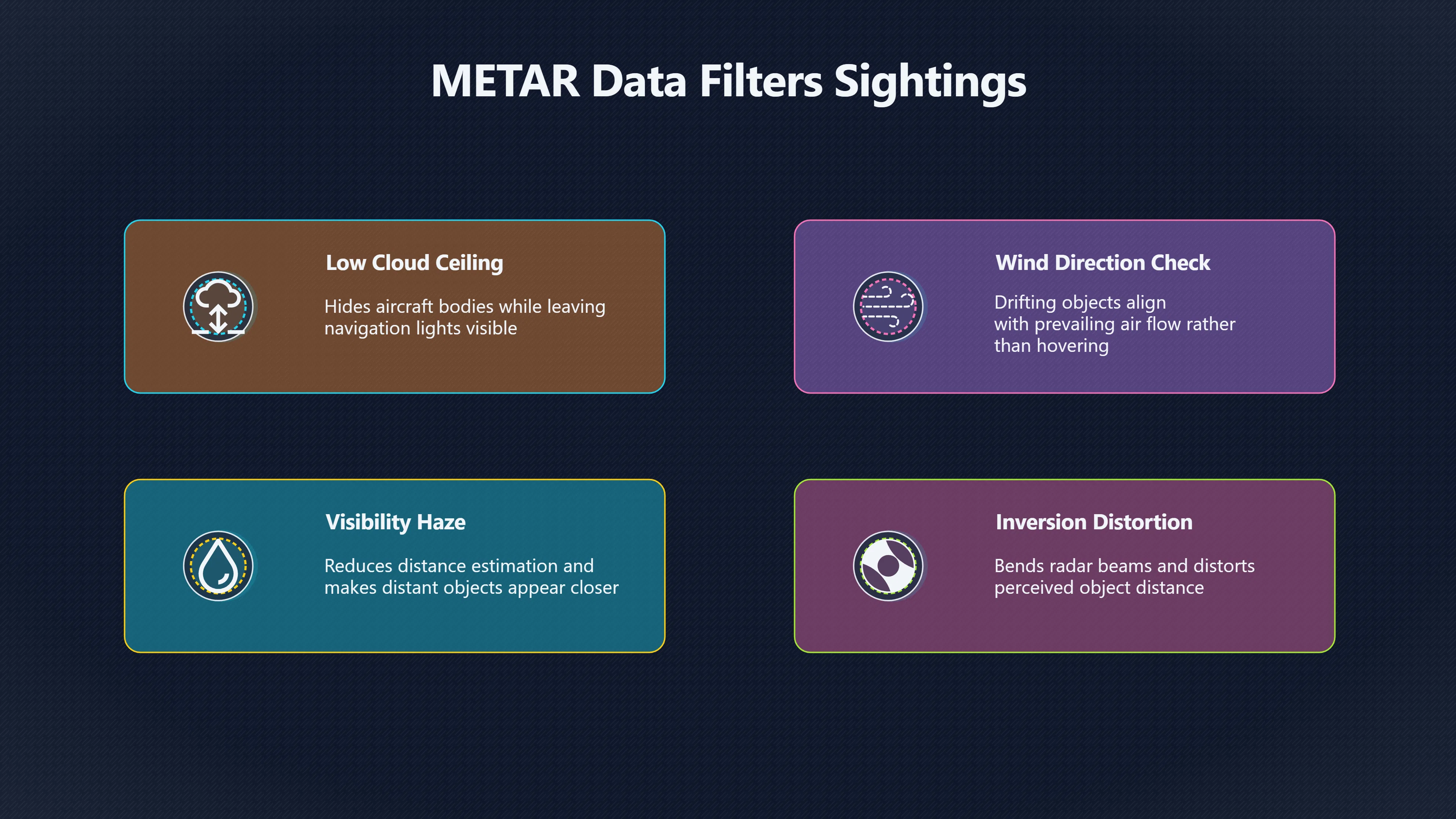
 That matters because many common misidentifications depend heavily on atmospheric conditions. Low cloud can hide aircraft structure while leaving navigation lights visible. Temperature inversions can distort distance and radar behaviour. Ice crystals can create bright pillars and mock suns. Thunderstorms can generate upper-atmosphere flashes that resemble structured luminous objects. A structured case file therefore treats weather as evidence with timestamps, coordinates, and uncertainty ranges rather than as vague background context. NASA’s 2023 independent UAP study stressed that better environmental data and standardised collection methods are central to improving case quality.[NASA Science]science.nasa.govScience Independent Study Team ReportNASA ScienceIndependent Study Team ReportSeptember 13, 2023 — The study of Unidentified Anomalous Phenomena (UAP) presents a unique scien…
Surface observations and aviation reports
The most useful starting point is usually the nearest aviation weather observations. These reports are designed for pilots, but they are equally valuable for UFO case reconstruction because they provide precise measurements of visibility, cloud height, wind, pressure, precipitation, and atmospheric conditions at specific times.
METAR reports — routine aviation weather observations — are especially important because they are highly standardised and widely archived. They include cloud cover, visibility, weather conditions, wind direction, and cloud ceiling information.[Aviation Weather Center]aviationweather.govAviation Weather CenterMETAR and TAF DataCeiling & Visibility Clouds Precipitation Thunderstorms Temperature Winds Turbulence Icing… P…[Met Office]metoffice.gov.ukMETARs & TAFsMETARs are coded weather reports summarising current conditions at aerodromes, including wind, visibility, weather, cloud, t… In practical UFO analysis, that means an investigator can test witness claims against measurable atmospheric conditions rather than relying on memory alone.
A case confidence check often starts with questions such as:
- Was visibility genuinely clear, or reduced by haze, mist, smoke, rain, or fog?
- Was there a low cloud ceiling that could hide aircraft bodies while leaving lights visible?
- Were winds strong enough to move balloons, lanterns, or drifting clouds in the reported direction?
- Did the atmosphere support unusual optical effects?
- Did conditions change rapidly during the sighting window?
These details matter because witness perception changes dramatically once visual references disappear. The Met Office notes that fog is effectively cloud at ground level and can reduce visibility below one kilometre in aviation terms.[Met Office]metoffice.gov.ukMETARs & TAFsMETARs are coded weather reports summarising current conditions at aerodromes, including wind, visibility, weather, cloud, t… In UFO reports, this can make stationary lights appear suspended in empty space or make distant objects seem much closer than they are.
Why cloud ceiling data changes interpretations
Cloud ceiling data is one of the strongest confidence modifiers in night-time cases. Aviation weather systems track the height of the lowest significant cloud layer because it directly affects what pilots can see.[Universal Weather and Aviation]universalweather.comaviation weather tips all you need to know about ceilingsUniversal Weather and AviationUnderstanding Ceiling Conditions and Flight Impacts29 Jul 2025 — Ceiling conditions—referring to the height…
Suppose witnesses report a bright object “hovering silently above the town” at 23:15. If nearby METAR data shows a broken cloud base at 700 feet with drizzle and poor visibility, several ordinary explanations become more plausible:
- Aircraft lights diffused through low cloud
- Helicopter searchlights reflecting from moisture
- Ground lighting projected onto cloud
- Bright planets intermittently obscured by cloud gaps
- Optical distortion from moisture and haze
The same report becomes more difficult to dismiss if records instead show:
- Excellent visibility
- No significant cloud
- Stable dry air
- Multiple observers at separated locations
- Consistent directional descriptions
Weather does not prove an extraordinary interpretation, but it changes how much weight investigators should place on apparent shape, motion, distance, and brightness.
Wind data and drifting-object checks
Wind direction and speed are among the simplest but most revealing checks in UFO investigation workflows.
Objects commonly reported as UFOs — lanterns, balloons, smoke plumes, illuminated debris, drifting drones, and some atmospheric reflections — tend to move with prevailing winds rather than against them. Aviation weather observations and forecast products therefore help investigators compare reported movement against known air flow.[Met Office]metoffice.gov.ukMETARs & TAFsMETARs are coded weather reports summarising current conditions at aerodromes, including wind, visibility, weather, cloud, t…
This comparison is especially useful in cases involving:
- Slow silent movement
- Hovering followed by gradual drift
- Sudden apparent acceleration caused by changing perspective
- Multiple lights moving together
- Objects disappearing into cloud
AI-assisted systems can automate this step by comparing witness direction-of-travel statements against archived wind layers at different altitudes. That matters because surface winds may differ significantly from winds a few thousand feet higher. A balloon apparently “moving intelligently” at ground level may simply be following a higher-altitude wind stream invisible to observers.
Radar, satellite and lightning layers
Weather radar and satellite imagery become particularly valuable when witness reports involve glowing masses, flashes, structured clouds, or rapidly changing luminous events.
These datasets help investigators answer a more specific question: was the atmosphere itself producing unusual visual phenomena at that time?
Storm systems and transient luminous events
Thunderstorm environments deserve special attention because they can generate rare upper-atmosphere electrical events such as sprites, blue jets, and elves. NASA’s UAP study specifically referenced sprites as an example of unusual atmospheric phenomena that observers may misidentify.[NASA Science]science.nasa.govScience Independent Study Team ReportNASA ScienceIndependent Study Team ReportSeptember 13, 2023 — The study of Unidentified Anomalous Phenomena (UAP) presents a unique scien… National Geographic has also documented how transient luminous events can appear highly unfamiliar even to experienced skywatchers.[National Geographic]nationalgeographic.comlightning sprites transient luminous events thunderstormsNational GeographicThe most otherworldly, mysterious forms of lightning on Earth26 Jun 2025 — Scientists are working to understand the cu…
These events matter in UFO investigations because they can produce:
- Brief structured red flashes
- Vertical luminous columns
- Expanding rings or jellyfish-like forms
- High-altitude glows above storms
- Sudden illumination without audible thunder
In older UFO cases, witnesses sometimes described “silent red entities” or “pulsing formations” above distant storm systems before the scientific understanding of sprites became widespread. That does not retroactively solve all such reports, but modern weather and lightning datasets allow investigators to test whether thunderstorm conditions were present.
Lightning-mapper satellites have improved this process significantly. NOAA’s GOES satellites continuously monitor atmospheric lightning activity across large regions.[NOAA]star.nesdis.noaa.govNOAA / NESDIS / STAR websiteGOES Imagery ViewerGOES Image Viewer. Click on a region to view images and animations for that region. Covera…[NESDIS]star.nesdis.noaa.govNOAA / NESDIS / STAR websiteGOES Imagery ViewerGOES Image Viewer. Click on a region to view images and animations for that region. Covera… STAR website These systems can reveal whether unusual flashes reported by witnesses corresponded to active storm cells, even when no cloud-to-ground strikes were noticed locally.

Radar returns and false confidence
Radar evidence often sounds persuasive in UFO discussions, but weather conditions can complicate interpretation.
Temperature inversions, moisture layers, precipitation, and anomalous propagation can produce misleading radar returns. Older radar systems were especially vulnerable to atmospheric distortion. Modern meteorological radar products therefore become useful not only for detecting storms but for testing whether unusual radar contacts appeared during conditions known to affect signal propagation.
This matters because a combined “visual plus radar” report is frequently treated as stronger evidence. Sometimes that is justified. Sometimes weather data weakens the case considerably.
For example:
- Heavy precipitation can create clutter or false returns.
- Strong inversions can bend radar beams abnormally.
- Dense moisture layers can produce anomalous echoes.
- Distant storms may create visual flashes while also degrading radar interpretation.
An AI-assisted workflow should therefore avoid treating radar confirmation as automatically independent evidence. Instead, it should compare radar anomalies against meteorological conditions minute by minute.
Satellite cloud imagery and line-of-sight reconstruction
Archived satellite imagery can help reconstruct what witnesses were physically capable of seeing.
This becomes valuable in cases where observers report:
- Objects emerging from clouds
- Lights hidden behind weather systems
- Sudden disappearances
- Structured formations inside storm clouds
- Large glowing masses over hills or coastlines
Geostationary weather satellites now provide high-frequency cloud imagery over large areas.[NOAA]star.nesdis.noaa.govNOAA / NESDIS / STAR websiteGOES Imagery ViewerGOES Image Viewer. Click on a region to view images and animations for that region. Covera…[NESDIS]star.nesdis.noaa.govNOAA / NESDIS / STAR websiteGOES Imagery ViewerGOES Image Viewer. Click on a region to view images and animations for that region. Covera… STAR website Investigators can combine this with witness coordinates, terrain elevation, and viewing direction to estimate whether cloud layers or storm structures matched the account.
In practice, this often changes confidence levels in subtle ways rather than producing dramatic debunks. A report may remain unexplained while still becoming less reliable because cloud conditions prevented accurate range estimation.
Turning weather matches into cautious case labels
The most useful role for weather analysis is not declaring that a UFO “was weather”. It is assigning more careful confidence labels to competing explanations.
A structured investigation benefits from separating cases into categories such as:
- Strong weather consistency — the report closely matches known atmospheric or optical conditions.
- Partial weather consistency — some features align with weather data, while others remain unclear.
- Weather contradiction — reported conditions conflict with recorded observations.
- Weather-insufficient — available data is too sparse for a confident assessment.
This distinction matters because many UFO discussions collapse into false certainty at both extremes. Sceptical commentary may dismiss witnesses too quickly, while believers may treat unresolved details as proof of something extraordinary.
A stronger investigative model asks narrower questions:
- Did the weather support or weaken the claimed motion?
- Did visibility conditions support reliable distance estimation?
- Were atmospheric optics likely?
- Were storms active nearby?
- Did winds match reported drift?
- Could cloud cover hide ordinary explanations?
When weather strengthens a case instead of weakening it
Weather analysis does not always reduce confidence in a sighting. Occasionally it does the opposite.
A report can become more interesting when records show:
- Excellent visibility
- No cloud interference
- Stable atmospheric conditions
- No storm activity
- No inversion conditions
- Weak winds inconsistent with drifting objects
- Multiple separated witnesses with consistent descriptions
In these situations, investigators may place less weight on atmospheric explanations and more weight on aircraft, drone, astronomical, or genuinely unresolved categories.
That still does not prove an anomalous object. It simply means the atmosphere is less likely to explain what observers reported.
Why automation helps
Manual weather reconstruction is time-consuming because useful evidence is scattered across aviation archives, radar products, satellite imagery, lightning networks, and forecast systems. AI-assisted workflows help by synchronising these layers into a single timeline tied to the exact coordinates and minute of the reported event.
A useful automated system can:
- Pull archived METAR and TAF data
- Compare witness descriptions against visibility conditions
- Check wind layers against object movement
- Overlay storm and lightning activity
- Flag inversion-prone weather setups
- Compare similar historical sightings under matching conditions
The important limitation is that automation should rank plausibility, not manufacture certainty. A weather match does not automatically close a case, and a lack of weather explanation does not automatically elevate a sighting into something extraordinary. The real value comes from reducing avoidable ambiguity and improving the reliability of the case file before stronger claims are made.
eBay marketplace picks
Marketplace Samples
Example marketplace items related to this page. Use the search link to explore similar finds on eBay.


Endnotes
1.
Source: science.nasa.gov
Title: Science Independent Study Team Report
Link:https://science.nasa.gov/wp-content/uploads/2023/09/uap-independent-study-team-final-report.pdf
Source snippet
NASA ScienceIndependent Study Team ReportSeptember 13, 2023 — The study of Unidentified Anomalous Phenomena (UAP) presents a unique scien...
Published: September 13, 2023
2.
Source: weather.gov
Link:https://www.weather.gov/asos/METAR.html
3.
Source: star.nesdis.noaa.gov
Link:https://www.star.nesdis.noaa.gov/GOES/
Source snippet
NOAA / NESDIS / STAR websiteGOES Imagery ViewerGOES Image Viewer. Click on a region to view images and animations for that region. Covera...
4.
Source: weather.gov
Link:https://www.weather.gov/ilm/aviation
Source snippet
Aviation WeatherGFA FORECAST. Ceiling & Visibility Clouds Precipitation Thunderstorms Temperature Winds Turbulence Icing... Center Weath...
5.
Source: aviationweather.gov
Link:https://aviationweather.gov/data/metar/
Source snippet
Aviation Weather CenterMETAR and TAF DataCeiling & Visibility Clouds Precipitation Thunderstorms Temperature Winds Turbulence Icing... P...
6.
Source: metoffice.gov.uk
Link:https://www.metoffice.gov.uk/services/transport/aviation/regulated/training-resources-for-aviation/metars-and-tafs
Source snippet
METARs & TAFsMETARs are coded weather reports summarising current conditions at aerodromes, including wind, visibility, weather, cloud, t...
7.
Source: metoffice.gov.uk
Title: whats the difference between mist fog and haze
Link:https://www.metoffice.gov.uk/blog/2025/whats-the-difference-between-mist-fog-and-haze
Source snippet
Met OfficeMist, fog, and haze: What's the difference?10 Sept 2025 — For aviation purposes, fog is the name given when visibility drops be...
8.
Source: universalweather.com
Title: aviation weather tips all you need to know about ceilings
Link:https://www.universalweather.com/blog/aviation-weather-tips-all-you-need-to-know-about-ceilings/
Source snippet
Universal Weather and AviationUnderstanding Ceiling Conditions and Flight Impacts29 Jul 2025 — Ceiling conditions—referring to the height...
9.
Source: metoffice.gov.uk
Link:https://www.metoffice.gov.uk/services/transport/aviation/regulated/training-resources-for-aviation/low-level-forecasts
Source snippet
Met OfficeLow Level ForecastsLow-level aviation forecasts, including F214, F215, F415, and F424, in helping pilots assess weather conditi...
10.
Source: nationalgeographic.com
Title: lightning sprites transient luminous events thunderstorms
Link:https://www.nationalgeographic.com/science/article/lightning-sprites-transient-luminous-events-thunderstorms
Source snippet
National GeographicThe most otherworldly, mysterious forms of lightning on Earth26 Jun 2025 — Scientists are working to understand the cu...
11.
Source: metoffice.gov.uk
Title: what is anticyclonic gloom
Link:https://www.metoffice.gov.uk/blog/2025/what-is-anticyclonic-gloom
Source snippet
?13 Oct 2025 — Anticyclonic gloom occurs when a high-pressure system settles over the UK, creating a stable atmosphere that suppresses ve...
12.
Source: metoffice.gov.uk
Link:https://www.metoffice.gov.uk/research/library-and-archive/publications/factsheets
Source snippet
FactsheetsIf you are interested in clouds or thunderstorms, UK climate or weather extremes, these factsheets clearly describe and illustr...
13.
Source: Wikipedia
Link:https://en.wikipedia.org/wiki/METAR
Source snippet
METARsMETAR is a format for reporting weather information. A METAR weather report is predominantly used by aircraft pilots, and by met...
14.
Source: youtube.com
Title: How to read a synoptic weather chart
Link:https://www.youtube.com/watch?v=RVBhb1cahNM
Source snippet
Met Office explains...These weather charts or synop charts are a meteorological road map that reveal the complex patterns behind the wea...
15.
Source: aviationweather.gov
Link:https://aviationweather.gov/gfa/?tab=cigvis
16.
Source: wiki.ivao.aero
Link:https://wiki.ivao.aero/en/home/training/documentation/metar_explanation
Source snippet
explanation | IVAO Documentation LibraryWhen the sky is obscured, the observations of vertical visibility should be reported in lieu of c...
17.
Source: GOV.UK
Title: met office weather and climate forecasting
Link:https://www.gov.uk/algorithmic-transparency-records/met-office-weather-and-climate-forecasting
Source snippet
Office: Weather and climate forecasting10 Feb 2025 — The purpose of the tool is to generate accurate forecasts of the weather across the...
18.
Source: ansperformance.eu
Title: META R
Link:https://ansperformance.eu/acronym/metar/
Source snippet
METAR - METeorological Aerodrome or Aeronautical ReportMETAR is a format for reporting weather information typically from airports or per...
Additional References
19.
Source: faa.gov
Link:https://www.faa.gov/air_traffic/publications/ATpubs/AIM_html/chap7_section_1.html
Source snippet
Chapter 7. Safety of FlightThe following are examples of aviation forecasts depicted on the GFA: Terminal Aerodrome Forecast (TAF); Ceili...
20.
Source: researchgate.net
Link:https://www.researchgate.net/publication/228727730_New_observations_of_sprites_from_the_space_shuttle
Source snippet
(PDF) New observations of sprites from the space shuttleWe imaged sprites from an altitude of 280 km using a calibrated multispectral cam...
21.
Source: navcanada.ca
Link:https://www.navcanada.ca/en/aviation-weather-services-guide.pdf
22.
Source: wired.com
Link:https://www.wired.com/2017/03/check-weather-satellites-flashy-lightning-mapper
Source snippet
This capability is crucial for predicting severe weather events, such as thunderstorms, tornadoes, and wildfires, helping to keep people...
23.
Source: boldmethod.com
Link:https://www.boldmethod.com/learn-to-fly/weather/cloud-ceilings-celestial-dome/
24.
Source: moratech.com
Link:https://www.moratech.com/aviation/metaf-abbrev.html
Source snippet
METAR/TAF AbbreviationsMETAR and TAF Weather Reports; Weather Identifiers:; B - Began BC Patches BL Blowing BR Mist >=5/8. DR Low Drift...
25.
Source: youtube.com
Link:https://www.youtube.com/watch?v=g5wBWOTrloA
Source snippet
How to Decode METARs and TAFsIn this video I go over examples of decoding aviation METARs and TAFs. Meteorological Aerodrome Reports (MET...
26.
Source: abc.net.au
Title: declassified ufo reports to open a window into new science
Link:https://www.abc.net.au/news/2021-07-01/declassified-ufo-reports-to-open-a-window-into-new-science/100254896
Source snippet
Astronomer says declassified UFO reports will open way...30 Jun 2021 — The declassifying of military UFO reports by the United States wi...
27.
Source: facebook.com
Link:https://www.facebook.com/paulmsmithphotography/posts/an-incredible-display-of-red-sprites-and-secondary-tles-over-storms-this-springi/1330772145345763/
Source snippet
It is not very often that you get such a display of power like this with...
28.
Source: facebook.com
Link:https://www.facebook.com/ScienceTubeOfficial0/posts/-this-isnt-a-glitch-this-is-realcaptured-above-a-powerful-thunderstorm-in-the-us/122247371906175506/
Source snippet
electrical discharges that occur between 30 and 55 miles...Read more...
Topic Tree