Within Weather layers
How Haze Turns Ordinary Lights Into Strange UFOs
Humidity, smoke, and haze can alter apparent distance, colour, speed, and shape during a UFO sighting.
On this page
- Why haze alters size and distance perception
- Colour shifts and pulsing lights near the horizon
- Testing haze conditions in AI sighting timelines
Page outline Jump by section
Introduction
Haze is one of the most common reasons ordinary aircraft lights are reported as unusual aerial objects. Moisture, smoke, dust, pollution, and fine airborne particles scatter light and reduce contrast, especially near the horizon. In UFO investigations, that matters because witnesses usually estimate an object’s speed, size, altitude, and behaviour from visual appearance alone. When haze alters those visual cues, a distant aircraft can appear stationary, enormous, shape-shifting, or physically impossible.
 This effect is well known in aviation safety research. Pilot training material from the FAA and other flight-safety organisations repeatedly warns that atmospheric haze makes objects appear farther away and higher than they really are. CAU[Learn To Fly]learntoflyblog.comLearn To FlyHuman Factors: Optical Illusions - Learn to Fly Blog7 Aug 2017 — Atmospheric haze can create an illusion of being at a greate… In a UFO context, the same illusion can make a conventional aircraft look unlike any familiar aircraft at all. AI-assisted sighting analysis therefore treats haze as a measurable evidence layer rather than a vague weather condition.
Why haze alters size and distance perception
The core problem is that human depth perception depends heavily on contrast and detail. In clear air, distant aircraft still show recognisable structure: blinking navigation lights, wing spacing, fuselage shape, or a clear sense of motion against the sky. Haze strips away those cues.
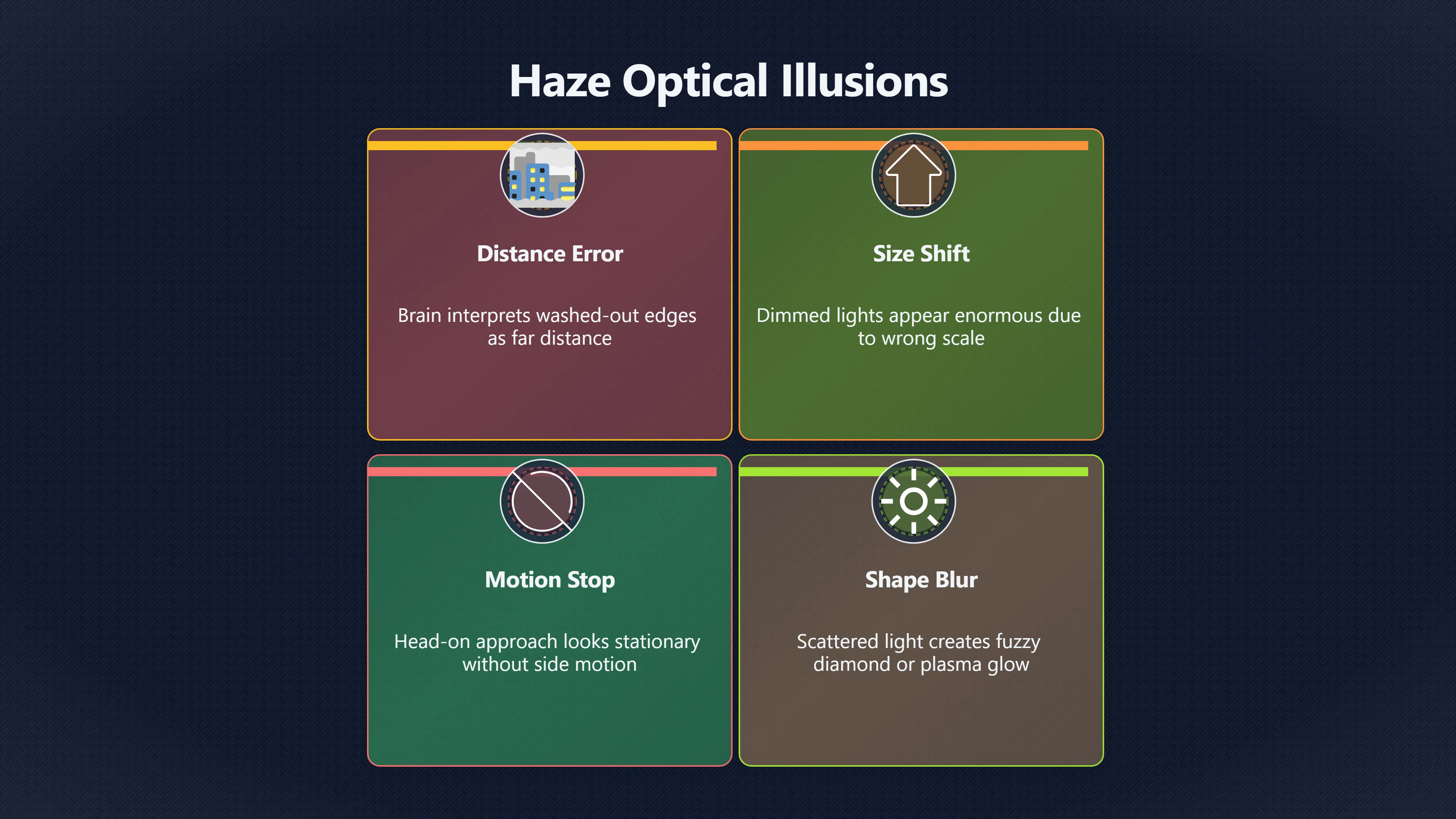
When airborne particles scatter incoming light, distant objects lose sharp edges and appear washed out. The brain interprets that loss of clarity as greater distance. Aviation training literature specifically notes that haze creates “an illusion of being at a greater distance”. CAU[Learn To Fly]learntoflyblog.comLearn To FlyHuman Factors: Optical Illusions - Learn to Fly Blog7 Aug 2017 — Atmospheric haze can create an illusion of being at a greate… Witnesses who believe an aircraft is far farther away than it really is may then misjudge its speed, altitude, or physical scale.
This creates several recurring UFO-report patterns:
- A landing aircraft appears motionless for long periods because it is flying directly toward the observer.
- A bright aircraft light seems enormous because the witness unconsciously scales its brightness to the wrong distance.
- Normal turns appear as sudden accelerations once perspective changes.
- A routine descent through haze can look like an object dropping vertically.
- A standard holding pattern can resemble hovering behaviour.
These effects become especially strong near airports. Aircraft on approach often keep landing lights aimed toward the observer for several minutes. Through humid or smoky air, those lights can bloom into glowing orbs with little visible aircraft structure behind them. Witnesses may report a silent hovering sphere even though the aircraft is moving steadily.
Perspective also matters. A distant aircraft travelling toward the observer shows little sideways motion. In clear air, its shape and blinking lights still reveal that it is an aircraft. In haze, only the central light source may remain visible. Without reliable reference points, the object can appear fixed in place, then suddenly “shoot away” when the aircraft changes heading or passes overhead.
FAA material on visual illusions and spatial disorientation repeatedly stresses that poor visibility and degraded visual references distort human judgement of distance, movement, and orientation.[Federal Aviation Administration]faa.govFederal Aviation Administration Spatial Disorientation: Visual Illusions10% of all general aviation accidents can be attributed to spatial disorientation, and 90% of these accidents are fatal.Read more…[FAA Safety]faasafety.govFAA Safety Your Senses in the ShadowsNighttime Visual Illusions…By using visual references, the pilot can gather information about distance, speed, and depth. Any conditio… UFO investigations encounter the same perceptual failures from the ground observer’s perspective.
Why aircraft lights become strange glowing shapes
Haze does not simply dim lights. It scatters them.
Tiny water droplets and aerosol particles spread light outward, producing halos, glow effects, and blurred edges. A single aircraft landing light can therefore appear as:
- A glowing disc
- A pulsating orb
- A fuzzy diamond or oval
- Multiple merged lights
- A “plasma-like” glow
- A shape that seems to expand and contract
At night, the effect becomes much stronger because the surrounding sky provides few reference points. The witness sees only the scattered light source rather than the aircraft body. Under humid conditions, light scatter may create visible shafts or cones extending outward from the object. Similar descriptions appear regularly in UFO witness testimony.
The effect is amplified when:
- Humidity is high
- Smoke or pollution levels are elevated
- The aircraft is low on the horizon
- The observer looks through long atmospheric distances
- Thin cloud or mist layers are present
The horizon is particularly deceptive because the observer is looking through far more atmosphere than when viewing overhead objects. Even modest haze can therefore radically distort low-angle lights while leaving overhead stars relatively sharp.
This helps explain reports where witnesses describe a “structured craft” that later resolves into ordinary air traffic once it climbs higher or approaches closer. The apparent structure may come from overlapping navigation lights diffused through haze rather than from a physical solid outline.
Colour shifts and pulsing lights near the horizon
Many UFO reports describe lights changing colour rapidly between red, orange, white, blue, and green. Haze and turbulent lower atmosphere layers can produce exactly that effect.
Near the horizon, incoming light travels through thicker air filled with moisture, aerosols, heat gradients, and turbulence. These layers refract and scatter different wavelengths unevenly. Aircraft lights therefore appear unstable and may flicker or pulse.
Common misinterpretations include:
- Red anti-collision beacons appearing as intermittent flashes from a “pulsing craft”
- White landing lights shifting to orange or yellow through smoke
- Green and red navigation lights smearing together into unusual colours
- Atmospheric turbulence causing rapid brightness fluctuations mistaken for intelligent signalling
Stars and planets near the horizon can produce similar effects through atmospheric scintillation, but aircraft add moving light sources, multiple colours, and changing angles that make the illusion even more dramatic.
Several aviation and night-flight illusion studies note that reduced visual references at night increase the risk of false movement perception and misjudged position.[Flight Training Central]flighttrainingcentral.combe aware of these 5 night flying deceptionsFlight Training CentralBe aware of these 5 night flying deceptions19 Dec 2022 — False Horizon Flying – at night under clear skies with gr…[Hartzell Propeller In UFO reports]hartzellprop.comwatch out for night flight illusionsHartzell PropellerWatch Out for These 5 Night Flight Illusions24 Sept 2019 — To prevent this illusion, pilots flying at night should rely…, this often appears as claims that a light was “responding”, “morphing”, or “changing behaviour”.
A particularly common pattern involves aircraft emerging gradually from haze. Initially, only a single diffuse light is visible. As the aircraft gets closer, additional lights become visible one by one. Witnesses may interpret this as a transforming object rather than a conventional aircraft becoming easier to resolve.
Why haze can make aircraft seem silent
Witnesses frequently report glowing objects with no audible engine noise. Haze itself does not block sound effectively, but the same atmospheric conditions that create haze often involve temperature inversions or layered air masses that alter sound propagation.
Distance estimation errors are again central. If haze causes a witness to believe an aircraft is much farther away than it really is, the expected sound level becomes mismatched with what they hear. A nearby aircraft may seem “too quiet”, while a distant aircraft may seem “impossibly loud”.
Modern aircraft also complicate perception because:[skybrary.aero]skybrary.aeroVisual Illusions AwarenessEntering a fog layer also creates the perception of a pitch up, thus inducing a tendency to push over and place…
- Head-on aircraft expose bright landing lights but little engine profile
- Wind direction strongly changes perceived sound location
- Urban noise masks low-frequency engine sound
- High humidity and inversion layers can redirect or dampen sound unevenly
This combination often produces reports of low, hovering lights with little apparent noise, especially during humid evenings or smoky conditions after sunset.

The “hovering UFO” effect during aircraft approach
One of the most persistent haze-related UFO misidentifications involves aircraft approaching directly toward an observer.
When an aircraft flies nearly head-on:
- Its angular movement is minimal
- Landing lights remain steady
- Wing motion is difficult to detect
- Haze removes body detail
- Distance becomes hard to judge
The aircraft can therefore appear stationary for several minutes.
Then, once the aircraft turns or passes laterally, the apparent motion changes dramatically. Witnesses often describe this as:
- Instant acceleration
- Sudden departure
- Impossible speed
- Teleportation-like movement
In reality, the object was moving continuously the entire time. The perceived “burst” comes from changing geometry and restored motion cues.
This effect becomes stronger at night over dark terrain, coastlines, or open countryside where few visual references exist. Flight-safety literature describes comparable “black hole” and low-reference illusions affecting pilots themselves.[Flight Safety Foundation]flightsafety.orgFlight Safety Foundation FSF ALAR Briefing Note 5.3 – Visual IllusionsFlight Safety FoundationFSF ALAR Briefing Note 5.3 – Visual IllusionsMarch 2, 2005 — The absence of visual references in the pilot's nea…[Flight Safety Foundation]flightsafety.orgFlight Safety Foundation FSF ALAR Briefing Note 5.3 – Visual IllusionsFlight Safety FoundationFSF ALAR Briefing Note 5.3 – Visual IllusionsMarch 2, 2005 — The absence of visual references in the pilot's nea… Ground observers can experience similar perceptual distortions.

Testing haze conditions in AI sighting timelines
In AI-assisted UFO investigation, haze should be tested as a measurable variable rather than treated as a subjective impression. A structured workflow can often determine whether atmospheric visibility conditions match the witness description unusually well.
Useful evidence layers include:
- METAR aviation weather reports for visibility and humidity
- Aerosol and smoke maps from satellite observations
- Surface dew point and temperature spread
- Air-quality and particulate measurements
- Cloud ceiling and thin cloud presence
- Wind direction relative to the witness line of sight
- Aircraft approach paths and runway alignment
- Elevation differences between witness and object
A strong reconstruction compares the witness timeline against known air traffic and local atmospheric conditions minute by minute.
For example:
- A witness reports a hovering orange orb low in the western sky.
- ADS-B aircraft tracking shows inbound aircraft aligned toward the observer.
- METAR data shows reduced visibility with high humidity and smoke haze.
- Video analysis reveals pulsing caused by autofocus hunting and atmospheric turbulence.
- The “hover” disappears once the aircraft banks during final approach.
That does not automatically prove every sighting is misidentification. Some reports still contain inconsistencies after atmospheric checks. However, haze analysis often explains why witnesses sincerely report extraordinary motion, shape, colour, or behaviour even when the source object was conventional.
What haze analysis can and cannot prove
Haze evidence is strongest when several factors align:
- The object was low on the horizon
- Visibility was degraded
- The sighting occurred near known air corridors
- Witnesses described glowing or fuzzy light forms
- Reported movement fits perspective effects
- Radar or flight tracking shows compatible aircraft
But haze alone rarely explains every feature of a report. Some limitations remain:
- Witness memory is often imprecise
- Smartphone cameras exaggerate blooming and focus distortion
- Local microclimates may differ from airport weather stations
- Military or non-transmitting aircraft may not appear in public tracking data
- Exact viewing angles are sometimes unknown
AI-assisted investigation therefore treats haze as one explanatory layer among many rather than a universal debunking tool. The key value is that haze effects are testable. Visibility records, humidity levels, aircraft paths, and atmospheric conditions can all be reconstructed after the event and compared against the reported behaviour.
In many cases, the result is not that witnesses “imagined” something. It is that ordinary aircraft seen through degraded atmosphere can genuinely look deeply unfamiliar, especially at night, near the horizon, and without reliable distance cues.
Amazon book picks
Further Reading
Books and field guides related to How Haze Turns Ordinary Lights Into Strange UFOs. Use these as the next step if you want deeper reading beyond the article.
UFOs: Generals, Pilots, and Government Officials Go on the Re...
Keeps atmospheric explanation checks within UFO investigation context.
Weather For Dummies
Directly supports haze, visibility and atmospheric interpretation.
The Weather Handbook
Useful for understanding visibility, haze and changing conditions.
eBay marketplace picks
Marketplace Samples
Example marketplace items related to this page. Use the search link to explore similar finds on eBay.


Endnotes
1.
Source: learntoflyblog.com
Link:https://learntoflyblog.com/human-factors-optical-illusions/
Source snippet
Learn To FlyHuman Factors: Optical Illusions - Learn to Fly Blog7 Aug 2017 — Atmospheric haze can create an illusion of being at a greate...
2.
Source: faa.gov
Title: Federal Aviation Administration Spatial Disorientation: Visual Illusions
Link:https://www.faa.gov/pilots/safety/pilotsafetybrochures/media/spatiald_visillus.pdf
Source snippet
10% of all general aviation accidents can be attributed to spatial disorientation, and 90% of these accidents are fatal.Read more...
3.
Source: faasafety.gov
Title: FAA Safety Your Senses in the Shadows
Link:https://www.faasafety.gov/files/events/SO/SO15/2024/SO15134204/YourSensesInTheShadows.pdf
Source snippet
Nighttime Visual Illusions...By using visual references, the pilot can gather information about distance, speed, and depth. Any conditio...
4.
Source: flighttrainingcentral.com
Title: be aware of these 5 night flying deceptions
Link:https://flighttrainingcentral.com/2022/12/be-aware-of-these-5-night-flying-deceptions/
Source snippet
Flight Training CentralBe aware of these 5 night flying deceptions19 Dec 2022 — False Horizon Flying – at night under clear skies with gr...
5.
Source: hartzellprop.com
Title: watch out for night flight illusions
Link:https://hartzellprop.com/watch-out-for-night-flight-illusions/
Source snippet
Hartzell PropellerWatch Out for These 5 Night Flight Illusions24 Sept 2019 — To prevent this illusion, pilots flying at night should rely...
6.
Source: flightsafety.org
Title: Flight Safety Foundation FSF ALAR Briefing Note 5.3 – Visual Illusions
Link:https://flightsafety.org/wp-content/uploads/2016/09/alar_bn5-3-illusions.pdf
Source snippet
Flight Safety FoundationFSF ALAR Briefing Note 5.3 -- Visual IllusionsMarch 2, 2005 — The absence of visual references in the pilot's nea...
Published: March 2, 2005
7.
Source: flightsafety.org
Title: in the dark
Link:https://flightsafety.org/asw-article/in-the-dark/
Source snippet
Flight Safety FoundationIn the Dark20 Jan 2017 — Most night-vision–related accidents, however, occur because pilots misperceive visual cu...
8.
Source: chinook-helicopter.com
Title: Visual Illusions
Link:https://www.chinook-helicopter.com/standards/Illusions/Visual_Illusions.html
Source snippet
To determine the actual course and direction...Read more...
Additional References
9.
Source: researchgate.net
Link:https://www.researchgate.net/publication/400385806_Physiology_in_Aviation_Hearing_Vision_Spatial_Disorientation_and_Visual_Illusions
Source snippet
Hearing, Vision, Spatial Disorientation, and Visual Illusions4 Feb 2026 — This paper examines the critical flight physiological factors t...
10.
Source: medium.com
Link:https://medium.com/faa/mitigating-the-hazard-of-visual-illusions-fb3c35009471
Source snippet
Mitigating the Hazard of Visual IllusionsA [review]({{ 'review/' | relative_url }}) of aircraft mishaps quickly reveals that visual illusions and/or poor visibility have b...
11.
Source: cfinotebook.net
Link:https://www.cfinotebook.net/notebook/weather-and-atmosphere/obstructions-to-visibility
Source snippet
Obstructions To VisibilityUnderstanding obstructions to visibility helps pilots recognize how phenomena such as fog, haze, smoke, and pre...
12.
Source: facebook.com
Link:https://www.facebook.com/groups/343329786021733/posts/2535777973443559/
Source snippet
That haze-type phenomenon on the horizonThat haze-type phenomenon on the horizon Sorry to reopen this but the haze isn't (a) pollution fr...
13.
Source: skybrary.aero
Link:https://skybrary.aero/sites/default/files/bookshelf/177.pdf
Source snippet
Visual Illusions AwarenessEntering a fog layer also creates the perception of a pitch up, thus inducing a tendency to push over and place...
14.
Source: instagram.com
Link:https://www.instagram.com/reel/DH1ue4INnGU/
15.
Source: flyaeroguard.com
Link:https://www.flyaeroguard.com/learning-center/visual-illusions/
Source snippet
A narrower than usual runway can create the illusion that the aircraft is in a higher altitude than it actually is.Read more...
16.
Source: reddit.com
Link:https://www.reddit.com/r/flying/comments/i0f0cn/why_does_haze_have_different_effects_on_visual/
Source snippet
In one case you're more looking at vertical distance, in the other you're looking at horizontal...Read more...
17.
Source: calaero.edu
Link:https://calaero.edu/aeronautics/aeromedical-factors/7-runway-illusions/
Source snippet
July 11, 2023 — 11 Jul 2023 — So much so that the FAA has something to say about it – “atmospheric haze can create an illusion of being a...
Published: July 11, 2023
18.
Source: facebook.com
Link:https://www.facebook.com/NIMETNIGERIA/posts/%EF%B8%8F-horizontal-visibility-why-it-matters-%EF%B8%8Fwhat-is-horizontal-visibilitythe-max-dis/1056628219832878/
Source snippet
night over a dark ocean, etc., it is Instrument Meteorological...Read more...
Topic Tree