Within UFO Case AI
Could It Be Starlink or a Satellite?
Satellite passes, Starlink trains, flares, and re-entries can make dramatic lights that look unfamiliar without orbital context.
On this page
- Lines, flares, and low horizon tracks
- Using orbital predictions carefully
- What satellite matches can and cannot prove
Page outline Jump by section
Introduction
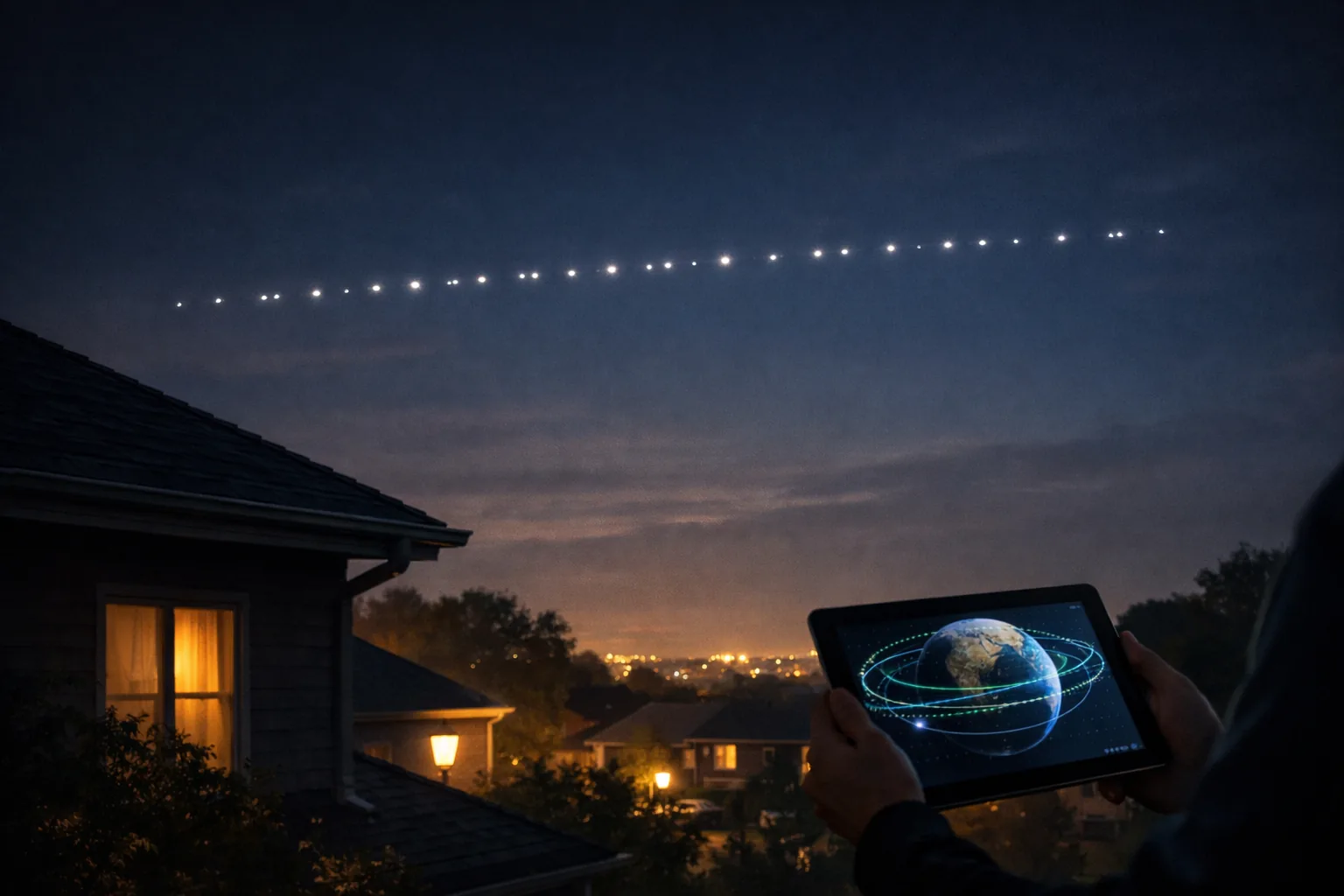
Satellite and Starlink checks are one of the fastest ways to turn an unusual sky-light report from “mysterious” into “testable”. A line of evenly spaced lights, a bright point that fades suddenly, a slow cluster breaking up across the sky, or a glowing spiral near twilight can all have orbital explanations. That does not mean every sighting is “just a satellite”, but it does mean an AI-assisted UFO investigation should check orbital context early, using the witness’s time, location, direction, elevation, duration, and any video metadata.
The key question is not simply “was a satellite somewhere overhead?” It is whether a predicted pass, launch train, flare, rocket body, or re-entry fits the reported geometry closely enough to explain what the witness actually saw. Good satellite work can rule in a mundane explanation, rule one out, or leave a careful “possible but not proven” result.
Why satellites can look stranger than expected
Most satellites do not shine by producing their own light. They become visible when sunlight reflects from their surfaces while the observer is already in darkness. SpaceX’s own brightness-mitigation guidance explains that satellites are typically visible near the day-night boundary, especially in the first hours after sunset or before dawn, and that brightness depends on altitude, geometry, surface material, and whether reflection is diffuse or mirror-like.[Starlink]starlink.comBrightness Mitigation Best Practices Satellite OperatorsBrightness Mitigation Best Practices Satellite Operators
That geometry matters in UFO investigation because witnesses often judge distance and speed poorly when a light is high in a dark sky. A satellite may look like a nearby aircraft with no flashing lights. A group of recently launched Starlink satellites may look like a controlled formation. A flare may look like an object “powering up” or “vanishing”. A re-entering rocket body may look like a slow fireball breaking into several pieces.
Starlink has made this check more important because the constellation is large and frequently replenished. Jonathan McDowell’s Starlink statistics page tracks individual Starlink satellites and their orbital history, with data updated as recently as May 2026 in the live table viewed for this report.[Planet 4589]planet4589.orgSource details in endnotes. Heavens-Above also lists Starlink launch-pass predictions, daily bright-satellite predictions, live sky views, and satellite databases, showing the kind of observer-specific tools that can be used to test a sighting rather than rely on guesswork.[Heavens-Above]heavens-above.comHeavens-Above…
Lines, flares, and low-horizon tracks
The classic Starlink sighting is a “train”: a string of lights moving together across the sky. This is most likely soon after launch, when satellites have not yet spread into their operational arrangement. To a witness, the pattern can feel artificial, silent, and unfamiliar: many points moving at the same pace, often in a near-straight line, without aircraft-style navigation lights.
A strong case-file intake should therefore ask for the exact pattern, not just “lights in the sky”. The most useful descriptors are:
- A straight line of evenly spaced dots: often consistent with a recent Starlink deployment if the timing and viewing direction match.
- One bright light that appears, brightens, then fades: possibly a satellite flare caused by a favourable reflection angle.
- Several lights following the same path at intervals: possibly multiple satellites in similar orbital planes.
- A slow glowing object or cluster with a trail: possibly a re-entry, especially if it lasts much longer than a meteor.
- A large spiral or expanding luminous cloud: possibly rocket-stage fuel venting or exhaust, not a satellite pass itself.
The March 2025 spiral seen across parts of the UK and Europe is a useful cautionary example. BBC Sky at Night Magazine reported the Met Office explanation that the illuminated swirl was likely caused by a SpaceX Falcon 9 rocket, with frozen exhaust or fuel reflecting sunlight and forming a spiral as the stage rotated.[Sky at Night Magazine]skyatnightmagazine.comSource details in endnotes. This kind of event can be mistaken for something hovering or atmospheric, but it is checked through launch timing, trajectory, illumination geometry, and the fact that many witnesses across a wide area reported the same broad feature.
Re-entries form a different pattern. The Aerospace Corporation explains that natural meteors usually last only seconds, while human-made re-entries are slower and can last 20–90 seconds or more; a tight cluster of bright points moving together and leaving streaks is very probably a re-entry breakup.[The Aerospace Corporation]aerospace.orgSource details in endnotes. Its CORDS re-entry database documents payloads and objects that have re-entered Earth’s atmosphere since 2000 and can be sorted by object, mission, type, launch date, and predicted re-entry time.[The Aerospace Corporation]aerospace.orgSource details in endnotes.
Using orbital predictions carefully
An AI-assisted workflow should treat satellite prediction as a matching problem, not a keyword search. The input is the sighting case file; the output is a set of candidate orbital events with confidence notes.
A practical workflow looks like this:
- Normalise the sighting time. Convert the witness time to UTC, preserve local time, record uncertainty, and check whether the device clock was reliable.
- Pin the observer position. A postcode, road junction, hilltop, beach, or field edge can change the predicted sky track.
- Estimate bearing and elevation. “West, about halfway up the sky” is rough but still useful; “over the church tower towards the north-west” is better.
- Query satellite and launch data. Use sources such as CelesTrak, Heavens-Above, Space-Track where available, Starlink-specific trackers, and re-entry databases.
- Compare the sky path. Check whether the object rose, crossed, faded, or set in the same part of the sky described by the witness.
- Check illumination, not just position. A satellite may be physically overhead but invisible if it is in Earth’s shadow.
- Preserve uncertainty. Record whether the match is strong, plausible, weak, or ruled out.
The biggest technical trap is stale orbital data. Skyfield’s satellite documentation warns that orbital elements go rapidly out of date, that the epoch date is when the element set is most accurate, and that older sightings require old archived elements while later predictions need fresh elements. It also notes that Two-Line Element data is only accurate to about a kilometre at epoch and degrades quickly.[Rhodes Mill]rhodesmill.orgRhodes Mill Earth Satellites — Skyfield documentationRhodes Mill Earth Satellites — Skyfield documentation
That limitation is not fatal for public UFO case triage. A kilometre-scale orbital uncertainty is often small compared with a witness’s uncertainty about time, bearing, and elevation. But it matters when analysts try to make a very tight claim, such as “this exact light in the video is satellite X”. In those cases, the workflow should prefer archived orbital elements close to the sighting time, multiple prediction tools, and explicit error margins.
What makes a satellite match strong
A strong satellite or Starlink explanation is not just a name pulled from a tracker. It has several independent alignments.
The most persuasive matches usually include:
- Time agreement: the pass occurs within the witness’s time window, allowing for clock error.
- Direction agreement: the predicted track crosses the reported part of the sky.
- Motion agreement: the object moves at a steady angular speed, usually silently, without aircraft-style manoeuvres.
- Brightness behaviour: the object appears or fades where illumination geometry predicts it should.
- Pattern agreement: a line, train, cluster, flare, or re-entry breakup matches the witness’s description.
- External consistency: other witnesses over a wide area report the same event along the predicted path.
A weak match may still be useful, but it should not be overstated. “There were Starlink satellites visible that evening” is not the same as “the sighting was Starlink”. The case file should state exactly what matched and what did not. For example, a Starlink train may explain a line of lights moving west to east for two minutes, but not a single stationary red object seen for twenty minutes in the opposite direction.
This is where AI helps most. It can compare the sighting against multiple satellite candidates, rank them by time and sky-position fit, flag contradictions, and generate a clear audit trail. The human investigator still needs to check whether the witness’s description has been forced to fit the data.
What satellite checks cannot prove
A satellite match can be very strong, but it rarely proves everything about a sighting. It can show that a known object should have been visible from a given place and time. It cannot prove that the witness looked at that object unless the video, bearing, timing, and visual behaviour align closely.
There are also several common failure modes:
- Bad timestamps: social media uploads often preserve posting time rather than recording time.
- Wrong location: “near Manchester” is not precise enough for a tight sky-track comparison.
- Camera distortion: phone zoom, stabilisation, rolling shutter, and autofocus can make points of light pulse, jump, or smear.
- Multiple objects: a witness may film a satellite while also describing an aircraft, planet, drone, or reflection.
- Launch confusion: Starlink trains, rocket bodies, re-entries, and fuel dumps are related to space activity but have different visual signatures.
- Over-broad explanations: saying “probably satellites” without a time-and-sky match weakens the investigation.
NASA’s UAP work is relevant here because it frames the problem as one of data quality. NASA says its UAP study focused on identifying available data, how best to collect future data, and how NASA could use that data to move understanding forward; the final report was presented as a step towards more systematic, evidence-led analysis.[NASA Science]science.nasa.govScience UAPScience UAP In a satellite check, that means preserving the raw witness account while adding verifiable orbital context, rather than replacing one unsupported claim with another.
How AI should present the result
The best output is not a dramatic label. It is a short, reviewable explanation with confidence and caveats.
A useful case-file entry might say: “A Starlink train from launch group X was predicted to pass west to east from the observer’s location between 21:42 and 21:46. The witness reported a silent line of 15–20 white lights moving west to east for about three minutes at 21:43. This is a strong candidate explanation. Remaining uncertainty: no original video metadata and bearing estimate is approximate.”
A weaker entry might say: “Several satellites were visible during the hour, but none matched the reported low northern track or the object’s apparent stationary phase. Satellite explanation remains possible but not demonstrated.”
This distinction is central to public-facing UFO investigation. Satellite checks are not sceptical box-ticking; they are evidence handling. When they work, they can resolve a dramatic sighting quickly. When they do not, they narrow the problem and show exactly why the case remains unresolved.
Amazon book picks
Further Reading
Books and field guides related to Could It Be Starlink or a Satellite?. Use these as the next step if you want deeper reading beyond the article.
NightWatch: A Practical Guide to Viewing the Universe
Helps readers understand visible satellites, sky geometry, and night observation.
The Demon-Haunted World
Supports careful evaluation of satellite explanations and uncertainty.
eBay marketplace picks
Marketplace Samples
Example marketplace items related to this page. Use the search link to explore similar finds on eBay.


Endnotes
1.
Source: starlink.com
Title: Brightness Mitigation Best Practices Satellite Operators
Link:https://starlink.com/public-files/BrightnessMitigationBestPracticesSatelliteOperators.pdf?srsltid=AfmBOor2a4KJiJGT_HdQZ7jQ1pmEUS0qhE2Z-iPqu6yU2BT3oEOItXfh
2.
Source: planet4589.org
Link:https://planet4589.org/space/con/star/stats.html
3.
Source: heavens-above.com
Link:https://www.heavens-above.com/
Source snippet
Heavens-Above...
4.
Source: aerospace.org
Link:https://aerospace.org/article/what-does-reentry-look-like
5.
Source: aerospace.org
Title: The Aerospace Corporation Reentries
Link:https://aerospace.org/reentries
6.
Source: science.nasa.gov
Title: Science UAP
Link:https://science.nasa.gov/uap/
7.
Source: space.com
Title: x starlink satellites
Link:https://www.space.com/spacex-starlink-satellites.html
8.
Source: space.com
Title: starlink satellite train how to see and track it
Link:https://www.space.com/starlink-satellite-train-how-to-see-and-track-it
9.
Source: space.com
Title: nasa ufo uap study team first results revealed
Link:https://www.space.com/nasa-ufo-uap-study-team-first-results-revealed
10.
Source: space.com
Title: 24839 satellites
Link:https://www.space.com/24839-satellites.html
11.
Source: space.com
Title: x starlink satellites 10 weird things
Link:https://www.space.com/spacex-starlink-satellites-10-weird-things
12.
Source: svs.gsfc.nasa.gov
Link:https://svs.gsfc.nasa.gov/search/?datasets=454
13.
Source: science.nasa.gov
Title: uap independent study team final report
Link:https://science.nasa.gov/wp-content/uploads/2023/09/uap-independent-study-team-final-report.pdf
14.
Source: science.nasa.gov
Title: UAPISTTermsof Reference Signed
Link:https://science.nasa.gov/wp-content/uploads/2023/04/UAPISTTermsofReference_Signed.pdf
15.
Source: spaceplace.nasa.gov
Link:https://spaceplace.nasa.gov/satellite/en/
16.
Source: planet4589.org
Link:https://planet4589.org/space/stats/active.html
17.
Source: celestrak.org
Title: Celes Trak
Link:https://celestrak.org/
18.
Source: celestrak.org
Link:https://www.celestrak.org/NORAD/documentation/gp-data-formats.php
19.
Source: celestrak.org
Link:https://www.celestrak.org/columns/v03n03/
20.
Source: celestrak.org
Link:https://www.celestrak.org/NORAD/elements/supplemental/
21.
Source: celestrak.org
Link:https://www.celestrak.org/NORAD/elements/
22.
Source: celestrak.org
Link:https://www.celestrak.org/columns/v04n03/
23.
Source: celestrak.org
Link:https://www.celestrak.org/publications/IAC/2025/IAC-25%2CA6%2C7%2C1%2Cx99453%2CPaper.pdf
24.
Source: heavens-above.com
Link:https://heavens-above.com/statsdaily.aspx
25.
Source: heavens-above.com
Link:https://www.heavens-above.com/SelectLocation.aspx
26.
Source: starlink.com
Link:https://starlink.com/public-files/BrightnessMitigationBestPracticesSatelliteOperators.pdf?srsltid=AfmBOoo5IEm7onWqM7eFjrU5MH0OLzLwICoTdNnq_WFpmnvw_usyOH9v
27.
Source: starlink.com
Link:https://starlink.com/gb/updates?srsltid=AfmBOorbINESMHwgtB7RM5p7mg7hJ78FP0ju0aYhIj7wxxxt0tq9U4M5
28.
Source: celestrak.com
Link:https://celestrak.com/SpaceTrack/
29.
Source: space-track.org
Link:https://www.space-track.org/
30.
Source: space-track.org
Link:https://www.space-track.org/documentation
31.
Source: skyatnightmagazine.com
Link:https://www.skyatnightmagazine.com/news/strange-spiral-cloud-in-the-sky
32.
Source: rhodesmill.org
Title: Rhodes Mill Earth Satellites — Skyfield documentation
Link:https://rhodesmill.org/skyfield/earth-satellites.html
33.
Source: facebook.com
Link:https://www.facebook.com/rapplerdotcom/posts/starlink-is-looking-to-increase-space-safety-by-lowering-the-satellites-orbit-fr/1402634445231953/
34.
Source: facebook.com
Link:https://www.facebook.com/spacefans1/posts/starlink-is-hitting-a-historic-milestone-this-month-spacexs-starlink-constellati/1344805287678477/
35.
Source: facebook.com
Link:https://www.facebook.com/YappAppNews/posts/starlink-satellites-spotted-in-uk-skies-this-morninga-string-of-bright-moving-li/730635113412303/
36.
Source: Wikipedia
Title: Heavens Above
Link:https://en.wikipedia.org/wiki/Heavens-Above
37.
Source: Wikipedia
Link:https://en.wikipedia.org/wiki/Satellite
38.
Source: Wikipedia
Link:https://en.wikipedia.org/wiki/Starlink
39.
Source: reddit.com
Link:https://www.reddit.com/r/spacex/comments/1q1gmgy/starlink_satellites_being_lowered_from_550_km_to/
40.
Source: eoportal.org
Link:https://www.eoportal.org/satellite-missions/starlink
41.
Source: satflare.com
Title: STARLIN K Train
Link:https://www.satflare.com/track.asp?q=starlinklaunch
42.
Source: spaceweatherarchive.com
Title: Starlink Satellite Flares (Part 1)
Link:https://spaceweatherarchive.com/2019/05/29/starlink-satellite-flares/
43.
Source: youtube.com
Link:https://www.youtube.com/watch?v=GhLXCJ1Gyyc
44.
Source: keeptrack.space
Link:https://keeptrack.space/resources/celestrak
45.
Source: dictionary.cambridge.org
Link:https://dictionary.cambridge.org/dictionary/english/satellite
46.
Source: britastro.org
Title: starlink satellites brightness reduction
Link:https://britastro.org/forums/topic/starlink-satellites-brightness-reduction
Additional References
47.
Source: youtube.com
Title: Are Those Lights in the Sky Satellites or UFOs?
Link:https://www.youtube.com/watch?v=zJg5k6aH_aA
Source snippet
What SpaceX Starlink Satellites Look Like in the Night Sky...
48.
Source: youtube.com
Title: How to Track the ISS and Satellites with Heavens-Above
Link:https://www.youtube.com/watch?v=V8lWQrtLQvE
Source snippet
Are Those Lights in the Sky Satellites or UFOs?...
49.
Source: facebook.com
Link:https://www.facebook.com/thesocialctv/posts/nasa-has-released-a-report-detailing-how-it-tracks-unidentified-anomalous-phenom/850192826467495/
50.
Source: medium.com
Link:https://medium.com/the-aerospace-corporation/a-quick-guide-to-understanding-orbital-debris-reentry-predictions-4b84a8e2bd04
51.
Source: thebaldgeek.github.io
Link:https://thebaldgeek.github.io/autoTLE.html
52.
Source: facebook.com
Link:https://www.facebook.com/groups/177859700191023/posts/1258822865428029/
53.
Source: reddit.com
Link:https://www.reddit.com/r/spacex/comments/wcrr42/brightness_mitigation_best_practices_for/
54.
Source: github.com
Link:https://github.com/CelesTrak
55.
Source: iauoutreach.org
Link:https://iauoutreach.org/global-projects/dark-and-quiet-skies
56.
Source: x.com
Link:https://x.com/spacegovuk/status/1904464636612628979
Topic Tree
Follow this branch
Parent topic
UFO Case AIRelated pages 9
- Aircraft Was It an Aircraft or Drone?
- Astronomy Was the UFO Really in the Sky Map?
- Case File What Makes a UFO Report Investigable?
- Case Match Has This UFO Sighting Happened Before?
- Confidence How Certain Can a UFO Explanation Be?
- Review Who Checks the AI UFO Verdict?
- Timeline What Else Was Happening During the Sighting?
- Video Limits Why Clear UFO Videos Can Still Mislead
- +1 more in sidebar
- Orbital Data How Bad Orbital Data Creates False UFO Matches
- Re entry Breakups When A Fireball Is Really Falling Space Debris
- Rocket Spirals What Causes Giant Spiral Lights In The Sky
- Satellite Flares Why Some Satellites Suddenly Brighten And Vanish
- Starlink Trains Why Starlink Trains Still Surprise Experienced Witnesses