Within Satellites
How Bad Orbital Data Creates False UFO Matches
Outdated orbital elements can create misleading satellite matches when analysts compare old sightings to fresh predictions.
On this page
- Why orbital elements age quickly
- Archived versus live tracking data
- Confidence limits in exact object claims
Page outline Jump by section
Introduction
A surprisingly common failure in UFO or UAP investigation is the “perfect satellite match” that only exists because the orbital data are wrong, stale, or used outside their safe prediction window. In practice, many online satellite trackers rely on Two-Line Element sets, usually called TLEs: compact orbital snapshots that estimate where a satellite should be at a given time. Those predictions drift over time, especially for low Earth orbit objects such as Starlink satellites, rocket bodies, and debris.[Wikipedia]WikipediaTwo-line element setTwo-line element set
 That matters directly to AI-assisted UFO analysis. A witness may report a bright moving light over Manchester at 21:14, and an automated tool may confidently announce “Starlink satellite identified”. But if the prediction used orbital data generated days or weeks after the sighting, or if the object had manoeuvred, decayed, or experienced changing atmospheric drag, the claimed match can be misleading or entirely false. Good investigation workflow therefore treats satellite identifications as probability assessments rather than exact answers.
Why orbital elements age quickly
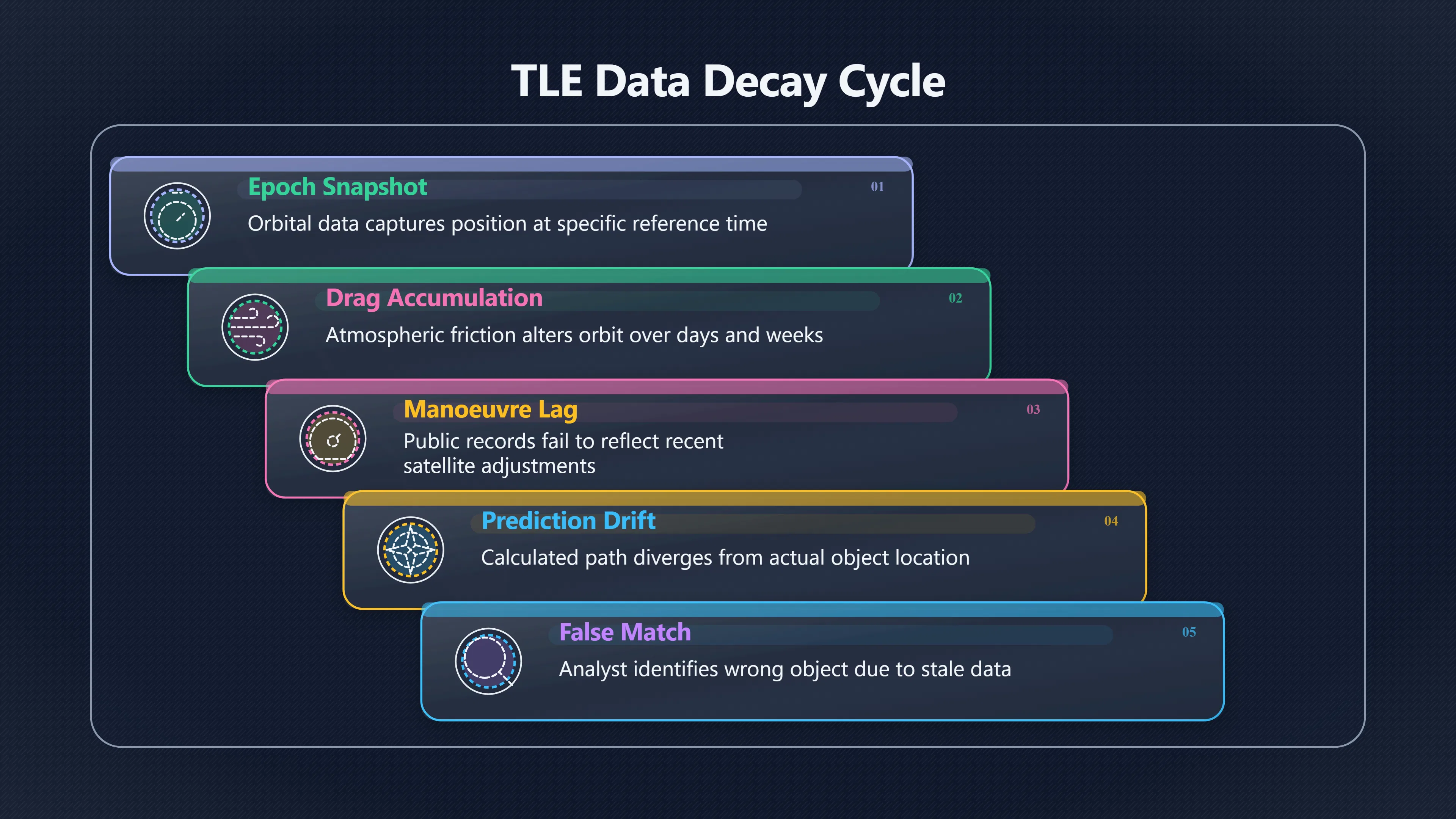
TLE data are not permanent truths about an orbit. They are time-sensitive approximations tied to a specific epoch, meaning a specific reference time. Once a satellite moves beyond that epoch, prediction errors begin to accumulate.[Wikipedia]WikipediaTwo-line element setTwo-line element set
For ordinary satellite spotting this is often acceptable. A hobbyist checking tonight’s International Space Station pass may only need rough timing accuracy. UFO investigation is stricter. Analysts are often trying to determine whether a light crossed a precise section of sky at a precise minute months or years earlier. Small orbital errors can therefore create false confidence.
Several factors make predictions deteriorate quickly:
- Atmospheric drag: Low Earth orbit satellites constantly lose energy due to the thin upper atmosphere. Variations in solar activity and atmospheric density change the drag unpredictably.[ScienceDirect]sciencedirect.comBSTAR is modified in TLEs to improve prediction precision.Read more…[ESA Proceedings Database]conference.sdo.esoc.esa.intMost of the uncertainty stems from inaccurate…Read more…
- Satellite manoeuvres: Modern constellations such as Starlink regularly adjust orbit. Public TLE data may lag behind those changes.
- Simplified models: Standard SGP4 prediction software is designed for practical tracking, not perfect reconstruction.[Wikipedia]WikipediaTwo-line element setTwo-line element set
- Debris instability: Rocket bodies and debris fragments can tumble, decay, or fragment further, complicating prediction.
The result is that a propagated orbit can drift significantly from reality. Public references commonly note kilometre-scale errors after only a few days for low Earth orbit objects.[Wikipedia]WikipediaTwo-line element setTwo-line element set More recent Starlink-focused research suggests median position errors can grow from roughly 1 km at six hours to tens of kilometres after a week, depending on orbital shell and modelling method.[arXiv]arxiv.orgHow long can you trust a Starlink TLE? An empirical comparison of SGP4 and high-fidelity propagation against operator-updated truth…
For UFO case review, that uncertainty matters because a visible pass depends on exact geometry. A satellite only becomes bright if sunlight, observer position, and reflective angle align correctly. A timing error of even a minute or two can shift the visible track enough to create a misleading “match”.
The biggest mistake: using modern predictions for historical sightings
One of the most common analytical errors appears when investigators enter an old sighting date into a modern tracking tool that quietly relies on current orbital elements.
This creates a hidden mismatch between:
- the date of the UFO report
- the epoch of the orbital data
- the software’s propagation assumptions
A satellite catalogue from May 2026 cannot reliably reconstruct the exact sky position of a manoeuvring Starlink satellite seen in October 2022 unless historical orbital data are used properly.
Jonathan McDowell’s historical TLE archive explicitly warns that archived orbital element databases are useful for historical analysis but not for live future prediction.[Planet 4589]planet4589.orgPlanet 4589Historical TLE Orbital ElementsThis database is useful for historical analysis, but does not contain recent element sets and s… The reverse problem is equally important: live prediction feeds are not reliable substitutes for historical reconstruction.
This issue becomes especially serious in social media UFO debunking. Viral claims are often countered within minutes using satellite apps or browser tools that were never designed for forensic historical reconstruction. The software may return the “nearest” orbital object whether or not the fit is genuinely strong.
An AI-assisted workflow should therefore record:
- the exact source of orbital data
- the epoch date of the TLE
- the propagation interval between epoch and sighting
- whether archived historical elements were used[planet4589.org]planet4589.orgPlanet 4589Historical TLE Orbital ElementsThis database is useful for historical analysis, but does not contain recent element sets and s…
- whether the object was known to manoeuvre
Without that metadata, a confident identification can look far more precise than it really is.
Archived versus live tracking data
Historical UFO investigation works best when analysts use archived TLE datasets captured close to the original event date.
Several systems provide this capability:
- historical Space-Track archives[space-track.org]space-track.orgHelp DocumentationNow, all the orbital elements in the satellite catalog (SATCAT) are available in the TLE class. However, the value of t… * CelesTrak historical datasets[celestrak.org]celestrak.orgA New Way to Obtain GP Data (aka TLEs)TLEs were designed to provide the minimum data necessary to propagate the orbit of a resident space…
- specialist orbital archives such as Planet4589
- astronomy software with archived TLE import support
These datasets allow reconstruction using orbital states that existed at the time rather than modern approximations.[Planet 4589]planet4589.orgPlanet 4589Historical TLE Orbital ElementsThis database is useful for historical analysis, but does not contain recent element sets and s…
Even then, there are limitations. Historical TLEs are still estimates rather than exact truth. Some objects were poorly tracked. Military satellites may have incomplete public data. Debris objects can disappear from tracking temporarily. Classification filters and catalogue errors also affect accuracy.
For UFO investigation, the practical lesson is important: archived data reduce uncertainty, but they do not eliminate it.
Why Starlink complicates historical analysis
Starlink has made the problem harder for several reasons.
First, the constellation is extremely large, meaning many satellites may pass through roughly similar regions of sky during a given evening. Second, satellites frequently manoeuvre. Third, newly launched trains disperse rapidly over time.
A poor-quality workflow may therefore:
- find a Starlink satellite roughly overhead,
- assume it explains the sighting,
- ignore geometry mismatch,
- ignore brightness mismatch,
- ignore witness timing uncertainty,
- ignore stale orbital data.
This can create “explanation locking”, where the investigation stops too early because an apparently plausible orbital object has been found.
A stronger workflow instead checks:
- angular track consistency,
- apparent brightness,
- timing tolerance,
- direction of travel,
- duration,
- elevation above horizon,
- visibility conditions,
- and whether multiple satellites fit equally well.
If several candidate satellites produce similarly weak matches, the result should remain “possible but uncertain” rather than “identified”.
False precision in automated UFO pipelines
AI systems can accidentally amplify weak orbital evidence because automated pipelines tend to reward nearest-neighbour matching.
A machine-learning workflow may:
- ingest a witness timestamp,
- query satellite databases,
- rank nearby objects,
- output the highest-scoring candidate.
That process can look scientific while hiding fragile assumptions underneath.
The danger increases when:
- witness times are approximate,
- clocks are wrong,
- phone metadata are missing,
- orbital data are stale,[celestrak.org]celestrak.orgFrequently Asked Questions: Two-Line Element Set Format.1 Jan 1998 — A NORAD two-line element set consists of two 69-character lines of d…
- or the witness estimated direction inaccurately.
An AI system may still return a mathematically “best” candidate even though the real-world confidence is poor.
This creates a known risk in automated UFO classification: false closure. The system appears decisive because it always produces an answer.
For public-facing investigation work, confidence scoring is therefore more useful than binary identification labels. A robust report should distinguish between:
- confirmed orbital match
- strong candidate
- possible satellite explanation
- weak correlation
- no reliable orbital fit
That distinction matters because many sightings genuinely remain ambiguous after satellite checks.
Brightness predictions are often less reliable than track predictions
Even when the orbital path is approximately correct, brightness estimates can fail badly.
Witnesses usually describe:
- sudden brightening,
- fading,
- flashing,
- colour shifts,
- or apparent hovering.
These effects depend heavily on:
- satellite orientation,
- tumbling,
- reflective surfaces,
- solar angle,
- and atmospheric conditions.
Public TLEs mainly describe orbital motion, not reflective behaviour. Two satellites on nearly identical tracks may appear dramatically different to observers.
This becomes important in UFO investigation because a poor brightness fit can invalidate an otherwise acceptable orbital path. A dim predicted satellite is a weak explanation for an object described as “brighter than Venus” unless independent evidence supports exceptional flaring behaviour.
Older flare databases also create confusion. Historic Iridium flares were predictable because of known reflective geometry, but modern satellites behave differently. Analysts sometimes incorrectly apply older flare expectations to newer spacecraft designs.
Confidence limits in exact object claims
The strongest satellite identifications usually combine several independent agreements:
- correct timing,
- correct track,
- correct elevation,
- correct brightness behaviour,
- correct duration,
- and archived orbital data close to the event epoch.
When only one or two factors align, caution is warranted.
This is especially true in retrospective UFO analysis years after the event. Orbital uncertainty compounds over time, and many online tools do not clearly communicate those limits to users. A visually convincing sky-map replay may therefore overstate certainty.
Even professional orbit analysts warn against treating public TLE propagation as exact truth. Research literature repeatedly notes that TLEs contain modelling limitations, measurement noise, and propagation uncertainty.[USU Institutional Repository]digitalcommons.usu.eduSatellite operators are directed to contact the Joint. Space Operations…Read more…[ScienceDirect For UFO case handling]sciencedirect.comBSTAR is modified in TLEs to improve prediction precision.Read more…, the practical takeaway is straightforward:
- A satellite match is strongest when historical orbital data close to the event are available.
- A modern back-calculated match for an old sighting is weaker than many people assume.
- “Something was overhead” is not the same as “this object explains the sighting”.
- AI systems should expose uncertainty instead of hiding it behind confident labels.
That does not mean satellite checks are unreliable. They remain one of the most useful first-pass filters in UFO investigation. But orbital datasets are evidence with error margins, not infallible sky records.
Amazon book picks
Further Reading
Books and field guides related to How Bad Orbital Data Creates False UFO Matches. Use these as the next step if you want deeper reading beyond the article.
The Signal and the Noise
Directly supports explaining how stale data can create false matches.
The Demon-Haunted World
Encourages careful validation rather than accepting exact-looking claims.
The Backyard Astronomer's Guide
Supports a careful observational approach to satellite checks.
eBay marketplace picks
Marketplace Samples
Example marketplace items related to this page. Use the search link to explore similar finds on eBay.


Endnotes
1.
Source: Wikipedia
Title: Two-line element set
Link:https://en.wikipedia.org/wiki/Two-line_element_set
2.
Source: celestrak.org
Link:https://www.celestrak.org/NORAD/documentation/gp-data-formats.php
Source snippet
A New Way to Obtain GP Data (aka TLEs)TLEs were designed to provide the minimum data necessary to propagate the orbit of a resident space...
3.
Source: celestrak.org
Link:https://www.celestrak.org/columns/v04n03/
Source snippet
Frequently Asked Questions: Two-Line Element Set Format.1 Jan 1998 — A NORAD two-line element set consists of two 69-character lines of d...
4.
Source: sciencedirect.com
Link:https://www.sciencedirect.com/science/article/abs/pii/S0273117708006121
Source snippet
BSTAR is modified in TLEs to improve prediction precision.Read more...
5.
Source: conference.sdo.esoc.esa.int
Link:https://conference.sdo.esoc.esa.int/proceedings/sdc8/paper/25
Source snippet
Most of the uncertainty stems from inaccurate...Read more...
6.
Source: arxiv.org
Link:https://arxiv.org/abs/2605.19850
Source snippet
How long can you trust a Starlink TLE? An empirical comparison of SGP4 and high-fidelity propagation against operator-updated truth...
7.
Source: planet4589.org
Link:https://planet4589.org/space/ele.html
Source snippet
Planet 4589Historical TLE Orbital ElementsThis database is useful for historical analysis, but does not contain recent element sets and s...
8.
Source: digitalcommons.usu.edu
Link:https://digitalcommons.usu.edu/cgi/viewcontent.cgi?article=3222&context=smallsat&httpsredir=1
Source snippet
Satellite operators are directed to contact the Joint. Space Operations...Read more...
9.
Source: sciencedirect.com
Link:https://www.sciencedirect.com/science/article/pii/S0273117725002856
Source snippet
Debiasing of two-line element sets for batch least squares...by MIH La Casta · 2025 · Cited by 3 — The P-OD process can be...
10.
Source: sciencedirect.com
Link:https://www.sciencedirect.com/science/article/pii/S0273117725003540
Source snippet
Atmospheric drag uncertainty quantification for orbit...by A Cano · 2025 · Cited by 5 — A methodology developed for uncertainty quantifi...
11.
Source: celestrak.org
Link:https://www.celestrak.org/NORAD/elements/
Source snippet
NORAD GP Element Sets Current DataA set of graphs and tables that show everything from the age distribution of the latest GP data, recent...
12.
Source: conference.sdo.esoc.esa.int
Link:https://conference.sdo.esoc.esa.int/proceedings/sdc6/paper/153/SDC6-paper153.pdf
Source snippet
(TLE) sets to extract additional orbital accuracy has been studied for several years.Read more...
13.
Source: space-track.org
Link:https://www.space-track.org/documentation
Source snippet
Help DocumentationNow, all the orbital elements in the satellite catalog (SATCAT) are available in the TLE class. However, the value of t...
14.
Source: cloudsat.cira.colostate.edu
Title: orbital elements
Link:https://www.cloudsat.cira.colostate.edu/resources/orbital-elements
Source snippet
Elements (TLEs)This page contains the archive of CloudSat two-line elements (TLEs) that can be used to determine the satellite's orbit. S...
Additional References
15.
Source: sarcnet.org
Link:https://www.sarcnet.org/satellites.html
Source snippet
SatellitesThis page provides satellite pass predictions, including predictions of satellite visibility from a single location or satellit...
16.
Source: satobs.org
Link:https://www.satobs.org/tletools.html
Source snippet
Tracking Programs and TLE ResourcesThe TLE is a standard mathematical model to describe a satellite's orbit. TLEs are just one type of fo...
17.
Source: analyticalgraphics.my.site.com
Link:https://analyticalgraphics.my.site.com/faqs/articles/Keyword/Where-can-I-find-archived-or-historical-TLE-data
Source snippet
Can I Find Archived or Historical TLE Data?In the Object Browser, right-click your satellite and got to Properties > Basic > Orbit.... S...
18.
Source: facebook.com
Link:https://www.facebook.com/groups/2365809903441367/posts/24963908966538139/
19.
Source: reddit.com
Link:https://www.reddit.com/r/Starlink/comments/enpdft/which_tracking_site_has_the_correct_info/
20.
Source: amostech.com
Link:https://amostech.com/TechnicalPapers/2007/Modeling_Analysis_Simulation/Kelecy.pdf
Source snippet
This paper summarizes the methods and limitations of deriving satellite maneuver information from historical two- line element (TLE) data...
21.
Source: space.stackexchange.com
Title: what is the accuracy uncertainty of two line elements tles
Link:https://space.stackexchange.com/questions/6167/what-is-the-accuracy-uncertainty-of-two-line-elements-tles
Source snippet
is the accuracy / uncertainty of Two Line Elements...Dec 3, 2014 — It depends on a lot of factors, including: Time since epoch; Altitude...
22.
Source: eprints.lancs.ac.uk
Title: lancs.ac.uk A Satellite Footprint Visualisation Tool
Link:https://eprints.lancs.ac.uk/id/eprint/6762/1/thesis_59.pdf
Source snippet
Satellite Footprint Visualisation Tool - Lancaster EPrints7 Sept 2005 — This thesis concerns the development of a numerical software tool...
23.
Source: orbitalradar.com
Link:https://orbitalradar.com/library
Source snippet
ble from where you are, with sky charts, countdown timers and...Read more...
24.
Source: heavens-above.com
Title: Satellite predictions and other astronomical data customised for your location
Link:https://www.heavens-above.com/
Source snippet
Satellite predictions and other astronomical data customised for your location...
Topic Tree