Within Case Match
When Similar UFO Reports Actually Have Different Causes
Useful UFO clustering depends on separating descriptive similarity from contextual and resolved-case similarity.
On this page
- Descriptive versus contextual matches
- Resolution based clustering rules
- Avoiding copied conclusions
Page outline Jump by section
Introduction
AI clustering can make UFO investigation faster, but it can also make it more misleading if similarities are handled carelessly. Two sightings may both describe a glowing orb, a silent triangle, or a hovering light, yet turn out to have entirely different causes once weather, air traffic, viewing angle, sensor type, and local conditions are checked. In AI-assisted UFO sighting investigation, clustering therefore works best as a sorting and comparison tool rather than a shortcut to conclusions.
 The key distinction is between descriptive similarity and contextual similarity. A witness description alone often groups together unrelated events. A more reliable system compares the full investigative context: time, direction of travel, wind conditions, nearby aircraft activity, satellite visibility, duration, sensor behaviour, and whether earlier cases were eventually resolved. NASA’s independent UAP study noted that machine learning can help identify rare events in large datasets, but only when the underlying data is well characterised and curated.[NASA Science]science.nasa.govNASA ScienceIndependent Study Team ReportArtificial intelligence (AI) and machine learning (ML) have proven to be essential tools for ide…
Descriptive Matches Often Create False UFO Families
The simplest clustering systems group reports by visible description. Reports containing terms such as “orb”, “triangle”, “disk”, “zig-zag”, or “hovering” are placed near one another in a similarity map. That approach is useful for searching archives quickly, but it also creates misleading “lookalike” clusters.
A classic problem is that many ordinary aerial objects converge into the same human description under poor viewing conditions. A bright planet near the horizon, a drone with navigation lights, a Chinese lantern, and an aircraft approaching head-on may all be described as a “stationary orange orb”. Witness language compresses very different physical situations into the same visual shorthand.
AI systems trained mainly on narrative wording become vulnerable to this compression effect. A clustering engine may incorrectly treat dozens of unrelated “triangle UFO” reports as a coherent pattern even when:
- some occurred near military flight paths,
- others happened during meteorological balloon launches,
- others came from infrared cameras,
- and some were likely perception errors caused by formation lights at night.
This is why investigative systems increasingly separate “appearance features” from “context features”. The first layer may still group reports that look similar, but a second layer checks whether the circumstances also align.
A report of three lights moving slowly against the wind, for example, clusters very differently from three lights maintaining formation speed along a known aircraft corridor. The descriptions sound alike; the behavioural context does not.
Contextual Clustering Changes the Outcome
The strongest UFO clustering systems treat a sighting as a structured event rather than a story. Instead of relying mainly on witness wording, they compare measurable attributes:
- timestamp,
- viewing direction,
- duration,
- angular motion,
- weather conditions,
- wind speed and direction,
- nearby ADS-B aircraft tracks,
- satellite visibility,
- launch schedules,
- altitude estimates,
- sensor type,
- and geographical setting.
This changes how apparently similar sightings separate into different investigative paths.
An orange light hovering for twenty minutes over a coastal town during strong upper-level winds may cluster with drifting lantern or balloon cases. A visually similar light making rapid directional changes near an airport during active drone reports may cluster with unmanned aircraft incidents instead. The visible appearance matters less than the environmental fit.
Research on contextual anomaly detection in machine learning follows the same principle: an event can only be judged properly when evaluated against its surrounding conditions rather than against appearance alone.[Science Publications]thescipub.comScience PublicationsA Clustering based Approach for Contextual Anomaly…Contextual anomaly detection is a sophisticated task because th…
In practice, this means a good UFO clustering engine does not ask only:
“What did this object look like?”
It also asks:
“What else was happening at that exact time and place?”
That distinction is often what separates a useful investigative tool from a catalogue of recycled UFO tropes.
Resolution-Based Clustering Is More Valuable Than Visual Clustering
The most useful clusters are usually built around resolved cases rather than unresolved mysteries.
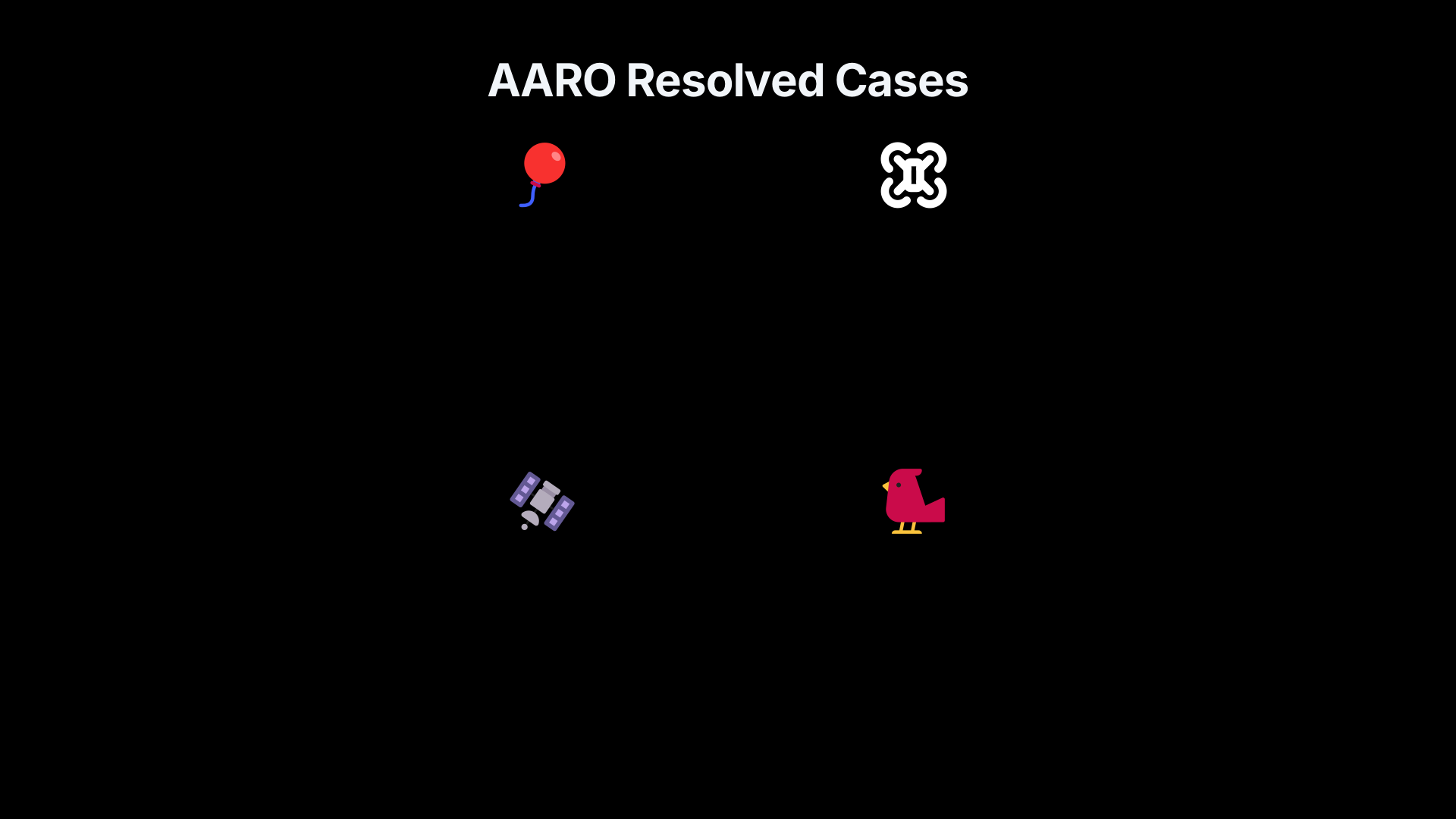
AARO’s published case material repeatedly shows that similarity assessments depend on both morphology and environmental behaviour. Several publicly released videos were assessed as balloons because their shape, movement, and wind-aligned drift matched previously resolved balloon imagery. Other cases were assessed as birds because movement and appearance aligned with known migration behaviour.[aaro.mil]aaro.milUAP ImageryAARO bases its assessment on the object's strong morphological consistency with other resolved imagery featuring balloons and…[aaro.mil]aaro.milUAP Reporting TrendsUAP Reporting Trends. January 1, 1996 - January 15, 2026. Closed Cases Resolution Outcomes. Bird(s): 28 (2.9%). Satel…
This creates a practical investigative rule:
- unresolved cases should not become the primary training examples;
- resolved cases should anchor the clustering model.
Otherwise, the system risks amplifying folklore rather than evidence.
For example, if hundreds of unresolved “fast-moving white orb” reports are grouped together without verified outcomes, the AI may learn a visually dramatic but evidentially weak category. If, however, the training set contains many confirmed balloons, satellites, birds, aircraft reflections, and drones, the clustering engine becomes better at recognising ordinary explanations early.
AARO trend data illustrates why this matters. Large proportions of resolved reports have ultimately matched balloons, satellites, birds, drones, or aircraft rather than extraordinary causes.[2meritalk.com]meritalk.comuap reports soar dod office receives 757 new sightingsUAP Reports Soar: DoD Office Receives 757 New Sightings15 Nov 2024 — “As of the publishing date of this report, all 174 cases have been f…
That does not mean every report is mundane. It means the strongest clustering systems begin with the explanations most frequently confirmed by evidence.
Why “Orb” Reports Frequently Split Into Different Clusters
“Orb” sightings provide a good example of how contextual clustering separates superficially identical reports.
A witness may describe:
- a glowing sphere,
- silent movement,
- unusual hovering,
- sudden disappearance,
- and no visible structure.
On description alone, thousands of reports may appear interchangeable. But contextual analysis usually divides them into several unrelated groups.
Astronomical and atmospheric clusters
Some orb reports occur shortly after sunset, low above the horizon, with little apparent movement. These often correlate with Venus, Jupiter, bright stars distorted by atmospheric turbulence, or temperature inversion effects.
Balloon and lantern clusters
Other orb reports drift with prevailing winds, change brightness gradually, or appear in groups during festivals or celebrations. Their movement profile matches lighter-than-air objects.
Drone clusters
A different subset shows rapid acceleration at short range, hovering near populated areas, or repeated movement patterns around roads or infrastructure. These reports often correlate with consumer drones.
Sensor artefact clusters
Infrared and military sensor systems generate another category entirely. Camera bloom, parallax, autofocus behaviour, compression artefacts, and thermal reflections can create apparent anomalies that resemble structured craft.
The visual description remains similar across all four groups. The underlying mechanisms do not.
AI Systems Also Learn From What Does Not Match
A major advantage of clustering is not merely finding similar cases but identifying mismatches.
If a report visually resembles earlier balloon cases but differs sharply in duration, radar behaviour, witness geography, and wind alignment, the AI may flag it as an outlier within the balloon cluster rather than automatically assigning the same explanation.
This is where clustering overlaps with anomaly detection. Clustering groups similar reports together; anomaly detection highlights cases that do not comfortably fit any established group.[odp.library.tamu.edu]odp.library.tamu.eduunsupervised models 2Anomaly detection is about finding observations that are different. For example, if we have…Read more…
That distinction matters because many UFO databases historically mixed together:
- resolved incidents,
- folklore retellings,
- incomplete witness memories,
- duplicate reports,
- and genuinely unusual observations.
A modern AI-assisted workflow tries to separate those layers instead of flattening them into a single “unexplained” category.
NASA’s UAP study stressed that AI tools are only as reliable as the quality and consistency of the underlying data.[NASA Science]science.nasa.govNASA ScienceIndependent Study Team ReportArtificial intelligence (AI) and machine learning (ML) have proven to be essential tools for ide… A poorly labelled archive can teach the system the wrong similarities.
Avoiding Copied Conclusions From Earlier UFO Cases
One of the biggest risks in UFO clustering is conclusion leakage: the tendency to inherit an explanation from an earlier case simply because the description sounds similar.
This problem becomes worse in highly publicised UFO narratives. Once famous imagery or terminology enters public culture, witnesses may unconsciously describe later sightings using the same language. AI systems trained heavily on public UFO databases can then reinforce those cultural patterns.
For example:
- “tic-tac” reports after the publicity around Navy encounters,
- “black triangle” reports after widespread media discussion,
- or “jellyfish UFO” descriptions following viral infrared footage.
A clustering engine that overweights language similarity may accidentally cluster media influence rather than physical similarity.
This is why strong investigative systems isolate original observational features from interpretive language. Instead of treating “tic-tac craft” as a meaningful category on its own, the system breaks the report into measurable components:
- elongated bright object,
- estimated speed,
- movement consistency,
- sensor source,
- altitude estimate,
- and environmental context.
The goal is to stop earlier narratives from contaminating later analysis.
The Best Clustering Systems Stay Probabilistic
A reliable UFO clustering engine should never behave like a definitive identification machine. It should operate probabilistically.
Instead of declaring:
“This is the same phenomenon as Case X.”
A better system produces something closer to:
- strong similarity to known balloon drift cases,
- moderate similarity to drone incidents,
- weak similarity to astronomical sightings,
- insufficient evidence for firm classification.
This is especially important because many reports contain missing or uncertain information. Witnesses may estimate speed poorly, misjudge altitude, or remember timing inaccurately. Phone footage often strips away depth, scale, and motion cues.
The safest AI-assisted workflows therefore treat clustering as investigative guidance rather than automated truth.
That approach aligns with how current UAP analysis bodies describe their work. AARO repeatedly distinguishes between resolved, unresolved, and anomalous cases rather than treating all unexplained reports as equivalent.[jbsa.mil]jbsa.mildod examining unidentified anomalous phenomenaNov 15, 2024 — "AARO has successfully resolved hundreds of cases in its holdings to commonplace objects such as balloons, birds, drones…[Universe Today]universetoday.compentagon ufo hotspotsPentagon's Latest UFO Report Identifies Hotspots for…14 Nov 2024 — "AARO has successfully resolved hundreds of cases in its holdings t…
What Clustering Is Actually Good For
When used carefully, clustering is valuable because it helps investigators prioritise checks rapidly across large report volumes.
A well-designed system can quickly surface:
- earlier sightings from the same flight corridor,
- historical balloon releases under matching wind conditions,
- recurring drone activity near infrastructure,
- repeated satellite flare misidentifications,
- or sensor artefacts associated with a particular camera system.
That speeds up elimination of common explanations and reduces time spent reinventing earlier investigations.
What clustering cannot do is prove that visually similar reports share a single extraordinary cause. Shared appearance is only the starting point. The decisive question is whether the surrounding evidence also converges.
In AI-assisted UFO sighting investigation, the most useful clustering systems are therefore conservative by design. They separate resemblance from causation, keep unresolved cases distinct from verified ones, and treat environmental context as more important than dramatic witness wording alone.
Amazon book picks
Further Reading
Books and field guides related to When Similar UFO Reports Actually Have Different Causes. Use these as the next step if you want deeper reading beyond the article.
The Signal and the Noise
Highly relevant to avoiding false patterns in clustered UFO reports.
Thinking, Fast and Slow
Explains judgement errors behind overconfident pattern recognition.
eBay marketplace picks
Marketplace Samples
Example marketplace items related to this page. Use the search link to explore similar finds on eBay.




Endnotes
1.
Source: science.nasa.gov
Link:https://science.nasa.gov/wp-content/uploads/2023/09/uap-independent-study-team-final-report.pdf
Source snippet
NASA ScienceIndependent Study Team ReportArtificial intelligence (AI) and machine learning (ML) have proven to be essential tools for ide...
2.
Source: aaro.mil
Link:https://www.aaro.mil/UAP-Cases/Official-UAP-Imagery/
Source snippet
UAP ImageryAARO bases its assessment on the object's strong morphological consistency with other resolved imagery featuring balloons and...
3.
Source: aaro.mil
Link:https://www.aaro.mil/UAP-Cases/UAP-Reporting-Trends/
Source snippet
UAP Reporting TrendsUAP Reporting Trends. January 1, 1996 - January 15, 2026. Closed Cases Resolution Outcomes. Bird(s): 28 (2.9%). Satel...
Published: January 1, 1996
4.
Source: jbsa.mil
Title: dod examining unidentified anomalous phenomena
Link:https://www.jbsa.mil/News/News/Article/3966080/dod-examining-unidentified-anomalous-phenomena/
Source snippet
Nov 15, 2024 — "AARO has successfully resolved hundreds of cases in its holdings to commonplace objects such as balloons, birds, drones...
5.
Source: meritalk.com
Title: uap reports soar dod office receives 757 new sightings
Link:https://www.meritalk.com/articles/uap-reports-soar-dod-office-receives-757-new-sightings/
Source snippet
UAP Reports Soar: DoD Office Receives 757 New Sightings15 Nov 2024 — “As of the publishing date of this report, all 174 cases have been f...
6.
Source: odp.library.tamu.edu
Title: unsupervised models 2
Link:https://odp.library.tamu.edu/dataanalyticsaccounting/chapter/unsupervised-models-2/
Source snippet
Anomaly detection is about finding observations that are different. For example, if we have...Read more...
7.
Source: nasa.gov
Title: update nasa shares uap independent study report names director
Link:https://www.nasa.gov/news-release/update-nasa-shares-uap-independent-study-report-names-director/
Source snippet
UPDATE: NASA Shares UAP Independent Study ReportSep 14, 2023 — The report contains the external study team's findings and recommendations...
8.
Source: aaro.mil
Link:https://www.aaro.mil/
Source snippet
AARO HomeUnidentified Anomalous Phenomena (UAP) means (A) airborne objects that are not immediately identifiable; (B) transmedium objects...
9.
Source: aaro.mil
Title: 2025 UAP Workshop Paper
Link:https://www.aaro.mil/Portals/136/PDFs/Information%20Papers/2025_UAP_Workshop_Paper.pdf
Source snippet
2025 UAP Workshop: Narrative Data, Infrastructures, and...Semi-automated triage, assisted by AI, offers promise for sifting through mass...
10.
Source: thescipub.com
Link:https://thescipub.com/abstract/jcssp.2019.1195.1202
Source snippet
Science PublicationsA Clustering based Approach for Contextual Anomaly...Contextual anomaly detection is a sophisticated task because th...
11.
Source: universetoday.com
Title: pentagon ufo hotspots
Link:https://www.universetoday.com/articles/pentagon-ufo-hotspots
Source snippet
Pentagon's Latest UFO Report Identifies Hotspots for...14 Nov 2024 — "AARO has successfully resolved hundreds of cases in its holdings t...
12.
Source: universetoday.com
Title: UF O Panelists Say NASA Needs Better Data
Link:https://www.universetoday.com/articles/ufo-uap-panel-nasa-better-data-ai
Source snippet
UFO Panelists Say NASA Needs Better DataMay 31, 2023 — During today's public hearing, panelists said NASA could contribute to the UAP deb...
Published: May 31, 2023
Additional References
13.
Source: war.gov
Title: dr jon kosloski director aaro media roundtable on the fy24 consolidated annual
Link:https://www.war.gov/News/Transcripts/Transcript/Article/3965734/dr-jon-kosloski-director-aaro-media-roundtable-on-the-fy24-consolidated-annual/
Source snippet
Jon Kosloski, Director, AARO, Media Roundtable on the...14 Nov 2024 — AARO has successfully resolved hundreds of cases in its holdings t...
14.
Source: reddit.com
Link:https://www.reddit.com/r/Futurology/comments/16ijwyl/nasa_shares_unidentified_anomalous_phenomena/
Source snippet
NASA Shares Unidentified Anomalous Phenomena...Advanced analysis techniques like machine learning have potential to help identify UAP an...
15.
Source: nypost.com
Link:https://nypost.com/2024/11/14/us-news/pentagon-says-nearly-two-dozen-ufo-sightings-cant-be-explained-true-anomalies/
Source snippet
The "all-domain anomaly resolution office" (AARO) identified 21 reports as "true anomalies" needing further investigation. Most sightings...
16.
Source: avi-loeb.medium.com
Link:https://avi-loeb.medium.com/nasa-aaro-and-the-galileo-project-agree-on-the-need-for-a-scientific-study-of-uap-58b39c005b57
Source snippet
medium.comNASA, AARO and the Galileo Project Agree on the Need for a...The data stream is analyzed by artificial intelligence software w...
17.
Source: aui.edu
Link:https://aui.edu/aaro-releases-report-on-unidentified-anomalous-phenomena-uap/
Source snippet
AARO Releases Report on Unidentified Anomalous...AARO Releases Report on Unidentified Anomalous Phenomena (UAP). The U.S. Department of...
18.
Source: studocu.com
Link:https://www.studocu.com/en-us/document/harvard-medical-school/estadistica/nasa-uap-independent-study-team-final-report-key-findings-and-recommendations/157385671
Source snippet
NASA UAP Independent Study Team Final ReportArtificial intelligence (AI) and machine learning (ML) have proven to be essential tools for...
19.
Source: facebook.com
Link:https://www.facebook.com/newshour/posts/the-us-in-2022-launched-the-all-domain-anomaly-resolution-office-aaro-as-part-of/1149122250416353/
Source snippet
The U.S. in 2022 launched the All-Domain Anomaly...✓ AARO has looked into over 800 UAP cases. Most turn out to be explainable (like dron...
20.
Source: read-me.org
Title: fiscal year 2024 consolidated annual report on unidentified anomalous phenomena
Link:https://read-me.org/more-social-sciences/2024/12/21/fiscal-year-2024-consolidated-annual-report-on-unidentified-anomalous-phenomena
Source snippet
Fiscal Year 2024 Consolidated Annual Report on...21 Dec 2024 — AARO resolved 118 cases during the reporting period, all of which resolve...
21.
Source: youtube.com
Link:https://www.youtube.com/watch?v=TQcqOW39ksk
Source snippet
Unidentified Anomalous Phenomena Independent Study ReportNASA commissioned an independent study team to examine unidentified anomalous ph...
22.
Source: astrobiology.com
Title: nasa releases uap independent study report and names research director
Link:https://astrobiology.com/2023/09/nasa-releases-uap-independent-study-report-and-names-research-director.html
Source snippet
NASA Releases UAP Independent Study Report And Names...14 Sept 2023 — The external study recommends that NASA use its open-source resour...
Topic Tree