Within Shape Labels
What AI needs beyond UFO shape words
Standardised time, location, weather, astronomy, aviation, and camera metadata can stop AI from treating vague shape words as physical evidence.
On this page
- Why unstructured labels create noisy clusters
- Metadata that changes a UFO comparison
- Separating witness wording from inferred properties
Page outline Jump by section
Introduction
A witness saying “it looked like a triangle” or “it was an orb” is not useless information, but it is weak information on its own. In AI-assisted UFO sighting investigation, shape words become genuinely valuable only when they are tied to reliable metadata: exact time, location, viewing direction, weather conditions, astronomy context, aircraft traffic, sensor settings, and the distinction between what the witness directly observed versus what they later inferred. NASA’s 2023 UAP study repeatedly stressed that the biggest obstacle to meaningful analysis is not a shortage of reports, but a shortage of “well-characterized” data with calibrated metadata and consistent observational standards.[NASA Science]science.nasa.govNASA ScienceIndependent Study Team ReportThe study of Unidentified Anomalous Phenomena (UAP) presents a unique scientific opportunity tha…
 That matters because AI systems are extremely sensitive to poor labelling. A database full of loosely tagged “orbs” or “triangles” can produce misleading similarity matches, false clusters, and self-reinforcing narratives. A metadata-first approach changes the question from “What shape did the witness choose?” to “What was actually happening in the sky, from where, under what conditions, and with what evidence quality?” NASA-style metadata standards are therefore less about bureaucracy and more about preventing AI from treating subjective wording as physical fact.
Why unstructured labels create noisy clusters
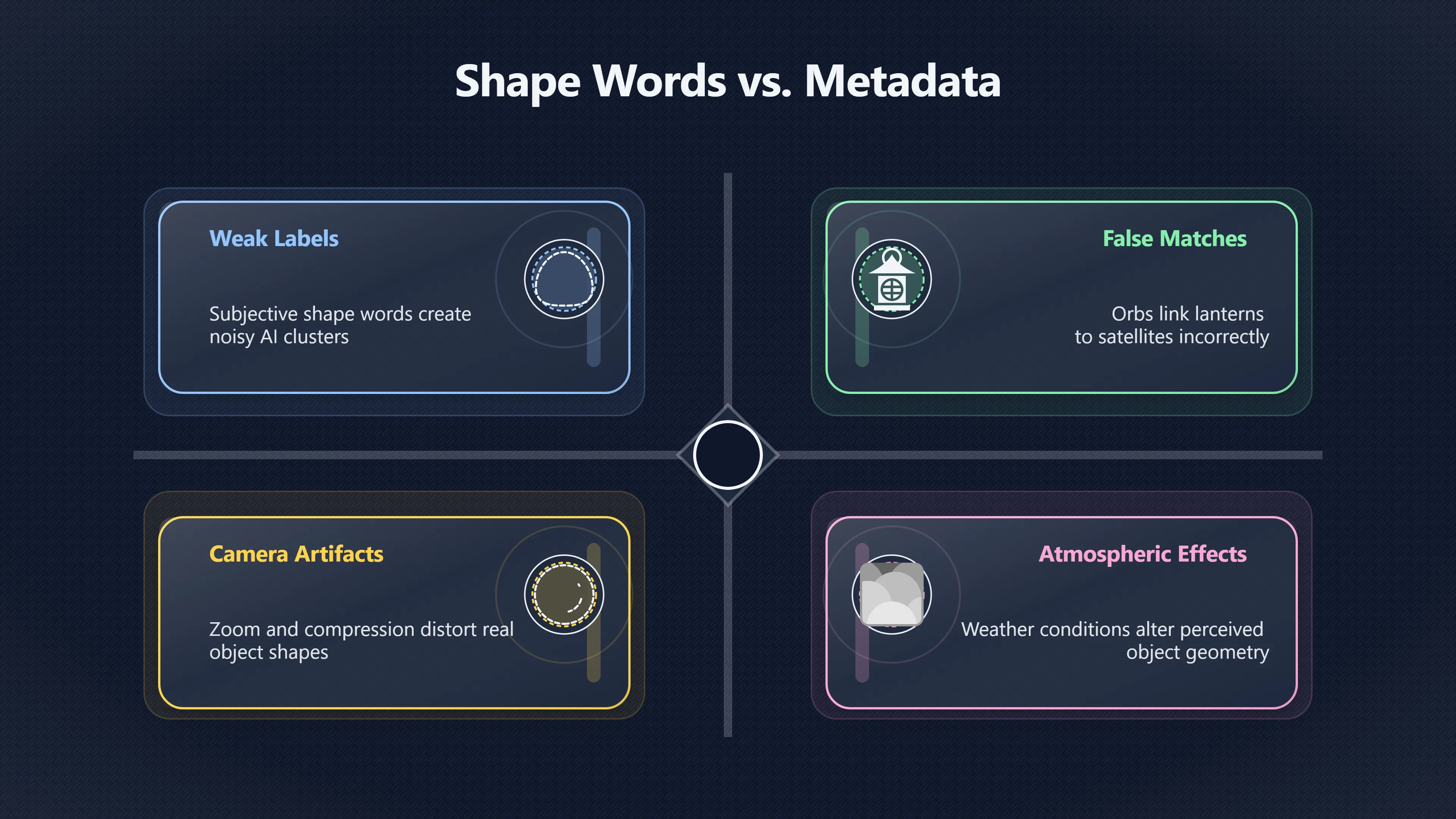
Many UFO databases still inherit habits from older catalogue systems that grouped cases by broad visual categories such as “disk”, “cigar”, “triangle”, or “light”. Those labels were useful for filing paper reports, but they are dangerous inputs for machine-learning systems because they compress very different phenomena into the same searchable category.
An AI model trained on raw witness text may interpret these as equivalent:
- “Black triangle hovering silently”
- “Three lights in triangular formation”
- “Triangular arrangement of stars through haze”
- “Delta-shaped aircraft silhouette”
- “Phone camera lens flare creating a triangle”
To a human investigator, these are clearly different observational situations. To a poorly structured similarity-search system, they may become near-duplicates because the word “triangle” dominates the index.
NASA’s UAP study team warned that current UAP analysis suffers from inconsistent observations, poor sensor calibration, missing metadata, and a lack of baseline environmental information.[NASA]science.nasa.govNASA ScienceIndependent Study Team ReportThe study of Unidentified Anomalous Phenomena (UAP) presents a unique scientific opportunity tha… The problem is not merely academic. Shape-driven clustering can distort entire investigative workflows:
- Lantern releases become linked to satellite sightings because both were labelled “orange orb”.
- Aircraft landing lights become grouped with hovering drone reports.
- Bright planets near the horizon become associated with manoeuvring “disks”.
- Compression artefacts in video become treated as recurring craft morphology.
Once those clusters form, later AI systems may inherit the same bias. The database begins learning the language habits of witnesses instead of the physical characteristics of events.
What AI needs beyond UFO shape words
NASA’s broader Earth science and geospatial programmes provide a useful model because they treat metadata as essential scientific context rather than optional description. Standards such as ISO 19115 are designed to preserve spatial, temporal, sensor, quality, and provenance information alongside observations. NASA Earthdata[ISO]iso.orgISO 19115:2003 - Geographic information — MetadataISO 19115:2003 defines the schema required for describing geographic information and…
For UFO investigation, that philosophy matters more than any single metadata schema. The key lesson is that observations should remain attached to their acquisition conditions.
A strong UFO case file therefore separates:
Metadata categoryWhy it matters for AI comparisonExact timestampAllows astronomy, satellite, and aviation correlationGPS locationEnables line-of-sight reconstruction and environmental checksViewing direction and elevationHelps distinguish stars, aircraft corridors, and satellite passesWeather conditionsExplains haze, inversion layers, cloud reflection, lightning, and optical distortionCamera model and settingsIdentifies exposure artefacts, zoom distortion, rolling shutter effects, and infrared bloomWitness movementDistinguishes stationary objects from observer-relative motionDurationFilters out transient flashes versus sustained observationsMultiple independent witnessesHelps test consistency and eliminate single-observer perception errorsRaw versus edited mediaProtects provenance and reduces contamination by social-media recompression
Without these fields, AI systems are often comparing stripped-down narratives divorced from the conditions that produced them.
NASA’s Earthdata systems and Common Metadata Repository rely on standardised metadata precisely because scientific observations become difficult to evaluate once provenance and acquisition context are lost.[NASA Earthdata]earthdata.nasa.govNASA EarthdataISO 19115 Geographic Metadata InformationThe current document, ISO 19115 Geographic Metadata Standard - Implementation Requ…[NASA Earthdata]earthdata.nasa.govNASA EarthdataISO 19115 Geographic Metadata InformationThe current document, ISO 19115 Geographic Metadata Standard - Implementation Requ… The same logic applies to UFO evidence. A glowing light filmed at 21:14 facing west from Cornwall in humid conditions during a visible Starlink pass is fundamentally different from a visually similar light filmed at 03:00 over central London under low cloud and heavy aviation traffic.
Metadata that changes a UFO comparison
The most important metadata fields are often the least dramatic ones. In practice, they frequently outperform witness shape descriptions when AI systems try to identify comparable cases.
Time metadata often beats shape metadata
A timestamp accurate to the minute can immediately trigger automated checks against:
- Satellite databases
- ISS visibility passes
- Planetary positions
- Meteor showers
- Rocket launches
- Re-entry events
- Civil aviation transponder data
- Military exercise notices where publicly available
A witness may describe “a silver disk”, but if the timestamp aligns with a documented satellite flare or rocket stage re-entry, the shape wording becomes secondary.
NASA’s UAP report repeatedly emphasised the importance of multiple measurements and contextual environmental data rather than isolated visual impressions.[NASA Science]science.nasa.govNASA ScienceIndependent Study Team ReportThe study of Unidentified Anomalous Phenomena (UAP) presents a unique scientific opportunity tha…
Camera metadata can expose false morphology
Phone cameras frequently transform ordinary lights into misleading shapes:
- Digital zoom exaggerates blur patterns
- Autofocus failures create soft “orb” structures
- Sensor blooming enlarges bright points
- Compression introduces artificial geometry
- Long exposure creates trails mistaken for motion
EXIF metadata can reveal exposure time, focal length, ISO settings, software edits, and geolocation data. Forensic image standards treat these fields as critical evidence context. NIST SCIEPublish This is especially important in modern UFO investigation because social-media uploads often strip metadata entirely. A reposted clip labelled[sciepublish.com]sciepublish.comForensic Value of Exif Data: An Analytical Evaluation…by N Soni · 2025 · Cited by 7 — This research systematically analyzes the behavi… “triangle UFO over Europe” may have lost the original timestamp, GPS coordinates, device data, and compression history before investigators ever see it.
Weather metadata changes interpretation
Atmospheric conditions radically affect perceived shape and motion.
Examples include:
- Ice crystals producing structured light pillars
- Temperature inversions distorting aircraft lights
- Thin cloud layers diffusing stars into glowing blobs
- Humidity causing halos around bright objects
- Wind direction explaining drifting lantern behaviour
Two “orb” reports may look visually identical while having entirely different atmospheric contexts. AI systems that ignore weather metadata risk clustering unrelated phenomena together.
NASA’s Earth-observation culture strongly emphasises environmental context because isolated visual imagery is often insufficient without surrounding conditions and calibration data.[NASA Earthdata]earthdata.nasa.govNASA EarthdataISO 19115 Geographic Metadata InformationThe current document, ISO 19115 Geographic Metadata Standard - Implementation Requ…[NASA Earthdata]earthdata.nasa.govNASA EarthdataISO 19115 Geographic Metadata InformationThe current document, ISO 19115 Geographic Metadata Standard - Implementation Requ…
Separating witness wording from inferred properties
One of the most useful NASA-style principles is the distinction between observation and interpretation.
A robust UFO intake form should separate:
Direct observations
These are things the witness actually perceived:
- “Three lights”
- “White glow”
- “Moved left to right”
- “Visible for 40 seconds”
- “No audible sound”
Inferred conclusions
These are interpretations layered onto the observation:
- “Triangular craft”
- “Intelligent control”
- “Metallic object”
- “Impossible manoeuvre”
- “Solid structure”
This distinction matters enormously for AI training data. If inferred conclusions are mixed into observational fields, the system begins treating assumptions as measurements.
For example, a witness seeing three lights may infer a triangular craft connecting them. Another witness may report the same visual arrangement but describe only separate lights. Shape-only clustering would separate those cases even though the raw observations are similar.
NASA’s UAP approach consistently frames the issue as a data-characterisation problem rather than a belief problem.[NASA Science]science.nasa.govNASA ScienceIndependent Study Team ReportThe study of Unidentified Anomalous Phenomena (UAP) presents a unique scientific opportunity tha… The aim is not to dismiss witnesses, but to preserve the difference between perception and interpretation so later analysis remains scientifically useful.
A practical metadata structure for UFO case files
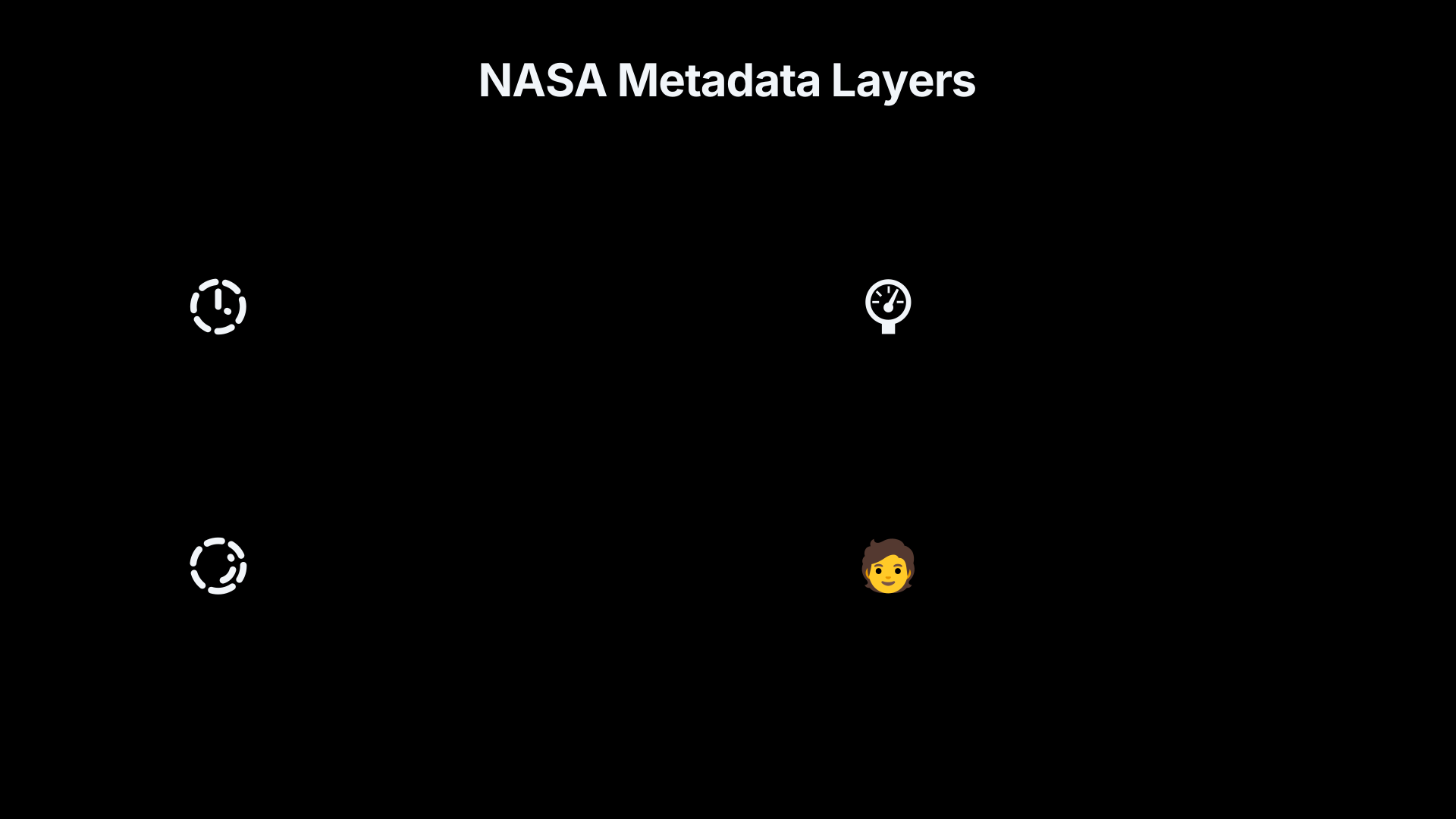
A NASA-style UFO metadata model does not need to be enormous to improve AI performance. Even a modest structured intake system can dramatically reduce false matches.
A practical implementation usually benefits from four distinct layers.
Event metadata
This defines when and where the sighting happened.
Typical fields include:
- UTC timestamp
- Local timezone
- GPS coordinates
- Viewing direction
- Elevation angle
- Duration
- Estimated distance confidence
Environmental metadata
This describes the surrounding conditions.
Typical fields include:
- Cloud cover
- Visibility
- Wind speed and direction
- Temperature
- Moon phase
- Nearby storms
- Light pollution level
Sensor metadata
This describes how evidence was captured.
Typical fields include:
- Device model
- Lens type
- Exposure settings
- Resolution
- Compression history
- Original versus edited file status
Witness metadata
This documents human factors without overreaching.
Typical fields include:
- Number of witnesses
- Independent or grouped observation
- Prior aviation or astronomy familiarity
- Confidence level
- Emotional state during observation
- Delay between sighting and report
The key principle is that the AI should know which fields are measurements, which are estimates, and which are interpretations.
Why provenance matters as much as the sighting itself
NASA and Earth-science metadata systems place heavy emphasis on provenance: where the data came from, how it was modified, and whether it can be trusted.[EOS]eos.orgThe Importance of Data Set Provenance for ScienceThe Importance of Data Set Provenance for Science - Eos.org4 Dec 2015 — The PCCS matrix details the content required to describe prove…[NASA Earthdata]earthdata.nasa.govNASA EarthdataISO 19115 Geographic Metadata InformationThe current document, ISO 19115 Geographic Metadata Standard - Implementation Requ…
That principle is increasingly important for UFO investigation because modern media passes through multiple unstable stages:
- Original recording
- Social-media upload
- Screen recording
- Cropped repost
- AI enhancement
- Commentary overlay
- Viral redistribution
By the time investigators encounter the footage, critical metadata may already be missing or corrupted.
A provenance-aware UFO database therefore tracks:
- Whether the original file exists
- Whether metadata survived transfer[sciepublish.com]sciepublish.comForensic Value of Exif Data: An Analytical Evaluation…by N Soni · 2025 · Cited by 7 — This research systematically analyzes the behavi…
- Whether edits are documented
- Whether AI enhancement tools were used
- Whether timestamps changed during reposting
This becomes especially important as generative AI tools make fabricated UFO imagery easier to produce. Metadata alone cannot prove authenticity, but the absence of provenance increasingly becomes a warning sign.
Better metadata reduces false mystery
One of the most important effects of structured metadata is psychological rather than technical. It reduces the tendency to treat dramatic wording as evidence.
A witness may sincerely report:
“A black triangular craft silently hovered overhead.”
But metadata may later show:
- The observation occurred under a major flight path
- The viewing angle matched incoming aircraft alignment
- Humid conditions amplified landing lights
- The witness was moving in a car
- The apparent hover effect resulted from relative motion
The witness description remains valuable, but it is no longer the sole organising feature of the case.
This is exactly the direction NASA’s UAP study pointed toward: less emphasis on sensational labels and more emphasis on calibrated, standardised, multi-source observational context.[NASA Science]science.nasa.govNASA ScienceIndependent Study Team ReportThe study of Unidentified Anomalous Phenomena (UAP) presents a unique scientific opportunity tha…
For AI-assisted UFO investigation, that shift is essential. A system trained mainly on shape words learns folklore patterns. A system trained on structured metadata has a better chance of distinguishing balloons from aircraft, stars from drones, and genuinely unusual cases from ordinary misidentifications.
Amazon book picks
Further Reading
Books and field guides related to What AI needs beyond UFO shape words. Use these as the next step if you want deeper reading beyond the article.
UFOs: Generals, Pilots, and Government Officials Go on the Re...
Provides broader evidence-led UFO context.
The Signal and the Noise
Directly relevant to moving beyond weak labels into metadata.
eBay marketplace picks
Marketplace Samples
Example marketplace items related to this page. Use the search link to explore similar finds on eBay.


Endnotes
1.
Source: science.nasa.gov
Link:https://science.nasa.gov/wp-content/uploads/2023/09/uap-independent-study-team-final-report.pdf
Source snippet
NASA ScienceIndependent Study Team ReportThe study of Unidentified Anomalous Phenomena (UAP) presents a unique scientific opportunity tha...
2.
Source: nasa.gov
Title: update nasa shares uap independent study report names director
Link:https://www.nasa.gov/news-release/update-nasa-shares-uap-independent-study-report-names-director/
Source snippet
UPDATE: NASA Shares UAP Independent Study Report14 Sept 2023 — We found that NASA can help the whole-of-government UAP effort through...
3.
Source: earthdata.nasa.gov
Link:https://www.earthdata.nasa.gov/about/esdis/esco/standards-practices/iso-19115-geographic-metadata-information
Source snippet
NASA EarthdataISO 19115 Geographic Metadata InformationThe current document, ISO 19115 Geographic Metadata Standard - Implementation Requ...
4.
Source: iso.org
Link:https://www.iso.org/standard/26020.html
Source snippet
ISO 19115:2003 - Geographic information — MetadataISO 19115:2003 defines the schema required for describing geographic information and...
5.
Source: earthdata.nasa.gov
Title: voyage discovery applying international metadata standards nasa earth science
Link:https://www.earthdata.nasa.gov/news/feature-articles/voyage-discovery-applying-international-metadata-standards-nasa-earth-science
Source snippet
NASA EarthdataApplying International Metadata Standards to NASA Earth...4 Nov 2020 — The MENDS Project recommended that NASA Earth scien...
6.
Source: earthdata.nasa.gov
Link:https://www.earthdata.nasa.gov/about/esdis/eosdis/cmr
Source snippet
NASA EarthdataCommon Metadata Repository (CMR)NASA's Common Metadata Repository (CMR) is the authoritative management system for all Eart...
7.
Source: nist.gov
Link:https://www.nist.gov/document/osac-2024-n-0011-standard-guide-forensic-digital-image-management-version-10
Source snippet
OSAC 2024-N-0011 Standard Guide for Forensic Digital...March 29, 2024 — written notes, electronic recording, image metadata, automat...
Published: March 29, 2024
8.
Source: sciepublish.com
Link:https://www.sciepublish.com/article/pii/567
Source snippet
Forensic Value of Exif Data: An Analytical Evaluation...by N Soni · 2025 · Cited by 7 — This research systematically analyzes the behavi...
9.
Source: nvlpubs.nist.gov
Link:https://nvlpubs.nist.gov/nistpubs/ir/2022/NIST.IR.8354.pdf
Source snippet
NIST PublicationsDigital Investigation Techniques: A NIST Scientific Foundation...Metadata associated with an object, such as, file MAC...
10.
Source: science.nasa.gov
Link:https://science.nasa.gov/uap/faqs/
Source snippet
NASA ScienceUAP FAQs6 days ago — The UAP independent study team's main focus for the report was to come up with a way in which to evaluat...
11.
Source: eos.org
Title: The Importance of Data Set Provenance for Science
Link:https://eos.org/opinions/the-importance-of-data-set-provenance-for-science
Source snippet
The Importance of Data Set Provenance for Science - Eos.org4 Dec 2015 — The PCCS matrix details the content required to describe prove...
12.
Source: science.nasa.gov
Link:https://science.nasa.gov/uap/
Source snippet
nasa.govUAP9 Jun 2022 — A study team to examine unidentified anomalous phenomena (UAPs) – that is, observations of events in the sky that...
13.
Source: earthdata.nasa.gov
Link:https://www.earthdata.nasa.gov/about/standards
Source snippet
Open Geospatial Consortium (OCG) KML was adopted as a NASA ESDS community standard... (ISO) metadata standard 19115. (Approved in Septem...
14.
Source: nasa.gov
Link:https://www.nasa.gov/news-release/nasa-to-release-discuss-unidentified-anomalous-phenomena-report/
Source snippet
NASA to Release, Discuss Unidentified Anomalous...NASA defines UAP as observations of events in the sky that cannot be identified as air...
15.
Source: earthdata.nasa.gov
Title: unified metadata model
Link:https://www.earthdata.nasa.gov/about/esdis/esco/standards-practices/unified-metadata-model
Source snippet
InformationNASA's Unified Metadata Model (UMM) is an extensible metadata model that provides a cross-walk for mapping between CMR-support...
16.
Source: youtube.com
Link:https://www.youtube.com/watch?v=rvBe_GWgRR4
Source snippet
NASA Earthdata Webinar: Implementing ISO 19115 Standards...This webinar addresses the initial design and implementation steps in the dev...
Additional References
17.
Source: beaglesecurity.com
Link:https://beaglesecurity.com/blog/vulnerability/exif-data-information-leakage.html
Source snippet
Information leakage in EXIF data of imagesEXIF stands for Exchangeable Image File Format and the EXIF data contains information such as t...
18.
Source: reddit.com
Link:https://www.reddit.com/r/Futurology/comments/16ijwyl/nasa_shares_unidentified_anomalous_phenomena/
Source snippet
NASA Shares Unidentified Anomalous Phenomena...The report contains the external study team's findings and recommendations which aim to i...
19.
Source: managingexpectations.net
Link:https://managingexpectations.net/blog/articles/nasa-uap-study-managing-expectations.html
Source snippet
NASA's UAP Study: What It Did — and Did Not — ConcludeNASA's study team treated UAP as a scientific and data problem: how should reliable...
20.
Source: medium.com
Link:https://medium.com/%40stacyfuende/geospatial-metadata-standards-for-developers-the-complete-guide-to-understanding-implementing-c951c56d8879
Source snippet
Geospatial Metadata Standards for Developers: The...ISO 19115 is the international standard for geographic information metadata. Publish...
21.
Source: rev.com
Link:https://www.rev.com/transcripts/nasa-holds-first-public-meeting-on-ufos-transcript
Source snippet
NASA Holds First Public Meeting on UFOs TranscriptThe UAP independent study was commissioned to create a roadmap on how to use the tools...
22.
Source: primitiveproton.com
Link:https://primitiveproton.com/unidentified-anomalous-phenomena-uap/
23.
Source: researchgate.net
Title: 394477131 Forensic Analysis of Image Metadata to Distinguish AI Generated Images
Link:https://www.researchgate.net/publication/394477131_Forensic_Analysis_of_Image_Metadata_to_Distinguish_AI-Generated_Images
Source snippet
Forensic Analysis of Image Metadata to Distinguish AI-...14 Aug 2025 — In this research, a metadata-based method studying the ability to...
24.
Source: youtube.com
Link:https://www.youtube.com/watch?v=TQcqOW39ksk
Source snippet
Unidentified Anomalous Phenomena Independent Study ReportNASA commissioned an independent study team to examine unidentified anomalous ph...
25.
Source: Wikipedia
Title: NASA Unidentified Anomalous Phenomena Independent Study Team
Link:https://en.wikipedia.org/wiki/NASA_Unidentified_Anomalous_Phenomena_Independent_Study_Team
Source snippet
NASA Unidentified Anomalous Phenomena Independent...UAPs are defined as phenomena or observations of events in the air, sea, space, a...
26.
Source: scientificamerican.com
Title: bad data not aliens may be behind ufo surge nasa team says
Link:https://www.scientificamerican.com/article/bad-data-not-aliens-may-be-behind-ufo-surge-nasa-team-says/
Source snippet
Bad Data, Not Aliens, May Be behind UFO Surge, NASA...9 Jun 2023 — NASA could enlist private companies to develop software apps designed...
Topic Tree