Within Weather layers
Why Balloons Can Drift Against The Surface Wind
Wind speed and direction often change with altitude, making balloons behave very differently from surface conditions.
On this page
- How wind layers change with altitude
- Why balloons appear stationary or suddenly turn
- Combining radiosonde data with witness timelines
Page outline Jump by section
Introduction
A common problem in UFO investigations is that witnesses compare an object’s movement with the wind they can feel on the ground. If the surface breeze is blowing west, but the object appears to drift north or remain stationary, the sighting may seem difficult to explain. Upper-air wind data often changes that assessment completely.
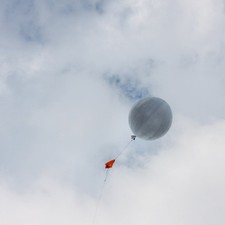
 Wind direction and speed can vary dramatically with altitude. A balloon at 20,000 feet may travel in a different direction from the wind at 2,000 feet, while a higher layer may reverse direction again. Weather balloons, research balloons, advertising balloons, drifting radar reflectors, and even some lightweight debris can therefore appear to move intelligently, pause, turn, or travel “against the wind” when viewed from the ground. In AI-assisted UFO sighting investigation, reconstructing those layered wind conditions is one of the fastest ways to test whether a reported object behaved like a free-floating balloon rather than a powered craft. Radiosonde records, trajectory models, and witness timelines together can turn a vague visual account into a measurable atmospheric reconstruction.[NOAA]noaa.govRadiosondes | National Oceanic and Atmospheric…16 Sept 2025 — The radiosonde flight can last in excess of two hours, and during th…[Weather.gov]weather.govRadiosonde ObservationIn that time, the radiosonde can ascend to an altitude exceeding 35 km (about 115,000 feet) and drift more than 300…
How Wind Layers Change With Altitude
The atmosphere is not a single moving air mass. It is a stack of layers with different temperatures, pressures, and airflow patterns. Meteorological balloons reveal these layers by climbing through them while transmitting position and atmospheric data back to the ground.[NOAA]ncei.noaa.govbservations from more than 2800 globally distributed stations…[Weather.gov]weather.govUpper Air10 Dec 2024 — The observation system consists of an instrument (radiosonde), and a gas-filled balloon. This radiosonde contains…
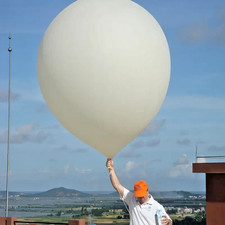
A typical radiosonde flight can rise above 100,000 feet and drift hundreds of kilometres from launch because the balloon is continuously carried by changing upper-air winds.[Weather.gov]weather.govonde can ascend to over 115,000 feet (35,000 meters) and drift more than…Read more…[Weather.gov]weather.govEducation Corner weather balloonThe weather balloon remains the best platform for observing temperature, wind, relative humidity, and pre… The wind profile collected during that ascent is one of the most useful hidden datasets in UFO analysis because it provides a vertical map of:
- Wind speed at different heights
- Wind direction changes with altitude[repository.library.noaa.gov]repository.library.noaa.govnoaa 56640 DS1Radiosonde data are assimilated into meteorological models to improve weather…Read…
- Jet stream influence
- Shear layers where airflow abruptly shifts
- Stable or turbulent atmospheric regions
This matters because witnesses usually estimate movement relative to trees, clouds, rooftops, or the horizon rather than relative to the object’s actual altitude. A balloon high above the observer may therefore appear to violate local wind conditions simply because it occupies a completely different wind regime.
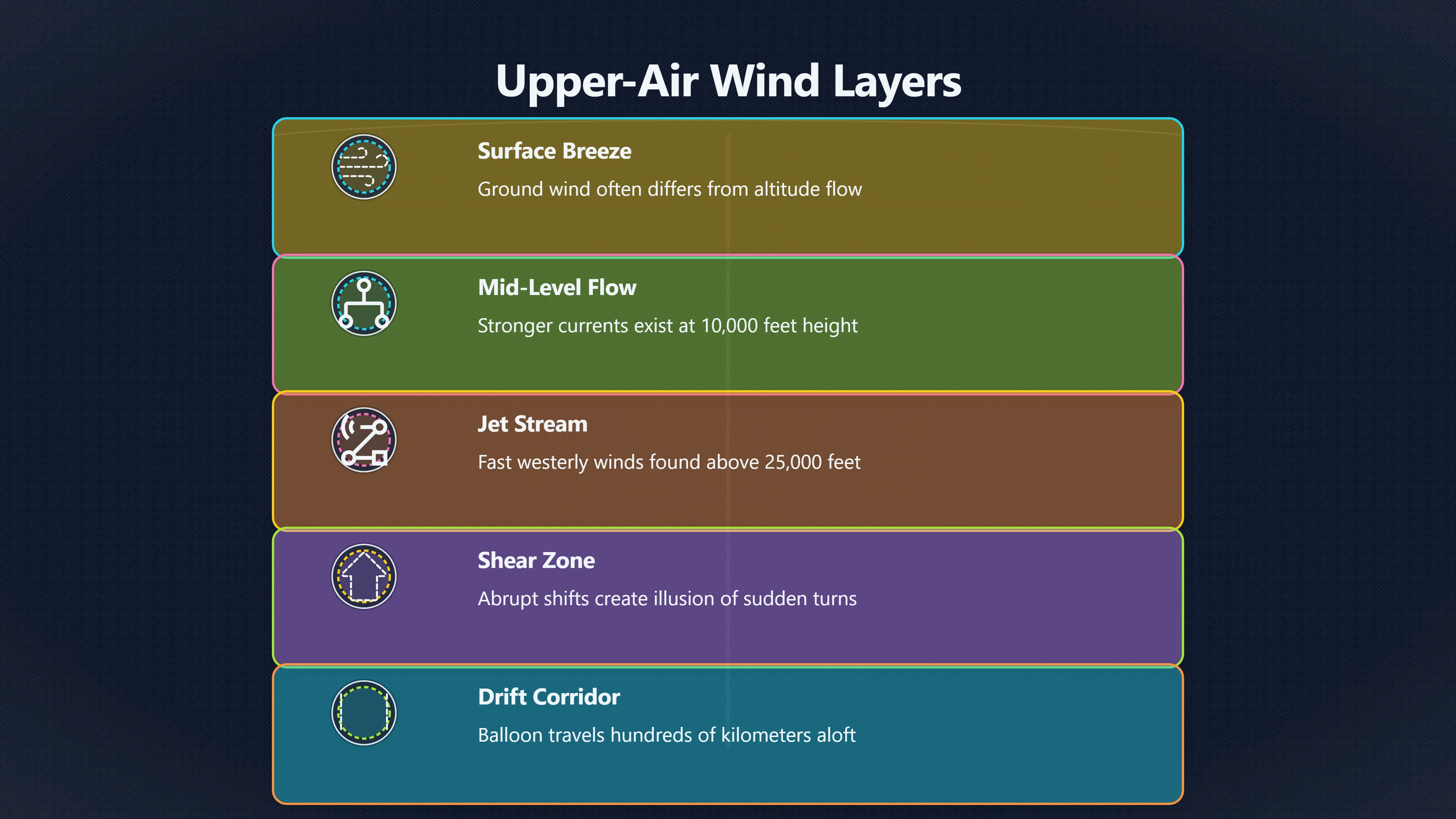
In some conditions, layered airflow becomes extreme. A balloon ascending through several thousand feet can encounter:
- A slow easterly surface breeze
- A strong southerly mid-level flow
- Fast westerly winds near the jet stream
From the ground, that can resemble deliberate manoeuvring. A witness may describe an object that “changed direction”, “made a controlled turn”, or “accelerated suddenly”, even though the motion was produced by vertical drift into a different wind layer.
Balloon pilots actively exploit this effect. Hot-air balloon navigation works largely by changing altitude to enter airflow moving in different directions.[Weatherzone]weatherzone.com.auunderstanding hot air balloon navigation21 Sept 2024 — Balloon pilots navigate through changes in elevation, utilising varying wind directions and speeds at different altitudes…[Seattle Ballooning]seattleballooning.comSeattle Ballooning How Do You Steer A Hot Air Balloon?Navigation Secrets29 Dec 2025 — Hot air balloons are not directly steerable aircraft. FAA guidance classifies them as free floating aircr…[Rainbow Ryders]rainbowryders.comhow pilots steer hot air balloonHow Do Pilots Steer a Hot Air Balloon? A Simple Breakdown27 Oct 2025 — Discover how hot air balloon pilots steer, using wind currents and… That same atmospheric structure can unintentionally create UFO-like behaviour in uncontrolled balloons.
Why Balloons Appear Stationary Or Suddenly Turn
Many UFO reports describe objects that hover unnaturally or remain fixed for long periods before abruptly moving away. Upper-air wind analysis frequently explains this pattern without requiring exotic propulsion.
Apparent hovering
A distant balloon moving directly toward or away from the observer may show very little sideways motion. If the witness lacks depth references, the object can appear completely stationary even while travelling quickly with the wind.
This becomes especially misleading near sunset or sunrise. Sunlit balloons at high altitude can remain brightly illuminated long after the ground is dark, making them stand out against a darker sky. A reflective balloon drifting slowly in upper-level winds can therefore appear as:
- A glowing orb
- A metallic disc
- A bright “star” that moves irregularly
- A hovering light that suddenly disappears
The effect becomes stronger when haze obscures depth perception.
Sudden turns
A balloon does not need propulsion to appear to turn sharply. Several ordinary mechanisms can create that impression:
- The balloon changes altitude and enters a new wind layer
- The observer changes position
- Perspective shifts against cloud backgrounds
- The object transitions from crosswind movement to head-on movement
In witness testimony, these changes are often compressed into dramatic descriptions such as “it changed course instantly” or “it reacted intelligently”.
Meteorological and aviation sources repeatedly note that balloons can effectively “steer” by moving into different wind currents at different heights.[Seattle Ballooning]seattleballooning.comSeattle Ballooning How Do You Steer A Hot Air Balloon?Navigation Secrets29 Dec 2025 — Hot air balloons are not directly steerable aircraft. FAA guidance classifies them as free floating aircr…[Rainbow Ryders]rainbowryders.comhot air balloon wind speedLimits Explained15 Dec 2025 — There is no strict hot air balloon max wind speed, but pilots often consider canceling when winds are forec… A drifting object that climbs or descends naturally can therefore seem to perform deliberate directional changes.
Why witness estimates become unreliable
Human observers are poor at estimating altitude, especially at night or against featureless skies. If a witness assumes an object is low and nearby when it is actually high and distant, the perceived speed can become wildly exaggerated.
For example:
- A high-altitude balloon drifting slowly may appear to race across the sky
- A distant object moving laterally may appear stationary
- Small heading changes can seem like intelligent course corrections
This is one reason modern UAP investigations increasingly compare sightings against atmospheric data before treating reported manoeuvres as evidence of advanced flight capability.
Combining Radiosonde Data With Witness Timelines
The practical value of upper-air wind analysis appears when investigators align atmospheric records with the exact sighting timeline.
A structured reconstruction usually starts with:
- Exact or approximate sighting time
- Witness location
- Viewing direction
- Estimated elevation angle
- Reported motion and duration
From there, AI-assisted workflows can retrieve upper-air observations from nearby radiosonde stations or historical archives such as NOAA’s Integrated Global Radiosonde Archive (IGRA).[NCEI]ncei.noaa.govbservations from more than 2800 globally distributed stations…[NCEI]ncei.noaa.govGlobal Radiosonde Archive (IGRA), Version 2December 1, 2025 — IGRA Version 2 consists of quality-controlled radiosonde observations of te…
The next step is to compare the reported motion with real wind vectors at multiple altitudes.
Example reconstruction logic
Suppose witnesses report:
- A bright object over south-east England
- Slowly drifting north-east
- Remaining nearly stationary for ten minutes
- Then accelerating eastward
An automated workflow may reveal:
- Light surface wind from the west
- Mid-level southerly flow at 10,000 feet
- Strong westerly jet stream winds above 25,000 feet
If the object’s apparent movement matches the upper-level pattern rather than the surface conditions, the balloon explanation becomes substantially stronger.
This does not automatically prove the object was a balloon. It simply shifts the probability assessment. The key investigative question becomes whether the observed behaviour is compatible with passive atmospheric drift.
Using trajectory models
Trajectory systems such as NOAA’s HYSPLIT model allow investigators to estimate where an airborne object may have travelled before or after a sighting.[Air Resources Laboratory]arl.noaa.govAir Resources Laboratory HYSPLITAir Resources LaboratoryHYSPLIT - Air Resources LaboratoryHYSPLIT is a complete system for computing simple air parcel trajectories, as w…
These models are useful for:
- Backtracking possible launch origins
- Estimating drift corridors
- Testing whether multiple reports describe the same object
- Comparing movement against known balloon launches
In a UFO workflow, this becomes especially valuable when several witnesses report the same object across different towns or times.
A trajectory reconstruction can show whether the movement pattern is physically consistent with atmospheric transport. If it is not, the balloon explanation weakens.

Why Surface Weather Alone Often Misleads Investigators
One recurring failure in amateur UFO analysis is reliance on ground-level weather apps alone. Surface conditions may tell investigators almost nothing about winds at balloon altitude.
A sighting may occur during:
- Calm conditions at ground level
- Strong upper-level winds invisible to observers
- Wind shear zones where directions reverse rapidly
- Stable inversion layers that trap objects visually
Because most people experience weather only at the surface, they intuitively assume all airborne objects should behave similarly. That assumption often drives statements such as:
- “It could not have been a balloon because the wind was wrong”
- “The object moved against the wind”
- “No aircraft could hover in those conditions”
Upper-air datasets frequently show those conclusions were based on incomplete atmospheric information rather than anomalous flight behaviour.
Weather balloons themselves demonstrate this directly. NOAA notes that radiosondes routinely drift long distances during ascent because winds vary substantially throughout the atmosphere.[NOAA]ncei.noaa.govGlobal Radiosonde Archive (IGRA), Version 2December 1, 2025 — IGRA Version 2 consists of quality-controlled radiosonde observations of te…
Where Balloon Explanations Still Fail
Upper-air analysis is a screening tool, not a universal debunking mechanism. Some reports remain difficult to explain even after atmospheric reconstruction.
Balloon explanations weaken when:[rainbowryders.com]rainbowryders.comhot air balloon wind speedLimits Explained15 Dec 2025 — There is no strict hot air balloon max wind speed, but pilots often consider canceling when winds are forec…
- Motion repeatedly contradicts measured wind fields
- The object shows sustained powered acceleration
- Multiple independent observations disagree with drift behaviour
- Radar tracks show speeds inconsistent with passive transport
- The object changes altitude too rapidly for buoyant lift
- Trajectory modelling cannot reproduce the reported path
Investigators also need to consider that witnesses may misremember timings, directions, or duration. Small timeline errors can significantly affect reconstructed trajectories.
Another limitation is data coverage. Radiosonde launches usually occur only twice daily at many stations.[World Meteorological Organization]community.wmo.intWorld Meteorological OrganizationObservation components of the Global Observing SystemFrom a global network of about 1,300 upper-air stat… A sighting between launches may require interpolation rather than exact atmospheric measurements. Local terrain and microclimates can further complicate reconstruction.
Still, upper-air wind analysis remains one of the strongest ordinary-explanation tests available because it relies on measurable atmospheric conditions rather than subjective interpretation alone.
How AI Improves Balloon Drift Analysis
Manual upper-air reconstruction is slow. Investigators traditionally had to compare weather charts, balloon data, maps, and witness statements separately. AI-assisted workflows increasingly automate that process.
A modern system can:
- Pull historical radiosonde data automatically[climatedataguide.ucar.edu]climatedataguide.ucar.eduClimate Data Guide Integrated Global Radiosonde Archive (IGRAGlobal Radiosonde Archive (IGRA) - Climate Data GuideDecember 11, 2025 — The largest publicly available collection of quality-controlled…
- Compare witness headings against wind vectors
- Estimate probable altitude ranges
- Model passive drift paths
- Correlate sightings across time and geography
- Flag inconsistencies requiring deeper review
This changes the role of balloon explanations in UFO investigation. Instead of relying on vague sceptical assumptions such as “it was probably a weather balloon”, investigators can test specific atmospheric behaviour against measurable evidence.
That distinction matters. A weak balloon explanation based only on intuition is not very informative. A balloon explanation supported by matching upper-air drift, altitude-appropriate wind vectors, and trajectory modelling is much stronger.
Modern UAP assessment bodies increasingly use this kind of reasoning. The US Department of Defense’s All-domain Anomaly Resolution Office has repeatedly noted that several reviewed UAP cases aligned closely with lighter-than-air objects moving at wind speed and direction.[aaro.mil]aaro.milUAP ImageryAARO bases its assessment on the object's strong morphological consistency with other resolved imagery featuring balloons and…
Amazon book picks
Further Reading
Books and field guides related to Why Balloons Can Drift Against The Surface Wind. Use these as the next step if you want deeper reading beyond the article.
The Weather Handbook
Useful for interpreting upper-air wind, visibility and local conditions.
The Cloudspotter's Guide
Keeps weather-layer discussion accessible to general readers.
eBay marketplace picks
Marketplace Samples
Example marketplace items related to this page. Use the search link to explore similar finds on eBay.


Endnotes
1.
Source: noaa.gov
Link:https://www.noaa.gov/jetstream/upperair/radiosondes
Source snippet
Radiosondes | National Oceanic and Atmospheric...16 Sept 2025 — The radiosonde flight can last in excess of two hours, and during th...
2.
Source: weather.gov
Link:https://www.weather.gov/upperair/factsheet
Source snippet
Radiosonde ObservationIn that time, the radiosonde can ascend to an altitude exceeding 35 km (about 115,000 feet) and drift more than 300...
3.
Source: weather.gov
Link:https://www.weather.gov/epz/upperair
Source snippet
Upper Air10 Dec 2024 — The observation system consists of an instrument (radiosonde), and a gas-filled balloon. This radiosonde contains...
4.
Source: weather.gov
Link:https://www.weather.gov/rah/virtualtourballoon
Source snippet
onde can ascend to over 115,000 feet (35,000 meters) and drift more than...Read more...
5.
Source: Wikipedia
Link:https://en.wikipedia.org/wiki/Hot_air_balloon
Source snippet
Hot air balloon... balloons is not possible; it is possible for pilots to try to achieve basic directional control by changing altitud...
6.
Source: ncei.noaa.gov
Link:https://www.ncei.noaa.gov/products/weather-balloon/integrated-global-radiosonde-archive
Source snippet
bservations from more than 2800 globally distributed stations...
7.
Source: ncei.noaa.gov
Link:https://www.ncei.noaa.gov/access/[metadata
Source snippet
Global Radiosonde Archive (IGRA), Version 2December 1, 2025 — IGRA Version 2 consists of quality-controlled radiosonde observations of te...
Published: December 1, 2025
8.
Source: arl.noaa.gov
Title: Air Resources Laboratory HYSPLIT
Link:https://www.arl.noaa.gov/hysplit/
Source snippet
Air Resources LaboratoryHYSPLIT - Air Resources LaboratoryHYSPLIT is a complete system for computing simple air parcel trajectories, as w...
9.
Source: Wikipedia
Title: Weather balloon
Link:https://en.wikipedia.org/wiki/Weather_balloon
10.
Source: aaro.mil
Link:https://www.aaro.mil/UAP-Cases/Official-UAP-Imagery/
Source snippet
UAP ImageryAARO bases its assessment on the object's strong morphological consistency with other resolved imagery featuring balloons and...
11.
Source: aoml.noaa.gov
Title: upper air observations
Link:https://www.aoml.noaa.gov/upper-air-observations/
Source snippet
Air Observations: How Weather Balloons Improve...1 Sept 2017 — Weather balloons, also known as radiosondes, provide detailed and reliabl...
12.
Source: ncei.noaa.gov
Title: weather balloon
Link:https://www.ncei.noaa.gov/products/weather-balloon
Source snippet
BalloonThese data are obtained from radiosondes, which are instrument packages tethered to balloons that are launched from the ground, as...
13.
Source: repository.library.noaa.gov
Title: noaa 69351 DS1
Link:https://repository.library.noaa.gov/view/noaa/69351/noaa_69351_DS1.pdf
Source snippet
Pico Balloon Archiveby T McKinney · 2024 — In this study, we validate the PBA's wind speed and di- rection calculations against the Integ...
14.
Source: repository.library.noaa.gov
Title: noaa 56640 DS1
Link:https://repository.library.noaa.gov/view/noaa/56640/noaa_56640_DS1.pdf
Source snippet
Radiosonde data are assimilated into meteorological models to improve weather...Read...
15.
Source: wpo.noaa.gov
Title: windborne weather balloon reaches new heights
Link:https://wpo.noaa.gov/windborne-weather-balloon-reaches-new-heights/
Source snippet
Weather Balloon Reaches New Heights...NOAA NWS Weather Forecast Offices use radiosondes to collect profiles of temperature, pressure, an...
16.
Source: Wikipedia
Link:https://en.wikipedia.org/wiki/Radiosonde
Source snippet
RadiosondeA radiosonde is a battery-powered telemetry instrument carried into the atmosphere usually by a weather balloon that measure...
17.
Source: Wikipedia
Title: List of reported UFO sightings
Link:https://en.wikipedia.org/wiki/List_of_reported_UFO_sightings
Source snippet
List of reported UFO sightingsThis is a list of notable reported sightings of unidentified flying objects (UFOs) some of which include...
18.
Source: weather.gov
Link:https://www.weather.gov/gjt/education_corner_balloon
Source snippet
Education Corner weather balloonThe weather balloon remains the best platform for observing temperature, wind, relative humidity, and pre...
19.
Source: community.wmo.int
Link:https://community.wmo.int/observation-components-of-global-observing-system
Source snippet
World Meteorological OrganizationObservation components of the Global Observing SystemFrom a global network of about 1,300 upper-air stat...
20.
Source: seattleballooning.com
Title: Seattle Ballooning How Do You Steer A Hot Air Balloon?
Link:https://seattleballooning.com/how-do-you-steer-a-hot-air-balloon-2/
Source snippet
Navigation Secrets29 Dec 2025 — Hot air balloons are not directly steerable aircraft. FAA guidance classifies them as free floating aircr...
21.
Source: rainbowryders.com
Title: how pilots steer hot air balloon
Link:https://rainbowryders.com/about/blog/how-pilots-steer-hot-air-balloon/
Source snippet
How Do Pilots Steer a Hot Air Balloon? A Simple Breakdown27 Oct 2025 — Discover how hot air balloon pilots steer, using wind currents and...
22.
Source: weatherzone.com.au
Title: understanding hot air balloon navigation
Link:https://www.weatherzone.com.au/news/understanding-hot-air-balloon-navigation/1889914
Source snippet
21 Sept 2024 — Balloon pilots navigate through changes in elevation, utilising varying wind directions and speeds at different altitudes...
23.
Source: climatedataguide.ucar.edu
Title: Climate Data Guide Integrated Global Radiosonde Archive (IGRA)
Link:https://climatedataguide.ucar.edu/climate-data/integrated-global-radiosonde-archive-igra
Source snippet
Global Radiosonde Archive (IGRA) - Climate Data GuideDecember 11, 2025 — The largest publicly available collection of quality-controlled...
Published: December 11, 2025
24.
Source: faa.gov
Link:https://www.faa.gov/
25.
Source: faa.gov
Title: Balloon Flying Handbook
Link:https://www.faa.gov/regulations_policies/handbooks_manuals/aviation/Balloon_Flying_Handbook
Source snippet
(FAA-H-8083-11B)23 Dec 2024 — Balloon Flying Handbook (FAA-H-8083-11B) Last updated: Monday, December 23, 2024 US Department of Transport...
Published: December 23, 2024
26.
Source: faa.gov
Title: ac91 71
Link:https://www.faa.gov/documentLibrary/media/Advisory_Circular/ac91-71.pdf
Source snippet
OPERATION OF HOT AIR BALLOONSA small, helium-filled balloon launched before a flight to determine wind direction and velocity and identif...
27.
Source: rainbowryders.com
Title: hot air balloon wind speed
Link:https://rainbowryders.com/about/blog/hot-air-balloon-wind-speed/
Source snippet
Limits Explained15 Dec 2025 — There is no strict hot air balloon max wind speed, but pilots often consider canceling when winds are forec...
28.
Source: sciencedirect.com
Link:https://www.sciencedirect.com/topics/earth-and-planetary-sciences/radiosondes
Source snippet
an overview | ScienceDirect TopicsVertical profiles of wind speed and direction are typically inferred from weather balloon drift, using...
Additional References
29.
Source: hurricanescience.org
Link:https://hurricanescience.org/science/observation/landbased/radiosonde/index.html
Source snippet
Upper-Air Observations: The RadiosondeData on wind speed and direction aloft are also obtained by tracking the position of the radiosonde...
30.
Source: hotairforhope.com
Link:https://www.hotairforhope.com/about-ballooning
Source snippet
About BallooningHowever, balloon pilots can control the up and down of the balloon by using their burners and vents to find wind layers a...
31.
Source: bufora.org.uk
Link:https://www.bufora.org.uk/guide-to-ufos
Source snippet
GUIDE TO UFOS | BUFORAWeather balloons are responsible for many daylight "UFO" observations. The majority of spurious reports are generat...
32.
Source: reddit.com
Link:https://www.reddit.com/r/askscience/comments/10zoxa0/how_is_the_spy_balloon_steerable/
Source snippet
How is the spy balloon steerable?: r/askscienceBalloons are “steerable” by changing altitude to find winds in a different direction. Alt...
33.
Source: youtube.com
Link:https://www.youtube.com/watch?v=pcLkkoR2LS4
Source snippet
Weather Balloons and RadiosondesLearn about how weather balloons are used to study upper-levels of the atmosphere and how the data are co...
34.
Source: epa.gov
Link:https://www.epa.gov/scram/air-quality-modeling-surface-and-upper-air-databases
Source snippet
Air Quality Modeling - Surface and Upper Air Databases27 Feb 2026 — This site provides two types of meteorological data: (1) surface data...
35.
Source: snohomishballoonride.com
Link:https://snohomishballoonride.com/the-science-of-hot-air-ballooning/
Source snippet
Instead, pilots utilize varying wind directions at different altitudes. By ascending...Read more...
36.
Source: aol.com
Link:https://www.aol.com/unidentified-flying-objects-were-weather-215727461.html
Source snippet
They didn't come from the National Weather Service, and it's unlikely they were science balloons...
37.
Source: docdb.cept.org
Link:https://docdb.cept.org/download/2081
Source snippet
The radiosonde will be often carried more than 100 km from the launch site before...Read more...
38.
Source: spacesafetymagazine.com
Title: This explanation was later supported by the National Weather
Link:https://www.spacesafetymagazine.com/space-exploration/extraterrestrial-life/ufo-weather-balloon-californian-mystery-solved/
Source snippet
UFO versus a Weather Balloon: Recent Californian Mystery Solved –January 11, 2013 — The mysterious space explosion was probably nothing m...
Published: January 11, 2013
Topic Tree